This chapter traces the trajectory of women's movements in India, from the 19th-century social reform movements and early women's organisations to the 'autonomous' women's movements that emerged post-1970s. It highlights the shift in focus from social welfare to issues of structural inequality, violence, and the recognition of differences among women themselves.
1. 19th Century Social Reform Movements and Early Women's Organisations
The 19th century social reform movements raised various issues concerning women, creating an atmosphere where the 'women's question' could not be ignored.
- Early Organisations: The early 20th century saw the growth of women's organisations at national and local levels. Key organisations included:
- Women's India Association (WIA) (1917)
- National Council for Women in India (NCWI) (1925)
- All India Women's Conference (AIWC) (1926)
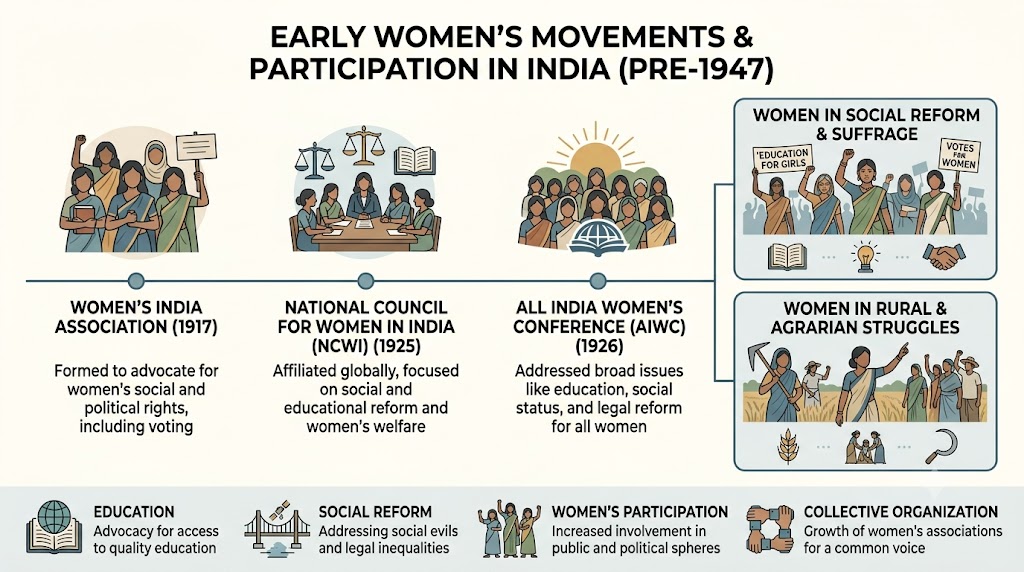
- Shifting Scope: While many of these organisations began with a limited focus, their scope extended over time. The AIWC began with the idea that 'women's welfare' and 'politics' were mutually exclusive. However, a few years later, its presidential address stated, "Can the Indian man or woman be free if India be a slave? How can we remain dumb about national freedom, the very basis of all great reforms?"
- Was this a Social Movement? This period of activity had organisations, ideology, leadership, a shared understanding, and aimed to bring about changes on a public issue—all features of a social movement. What they succeeded in doing was to create an atmosphere where the women's question could not be ignored.
2. Agrarian Struggles and Revolts
It is often assumed that only middle-class educated women are involved in social movements. However, part of the struggle has been to remember the forgotten history of women's participation in rural and tribal movements.
- Participation in Struggles: Women participated along with men in struggles and revolts originating in tribal and rural areas during the colonial period.
- Key Examples:
- Tebhaga Movement: A peasant movement in Bengal.
- Telangana Arms Struggle: A movement against the Nizam's rule.
- Warli Tribal Revolt: A revolt against bondage in Maharashtra.
3. Post-1947: The Lull and Renewal
An issue often raised is that if there was an active women's movement before 1947, what happened afterwards? There are several explanations for the apparent lull.
- Reasons for the Lull:
- Many women activists involved in the nationalist movement got involved in the nation-building task.
- The trauma of Partition was also responsible for a period of inactivity.
- The 'Second Phase' (Mid-1970s): The mid-1970s witnessed a renewal of the women's movement in India, which some call the second phase of the Indian women's movement. There were changes both in terms of organisational strategy and ideologies.
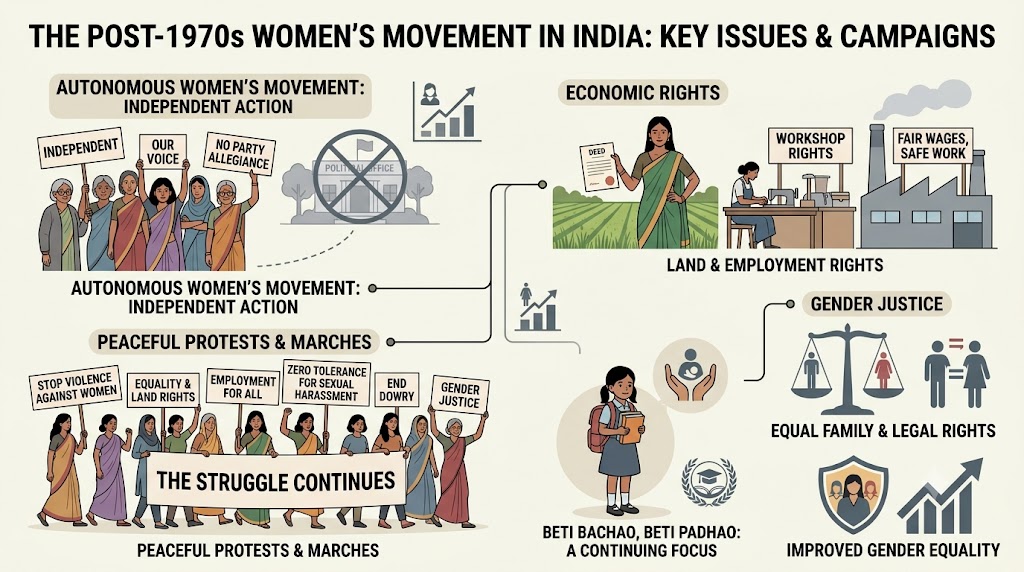
- Growth of 'Autonomous' Movements: The term 'autonomy' referred to the fact that these movements were independent from political parties, as distinct from those women's organisations that had links with political parties. It was felt that political parties tended to marginalise issues of women.
4. Key Issues and Campaigns
The new phase of the women's movement focused on issues that were previously marginalised, most notably violence against women. This period also saw significant legal changes due to sustained campaigns.
- Violence Against Women:
- The mid-1970s saw educated women taking to radical, active politics and promoting an analysis of women's issues.
- Incidents such as the Mathura rape case (1978) and the Maya Tyagi case (1980) became important triggers for nationwide protest movements against violence against women and helped crystallise these concerns into organisational efforts.
- Legal and Social Changes:
- Important legal changes have taken place thanks to the campaign by the women's movement. You may have noticed that application forms for schools now have both father's and mother's names. This was not always the case.
- Issues of land rights and employment have been fought alongside rights against sexual harassment and dowry.
5. Recognising Differences Among Women
There has been a growing recognition that while all women are in some way disadvantaged vis-à-vis men, all women do not suffer the same level or kind of discrimination.
- Different Levels of Discrimination: The concerns of the educated middle-class woman are different from the peasant woman, just as the concern of the Dalit woman is different from the 'upper caste' woman.
- Impact of Caste on Violence: An analysis of the practices of violence against women by caste reveals that while the incidence of dowry deaths and violent controls on mobility and sexuality by the family are frequent among the dominant upper castes, Dalit women are more likely to face the collective and public threat of rape, sexual assault, and physical violence at the workplace and in public.
6. Gender-Just Society and Constraints
There has been greater recognition that both men and women are constrained by dominant gender identities. The idea of a gender-just society is based on the idea that for true freedom to grow and develop, injustices of all kinds have to end.
- Constraint on Men: Men in patriarchal societies feel they must be strong and successful. It is not manly to express oneself emotionally. A gender-just society would allow both men and women to be free.
- Basis for a Gender-Just Society: The idea of a gender-just society is based upon two important factors—educated women with multiple roles and an improved sex ratio.
- Beti Bachao, Beti Padhao: The programme of the Government of India, the Beti Bachao, Beti Padhao Yojana, is an important effort in the actualisation of a gender-just society.
- Government Schemes: The Pre-Natal Diagnostic Techniques (Regulation and Prevention of Misuse) Act, 1994 is a legal measure specifically designed to prevent the misuse of technology for sex-selective abortions, which directly targets the issue of a declining sex ratio.
Common Mistakes
- Thinking that women's movements only focus on middle-class women. Women participated in agrarian and tribal struggles like the Tebhaga and Telangana movements, and the concerns of Dalit women differ from upper-caste women.
- Believing that the women's movement lost momentum after independence. While there was a lull, the mid-1970s witnessed a renewal and the emergence of 'autonomous' women's movements.
- Confusing the All India Women's Conference (AIWC) with the Women's India Association (WIA). AIWC was founded in 1926, while WIA was founded in 1917.
- Assuming that all women experience discrimination in the same way. The text highlights that the nature of violence and discrimination varies significantly by caste.
- Forgetting that the 'autonomous' movement's key characteristic was its independence from political parties, not just from male dominance.