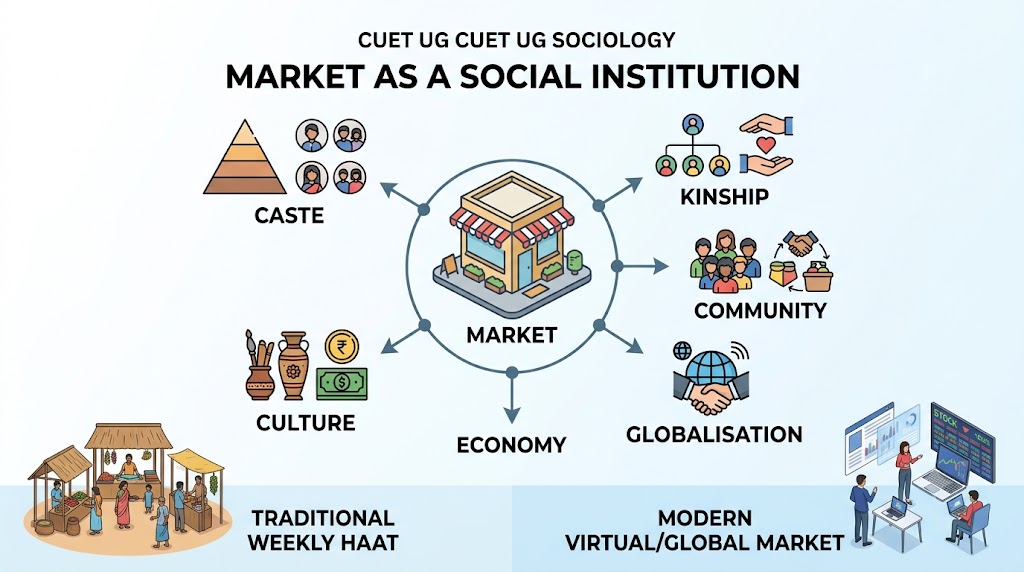
The market is usually seen as a purely economic institution, but this chapter shows that it is equally a social institution — shaped by caste, kinship, community, and history — comparable to family, caste, or tribe, and covering everything from the village weekly haat to the globalised virtual stock exchange.
What Do We Mean by 'The Market'?
In everyday usage, 'market' can mean a physical place (the fruit market), a gathering of buyers and sellers (a weekly vegetable market), a category of trade (the market for cars), or the demand for a product/service (the market for computer professionals).
- Used in a general sense without reference to any specific place, gathering, or field, 'the market' becomes almost equivalent to 'the economy' — the entire spectrum of economic activities and institutions.
- This chapter treats the market as both an economic AND a social institution, comparable to caste, tribe, or family.
Sociological Perspectives on Markets and the Economy
Economics (originally called 'political economy') studies how markets work — how prices are set, how investment affects outcomes, what drives saving/spending — typically treating the economy as a self-contained system operating by its own laws, separate from the wider social/political context.
Adam Smith (18th century) wrote The Wealth of Nations, arguing that the market economy is built from countless individual exchanges that automatically create an ordered, functioning system — even though no individual transaction was intended to create that system.
- 'The Invisible Hand': Smith's term for the unseen force converting individual self-interest into collective social benefit. Even though each person pursues only their own gain, the aggregate effect benefits society by stimulating the economy and creating wealth.
- Laissez-faire ('leave alone'/'let it be'): the economic philosophy, supported by Smith, that markets should be free from state or other regulation.
Sociological perspective differs sharply: sociologists view markets as social institutions constructed in culturally specific ways — controlled/organised by particular social groups or classes, and connected to other institutions and social structures. This is the idea that economies are socially 'embedded' — illustrated in the NCERT chapter through two extended examples: a weekly tribal haat, and a 'traditional business community' and its trading networks in colonial India.
The Weekly Tribal Market: Dhorai Village, Bastar, Chhattisgarh
Periodic (weekly) markets are central to social and economic life in agrarian/peasant societies. They bring together villagers to sell agricultural/forest produce and buy manufactured goods, and attract traders, moneylenders, entertainers, astrologers, and other specialists.
- In hilly and forested areas inhabited by adivasis, where settlements are scattered and roads/communication poor, the weekly market (haat) is the major institution for both economic exchange and social interaction — for meeting kin, arranging marriages, exchanging gossip.
- Case study — Dhorai, North Bastar, Chhattisgarh: On non-market days, Dhorai is a quiet, near-empty hamlet. On market day (Friday), it transforms — trucks arrive, Forest Guards and officials disburse payments to tribal labourers, and tribals stream in from all directions with forest, field, and craft produce, joined by Hindu vegetable sellers and specialised craftsmen (potters, weavers, blacksmiths).
- The market square (~100 yards, quadrangular, centred on a banyan tree) has thatched stalls arranged in concentric rings.
- Goods exchanged: manufactured goods (jewellery, trinkets, pots, knives), non-local foods (salt, haldi/turmeric), local produce and craft items (bamboo baskets), and forest produce (tamarind, oil-seeds).
- Buyers are mostly adivasis; sellers are mainly caste Hindus. Adivasis earn cash from forest/agricultural produce sales and wage labour, spending it mainly on low-value trinkets, jewellery, and manufactured cloth.
Seating/spatial arrangement (Alfred Gell's study): The layout of the Bastar market itself symbolises social hierarchy —
- Centre: occupied by non-tribals (rich 'dikus' selling semi-precious stones)
- Second/middle ring: middle-class traders
- Periphery: tribals and lower castes
Tribals and non-tribal traders interact purely for business — their social positions are otherwise entirely separate, and the market is the only point of common contact between them.
Changes in the Tribal Market During Colonialism
The weekly market in tribal areas is old, but its character transformed markedly once these regions came under colonial control:
- Tribal areas were 'opened up' by building roads and 'pacifying' local people (many of whom resisted through 'tribal rebellions') — explicitly to exploit the rich forest and mineral resources of these areas.
- This brought an influx of traders, moneylenders, and other non-tribal people ('dikus') from the plains.
- Forest produce began being sold to outsiders; money and new goods entered the local economy.
- Tribals were recruited as labourers on colonial plantations and mines — a 'market' for tribal labour developed.
- Consequences were largely negative for local people: entry of outside traders/moneylenders led to impoverishment of adivasis, many of whom lost their land to outsiders.
Caste-Based Markets and Trading Networks: Pre-colonial and Colonial India
Older accounts assumed India's pre-colonial economy was unchanging, self-sufficient, and organised mainly through non-market exchange — with economic transformation beginning only under colonialism. Recent historical research challenges this:
- Much of India's economy was already extensively monetised in the late pre-colonial period.
- While non-market systems like the jajmani system did exist, villages were still linked into wider exchange networks even pre-colonially.
- Pre-colonial India was a major manufacturer and exporter of handloom cloth (cotton and luxury silks) and other goods (spices) in global demand, especially in Europe.
- India had well-organised manufacturing centres, indigenous merchant groups, trading networks, and sophisticated banking systems.
- The hundi (bill of exchange/credit note) enabled long-distance trade — a merchant in one region could issue a hundi honoured by a merchant elsewhere, because trade occurred primarily within caste and kinship networks.
Jajmani system: non-market exchange of produce, goods, and services within a (North) Indian village, without the use of money, based on caste system and customary practices. Jajmans = landlords; Prajans = hereditary service castes (goldsmiths, barbers, tailors) paid in kind or cash, with the arrangement passed down generation to generation.
Case study — Nakarattars (Nattukottai Chettiars) of Tamil Nadu:
- Illustrates how indigenous trading networks operated during the colonial period.
- Nakarattar banking and trade activities were deeply embedded in the community's social organisation — banks were essentially joint family firms, so business structure mirrored family structure.
- They loaned and deposited money in caste-defined social relationships based on business territory, residential location, descent, marriage, and common cult membership.
- Unlike Western banking (government-controlled central bank), public confidence rested on reputation, decisions, and reserve deposits shared within the caste community — i.e., a caste-based banking system.
- Extensive caste-based social networks allowed Chettiar merchants to expand into Southeast Asia and Ceylon.
- This is sometimes interpreted as a form of 'indigenous capitalism' — raising the question of whether capitalism can take forms other than the one that arose in Europe.
Social Organisation of Markets: 'Traditional Business Communities'
There is a close connection between caste and the economy — including in trade and markets. 'Vaishya' is one of the four varnas, reflecting the traditional importance of merchants/traders — though, like other varna statuses, it is often claimed/aspired to rather than fixed; some caste groups entered trade and acquired Vaishya status through upward mobility.
- Traditional business communities include not only Vaishyas (e.g., Banias in North India) but also groups with distinct religious/community identities: Parsis, Sindhis, Bohras, Jains.
- Merchant communities did not always hold high status — e.g., during the colonial period, the long-distance salt trade was controlled by the Banjaras, a marginalised 'tribal' group.
- Why caste-based specialisation? Trade/commerce often operates through caste and kinship networks (trust is higher within one's own community), creating a caste monopoly in certain business areas.
Colonialism and the Emergence of New Markets
- Colonialism caused major disruptions in production, trade, and agriculture — the classic example is the collapse of the handloom industry due to cheap manufactured textiles flooding in from England.
- Colonialism was the turning point that fully linked India to the world capitalist economy: pre-colonial India was a major supplier of manufactured goods; post-colonisation, India became a source of raw materials/agricultural products and a consumer of British manufactured goods.
- New groups, especially Europeans, entered trade — sometimes allying with existing merchant communities, sometimes displacing them. Some merchant communities adapted and improved their position under changing conditions.
- Case study — Marwaris: Became India's most widespread/well-known business community during the colonial period, exploiting new opportunities in colonial cities like Calcutta. Their success rested on extensive social networks creating trust for banking. Many became moneylenders and bankers who helped finance British commercial expansion. Post-Independence, many transformed into modern industrialists (e.g., Birlas, Bajaj, Dalmia) — Marwaris still control more of India's industry than any other community today.
Understanding Capitalism as a Social System
Karl Marx, one of the founders of modern sociology, was a major critic of capitalism.
- Marx understood capitalism as a system of commodity production — production for the market, using wage labour.
- All economic systems are also social systems: each mode of production has particular relations of production, giving rise to a specific class structure.
- The economy is not just 'things' (goods circulating); it is made of relations between people connected through the production process.
- Under capitalism, labour itself becomes a commodity — workers must sell their labour power in the market to earn a wage.
- This produces two basic classes: capitalists (own the means of production, e.g. factories) and workers (sell their labour to capitalists).
- Capitalists profit by paying workers less than the value of what they actually produce — extracting surplus value from labour.
Commoditisation and Consumption
Commodification/commoditisation: the process by which something that previously had no market/exchange value becomes a commodity — bought and sold for money.
- Examples: sale of human organs (e.g., kidneys), bottled water (unthinkable to earlier generations), marriage bureaus/matrimonial websites replacing family-arranged marriages, private 'personality development'/spoken-English institutes, and the growth of private schools/colleges/coaching as commodified education.
- Marx and other critics view commodification as having negative social effects — historically, even human beings were commodified as slaves, though today that is considered immoral; yet buying/selling labour is now normalised, which Marx argued is unique to capitalist societies.
Consumption and status:
- In capitalist society, consumption carries symbolic meaning, not just economic function — it communicates social distinctions.
- Max Weber coined the term 'status symbol' — noting that goods people buy/use are closely tied to their social status (e.g., cell phone brand or car model as a status marker among India's middle class today).
- Weber also argued that classes and status groups are differentiated by lifestyle — consumption is one part of lifestyle, alongside home decor, dress, and leisure activities.
Globalisation: Interlinking Local, Regional, National, and International Markets
Since the late 1980s, India shifted from state-led development to liberalisation, ushering in an era of globalisation — increasing worldwide interconnection economically, culturally, and politically.
- Globalisation includes increased international movement of commodities, money, information, and people, plus development of enabling technology/infrastructure (computers, telecommunications, transport).
- Markets in one part of the globe now affect distant markets — e.g., India's software industry can be hit by a US economic slump (as after 9/11).
- Software services and BPO (Business Process Outsourcing) industries (e.g., call centres) are major channels connecting India to the global economy, providing low-cost services/labour to Western customers.
- Under globalisation, people, cultural products, and images — not just money and goods — circulate globally and create new markets (e.g., marketing of Indian yoga and Ayurveda in the West).
- Case study — Pushkar Camel Fair, Rajasthan: a traditional cattle/camel market and religious pilgrimage event (near Kartik Purnima) that has itself become a commodified international tourist attraction — showing how a market can become a 'product' within another market (tourism).
- Nasdaq (Wall Street, New York) exemplifies a virtual/electronic market — stocks bought/sold via the internet, no paper currency. Satyam was the first Indian company to register with Nasdaq. New York, London, and Tokyo are major global financial capitals.
Debate on Liberalisation: Market vs State
Liberalisation: the process where state controls over economic activity are relaxed, leaving more decisions to market forces. Includes:
- Privatisation of public sector enterprises (PSUs)
- Loosening government regulation on capital, labour, and trade
- Reduction of tariffs and import duties (easier foreign imports)
- Easier access for foreign companies to set up industries in India
Marketisation = use of market-based solutions (rather than government regulation/policy) to solve social, political, or economic problems — deregulation, privatisation, removing government controls over wages/prices.
| Advantages of Liberalisation | Disadvantages of Liberalisation |
|---|---|
| Access to previously unavailable commodities and foreign brands | Automobiles, electronics lose out to superior/cheaper foreign competition |
| Privatisation can improve efficiency and quality via competition | Farmers face competition from foreign agriculture without adequate protection |
| Foreign investment and foreign exchange fuel growth | Loss of employment from privatisation/closure of PSUs |
| Increased employment for skilled labour (IT, software, some agri-exports like fruit/seafood) | Growth of unorganised-sector employment at the expense of the (better-paid, more secure) organised sector |
- Support price: government-fixed minimum price at which it agrees to buy farmers' produce, ensuring minimum farmer income even if market price falls below it.
- Subsidies: government reduces the price of inputs (fertilisers, kerosene, electricity, etc.) for consumers/producers, absorbing the difference itself.
- Liberalisation opposes support prices and subsidies as government interference in free markets — their reduction/withdrawal has made it harder for many farmers to earn a decent livelihood.
- Roughly 70% of India's workforce is in the unorganised sector — a key CUET-relevant statistic linked to the liberalisation debate.
Key Terms Glossary (Words That Matter)
| Term | Definition |
|---|---|
| Capital | An accumulated fund of investible resources that grows through the process of accumulation |
| Capitalism | A system of commodity production (production for the market) using wage labour |
| Class | An economic grouping based on common position in the social relations of production, income/wealth levels, lifestyle, and political preference |
| Commodification | The transformation of a non-commodity into a commodity (bought/sold for money) |
| Commodity | A good or service that may be bought or sold in the market |
| Commodity fetishism | A condition where social relations become expressed as relations between things |
| Consumption | Final use of goods/services by the people who purchased them |
| Economic anthropology | Subfield studying the range of economies and cultures, especially non-market systems, across historic and ethnographic contexts |
| Globalisation | Complex process of economic, social, technological, cultural, and political change increasing interdependence and interaction among people/companies worldwide |
| Jajmani System | Non-market exchange of goods/services within a North Indian village, without money, based on caste and customary practice |
| Labour power | The mental/physical capacity for labour (distinct from labour itself, which is the work actually performed) |
| Laissez-faire | Economic philosophy advocating a free market with minimal government intervention |
| Liberalisation | Relaxation of state controls over economic activity, leaving more to market forces |
| Marketisation | Use of market-based solutions to address social/political/economic problems |
| Market | A situation where buying and selling transactions are decided through money between buyers and sellers |
| Stock Market | A market for company stocks/shares — the mechanism for buying and selling such shares |
| Surplus value | The increase in value/return on capital investment (Marx: value extracted from labour beyond wages paid) |
| Virtual market | An electronically-existing market conducting transactions via computers/telecommunication (paperless market) |
Common Mistakes
- Treating the market as purely an economic institution — CUET repeatedly tests the sociological point that markets are 'socially embedded' in caste, kinship, and community structures.
- Confusing the Jajmani system (non-market, caste/customary-based) with a barter system (non-monetary exchange but not necessarily caste-bound) — they overlap but are not identical concepts.
- Assuming pre-colonial India had no monetised economy or trading networks — recent historical research shows India was already extensively monetised and had sophisticated banking (hundi) and manufacturing before colonialism.
- Mixing up 'commodification' (a non-commodity becoming a commodity) with ordinary 'consumption' (using an already-existing commodity) — these are related but distinct exam concepts.
- Attributing the term 'status symbol' to Marx instead of Max Weber, or 'invisible hand' to anyone other than Adam Smith — thinker-concept pairing is a frequent matching-question trap.
- Assuming liberalisation's effects were uniformly positive or uniformly negative — NCERT explicitly frames the impact as 'mixed', with some sectors (IT, software) benefiting and others (automobiles, agriculture) losing out to foreign competition.
- Forgetting that Alfred Gell's Bastar market study describes a specific spatial/seating hierarchy (non-tribals at centre, tribals/lower castes at periphery) — this specific detail is a common PYQ trap distinguishing it from generic 'market is social' statements.