Disability in Indian sociology is understood not merely as physical or mental impairment but as a form of social exclusion — society itself is built in ways that fail to cater to differently-abled people's needs, and this topic is heavily tested through the specific methodology NCERT documents around the 2011 Census enumeration of disability.
Why 'Differently Abled', Not Just 'Disabled'
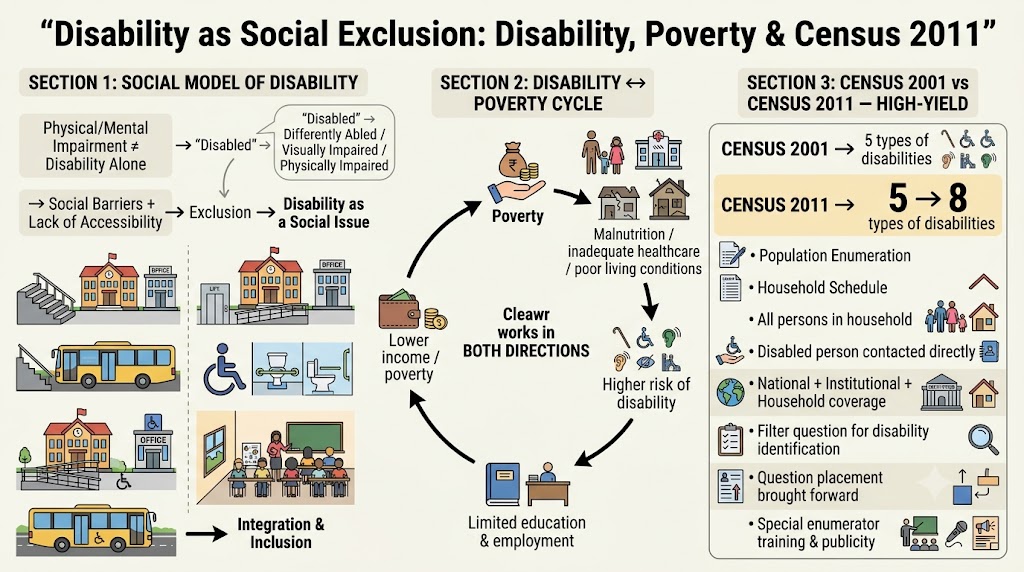
People are not 'disabled' only because they are physically or mentally 'impaired' — they are also disabled because society is built in a manner that does not cater to their needs. The very term 'disabled' is significant precisely because it draws attention to the fact that public perception of 'disability' needs to be questioned.
Common features central to the public perception of 'disability' worldwide (these are the exact assumptions NCERT identifies as needing to be challenged):
- Disability is understood as a biological given.
- Whenever a disabled person faces problems, it is taken for granted that the problems originate from their impairment.
- The disabled person is seen as a victim.
- Disability is supposed to be linked with the disabled individual's self-perception.
- The very idea of disability suggests they are in need of help.
Terminology in the Indian Context
In India, labels such as 'disability', 'handicap', 'crippled', 'blind', and 'deaf' are used synonymously — a conflation NCERT flags as problematic. Destiny is seen as the culprit, and disabled people are viewed as victims; the common perception frames disability as retribution for past karma (actions) from which there can be no reprieve.
The very term 'disabled' challenges each of these assumptions. More recent, less stigmatising terms — 'mentally challenged', 'visually impaired', 'physically impaired' — came to replace older, more negative/trite terms such as 'retarded', 'crippled', or 'lame'.
The Disability–Poverty Relationship
There is a close relationship between disability and poverty, operating in both directions:
- Causes of disability linked to poverty: malnutrition, mothers weakened by frequent childbirth, inadequate immunisation programmes, and accidents in overcrowded homes all contribute to a higher incidence of disability among poor people than among those in easier circumstances.
- Consequences of disability leading to poverty: lack of education and inability to secure jobs; if not accepted by family, this can lead to begging; poor/unsanitary living conditions, inadequate health and education, and lack of immunisation (e.g. missed polio drops) compound the cycle.
According to the 2001 Census, 2.19 crore people in India were physically challenged.
Approach Adopted for the Disabled in Census 2011 (High-Yield PYQ Area)
This specific methodology is one of the most precisely-tested factual areas in CUET for this topic:
- Information on disability was collected during the Population Enumeration phase of Census 2011, through the 'Household Schedule'.
- Questions on disability were asked about all persons in the household.
- Enumerators were instructed to contact the disabled person in the household directly, besides the main respondent, to collect information.
- All types of household — 'National', 'Institutional', AND 'Household' — were covered. (This is a key exam trap: a PYQ tests the FALSE claim that 'only National households were covered' — this is INCORRECT; all three types were covered.)
- Questions and instructions were finalised after: field trial of selected questions in selected areas; extensive deliberation with civil society organisations and the nodal ministry; and a pre-test covering rural/urban samples in all States.
- Aspects considered in finalising the questions: simple nomenclature for easy comprehension by both enumerator and respondent; relevance of the data for planners/policymakers; and feasibility of covering all disability types listed in the Persons with Disabilities Act, 1995 and the National Trust Act, 1999.
- A filter question to ascertain disability status was included.
- Census 2011 attempted to collect information on EIGHT types of disabilities, compared to only FIVE types in Census 2001. (Another key numeric fact for CUET.)
- The placement of the disability question in the Census schedule was changed and brought forward.
- Special efforts were made to improve coverage, including extensive training to enumerators and publicity measures.
Struggles, Advocacy, and Provisions
- Differently-abled people have increasingly organised through protests and associations, pushing for legal recognition and accommodation.
- Contemporary accessibility provisions: accessible bathrooms in malls and airports; separate educational facilities (though the disabled community generally wants integration with mainstream education, not separation); provisions like parking, ramps, lifts, and buses in schools, courts, malls, and airports — though NCERT/CBSE-linked material notes these remain insufficient (most hospitals, for instance, still lack ramps).
- Awareness is increasing, but so is the number of people with disabilities — meaning the challenge is not simply resolving with time/awareness alone.
Common Mistakes
- Treating disability as a purely medical/biological condition — NCERT explicitly frames the SOCIAL dimension: society's failure to accommodate needs is part of what constitutes disability, not just the individual impairment itself.
- Assuming Census 2011 covered only 'National' type households for disability data — this is FALSE and a specific PYQ trap; Census 2011 covered National, Institutional, AND Household types.
- Confusing the number of disability types recorded — Census 2001 recorded 5 types; Census 2011 expanded this to 8 types. Mixing up which census year had which number is a common error.
- Assuming the differently-abled community wants separate/segregated facilities — NCERT/CBSE material notes that while separate educational facilities exist, the broader goal expressed is INTEGRATION with mainstream society, not segregation.
- Overlooking the terminology shift — 'mentally challenged', 'visually impaired', 'physically impaired' specifically replaced older stigmatising terms like 'retarded', 'crippled', 'lame'; conflating old and new terminology as interchangeable misses this deliberate shift.
- Treating the disability-poverty relationship as one-directional — it operates in BOTH directions: poverty-related factors cause higher disability incidence, AND disability itself (via reduced education/employment access) can push people into poverty.
- Assuming accessibility provisions (ramps, lifts) are now adequate across India — source material explicitly states these remain insufficient, citing that most hospitals still lack ramps despite increasing awareness.