'Communities, Nations & Nation States' for CUET-UG Sociology (Unit 4). Designed strictly according to NTA's Assertion-Reasoning, Match-the-Following, and Statement-based question patterns.
1. Community Identity: Deep Structural Analysis
Community identity refers to identities associated with membership in a social community (family, caste, tribe, religion, region).
- Ascribed Identity: Acquired by birth rather than individual achievement. Features: Involuntary, zero choice, ascribed status. Examples: Caste, religion, mother tongue, gender.
- Achieved Identity: Acquired through personal effort, qualifications, and choices. Examples: Profession (Doctor, IAS), educational qualification.
- Key Characteristics:
- Community identities are universal; everyone has a mother tongue, family, and region.
- They are deeply emotional and rooted. People react strongly when their community identity is threatened.
- Even if individuals personally disagree with certain practices of their community, the identity continues to influence them socially.
- Asymmetric Perception (Mirror-Image Construct): In ethnic or communal conflicts, each side perceives itself as the victim/hero and the opposing side as the aggressor/villain.
CUET Assertion-Reasoning Tip: Ascribed identities are difficult to shake off because they are determined by birth, not choice.
2. Diversity vs. Inequality: Conceptual Distinction
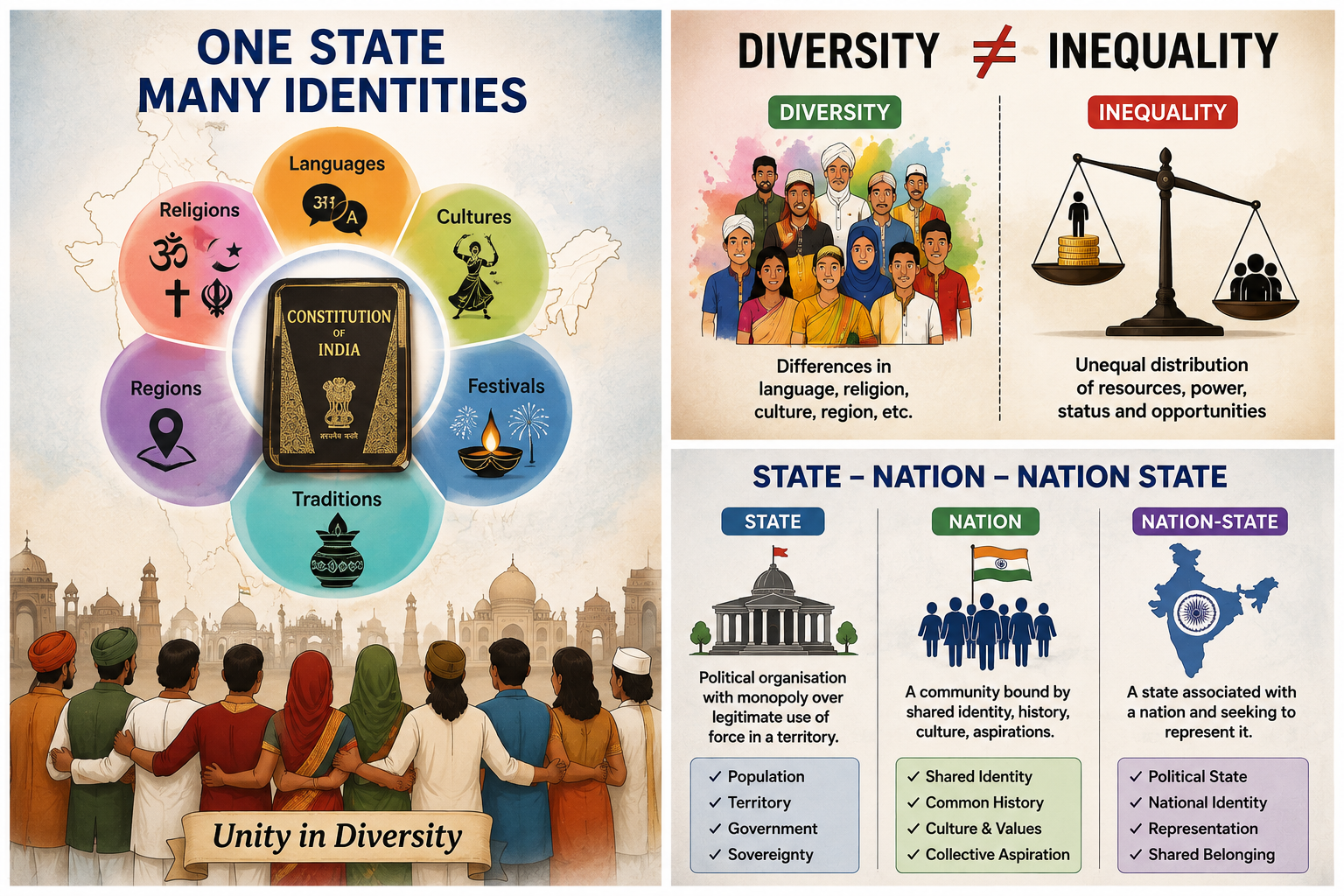
- Diversity: Refers to cultural, linguistic, religious, regional, or ethnic pluralism. It represents physical and social variation among human groups.
- Inequality: Refers to vertical social stratification—unequal distribution of economic resources, social status, power, and political privileges.
- Key Rule: Diversity does NOT inherently cause social conflict or inequality.
- Conflict Trigger Mechanism: Conflict may arise when cultural, linguistic, religious or regional identities become connected with competition over scarce resources, political power or economic opportunities.
CUET Trap: Cultural diversity is not, by itself, the primary cause of social inequality in India.
3. State, Nation, Nation-State & State-Nation Framework
- State (Max Weber's Definition): An organization that successfully claims a 'monopoly of legitimate physical force' within a given geographical territory. Attributes: Population, Defined Territory, Government, and Sovereignty.
- Nation: A political-cultural community bound by a collective sense of shared identity, history, aspirations, or cultural heritage. No single feature (language, religion, or race) is mandatory for defining every nation.
- Nation-State: A political state associated with a nation and seeking to represent a shared national identity.
- Non-Alignment of Nation and State:
- One nation does NOT equal one state (e.g., Kurds spread across multiple Middle Eastern countries; Jamaicans living across the globe).
- One state can contain multiple nations/cultural groups (e.g., India, Canada).
- India as a 'State-Nation' (Stepan, Linz, & Yadav Concept): India does NOT force a single national identity ('Nation-State' model). Instead, as a 'State-Nation', it accommodates multiple linguistic, religious, and ethnic identities within a single democratic constitutional structure.
4. Cultural Models of Nation-Building
- Assimilationist Model:
- Objective: Total cultural uniformity across both public and private life.
- Mechanism: Encourages, persuades, or forces minority communities to abandon their distinct identities and adopt the dominant culture.
- CUET Keyword: 'Uniform set of cultural values' and 'Suppression of minority identities'.
- Integrationist Model:
- Objective: Unity in public life while respecting diversity in private life.
- Mechanism: Establishes a common national pattern for public institutions (law, governance, economy) while allowing minority communities space to preserve their language, culture, and religion in their private spheres.
- CUET Keyword: 'Common public pattern' + 'Private cultural space'.
5. Regionalism & Reorganisation of Indian States
Regionalism refers to political, social, or cultural mobilization centered around the interests and identity of a specific geographical region.
- Root Causes: Linguistic diversity, cultural distinctiveness, tribal identity, geographic isolation, and regional economic disparities (uneven development). Note: Casteism is NOT a root cause of regionalism.
- Linguistic State Formation Chronology:
- 1953: Potti Sreeramulu's 56-day fast-unto-death led to intense agitation, forcing the creation of Andhra State (first linguistic state).
- 1953-1955: States Reorganisation Commission (SRC) appointed (headed by Fazl Ali).
- 1956: States Reorganisation Act enacted, reorganizing Indian states along linguistic lines.
- Impact on Federalism (Ramachandra Guha's thesis): Contrary to fears that linguistic states would break India, accommodating regional aspirations actually strengthened national unity.
- 2000 New States (Jharkhand, Chhattisgarh, Uttarakhand): Formed based on tribal identity, ecology, regional deprivation, and developmental neglect—NOT language.
6. Sociological Minority & Constitutional Safeguards
A sociological minority is not defined merely by numerical smallness; relative disadvantage, collective identity and solidarity are important considerations.
- Article 29(1): Guarantees any section of citizens with a distinct language, script, or culture the right to conserve the same.
- Article 29(2): Denies discrimination in admission to state-aided or state-maintained educational institutions solely on grounds of religion, race, caste, or language.
- Article 30(1): Grants all religious and linguistic minorities the fundamental right to establish and administer educational institutions of their choice.
- Article 30(2): Prohibits the State from discriminating against any educational institution in granting financial aid on the grounds that it is under minority management.
7. Communalism, Secularism & Civil Society
- Communalism: An aggressive political ideology that constructs political interests around religious identity. It claims that religion overrides class, gender, and economic interests. Key Fact: Communalism is a political process, not personal religious devotion.
- Indian Secularism vs. Western Secularism:
- Western Secularism: Strict separation of Church and State (mutual exclusion). Western secularism is generally associated with separation between religious institutions and the state, although different countries follow different models.
- Indian Secularism: Equal respect, religious freedom and protection from religious domination.
- Civil Society: The non-state, non-commercial sphere of voluntary association (NGOs, Trade Unions, Independent Media, Farmers' Movements).
- Right to Information (RTI) Act 2005: Originated from a grassroots civil society movement led by Mazdoor Kisan Shakti Sangathan (MKSS) in Rajasthan. Enacted on 15 June 2005; came into force on 12 October 2005.