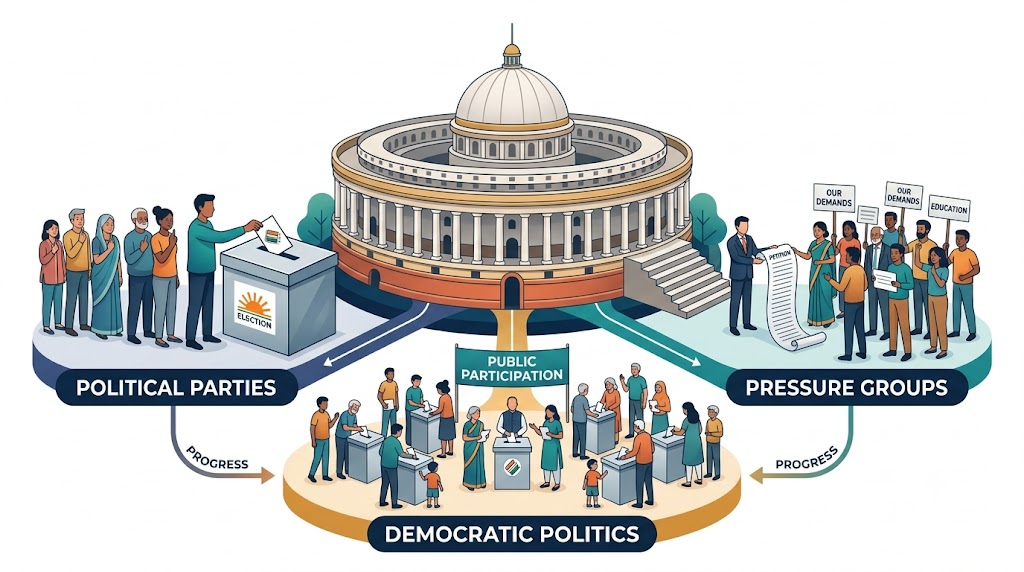
In a democratic state, political parties and interest groups are crucial actors in governance and policy-making. They represent diverse societal interests and compete for power or influence.
1. Political Parties, Pressure Groups and Interest Groups
In a democratic form of government, political parties are key actors. Different groups seek to make their voices heard and draw the attention of the government to their grievances.
Industrialists form associations such as Federation of Indian Chambers and Commerce (FICCI) and Association of Chambers of Commerce (ASSOCHAM). Workers form trade unions such as the Indian Trade Union Congress (INTUC) or the Centre for Indian Trade Unions (CITU). Farmers form agricultural unions such as Shetkari Sangathan. Agricultural labourers have their own unions.
2. Political Parties
A political party may be defined as an organisation oriented towards achieving legitimate control of government through an electoral process.
A political party is an organisation established with the aim of achieving governmental power and using that power to pursue a specific programme.
Political parties are based on certain understanding of society and how it ought to be.
In a democratic system, the interests of different groups are also represented by political parties, who take up their case.
3. Interest Groups
Interest Groups are organised to pursue specific interests in the political arena, operating primarily by lobbying the members of legislative bodies.
Different interest groups will work towards influencing political parties.
When certain groups feel that their interests are not being taken up, they may move to form an alternative party. Or they form pressure groups who lobby with the government.
4. Pressure Groups
Pressure groups are formed when certain groups feel that their interests are not being taken up by political parties.
They lobby with the government in order to pressurise it regarding their demands and interests.
Pressure groups do not ordinarily seek to achieve governmental power through elections. Their main purpose is to influence government and public policy.
In some situations, there may be political organisations which seek to achieve power but are denied the opportunity to do so through standard means. These organisations are best regarded as movements until they achieve recognition.
5. Examples of Interest and Pressure Groups
| Social/Economic Group | Organisation |
|---|---|
| Industrialists | Federation of Indian Chambers and Commerce (FICCI), Association of Chambers of Commerce (ASSOCHAM) |
| Workers | Indian Trade Union Congress (INTUC), Centre for Indian Trade Unions (CITU) |
| Farmers | Shetkari Sangathan |
| Agricultural Labourers | Their own unions |
These organisations provide organised channels through which different groups can present their interests and seek to influence political decision-making.
6. Different Ways of Making Interests Heard
Different groups use different ways to make their voices heard and draw the attention of the government to their grievances.
- Formal delegation of a political party to meet the Prime Minister or another government functionary
- Protest on the streets
- Writing or providing information in newspapers
- Public meetings
- Representation through political parties
- Lobbying with government
7. Unequal Ability to Influence the Government
All groups will not have the same access or the same ability to pressurise the government.
Some argue that the concept of pressure groups underestimates the power that dominant social groups such as class, caste or gender have in society.
They feel that it would be more accurate to suggest that dominant class or classes control the state.
This does not negate the fact that social movements and pressure groups also continue to play a very important role in a democracy.
8. Max Weber on Parties
Max Weber distinguished the location of different social groups in society. The genuine place of classes is within the economic order, while the place of status groups is within the social order.
According to Weber, parties live in a 'house of power'.
Party actions are always directed towards a goal which is striven for in a planned manner.
The goal may be a 'cause', where the party may aim at realising a programme for ideal or material purposes, or the goal may be 'personal', involving sinecures, power, and honour for the leader and followers of the party.
9. Political Parties vs Interest Groups vs Pressure Groups
| Political Parties | Interest Groups | Pressure Groups |
|---|---|---|
| Seek legitimate control of government through an electoral process | Pursue specific interests in the political arena | Lobby with the government to pressurise it regarding demands |
| Aim at achieving governmental power | Primarily lobby members of legislative bodies | Seek to influence government rather than ordinarily form the government |
| Use governmental power to pursue a specific programme | Work towards influencing political parties | May emerge when political parties do not take up a group's interests |
10. CUET Quick Revision Points
- Political Party → legitimate control of government through electoral process.
- Political Party → aims at governmental power and a specific programme.
- Interest Group → pursues specific interests in the political arena.
- Interest Group → primarily uses lobbying of legislative bodies.
- Pressure Group → lobbies with government when interests are not taken up.
- FICCI & ASSOCHAM → Industrialists.
- INTUC & CITU → Workers.
- Shetkari Sangathan → Farmers.
- Max Weber → Parties live in the 'house of power'.
- Important distinction → Political parties seek governmental power; interest and pressure groups seek to influence political decision-making.
- CUET trap → Not all groups have equal access or ability to pressurise the government.
- Dominant social groups → Class, caste and gender can have greater power and influence over the state.
11. Common Mistakes
- Confusing a Political Party with an Interest Group. A political party aims to achieve legitimate control of government through an electoral process, while an interest group pursues specific interests in the political arena.
- Equating Pressure Groups with political parties. Pressure groups seek to influence the government and public policy rather than ordinarily seeking to form the government.
- Forgetting that different groups do not have the same access or the same ability to pressurise the government.
- Ignoring the influence of dominant social groups such as class, caste or gender in society.
- Confusing FICCI and ASSOCHAM with workers' organisations. They represent industrialists.
- Confusing INTUC and CITU with farmers' organisations. They represent workers.
- Confusing Shetkari Sangathan with an industrialists' or workers' organisation. It represents farmers.
- Forgetting Max Weber's statement that parties live in a 'house of power'.