Process of Cultural Change refers to changes in the values, beliefs, practices, customs, institutions, lifestyles and patterns of behaviour of a society over time. Major processes include Modernisation, Westernisation, Sanskritisation and Secularisation. Social reform movements have also played an important role in changing social practices and institutions in India.
1. Cultural Change
Cultural change refers to changes in the values, beliefs, practices, customs, institutions, lifestyles and patterns of behaviour of a society over time.
Cultural change can occur because of modernisation, Westernisation, Sanskritisation, secularisation, social reform movements, education, urbanisation, industrialisation, new technology and contact between different cultures.
Important: Cultural change does not necessarily mean complete replacement of old traditions. Old and new practices can coexist.
2. Modernisation
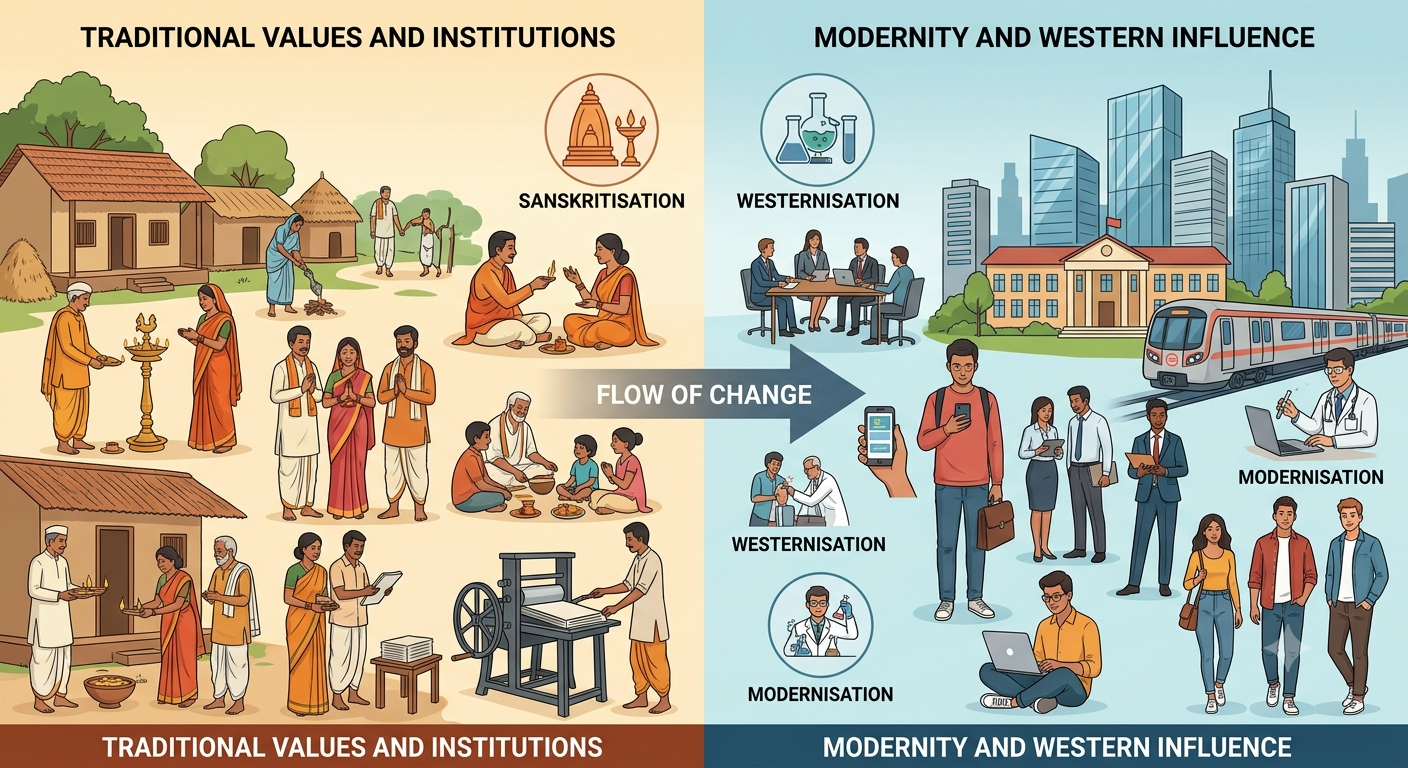
Modernisation refers to the process through which societies undergo changes associated with modern forms of economy, technology, institutions, education, politics and social relationships.
Major features:
- Development of science and technology
- Industrialisation
- Urbanisation
- Expansion of education
- Growth of rational and scientific thinking
- Expansion of democratic institutions
- Greater occupational mobility
- Increasing importance of individual achievement
- Expansion of mass communication
- Changes in family and gender relations
Modernisation does not mean simply copying Western culture.
3. Traditional and Modern Orientation
| Traditional Orientation | Modern Orientation |
|---|---|
| Status based on birth | Greater importance to achievement |
| Hereditary occupations | Occupational mobility |
| Custom-based practices | Greater emphasis on rationality |
| Limited formal education | Expansion of education |
| Localised social relations | Wider social networks |
| Greater dependence on tradition | Greater acceptance of innovation |
4. Modernisation in India
Modernisation in India has been influenced by indigenous developments as well as processes introduced or accelerated during colonial rule.
- Modern education
- Scientific and technological development
- Industrialisation
- Urbanisation
- Democratic politics
- Constitutional rights
- Expansion of formal institutions
- Changes in caste and occupational relations
- Growth of mass media
Modernisation has produced both opportunities and tensions. Expansion of education can increase opportunities for social mobility, urban employment can weaken some traditional occupational restrictions, democratic institutions can increase political participation, and technology can transform communication and everyday life.
5. Westernisation
Westernisation is a concept particularly associated with M.N. Srinivas. It refers to changes in Indian society resulting from prolonged contact with Western culture and institutions, particularly during British rule.
Areas influenced by Westernisation:
- Education
- Science and technology
- Law
- Administration
- Military organisation
- Dress and food habits
- Communication
- Urban lifestyle
- Ideas of equality and individual rights
Westernisation can involve changes in values, institutions, behaviour, lifestyle, technology, education and legal and administrative systems.
6. Westernisation vs Modernisation
| Modernisation | Westernisation |
|---|---|
| Broader process of social transformation | Cultural and institutional influence of the West |
| Includes science, technology, rationality, democracy and education | Associated with contact with Western society and institutions |
| Can occur without simply copying the West | Specifically involves Western influence |
| Broader concept | More specific concept |
Remember: Modernisation and Westernisation are related but not identical.
7. Sanskritisation
Sanskritisation is a concept developed by M.N. Srinivas.
It refers to the process by which a lower or subordinate caste seeks to improve its social status by adopting the customs, rituals, beliefs, practices and lifestyle associated with higher-ranking castes, particularly the twice-born castes.
Common practices adopted may include:
- Vegetarianism
- Abstinence from alcohol
- Ritual practices associated with higher castes
- Particular forms of dress
- Religious practices
- Higher-caste customs and values
The main objective is upward movement in the local social hierarchy or improvement in social status.
8. Features of Sanskritisation
- Social mobility: It can provide a way for a caste or community to seek higher social status.
- Association with caste: The concept was developed to explain changes within the caste system.
- Caste is not necessarily removed: Sanskritisation may change the position claimed by a group without eliminating the caste system.
- Imitation of higher-status practices: The practices adopted may be associated with a locally influential or dominant caste.
- Different from Westernisation: Sanskritisation involves adoption of practices associated with higher-status Indian castes, whereas Westernisation involves Western cultural and institutional influence.
9. Sanskritisation and Social Mobility
Sanskritisation is closely connected with social mobility.
Process:
Lower-status group → Adopts higher-status practices → Claims improved social status → Attempts upward mobility
However, Sanskritisation does not automatically guarantee acceptance or equality.
10. Dominant Caste
The concept of dominant caste is also associated with M.N. Srinivas.
A dominant caste may have influence in a locality because of factors such as:
- Numerical strength
- Ownership of land
- Economic power
- Political influence
- Access to education
- Social status
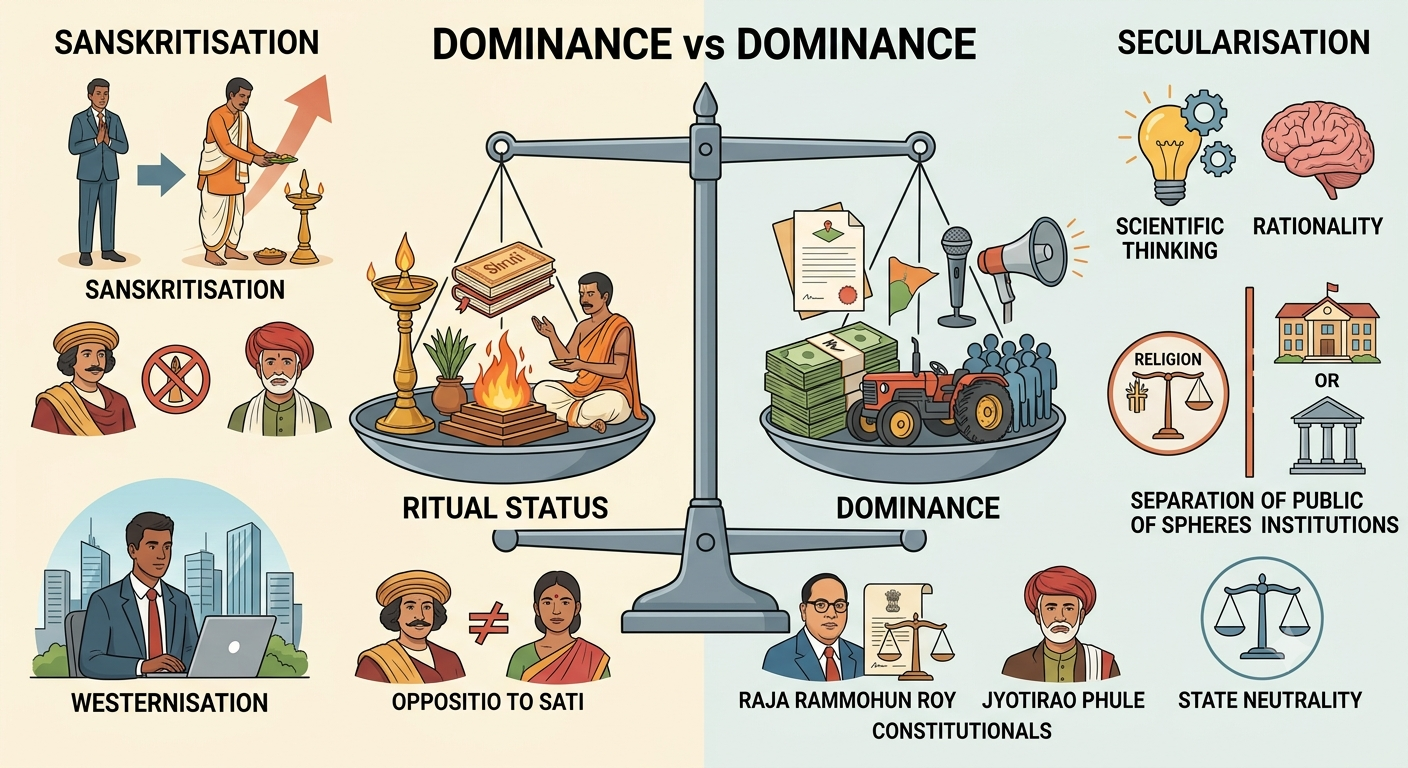
A dominant caste does not necessarily have the highest ritual status.
Key distinction: Ritual status is not the same as social or local dominance.
11. Secularisation
Secularisation refers to changes in which religious beliefs, practices and institutions become less dominant in certain areas of social life.
It can involve:
- Decline in the control of religious institutions over some areas of social life
- Greater importance of secular institutions
- Differentiation between religious and non-religious spheres
- Increasing importance of rational and scientific explanations in some areas
- Changes in the role of religion in public institutions
Important: Secularisation does not necessarily mean disappearance of religion.
12. Secularisation in India
Indian secularisation has developed in a distinctive social and constitutional context.
- Religious freedom
- Equal treatment of citizens
- State neutrality towards different religions
- Constitutional protection against religious discrimination
- Possibility of state intervention in religious practices for social reform
Indian society continues to contain strong religious beliefs and practices. Therefore, secularisation does not mean complete disappearance of religion.
13. Comparison of Major Processes
| Process | Main Meaning | Associated Thinker |
|---|---|---|
| Modernisation | Transformation towards modern institutions, rationality, technology and new social arrangements | Broad sociological concept |
| Westernisation | Changes resulting from contact with Western culture and institutions | M.N. Srinivas |
| Sanskritisation | Adoption of higher-caste practices to seek improved social status | M.N. Srinivas |
| Secularisation | Changing or reduced dominance of religion in certain areas of social life | Broad sociological concept |
14. Social Reform
Social reform refers to organised efforts to change social practices, institutions and customs considered unjust, discriminatory or harmful.
Social reform movements have challenged:
- Caste discrimination
- Untouchability
- Gender inequality
- Child marriage
- Sati
- Restrictions on widow remarriage
- Lack of women's education
- Religious and social orthodoxy
Social reform movements played an important role in changing social practices and institutions in India.
15. Raja Rammohun Roy and Brahmo Samaj
Raja Rammohun Roy was an important nineteenth-century social reformer.
He opposed sati and social and religious orthodoxy and supported women's education, rational thought, social reform and modern education.
He founded the Brahmo Samaj in 1828.
Key association: Raja Rammohun Roy → Brahmo Samaj → Opposition to Sati and social reform.
16. Ishwar Chandra Vidyasagar
Ishwar Chandra Vidyasagar was an important nineteenth-century social reformer.
He strongly supported:
- Widow remarriage
- Women's education
- Reform of social customs
His efforts contributed to the passage of the Hindu Widows' Remarriage Act, 1856.
Key association: Vidyasagar → Widow remarriage + Women's education.
17. Jyotirao Phule and Satyashodhak Samaj
Jyotirao Phule was a major critic of caste inequality and Brahmanical domination.
He worked for lower-caste communities, women's education, education of oppressed groups and criticism of caste hierarchy.
He founded the Satyashodhak Samaj in 1873.
Key association: Jyotirao Phule → Satyashodhak Samaj → Anti-caste reform.
18. Savitribai Phule
Savitribai Phule played an important role in promoting women's education.
She worked with Jyotirao Phule to establish schools for girls and marginalised communities.
Key association: Savitribai Phule → Women's education.
19. Narayana Guru
Narayana Guru worked against caste inequality, particularly in Kerala.
His teachings emphasised social equality, human dignity, criticism of caste discrimination, education and social upliftment.
Key association: Narayana Guru → Anti-caste reform + Social equality.
20. Periyar E.V. Ramasamy
Periyar E.V. Ramasamy was a major social reformer and anti-caste thinker in South India.
He opposed caste hierarchy, Brahmanical domination, social inequality and patriarchal practices.
He promoted rationalism, self-respect, social equality and women's rights.
Key association: Periyar → Self-Respect Movement → Anti-caste + Rationalism.
21. Dr. B.R. Ambedkar and Social Reform
Dr. B.R. Ambedkar was one of the most important anti-caste thinkers and leaders.
He opposed untouchability, caste discrimination and caste-based inequality.
He emphasised equality, liberty, fraternity, education and social justice.
He played a central role in the framing of the Indian Constitution.
Key association: Ambedkar → Anti-caste struggle + Equality + Social justice.
22. Social Reform and Law
| Reform | Important Law / Constitutional Provision |
|---|---|
| Abolition of Sati | Bengal Sati Regulation, 1829 |
| Widow Remarriage | Hindu Widows' Remarriage Act, 1856 |
| Child Marriage | Child Marriage Restraint Act, 1929 |
| Untouchability | Article 17 of the Constitution |
| Protection against caste discrimination | Constitutional safeguards |
23. Social Reform vs Social Change
| Social Reform | Social Change |
|---|---|
| Deliberate effort to improve or change social practices | Broader transformation in society |
| Often organised and purposeful | Can be planned or unplanned |
| Targets specific social problems | Can affect many areas of society |
| Often involves movements and legislation | Can result from technology, economy, demography, politics and other factors |
Example: Campaign against child marriage → Social Reform. Growth of cities due to industrialisation → Social Change.
24. Cultural Change and Continuity
Cultural change does not mean that old traditions simply disappear. Indian society often shows a combination of tradition and modernity.
- Modern education alongside traditional family practices
- Modern technology alongside religious practices
- Urban lifestyles alongside caste and community identities
- Western clothing alongside traditional dress
- Scientific medicine alongside traditional healing practices
Therefore, cultural change is often selective and uneven.
25. Important Thinker-Concept Map
| Thinker | Concept / Contribution |
|---|---|
| M.N. Srinivas | Sanskritisation |
| M.N. Srinivas | Westernisation |
| M.N. Srinivas | Dominant Caste |
| Raja Rammohun Roy | Brahmo Samaj; opposition to Sati |
| Ishwar Chandra Vidyasagar | Widow remarriage; women's education |
| Jyotirao Phule | Satyashodhak Samaj; anti-caste reform |
| Savitribai Phule | Women's education |
| Narayana Guru | Anti-caste reform and social equality |
| Periyar E.V. Ramasamy | Self-Respect Movement; rationalism and anti-caste reform |
| B.R. Ambedkar | Anti-caste struggle; equality and social justice |
26. High-Value Concept Differences
Sanskritisation vs Westernisation
Sanskritisation: Higher-caste Indian practices → Social status improvement → Caste groups → M.N. Srinivas.
Westernisation: Western cultural and institutional influence → Education, law, administration, lifestyle etc. → M.N. Srinivas.
Modernisation vs Westernisation
Modernisation: Broader transformation towards modern institutions and rationality.
Westernisation: Specific influence of Western culture and institutions.
Westernisation can contribute to modernisation, but the two concepts are not identical.
Secularisation vs Modernisation
Secularisation: Changing role or dominance of religion.
Modernisation: Wider changes in economy, technology, institutions, education, politics and social relations.
Social Reform vs Sanskritisation
Social Reform: Attempts to change unjust or harmful social practices.
Sanskritisation: A lower-status group adopts higher-status practices to seek upward social mobility.
27. CUET Quick Revision
- Modernisation = modern institutions + rationality + technology + education.
- Westernisation = influence of Western culture and institutions.
- Sanskritisation = adoption of higher-caste practices for upward social mobility.
- Secularisation = changing or reduced dominance of religion in certain spheres.
- M.N. Srinivas = Sanskritisation + Westernisation + Dominant Caste.
- Raja Rammohun Roy = Brahmo Samaj + opposition to Sati.
- Vidyasagar = widow remarriage + women's education.
- Jyotirao Phule = Satyashodhak Samaj + anti-caste reform.
- Savitribai Phule = women's education.
- Narayana Guru = anti-caste equality.
- Periyar = Self-Respect Movement + rationalism.
- Ambedkar = anti-caste struggle + equality + social justice.
- Cultural change ≠ complete disappearance of tradition.
- Secularisation ≠ disappearance of religion.
- Modernisation ≠ Westernisation.
- Sanskritisation ≠ abolition of caste.