This chapter focuses on the agrarian structure, land reform legislation, and the Green Revolution in India, highlighting the colonial legacy, post-independence reforms, and their intended and unintended social consequences. It examines how land ownership, technology, and state policies have shaped rural society and class relations.
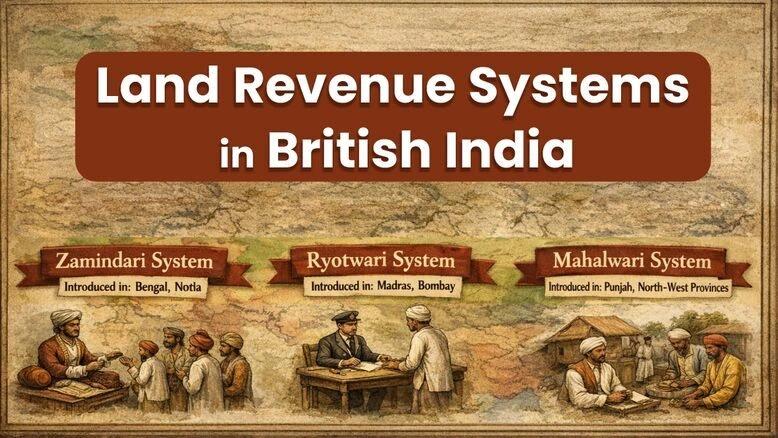
1. The Colonial Agrarian Structure: Zamindari and Raiyatwari Systems
The agrarian structure of India was fundamentally reshaped by British colonial revenue policies. These systems created different structures of landholding and taxation.
- Zamindari System:
- Under this system, the British ruled through local zamindars (landlords) who were granted property rights and given more control over land than they had before.
- The heavy land revenue imposed by the colonisers forced the zamindars to extract as much produce or money as possible from the cultivators.
- Key Result: Agricultural production stagnated or declined during much of the British rule, as peasants fled from oppressive landlords, and frequent famines and wars decimated the population.
- Raiyatwari System:
- In areas under direct British rule, the 'raiyat' (cultivator) was made responsible for paying the tax directly to the colonial government, without an intermediary like a zamindar.
- The colonial government dealt directly with the cultivator.
- Key Result: The Raiyatwari system differed from Zamindari because it eliminated the intermediary between the cultivator and the colonial government. Its effects varied across regions, and it should not be treated as universally leading to lower taxation or greater agricultural prosperity.
| Feature | Zamindari System | Raiyatwari System |
|---|---|---|
| Tax Payer | Zamindar (Intermediary) | Raiyat (Cultivator directly) |
| Intermediary | Present (Zamindars) | Absent |
| Impact on Agriculture | Stagnation/Decline | Varied by region |
| Regional Example | Bengal, North India | Southern India (Telugu speaking areas) |
2. Land Reforms in Independent India (1950s-1970s)
After independence, the state sought to reform the agrarian structure to address low productivity and intense rural poverty. From the 1950s to the 1970s, a series of land reform laws were passed at national and state levels.
- First Legislation: Abolition of the Zamindari System
- This was the most effective of all land reform laws, aiming to remove the layer of intermediaries standing between the cultivators and the state.
- It succeeded in weakening the economic and political power of the zamindars and strengthened the position of actual landholders and cultivators at the local level.
- Limitation: It did not wipe out landlordism or tenancy/sharecropping systems, which continued in many areas. It only removed the top layer of landlords.
- Tenancy Abolition and Regulation Acts:
- These laws attempted to outlaw tenancy altogether or regulate rents to give some security to tenants.
- In most states, they were never implemented effectively. However, in West Bengal and Kerala, there was a radical restructuring that gave land rights to the tenants.
- Land Ceiling Acts:
- These laws imposed an upper limit on the amount of land a family can own. The ceiling varies based on the kind of land, its productivity, and other factors (e.g., very productive land has a low ceiling, while unproductive dry land has a higher ceiling).
- The state is supposed to identify and take possession of surplus land (above the ceiling limit) and redistribute it to landless families, SCs, and STs.
- Loopholes: In most states, these acts proved to be toothless. Landowners used strategies to escape the provisions, most notably 'benami transfers', where land is registered in the names of relatives or servants to retain control.
- Example: In some places, rich farmers divorced their wives (but continued to live with them) to avoid the Land Ceiling Act, as a separate share was allowed for unmarried women but not for wives.
3. The Green Revolution (1960s-1970s)
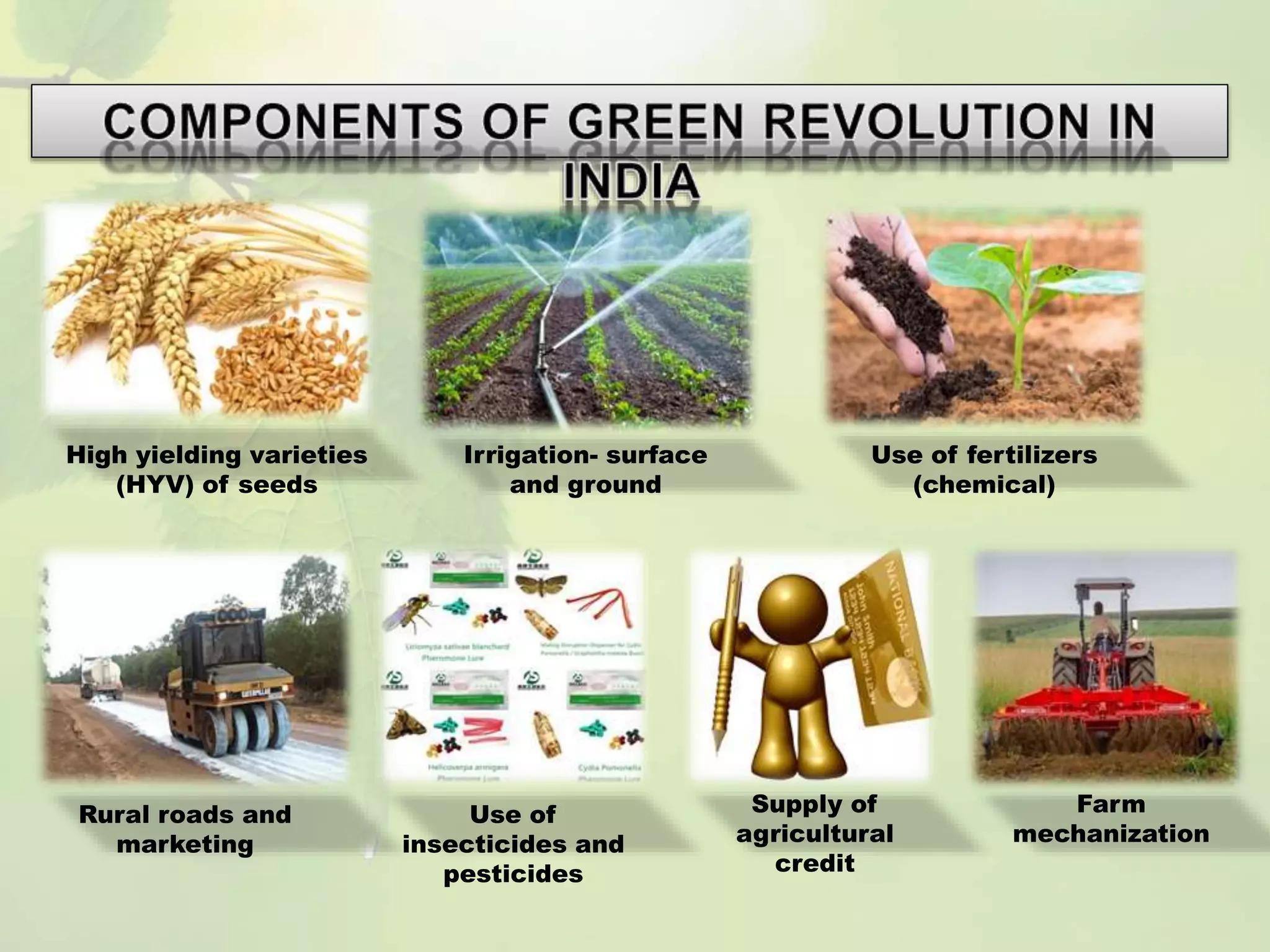
The Green Revolution was a government program of agricultural modernisation, largely funded by international agencies, based on providing high-yielding variety (HYV) or hybrid seeds along with pesticides, fertilisers, and other inputs.
- Targeted Areas: It was introduced only in areas with assured irrigation, as sufficient water was necessary for the new seeds. It was targeted mainly at wheat and rice-growing areas.
- Regions with First Wave: The first wave was received by Punjab, western U.P., coastal Andhra Pradesh, and parts of Tamil Nadu.
- Positive Impact: Agricultural productivity increased sharply, and India became self-sufficient in foodgrain production for the first time in decades.
- Negative Social Effects: Sociologists pointed out that in most Green Revolution areas, it was primarily the medium and large farmers who were able to benefit from the new technology, because inputs were expensive and small and marginal farmers could not afford them.
- Class Differentiation: The ultimate outcome was a process of 'differentiation', where the rich grew richer and many of the poor stagnated or grew poorer.
- Displacement of Service Castes: The introduction of machinery (tillers, tractors, threshers, harvesters) led to the displacement of service caste groups who used to carry out these activities, increasing rural-urban migration.
- Regional Inequalities: The Green Revolution worsened regional inequalities. States like Bihar, eastern U.P., and dry regions like Telengana remained relatively undeveloped, with a continued entrenched 'feudal' agrarian structure.
- Second Phase: The second phase of the Green Revolution extended into dry and semi-arid regions, leading to a shift from dry to wet (irrigated) cultivation. This has increased rather than reduced livelihood insecurity, as farmers who once grew food for consumption now depend on the market.
4. Transformation of Rural Social Relations
The post-independence period, particularly in Green Revolution areas, saw profound transformations in the nature of social relations. Sociologist Jan Breman described this as a shift from 'patronage to exploitation'.
- Changes in Labour Relations:
- An increase in the use of agricultural labour as cultivation became more intensive.
- A shift from payment in kind (grain) to payment in cash.
- A loosening of traditional bonds or hereditary relationships between farmers and agricultural workers (bonded labour), leading to the rise of a class of 'free' wage labourers.
- Capitalist Transition: This transformation is regarded as a transition to capitalist agriculture, based on the separation of workers from the means of production (land) and the use of 'free' wage labour.
- Emergence of New Rural Elites: Well-to-do farmers in agriculturally rich regions (coastal Andhra Pradesh, western U.P., central Gujarat) invested their profits in other businesses, giving rise to new entrepreneurial groups that moved to growing towns and became new regional elites.
- Rural-Urban Dominant Class: In areas of rapid agricultural development, there has been a consolidation of the old landed groups who transformed themselves into a dynamic, entrepreneurial rural-urban dominant class.
- Kerala's Different Path: States like Kerala underwent a different process, where political mobilisation, redistributive measures, and linkages to an external economy (Gulf countries) brought about substantial transformation, leading to a rural mixed economy dependent on remittances.
5. Circulation of Labour & 'Footloose Labour'
Another significant change linked to commercialisation is the growth of migrant agricultural labour.
- Seasonal Migration: As traditional patronage bonds broke down and seasonal demand for labour increased in prosperous areas like Punjab, a pattern of seasonal migration emerged. Thousands of workers circulate between their home villages and more prosperous areas.
- Reason for Migration: Increasing inequalities from the mid-1990s forced many households to combine multiple occupations. Men migrate periodically for work, leaving women and children in their villages with elderly grandparents.
- 'Footloose Labour': Jan Breman termed these migrant workers 'footloose labour', but this does not imply freedom. They usually do not get minimum wages, are more easily exploited, and are preferred by wealthy farmers for harvest operations because they can be paid less.
- Feminisation of Agricultural Labour: In poor areas where male members work outside, cultivation has become primarily a female task, leading to the 'feminisation of agricultural labour force'. Women earn lower wages than men, and are largely excluded from land ownership due to patrilineal kinship systems.
6. Globalisation, Liberalisation & Agrarian Crisis
Since the late 1980s, the policy of liberalisation and participation in the World Trade Organisation (WTO) has significantly impacted agriculture and rural society.
- Exposure to Global Markets: After decades of state protection, Indian farmers have been exposed to competition from the global market. India has decided to import wheat, reversing the policy of self-reliance.
- Contract Farming: In regions like Punjab and Karnataka, farmers enter contracts with multinational companies (e.g., PepsiCo) to grow crops (tomatoes, potatoes), which the company then buys. The company identifies the crop, provides seeds, know-how, and working capital, while the farmer is assured of a market at a predetermined price. However, this leads to greater insecurity, diversions of land from food grain production, and makes indigenous knowledge less relevant.
- Entry of Multinationals in Inputs: Multinationals have entered the agricultural sector as sellers of seeds, pesticides, and fertilisers, replacing government 'agricultural extension' agents. This has led to increased dependence on expensive inputs, reducing profits and creating an ecological crisis.
- Farmers' Suicides: The spate of farmers' suicides since 1997-98 can be linked to 'agrarian distress' caused by structural changes, changed cropping patterns (shift to cash crops), liberalisation policies, heavy dependence on high-cost inputs, withdrawal of state support, and individualisation of agricultural operations. Official statistics show 8,900 suicides by farmers between 2001 and 2006 in Andhra Pradesh, Karnataka, Kerala, and Maharashtra. Sociologists view these as 'matrix events', where a range of factors coalesce.
- The Crisis: Agriculture for many is becoming untenable, state support has declined, and agricultural issues are no longer key public issues. The lack of mobilisation means agriculturists cannot form powerful pressure groups to influence policy.
Common Mistakes
- Confusing the Zamindari and Raiyatwari systems. Zamindari involved an intermediary, while Raiyatwari established a direct revenue relationship between the colonial government and the cultivator.
- Assuming that the Raiyatwari system universally resulted in lower taxation or greater agricultural prosperity. Its effects varied across regions.
- Assuming that the Green Revolution benefited all farmers equally. In reality, it primarily benefited medium and large farmers who could afford expensive inputs, leading to increased inequalities.
- Thinking that 'benami transfers' refers to legitimate land transfers. They were a strategy used to evade the Land Ceiling Act by registering land in another name.
- Confusing the shift from 'patronage to exploitation' as a purely positive change. While it loosened hereditary bonds, it also led to the rise of 'free' wage labourers who are often exploited for cash wages.
- Forgetting that the Green Revolution worsened regional inequalities, leaving states like Bihar and eastern U.P. with relatively less developed agrarian structures.
- Confusing 'footloose labour' with free or secure labour. Jan Breman used the term for migrant workers who are often vulnerable to exploitation and may not receive minimum wages.
- Treating the agrarian crisis and farmers' suicides as the result of a single factor. Sociologists view them as 'matrix events' in which multiple factors come together.