This chapter explores environmental movements in India, focusing on the Chipko Movement as a key case study to understand the intersection of ecology, economy, and identity. It highlights how these movements challenge the dominant model of development and articulate the concerns of marginalised communities.
1. Understanding Environmental Movements
Environmental movements have become a significant form of social action globally and in India. They challenge the unchecked use of natural resources and critique a model of development that creates new needs, further demanding greater exploitation of already depleted resources.
- Critique of Development: This model has been critiqued for assuming that all sections of people will be beneficiaries. Large dams displace people, industries displace agriculturalists, and industrial pollution has its own disastrous impacts.
- 'Old' and 'New' Movement Features: Environmental movements often raise both 'red' (class-based inequality, resource distribution) and 'green' (ecological sustainability) issues simultaneously. They also involve identity politics and cultural anxieties, making them complex and difficult to classify strictly as old or new social movements.
2. The Chipko Movement: A Detailed Case Study
The Chipko Movement in the Himalayan foothills is a good example of an ecological movement, but it also illustrates the intermingling of economy, ecology, and political representation.
- The Catalyst: The unusually heavy monsoon of 1970 precipitated a devastating flood in the Alaknanda valley. Water inundated 100 square kilometres of land, washed away 6 metal bridges, 10 kilometres of motor roads, 24 buses, and 366 houses. 500 acres of standing paddy crops were destroyed. This flood marked a turning point in the ecological history of the region, as villagers began to perceive the links between deforestation, landslides, and floods.
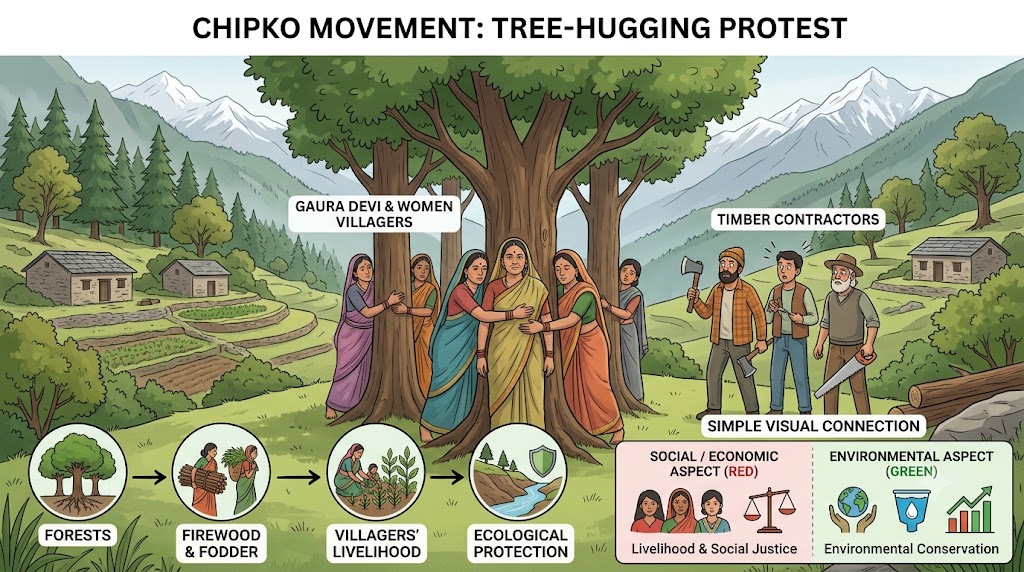
- Action: When the government went ahead with the yearly auction of forests in November, villagers rallied to save the oak and rhododendron forests. When contractors came to cut down trees, villagers, including large numbers of women, stepped forward to hug the trees to prevent them from being felled.
- Key Incident: In the Reni forest, Gaura Devi, the head of the village Mahila Mandal (Women's Club), mobilised other housewives after a small girl spied workers with implements. When the women refused to budge despite abuse and threats, the men were eventually forced to retire.
- Organisation: The villagers' cause was taken up by the Dashauli Gram Swaraja Sangh (DGSS), a cooperative organisation based in Chamoli district.
3. Key Themes in the Chipko Movement
The Chipko movement is not just about trees; it embodies a struggle between different ways of valuing the environment and asserting the rights of marginalised communities.
- Subsistence vs. Profit: At stake was the villagers' subsistence. They relied on the forest for firewood, fodder, and daily necessities. This conflict placed the economy of subsistence against the economy of profit.
- Red and Green Issues: For the villagers, the 'red' issues of social inequality (villagers versus the government representing commercial capitalist interests) and the 'green' issues of ecological sustainability were interlinked. They valued the forest not just for profit but as a form of ecological wealth that benefits all.
- Political Representation: The movement also expressed resentment against a distant government headquartered in the plains that seemed indifferent and hostile to hill villagers' concerns.
- Gender Dimension: The prominent role of women like Gaura Devi in the movement highlighted the gendered nature of environmental struggle, as women were the primary users of forest resources.
4. The Global Context of Environmental Movements
In the current information age, social movements around the globe are able to join together in huge regional and international networks. Environmental movements are no longer confined to local boundaries.
- International Networks: Non-governmental organisations, religious and humanitarian groups, human rights associations, consumer protection advocates, and environmental activists can now campaign together in the public interest.
- Internet-based Networking: The enormous protests against the World Trade Organisation (WTO) that took place in Seattle were organised in part through internet-based networks.
- Blurring of Boundaries: This globalisation of social movements has changed the role they can play, making them more transnational and interconnected, while still rooted in local concerns.
5. Related Developments: Van Panchayats and Environmental Concerns
Environmentally conscious local institutions have emerged as a response to ecological degradation and state policies.
- Van Panchayats in Uttarakhand: Women in Uttarakhand have set up van panchayats to manage local forests. Members develop nurseries, nurture tree saplings for planting on hill slopes, and police nearby forests to prevent illegal felling. The Chipko movement had its beginnings in this area.
- Environmental Crises: The text also points to other environmental challenges, such as the ecological crisis created by the increased dependence on expensive fertilisers and pesticides in agriculture. This is linked to globalisation and the entry of multinationals as agricultural input sellers, which has led to soil degradation and water pollution.
Common Mistakes
- Thinking that the Chipko Movement was only about 'green' issues. It was equally about 'red' issues of class inequality and resource distribution, as well as political representation.
- Assuming that environmental movements are purely local. They are increasingly global, with international networking via the internet and alliances across borders.
- Forgetting that the Chipko movement's prominent role of women (like Gaura Devi) highlights the gendered nature of environmental struggles.
- Believing that the Chipko movement was a spontaneous, unorganised protest. It was taken up by the Dashauli Gram Swaraja Sangh (DGSS), a cooperative organisation.
- Ignoring the link between environmental movements and broader critiques of development. The chapter argues that big dams and industries displace people, leading to ecological movements that challenge this model.