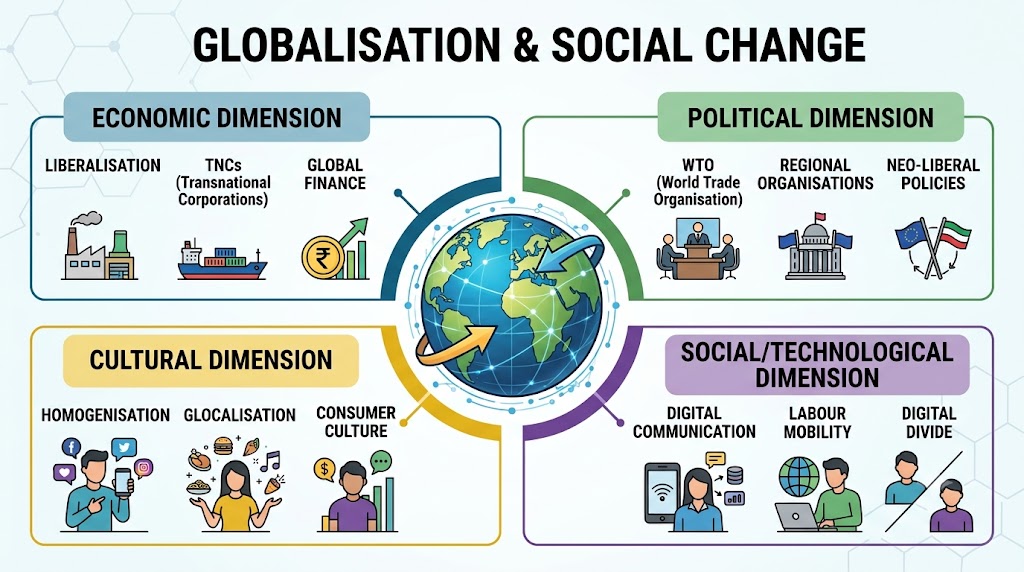
This chapter examines globalisation as a process of growing interdependence among societies and economies, with particular attention to its economic, political, technological, labour, and cultural dimensions. It explores how globalisation has transformed Indian society while producing both new opportunities and new forms of inequality and cultural change.
1. Understanding Globalisation: Definition and Scope
Globalisation refers to the growing interdependence between different peoples, regions, and countries as social and economic relationships increasingly stretch worldwide. Although economic forces are important, globalisation has also been driven significantly by advances in information and communication technologies, which have increased the speed and scope of interaction.
Globalisation is not a completely new phenomenon. India has been connected with other regions for thousands of years. The Silk Route linked India with China, Persia, Egypt, and Rome. The seventh-century Chinese scholar Yi Jing learned Sanskrit in Java while travelling from China to India.
Indian culture has historically shown an open approach towards outside influences. The parable of the 'kupamanduka', or well-frog, warns against isolationism. The frog living inside a well knows only its limited surroundings and becomes suspicious of everything outside.
Colonialism and globalisation were also closely connected with the development of modern capitalism. Colonial expansion created demands for new sources of capital, raw materials, energy, markets, and labour. The movement of indentured labourers from India to different parts of Asia, Africa, and the Americas is an example of historical global migration.
2. Economic Dimensions of Globalisation
The economic dimension of globalisation is associated with policy changes, technological developments, international financial flows, and the growing importance of transnational corporations.
Liberalisation refers to a range of policy decisions taken in India since 1991 to open the Indian economy to the world market. It marked a shift away from the earlier system of extensive state control. The basic assumption was that greater integration with the global market would benefit the Indian economy.
Structural adjustment programmes were associated with loans from international institutions such as the International Monetary Fund (IMF). Such loans could come with conditions, including reductions in state expenditure on areas such as health, education, and social security.
Transnational Corporations (TNCs) are companies that produce goods or market services in more than one country. They are oriented towards global markets and profits, even when they have a clear national base. Examples include Coca-Cola, General Motors, and Colgate-Palmolive. Some Indian companies have also become transnational.
The electronic economy allows banks, corporations, and investors to transfer funds internationally almost instantaneously. Such rapid movement of financial capital can also create risks, including sudden rises and falls in stock markets when foreign investors buy or sell stocks.
The weightless economy refers to an economy in which products and services are increasingly based on information, such as computer software, media and entertainment products, and internet-based services. A knowledge economy is one in which a significant part of the workforce is involved in designing, developing, marketing, selling, and servicing goods rather than simply producing them physically.
Globalisation of finance has integrated financial markets across countries. Billions of dollars can be transferred through electronic circuits within seconds, while capital and securities markets operate across different time zones. New York, Tokyo, and London are major financial centres, while Mumbai is regarded as India's financial capital.
3. Global Communications and the Digital Divide
Advances in communication technology and telecommunications infrastructure have transformed global interaction. These technologies contribute to the compression of time and space, allowing people located thousands of kilometres apart to communicate, exchange documents, and share images almost instantly.
For example, people in Bangalore and New York can communicate and exchange information using modern communication technologies and satellite systems.
The benefits of digital connectivity, however, are not equally distributed. The digital divide refers to differences in access to and use of digital technologies. Cyber connectivity has largely remained an urban phenomenon, while many rural areas continue to face problems such as erratic electricity supply, widespread illiteracy, and inadequate infrastructure.
India's telecommunications network expanded rapidly after independence. In 1947, there were about 84,000 telephone lines for a population of around 350 million. By 1999, India had more than 25 million telephone lines, making it the ninth-largest telephone network in the world. By 2006, India had become the country with the fourth-largest usage of cell phones globally, with around 123.44 million mobile phones.
The spread of Public Call Offices (PCOs) also reflected India's socio-cultural emphasis on maintaining contact with family members. Telecommunication advertisements frequently depicted communication between parents, children, and grandparents.
4. Globalisation and Labour: The New International Division of Labour
Globalisation has created a new international division of labour, in which production and employment are increasingly distributed across different countries according to factors such as labour costs.
The example of Nike illustrates this process. As labour costs increased in Japan, production shifted to countries such as South Korea, Thailand, Indonesia, and eventually India. This mobility of production can make workers vulnerable because companies may shift production to locations where labour is cheaper.
Post-Fordism refers to a shift away from the mass production of goods at a centralised location, associated with Fordism, towards more flexible production at dispersed locations.
Global sourcing demonstrates the international character of modern production. The Pontiac Le Mans, for example, involved components sourced from several countries, including South Korea, Japan, Germany, Taiwan, Singapore, the UK, and Barbados.
Globalisation has created new career opportunities, particularly for sections of the urban middle class working in areas such as information technology and BPOs. However, employment growth has not always matched economic growth. An ILO report noted that employment in Asia and the Pacific increased by only about 1.6 per cent between 2003 and 2004, despite economic growth of more than 7 per cent.
5. Political Dimensions of Globalisation
Globalisation has important political dimensions in addition to its economic effects. The collapse of the erstwhile socialist world contributed to the spread of a particular economic and political approach commonly associated with neo-liberal economic measures.
Neo-liberalism emphasises free enterprise and greater reliance on market forces. It is critical of extensive state regulation and state subsidies, arguing that freer markets can promote efficiency and economic growth.
Globalisation has also encouraged regional and international forms of political collaboration. Examples include the European Union (EU), the Association of South East Asian Nations (ASEAN), and the South Asian Association for Regional Cooperation (SAARC).
International Governmental Organisations (IGOs) are organisations established by participating governments to regulate or manage areas of activity that extend across national boundaries. The World Trade Organisation (WTO) has an important role in setting rules governing international trade.
International Non-Governmental Organisations (INGOs) are independent organisations that are not part of government institutions. Examples include Greenpeace, the Red Cross, Amnesty International, and Medecins Sans Frontieres (Doctors Without Borders).
6. Cultural Dimensions: Homogenisation and Glocalisation
Globalisation has produced significant changes in culture and everyday life. One concern is cultural homogenisation, the idea that different cultures may increasingly become similar under global influences.
A contrasting process is glocalisation, which refers to the mixing of global influences with local cultures and practices. Foreign companies often adapt their products and strategies to local traditions to increase their marketability.
In India, foreign television channels such as Star, MTV, Channel V, and Cartoon Network have used Indian languages and local cultural references. Similarly, McDonald's adapted its Indian offerings by focusing on vegetarian and chicken products and modifying its menu according to local cultural practices.
The process of globalisation has also contributed to a culture of consumption. While manufacturing industries played a major role in urban growth during earlier decades, cultural consumption involving food, fashion, music, tourism, and entertainment has increasingly shaped cities. This is visible in the growth of shopping malls, multiplexes, amusement parks, and water parks.
Globalisation can also threaten indigenous traditions and knowledge systems. The decline of traditional theatre groups in parts of Mumbai illustrates how changes in employment and urban life can affect cultural practices. There have also been attempts by multinational companies to patent traditional knowledge and resources associated with Tulsi, Haldi, Rudraksha, and Basmati rice, highlighting the importance of protecting indigenous knowledge.
Common Mistakes
- Do not confuse globalisation with liberalisation. Globalisation is the broader process of worldwide interdependence, while liberalisation refers to policies that open an economy to market forces and the world economy.
- Do not assume that globalisation is entirely new. India had long-distance economic and cultural connections through routes such as the Silk Route long before modern globalisation.
- Do not assume that globalisation benefits every social group equally. Its benefits and costs are distributed unevenly across classes, regions, and occupations.
- Do not confuse homogenisation with glocalisation. Homogenisation suggests increasing cultural similarity, while glocalisation involves combining global influences with local cultures.
- Do not confuse the weightless economy with the disappearance of physical production. It refers to the growing importance of information-based products and services.
- Do not assume that globalisation is only an economic process. It also has political, technological, labour, and cultural dimensions.
- Do not confuse post-Fordism with Fordism. Fordism is associated with mass production at centralised locations, whereas post-Fordism emphasises flexible and dispersed production.
- Do not assume that digital connectivity is equally available everywhere. The digital divide shows significant differences between connected and poorly connected sections, particularly between urban and rural areas.
- Do not assume that globalisation always destroys local culture. Glocalisation demonstrates that global and local cultural elements can combine and produce new cultural forms.
- Do not forget the political dimension of globalisation. Neo-liberal economic measures emphasise free enterprise and market forces and are critical of extensive state regulation and subsidies.