Gender inequality is a form of social inequality and exclusion — much like caste and class — but with its own specific features, and India's struggle for women's equality unfolded through two distinct waves: nineteenth-century middle-class reform movements challenging tradition, and a 1970s-onward re-emergence focused on modern legal and social issues.
Gender Inequality as a Form of Social Exclusion
Because of obvious biological and physical differences between men and women, gender inequality is often wrongly treated as 'natural'. Sociologically, however, gender is a form of social inequality and exclusion, like caste and class — but with its own specific features distinct from those other axes of inequality.
Nineteenth-Century Reform Movements: Origins and Character
The 'women's question' arose in modern India as part of nineteenth-century middle-class social reform movements. These are often called 'middle class reform movements' because many reformers came from the newly emerging Western-educated Indian middle class.
- Reformers were simultaneously inspired by the democratic ideals of the modern West and by deep pride in their own historical democratic traditions.
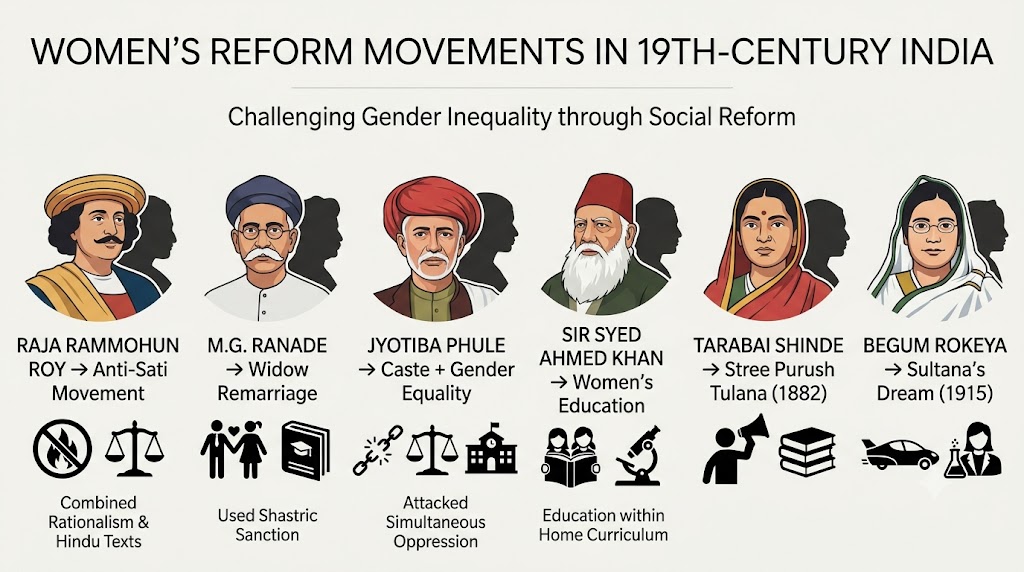
- Key movements: the anti-sati campaign led by Raja Rammohun Roy in Bengal; the widow remarriage movement in the Bombay Presidency (Ranade as a leading reformer); Jyotiba Phule's simultaneous attack on caste and gender oppression; and the social reform movement in Islam led by Sir Syed Ahmed Khan.
Key Male Reformers
| Reformer | Key Contributions |
|---|---|
| Raja Rammohun Roy | Starting point of 19th-century Bengal social reform. A decade before founding the Brahmo Samaj (1828), he led the campaign against 'sati' — the first women's issue to receive public attention. His ideas mixed Western rationality with an assertion of Indian traditionality — he attacked sati using BOTH humanitarian/natural-rights arguments AND Hindu shastric texts. |
| M.G. Ranade | Used the writings of Bishop Joseph Butler (Analogy of Religion, Three Sermons on Human Nature) — texts that dominated Bombay University's moral philosophy syllabus in the 1860s. Wrote 'The Texts of the Hindu Law' on the 'Lawfulness of the Remarriage of Widows and Vedic Authorities for Widow Marriage', elaborating shastric sanction for widow remarriage. |
| Jyotiba Phule | Came from a socially excluded (lower) caste, unlike Ranade/Rammohun Roy's upper-caste middle-class background. Founded the Satyashodhak Samaj ('truth-seeking society'). His reform efforts aided the two groups considered lowest in traditional Brahmin culture: women and untouchables — attacking caste and gender discrimination together. |
| Sir Syed Ahmed Khan | Led reform of Muslim society, drawing on both modern Western ideas AND sacred texts (parallel to Rammohun Roy's approach). Wanted girls educated, but within the home. Like Dayanand Saraswati of the Arya Samaj, supported women's education but with a curriculum including religious principles, housekeeping, and childrearing. |
Key Women Reformers and Writers
| Reformer | Key Work | Significance |
|---|---|---|
| Tarabai Shinde | Stree Purush Tulana ('Comparison of Men and Women'), 1882 | Written by a Maharashtrian housewife as a protest against the double standards of male-dominated society. Triggered by a case where a young Brahmin widow was sentenced to death for killing her illegitimate newborn, while no effort was made to identify/punish the child's father. The book created a major public stir when published. |
| Begum Rokeya Sakhawat Hossain | Sultana's Dream, 1915 | Born into a well-to-do Bengali Muslim family with a liberal husband who supported her education (Urdu, then Bengali and English). Already a successful Urdu/Bengali author before writing this piece to test her English writing. Probably the earliest example of science fiction writing in India, and among the first anywhere by a woman author. Depicts a magical country with reversed gender roles — men confined to the home observing 'purdah', while women are scientist-inventors controlling clouds/rain and flying 'air-cars'. |
The Karachi Session, 1931: Constitutional Foundations
In 1931, the Karachi Session of the Indian National Congress issued a declaration on the Fundamental Rights of Citizenship in India, committing itself to women's equality. Key provisions (later echoed in the Constitution):
- All citizens equal before the law, irrespective of religion, caste, creed, or sex.
- No disability attaches to any citizen, by reason of religion, caste, creed, or sex, regarding public employment, office of power/honour, or the exercise of any trade/calling.
- Franchise on the basis of universal adult suffrage.
- Women given the right to vote, to represent, and to hold public office.
Women's Struggle for Rights After Independence
Women's issues re-emerged in the 1970s, two decades after Independence — with a notably different focus from the 19th-century reform movements:
| 19th-century reform emphasis | 1970s 'modern' issues emphasis |
|---|---|
| Backward aspects of tradition — sati, child marriage, ill-treatment of widows | Rape of women in police custody; dowry murders; representation of women in popular media; gendered consequences of unequal development |
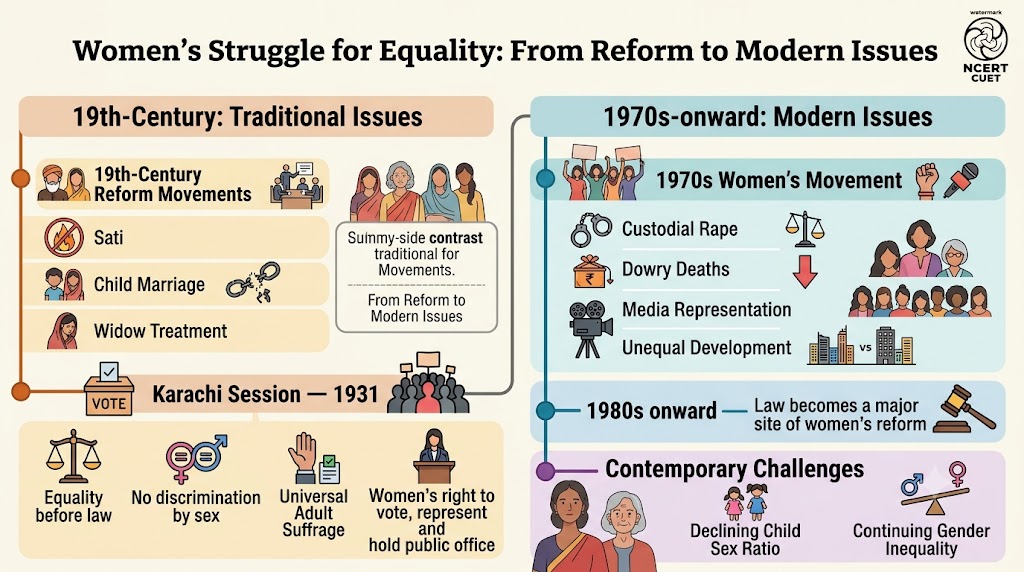
- The law became a major site for reform in the 1980s and after — many laws affecting women had not been updated since the 19th century.
- A sharp fall in the child sex ratio, and the implicit social bias against the girl child, represents one of the newer challenges of gender inequality in contemporary India.
Common Mistakes
- Treating gender inequality as purely biological/natural — NCERT explicitly frames it as a social form of inequality and exclusion, comparable to (but distinct from) caste and class.
- Confusing the reformers' approaches — Rammohun Roy and Ranade drew on BOTH Western rationalist AND indigenous shastric/religious arguments; this dual approach is a key exam point, not a contradiction to gloss over.
- Overlooking Phule's distinctiveness — unlike upper-caste reformers (Roy, Ranade), Phule came from a socially excluded caste and uniquely linked caste and gender oppression together; conflating him with the other reformers misses this key distinction.
- Mixing up the two women-authored texts — Stree Purush Tulana (Tarabai Shinde, 1882, protest against double standards) vs. Sultana's Dream (Begum Rokeya, 1915, gender-role-reversal science fiction) — different authors, different years, different genres.
- Assuming Sir Syed Ahmed Khan's support for women's education was unconditional/modern in the Western sense — NCERT specifies he wanted girls educated within the home, with a curriculum still centred on religious principles and housekeeping.
- Forgetting the Karachi Session (1931) predates Independence by over a decade — it's a key pre-Independence milestone often confused with post-Independence constitutional provisions.
- Treating the 19th-century and 1970s women's movements as having identical concerns — NCERT explicitly contrasts 'traditional' 19th-century issues (sati, child marriage, widows) against 'modern' 1970s issues (custodial rape, dowry murder, media representation, sex ratio).