Religious minority protection in Indian sociology hinges on precise concepts tested repeatedly in CUET — the specific definition of communalism, the exact constitutional articles safeguarding minority educational rights, and the typology of state responses to cultural diversity (assimilationist, integrationist, and beyond).
Communalism: Precise Definition
Communalism is a term related to 'community', but it does NOT simply mean religious identity itself — it refers to a specific political-social process. Key features tested directly in CUET:
- 'Communal' relates to something related to a community — the word's root sense.
- Communalism is NOT only about religion — it is fundamentally also about politics. This is a key exam trap: students often wrongly assume communalism = religion alone.
- A devout religious believer may or may not be communal. Being religious and being communal are analytically distinct — genuine faith does not automatically imply communal politics.
- Communalism results in constructing the identity of large and diverse groups as singular and homogeneous. This is the core sociological definition — it flattens genuine internal diversity within a religious community into one uniform, oppositional identity.
This four-point definition (community-relatedness, political not just religious, believer ≠ communal, and homogenisation of diverse identity) is precisely how CUET has tested this concept — memorise these distinctions exactly.
Community Identity: Features and Boundaries
Community identity refers to belonging based on birth/ascription — a group one is born into rather than one that is achieved through individual effort.
- Examples of community identity: membership of family, membership of a religious group, membership of a caste group.
- NOT an example of community identity: membership of a professional group — because professional membership is achieved (through training/qualification/choice), not ascribed at birth. This distinction is a recurring CUET trap.
- Identity markers commonly associated with discrimination and exclusion include: gender, ethnicity, disability, and caste — a broad, intersecting set of exclusionary axes that includes but extends beyond religion.
Constitutional Protections for Religious Minorities
CUET tests precise Article numbers and sub-clauses — these are frequently confused with each other, so exact distinctions matter:
| Article | Provision |
|---|---|
| Article 29(1) | Protects the right of any section of citizens with a distinct language, script, or culture to conserve it. |
| Article 29(2) | No citizen shall be denied admission into any educational institution maintained by the State or receiving State funds, on grounds ONLY of religion, race, caste, language, or any of them. This is a non-discrimination-in-admission clause. |
| Article 30(1) | Grants all religious and linguistic minorities the right to establish and administer educational institutions of their own choice. |
| Article 30(2) | The State shall not discriminate against any educational institution in granting aid on the ground that it is under minority management. |
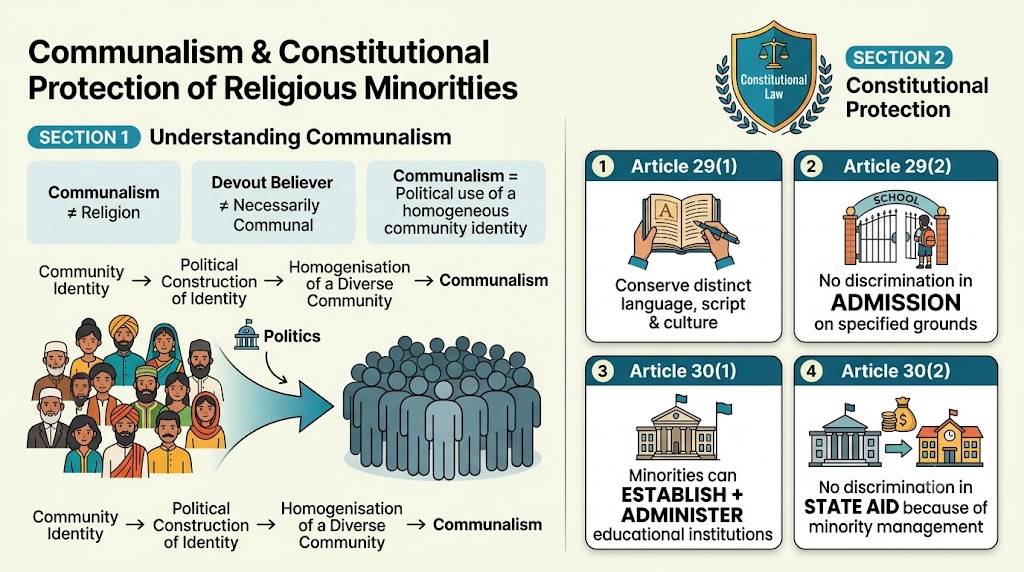
Key exam distinction: Article 29(2) is about non-discrimination in ADMISSION to any institution (regardless of who runs it), while Article 30(1) is specifically about minorities' right to ESTABLISH AND ADMINISTER their own institutions. These are frequently swapped as distractors in CUET options — read the question stem carefully to identify whether it's asking about admission rights or establishment/administration rights.
State Policy Typology Toward Minority/Non-National Cultures
CUET tests a specific typology of state responses to cultural and religious plurality — memorise these four terms precisely, as they are easily confused:
| Policy Type | Definition |
|---|---|
| Assimilationist | Policies that insist public culture be restricted to a common national pattern, while all non-national culture is relegated to the private sphere. Minorities are expected to blend into the dominant culture in public life. |
| Integrationist | Seeks to bring diverse groups into a shared political/civic framework while allowing some degree of distinct cultural expression, distinct from full assimilation. |
| Non-assimilationist | Does not require minorities to adopt the dominant culture; allows for cultural difference to persist and be publicly visible. |
| Disintegrationist | A term denoting policies/processes that fragment or break apart a unified national culture — the conceptual opposite pole from assimilationist unity. |
State-Nation vs. Nation-State
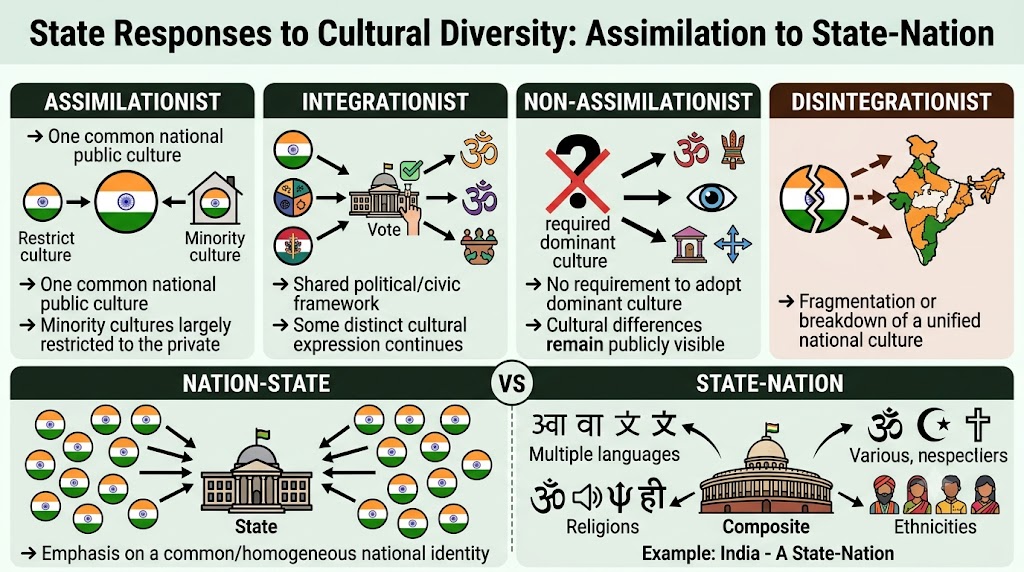
This distinction is central to how pluralistic democracies like India accommodate religious minorities:
- Nation-State: the conventional model where a single, homogeneous national culture/identity is expected to define the state.
- State-Nation (the opposite framing): means all languages, ethnicities, religions, and individual entities can co-exist peacefully and cooperatively within a single state — the state accommodates plurality rather than imposing homogeneity. India is typically discussed as functioning more as a 'state-nation' given its religious and linguistic diversity.
Civil Society and Minority Organisation
The criterion for inclusion in 'civil society' is that an organisation must be non-state controlled — i.e., independent of direct government control, though it may work alongside or in tension with the state. This matters for religious minorities because minority-led community organisations, advocacy groups, and cultural associations typically function as civil society actors — outside direct state control, but shaping public discourse and providing community support and representation.
Causes and Consequences of Religious Minority Marginalisation
Causes (general sociological framing, applicable across contexts including India):
- Historical/cultural factors: legacy of persecution and distrust; stereotypes portraying minorities as 'other' or inferior.
- Political/social structures: majoritarian politics favouring the dominant religious group through policy and law; social hierarchies limiting minority access to resources.
- Economic disparities: lower economic opportunity, discrimination in employment/housing/education compounding exclusion.
Consequences: social isolation, limited political participation/representation, cultural erosion under assimilation pressure, and negative psychosocial impact (higher rates of anxiety/depression linked to alienation and powerlessness).
Strategies for protection/inclusion: constitutional guarantees and anti-discrimination law; affirmative action in education/employment; cultural sensitivity education and inclusive curricula; interfaith dialogue; support for minority-led community organisations; and balanced, non-stereotyped media representation.
Common Mistakes
- Assuming communalism is purely a religious phenomenon — CUET explicitly tests that communalism is about POLITICS as much as religion, and that being a devout believer does not automatically make someone communal.
- Confusing Article 29(2) (non-discrimination in ADMISSION) with Article 30(1) (right to ESTABLISH AND ADMINISTER minority institutions) — these are the two most commonly swapped options in CUET distractors on this topic.
- Treating professional group membership as an example of 'community identity' — it is NOT, because it is achieved rather than ascribed at birth, unlike family, caste, or religious group membership.
- Mixing up 'assimilationist' and 'integrationist' policy — assimilationist policy pushes minority culture entirely into the private sphere; integrationist policy allows continued (if limited) public cultural distinctness within a shared civic framework.
- Treating 'Nation-State' and 'State-Nation' as synonyms — Nation-State implies homogeneous national identity; State-Nation explicitly describes the co-existence of multiple religions/ethnicities/languages within one state, which is the framing more applicable to plural societies like India.
- Assuming civil society organisations are state-run or state-funded bodies — the defining criterion is that they are NON-state controlled, which is precisely why minority community organisations are typically classified as civil society actors.