Family and kinship are among the oldest and most universal social institutions, shaping how individuals are socialised, how resources and property pass across generations, and how societies organise care, descent, and authority.
Defining Family and Kinship
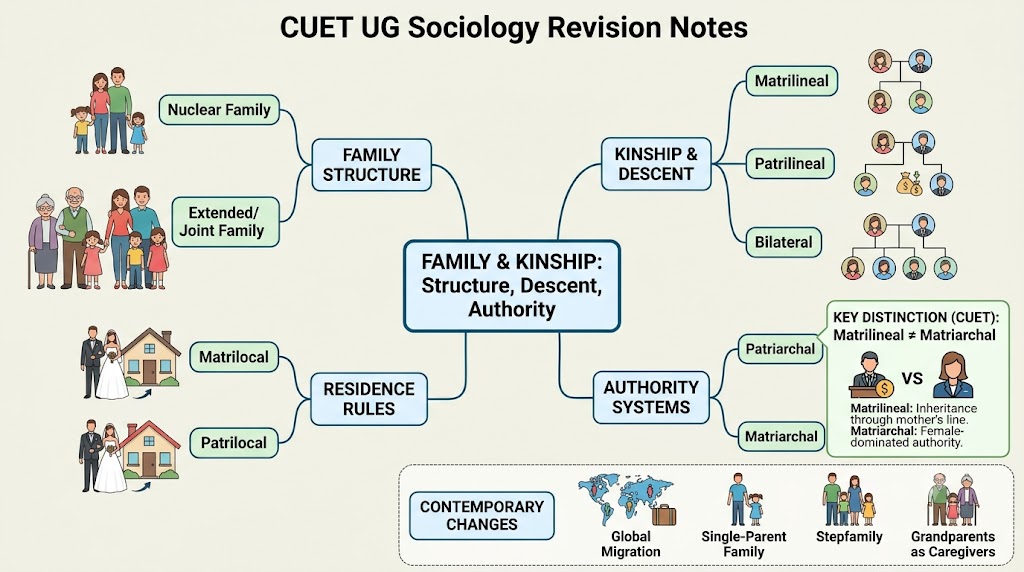
- Family: a primary social unit consisting of parents and their offspring, united by biological or legal ties, providing care, support, and a sense of belonging. The concept and form of family varies across cultures and changes over time.
- Kinship: the network of relationships between individuals who share common ancestors or descent — includes blood relations, adopted members, and those related by marriage. Kinship systems classify social relationships and shape resource distribution and social behaviour.
- Family can be studied both as a social institution in itself and in its relationship to other social institutions of society (economy, religion, state).
- A family can be classified along multiple independent axes: nuclear vs extended (composition), male-headed vs female-headed (authority), and matrilineal vs patrilineal (line of descent) — these are separate dimensions, not the same classification repeated.
Nuclear and Extended Family
| Type | Definition |
|---|---|
| Nuclear Family | Consists of only one set of parents and their children — the most common form in modern societies, marked by shared responsibilities and intimate relationships. |
| Extended Family (Joint Family) | Has more than one couple, and often more than two generations, living together — e.g., a set of brothers with their individual families, or an elderly couple with their sons, grandsons and respective families. Often seen as symptomatic/characteristic of India. |
Non-traditional family forms also discussed in contemporary sociology include: single-parent families (one parent raising children due to divorce, death, or by choice), same-sex parenting (via adoption/surrogacy/partnership), and stepfamilies (formed when individuals with children from previous relationships unite).
Theoretical Perspectives on Family
| Theory | Core Argument |
|---|---|
| Functionalist Theory | Emphasises the family's role in fulfilling essential functions — reproduction, socialisation, emotional support. Talcott Parsons argued the family maintains stability and order in society through role expectations and norms. |
| Conflict Theory | Views the family as a site of potential conflict due to differing interests and power dynamics. Karl Marx argued the family reproduces class inequalities, with parental authority over children reflecting broader societal power structures. |
| Interactionist Perspective | Focuses on social interactions within families and how these shape individual identity and behaviour — a micro-level analysis of family dynamics, communication patterns, and role performances. |
Kinship Systems: Descent and Residence
Kinship systems classify relatives based on descent, affinity (marriage ties), or a combination of both.
| System | Basis |
|---|---|
| Matrilineal | Descent is traced through the mother's line; relatives are categorised by their position relative to the mother's siblings. Rule of inheritance: property passes from mother to daughter. |
| Patrilineal | Descent is traced through the father's line. Rule of inheritance: property passes from father to son. |
| Bilateral | Recognises both parents' lineages, creating a more complex web of kinship ties. |
Rule of residence is a separate axis from descent:
- Matrilocal: the newly married couple stays with the woman's parents.
- Patrilocal: the newly married couple lives with the man's parents.
Important distinction (high-yield for CUET): descent (matrilineal/patrilineal) and residence (matrilocal/patrilocal) and authority (patriarchal/matriarchal) are three separate classificatory dimensions — a society can be matrilineal in inheritance without being matriarchal in authority.
Patriarchy vs Matriarchy — a Key Distinction
- Patriarchal family structure: men exercise authority and dominance — this is empirically widespread and well documented.
- Matriarchy: a theoretical concept where women would play a similarly dominant role as men do in patriarchy. Critical exam point: unlike patriarchy, matriarchy has been a theoretical rather than an empirical concept — there is no historical or anthropological evidence of true matriarchal societies (i.e., societies where women exercise overall dominance).
- Matrilineal societies do exist, but these are NOT the same as matriarchy: in matrilineal societies, women inherit property from their mothers but do not necessarily exercise control over it, nor are they typically the decision-makers in public affairs. This is one of the most commonly tested conceptual traps in this chapter — matrilineal ≠ matriarchal.
Contemporary Changes in Family Structures
- Divorce and remarriage: increasing rates have made stepfamilies more common.
- Same-sex marriage and adoption: legal recognition has transformed family structures, particularly in Western societies.
- Global migration: movement across borders for work/education creates new family configurations and challenges traditional kinship networks — commonly leads to stepfamilies becoming more common, rather than a simple 'breakdown' of family as such.
- Single parenthood: rising due to economic factors or personal choice, presenting distinct challenges and opportunities for family dynamics.
- India-specific example (high-yield): the migration of men from villages in the Himalayan region for work can lead to an unusually high proportion of women-headed households in those villages.
- Another India-specific example: in India's software/IT industry, demanding work schedules of young parents have led to an increasing number of grandparents moving in as caregivers for young grandchildren — showing how economic change reshapes family living arrangements.
- Overall takeaway: not only have family structures changed, but cultural ideas, norms, and values around family have also changed — though such changes are not easy to bring about.
Common Mistakes
- Confusing matrilineal (descent/inheritance rule) with matriarchal (women hold actual authority/dominance) — matrilineal societies exist and are documented, but true matriarchal societies have no historical or anthropological evidence.
- Treating 'rule of residence' (matrilocal/patrilocal) and 'rule of descent' (matrilineal/patrilineal) as the same classification — they are independent dimensions of a kinship system.
- Attributing global migration's effect on family purely to 'breakdown' — the more precise, testable outcome highlighted is the rise of stepfamilies and new family configurations, not simple collapse.
- Missing that Talcott Parsons is specifically linked to Functionalist theory (role expectations/stability) while Karl Marx is linked to Conflict theory (family reproducing class inequality) — these thinker-theory pairings are frequently tested.
- Assuming extended/joint family is the same as 'large family' generically — the defining feature is more than one couple and often more than two generations living together, not merely a large household.