The chapter traces the transformation of India's class structure from the colonial to the post-liberalisation era, highlighting shifts in rural agrarian classes, the rise of new rural elites, the dynamics of industrial workers, and the emergence of a new urban middle class.
1. The Colonial Context: Creation of a Dependent Middle Class
Colonialism not only transformed the economy but also reshaped the social hierarchy by creating new classes.
- New Middle Class: The British created a western-educated Indian middle class to help administer the colony. This class was a mix of professionals (doctors, lawyers), government servants, and some commercial groups.
- Land Ownership Substitute: The British offered land ownership and English education as substitutes for traditional economic roles. However, these substitutes were not connected to agricultural productivity or Indian cultural traditions, leading to a 'genuine middle class' not emerging.
- Zamindars and Graduates: The result was a system where zamindars became parasites on land and graduates became job hunters, creating a class dependent on the colonial state rather than a vibrant entrepreneurial class.
- Economic Dependency: Colonialism directly interfered to strengthen British capitalism. It changed laws, altered manufacturing, and made the Indian economy dependent on British industrialisation. The Indian capitalist class that emerged was largely tied to the colonial order.
2. Rural Class Structure: Land, Caste, and Agrarian Relations
In rural India, class structure is deeply intertwined with the caste system, with land being the most important productive resource and form of property.
- Land Distribution: The distribution of landholdings is highly unequal. In some areas, a few families own most of the land, while the majority are landless or marginal farmers. About 40 to 50 per cent of families in many regions do not own any land at all.
- Class-Caste Correspondence: Typically, upper and middle castes have the best access to land. The dominant landowning groups usually belong to castes categorised as 'Shudra' or 'Kshatriya' varnas. Examples of such dominant castes are:
- Jats and Rajputs in U.P.
- Vokkaligas and Lingayats in Karnataka.
- Kammas and Reddis in Andhra Pradesh.
- Jat Sikhs in Punjab.
- Agrarian Labour: A large portion of the agricultural labour force is drawn from 'lower caste' groups (SC/ST/OBC). Until recently, 'untouchable' or Dalit castes were not allowed to own land and provided most of the agricultural labour for the dominant landowning castes.
- Bonded Labour: Practices like begar (free labour) and bonded labour systems (e.g., halpati in Gujarat, Jeeta in Karnataka) tied the working poor to landowners. Though legally abolished, they persist in many areas.
3. Transformation of Rural Classes: From Landed Elites to New Entrepreneurs
Agricultural development, especially after the Green Revolution, altered the rural class structure by enriching certain groups and encouraging diversification.
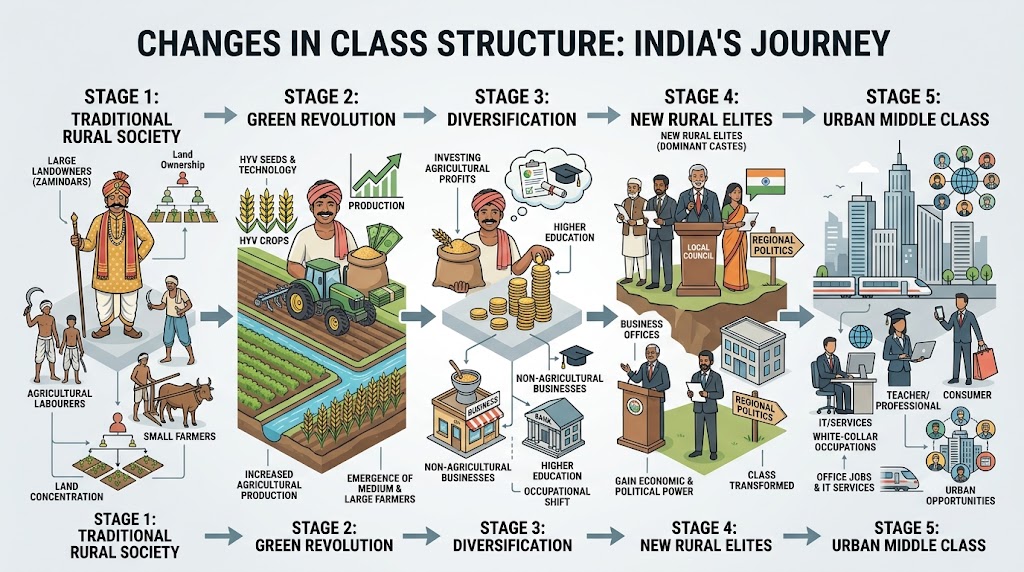
- Enrichment of Medium and Large Farmers: In the 1960s and 1970s, well-to-do farmers from dominant castes invested their agricultural profits in new ventures. This process of diversification gave rise to new entrepreneurial groups.
- New Regional Elites: These farmers moved out of rural areas and into growing towns, becoming new regional elites that were economically and politically dominant. Examples include coastal Andhra Pradesh, western Uttar Pradesh, and central Gujarat.
- Role of Education: The spread of higher education, especially private professional colleges, allowed the new rural elites to educate their children, who then joined white-collar professions or businesses, feeding into the expansion of the urban middle classes.
- Kerala's Different Path: States like Kerala saw a different kind of transformation. Political mobilisation, redistributive land reforms, and linkages to an external economy (especially the Gulf countries) brought about a substantial change. The rural here is a mixed economy, dependent on retail sales, services, and remittances from abroad.
- Backward Classes Movement: The rise of the Backward Classes movement emphasised the role of secular factors in upward mobility. Dominant castes became prestigious in their own right, and Dalits began to assert their identity with pride, though this has not solved the problem of their marginalisation.
4. The Industrial Working Class: Emergence and Challenges
The industrial working class in India emerged during the colonial period and developed its own social and political identity.
- Emergence: Factory production began in India in the early 1860s, primarily in port towns like Calcutta (Kolkata) and Bombay (Mumbai). Workers were cheap as the colonial government did not regulate wages or working conditions.
- Trade Unions: The first trade union was established in April 1918 in Madras by B.P. Wadia. In 1920, the All India Trade Union Congress (AITUC) was formed in Bombay. Leaders involved included S.A. Dange, M.N. Roy, V.V. Giri, and Jawaharlal Nehru. The Indian National Trade Union Congress (INTUC) was formed in 1947 as the Congress-affiliated union.
- Casteism within the Working Class: Despite unity, caste divisions persisted. Mill workers would interact and chew paan together but would not drink water from a colleague's hands. North Indian workers were seen as casteless by Marathi workers, so untouchability was not practised against them.
- Changing Nature of Work: The rise of contract work, outsourcing, and 'badli' workers (substitutes for permanent workers) has made employment insecure. In Maruti Udyog Ltd, two cars roll off the assembly line every minute, but workers are exhausted by age 40 and production has increased without an increase in permanent jobs.
5. The Urban Middle Class: Growth and Aspirations
The urban middle class has expanded significantly, especially with the growth of the IT sector, but it is a class with internal diversities and aspirations.
- Growth of IT and Services: The IT sector and service industries have created a new class of upwardly mobile professionals working in software firms, multinational banks, chartered accountancy firms, and media. This class has high salaries but also highly stressful work schedules.
- Growth of Consumption: The spread of multinational companies and the IT revolution has created a class that is the main clientele of a booming consumer industry. Shopping is now a past-time, and cultural consumption (art, food, fashion, tourism) shapes the growth of cities.
- Occupational Diversification: The urban middle class is diverse. It includes professionals, government employees, and private sector workers. The only way to get a secure government job is often seen as a major avenue for upward mobility.
- New Middle-Class Lifestyle: This class is often Westernised in its lifestyle, attire, and food habits. However, westernisation does not necessarily mean adopting modern democratic values. Many may be western in appearance but hold conservative views.
6. Globalisation, Liberalisation and Class Inequality
The policy of liberalisation since 1991 has widened inequalities and changed the class dynamics in India.
- Rising Inequality: Liberalisation and privatisation worldwide appear to be associated with rising income inequality. Very few people in India have access to secure jobs, and even those in regular employment face increasing insecurity.
- Structural Change in Employment: In India, over 50% of the population is self-employed, only about 14% are in regular salaried employment, and approximately 30% are in casual labour. Over 90% of the work is in the unorganised sector.
- Outsourcing and Contract Work: Companies are reducing permanent employees and outsourcing work to smaller companies or homes. This has made employment more insecure and has reduced the bargaining power of workers.
- Consumerism: The growth of a consumer culture has led to the emergence of shopping malls, multiplexes, and a culture where spending is encouraged. This consumer culture is largely driven by the upwardly mobile urban professional class, making it a key indicator of class identity and aspiration.
Common Mistakes
- Thinking that the class structure in India is purely economic. In reality, it is deeply intertwined with the caste system, especially in rural areas.
- Assuming that the Green Revolution benefited all farmers equally. It was primarily the medium and large farmers from dominant castes who benefited, leading to increased inequalities.
- Forgetting that the Indian middle class was largely created by the colonial state and dependent on it, rather than being an independent entrepreneurial class.
- Believing that 'Flexi-time' always benefits the employee. In the IT sector, it is often used to legitimise extended working hours and increase workload.
- Ignoring the role of caste in the industrial working class. Despite trade union unity, caste prejudices persisted among workers.