The State and civil society play important roles in maintaining unity, protecting rights and managing diversity in a plural and unequal society. In India, democratic institutions, constitutional safeguards and civil society organisations help different communities participate in public life while protecting their identities and interests.
1. Plural Society: Meaning and Characteristics
Plural society refers to a society in which people belonging to different social, cultural, religious, linguistic, ethnic and regional groups live together within a common political framework.
- India is a plural society because of its religious, linguistic, cultural, ethnic and regional diversity.
- Different communities may have distinct identities, traditions, languages and cultural practices.
- Plurality does not automatically produce social conflict.
- Conflict may arise when differences become connected with competition over resources, political power, economic opportunities or social status.
CUET Key Point: Diversity and inequality are different concepts. Diversity refers to differences among groups, whereas inequality refers to unequal access to resources, power, status and opportunities.
2. Role of the State in a Plural Society
In a plural society, the State has to maintain unity while also recognising and protecting social and cultural diversity.
- Protection of Rights: The State protects Fundamental Rights and ensures equal citizenship.
- Social Justice: It introduces measures to reduce social inequality and protect disadvantaged groups.
- Accommodation of Diversity: The State recognises different linguistic, religious, cultural and regional identities.
- Law and Order: It regulates conflicts and protects citizens from violence and discrimination.
- Welfare: It provides public services and welfare measures related to education, health and social security.
- Democratic Participation: It provides constitutional and institutional mechanisms through which different groups can participate in political life.
CUET Focus: The State has to balance national unity with cultural diversity.
3. Assimilationist Model
The assimilationist model seeks to create a relatively uniform cultural pattern by encouraging or requiring minority groups to adopt the dominant culture.
- Emphasises cultural uniformity.
- Minority communities may be encouraged, persuaded or compelled to adopt the dominant culture.
- Distinct cultural identities may become weakened or suppressed.
- The objective is greater cultural homogeneity within the nation.
CUET Keyword: Assimilation = Uniformity
4. Integrationist Model
The integrationist model seeks to establish unity in public life while allowing cultural diversity in the private sphere.
- Creates a common public pattern for institutions, law and governance.
- Allows minority communities to preserve their language, religion and culture in their private spheres.
- Recognises diversity while maintaining a common national framework.
- Focuses on accommodation rather than complete cultural uniformity.
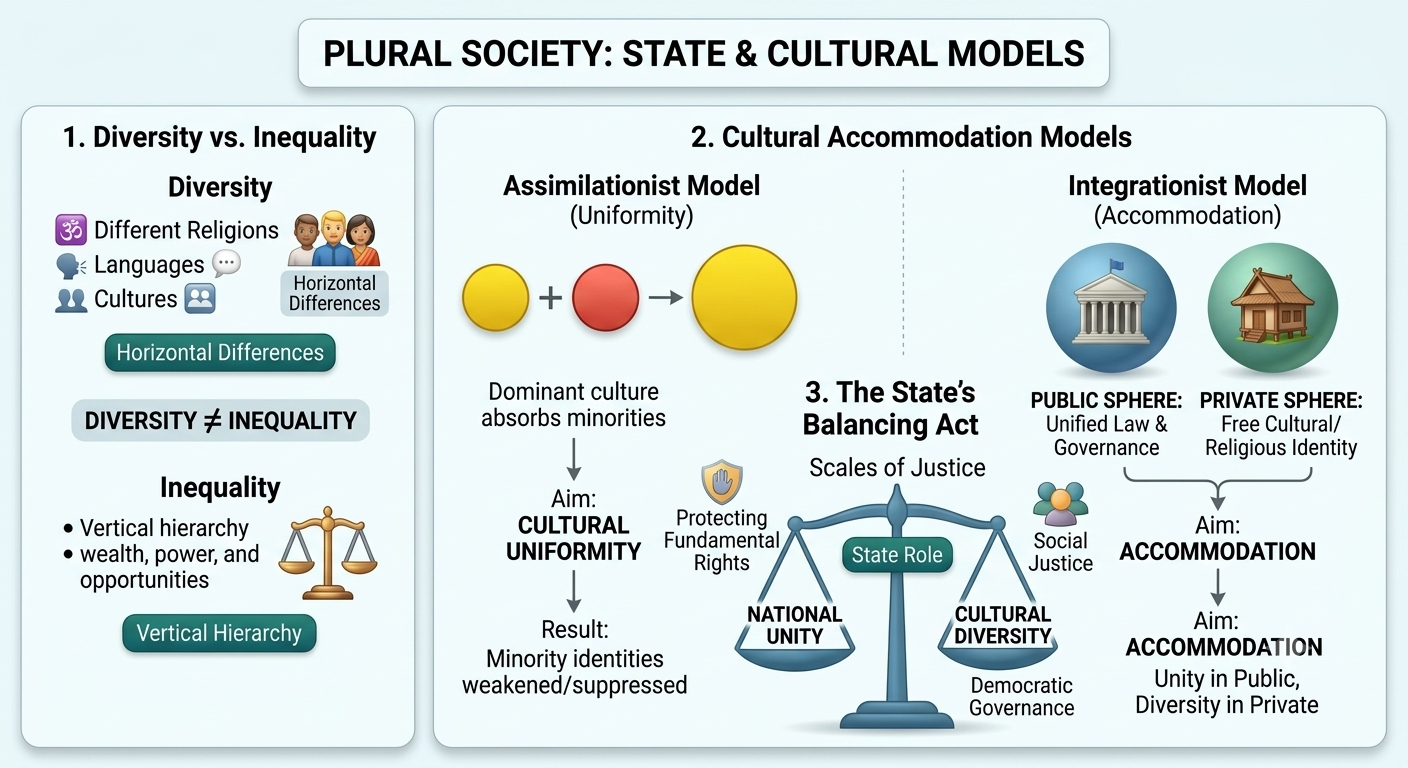
CUET Keyword: Integration = Common public pattern + Private cultural space
Quick Difference: Assimilation aims at cultural uniformity, whereas integration allows cultural differences to coexist within a common public framework.
5. Civil Society: Definition and Key Functions
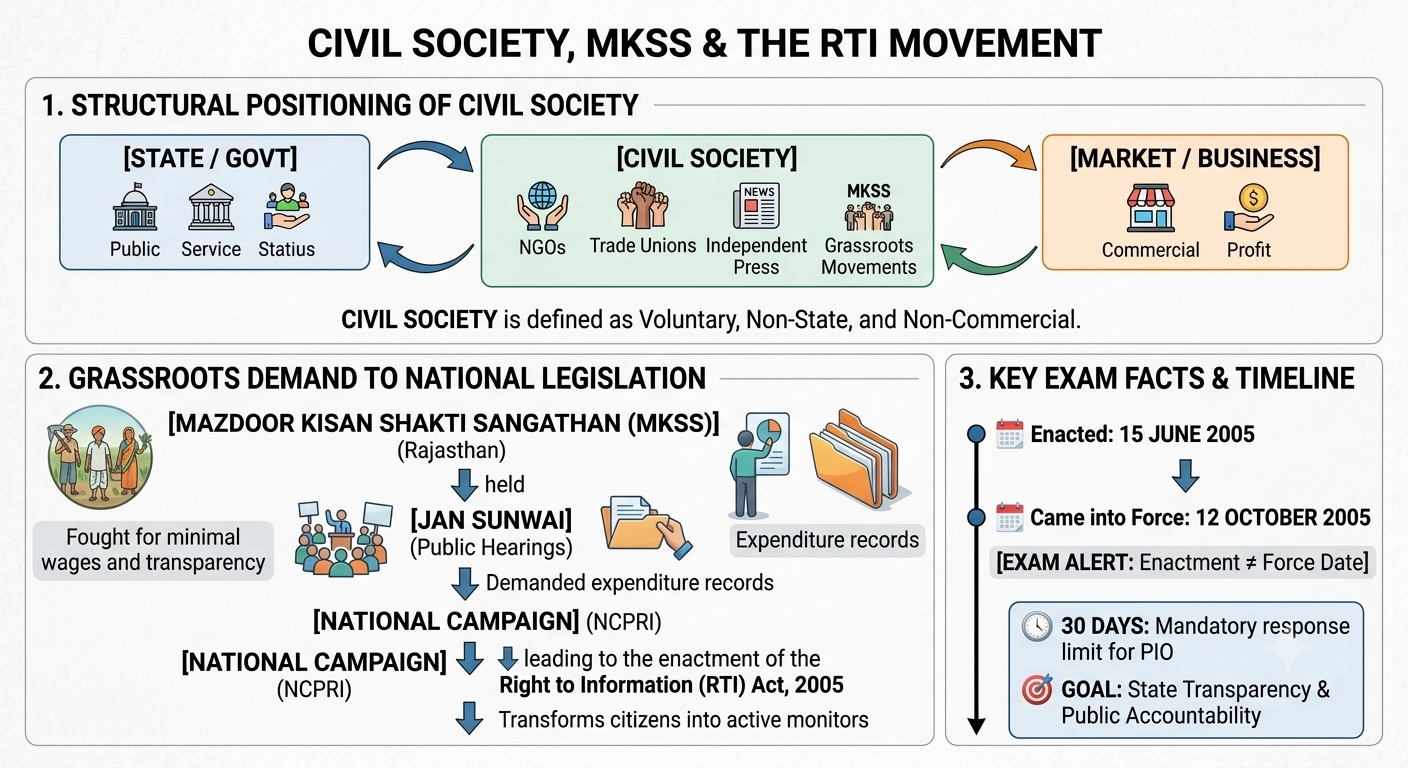
Civil society refers to the sphere of voluntary associations and organisations that exists outside the State and the market.
Examples:
- Non-governmental organisations (NGOs)
- Trade unions
- Farmers' organisations
- Women's organisations
- Human-rights organisations
- Independent media
- Social movements
Key Characteristics:
- Voluntary association
- Non-state sphere
- Generally non-commercial or non-market in character
- Collective action
- Public participation
- Advocacy of social interests
CUET Trap: Civil society is neither the State nor the market/business sector.
6. Role of Civil Society
Civil society strengthens democratic participation and provides a space through which citizens can collectively express their interests.
- Representation: Gives voice to different social groups and communities.
- Accountability: Questions government actions and demands transparency from public authorities.
- Awareness: Creates awareness about rights, laws and social issues.
- Social Change: Challenges discrimination, injustice and inequality.
- Democratic Participation: Encourages citizens to participate actively in public affairs.
- Advocacy: Raises public demands and influences policies and decision-making.
7. Relationship Between State and Civil Society
The State and civil society have different but interconnected roles in a democracy.
- State: Laws, rights, institutions, welfare and governance.
- Civil Society: Participation, advocacy, mobilisation and accountability.
Civil society can act as a link between citizens and the State by communicating public concerns, monitoring government actions and demanding accountability.
Conceptual Flow: Citizens → Collective Action → Public Demands → State Accountability → Democratic Governance
8. Right to Information (RTI) Act, 2005
The Right to Information Act, 2005 is an important example of how citizens and civil society can strengthen transparency and accountability in democratic governance.
Major Objectives:
- Provides citizens access to information held by public authorities.
- Promotes transparency in government functioning.
- Strengthens accountability of public authorities.
- Helps citizens monitor government activities.
- Supports democratic participation and good governance.
Important Dates:
- 15 June 2005: RTI Act enacted.
- 12 October 2005: RTI Act came into force.
CUET Trap: Do not confuse the date of enactment with the date on which the Act came into force.
9. Mazdoor Kisan Shakti Sangathan (MKSS)
Mazdoor Kisan Shakti Sangathan (MKSS) played an important role in the grassroots movement for the Right to Information in Rajasthan.
- It mobilised rural workers and citizens around issues of transparency and accountability.
- It demanded access to government records and information about public expenditure.
- The movement demonstrated how grassroots civil society can influence democratic institutions and public policy.
CUET Memory Link: MKSS → Grassroots Movement → Transparency → RTI
10. Civil Society and Democracy
Civil society makes democracy more participatory by allowing citizens to remain involved in public affairs beyond elections.
- Encourages active citizenship.
- Creates pressure for government accountability.
- Provides representation to diverse interests.
- Helps bring marginalised concerns into public debate.
- Supports transparency and democratic governance.
Key Idea: Democracy is strengthened when citizens can organise, express demands and hold public institutions accountable.
11. CUET Quick Revision
- Plural Society: Coexistence of diverse social and cultural groups.
- State: Rights, justice, welfare, law and order and accommodation of diversity.
- Assimilation: Cultural uniformity.
- Integration: Common public pattern + private cultural space.
- Civil Society: Voluntary non-state and generally non-market sphere.
- RTI: Transparency + Accountability.
- MKSS: Grassroots movement associated with the RTI movement.
- 15 June 2005: RTI Act enacted.
- 12 October 2005: RTI Act came into force.
12. CUET Exam Focus
High-Priority Areas:
- Meaning and characteristics of civil society.
- Role of the State in a plural society.
- Difference between assimilationist and integrationist models.
- Role and functions of civil society.
- Right to Information Act, 2005.
- MKSS and the grassroots RTI movement.
- Transparency and accountability.
- Relationship between State, citizens and civil society.
- Important RTI dates.
CUET Tip: Questions may test conceptual differences, statement-based reasoning, factual details and examples of civil society action.