This chapter examines how the Indian Constitution serves as a dynamic instrument for social change, bridging the gap between legal provisions and social justice, with a focus on grassroots democracy, political representation, and the challenges of transforming a hierarchical society.
Constitutional Norms and Social Justice
Law vs. Justice: The essence of law is its force—it carries the means to coerce obedience. The essence of justice is fairness. The Constitution is the basis of all rules and authorities; all other laws are made as per the procedures prescribed by it.
Supreme Court as Interpreter: The Supreme Court is the highest court and the ultimate interpreter of the Constitution. It has expanded the meaning of Fundamental Rights in several important ways:
- Article 21 (Right to Life & Liberty): Interpreted to include livelihood, health, shelter, education, and dignity—not mere animal existence. Used to provide relief to prisoners, bonded labourers, and against environmental degradation.
- Right to Information (1993): Held as part of the Right to Freedom of Speech and Expression under Article 19(1)(a).
- Article 14 (Right to Equality): The Directive Principle of 'Equal Pay for Equal Work' was read into this article, providing relief to plantation and agricultural labourers.
Constitutional Norms & Social Movements: Social movements have aided courts and authorities in interpreting rights and principles in keeping with contemporary understanding of social justice.
Panchayati Raj and Rural Social Transformation
Idea of Panchayati Raj: Literally translates to 'Governance by five individuals.' Aims to ensure a functioning and vibrant democracy at the village or grassroots level.
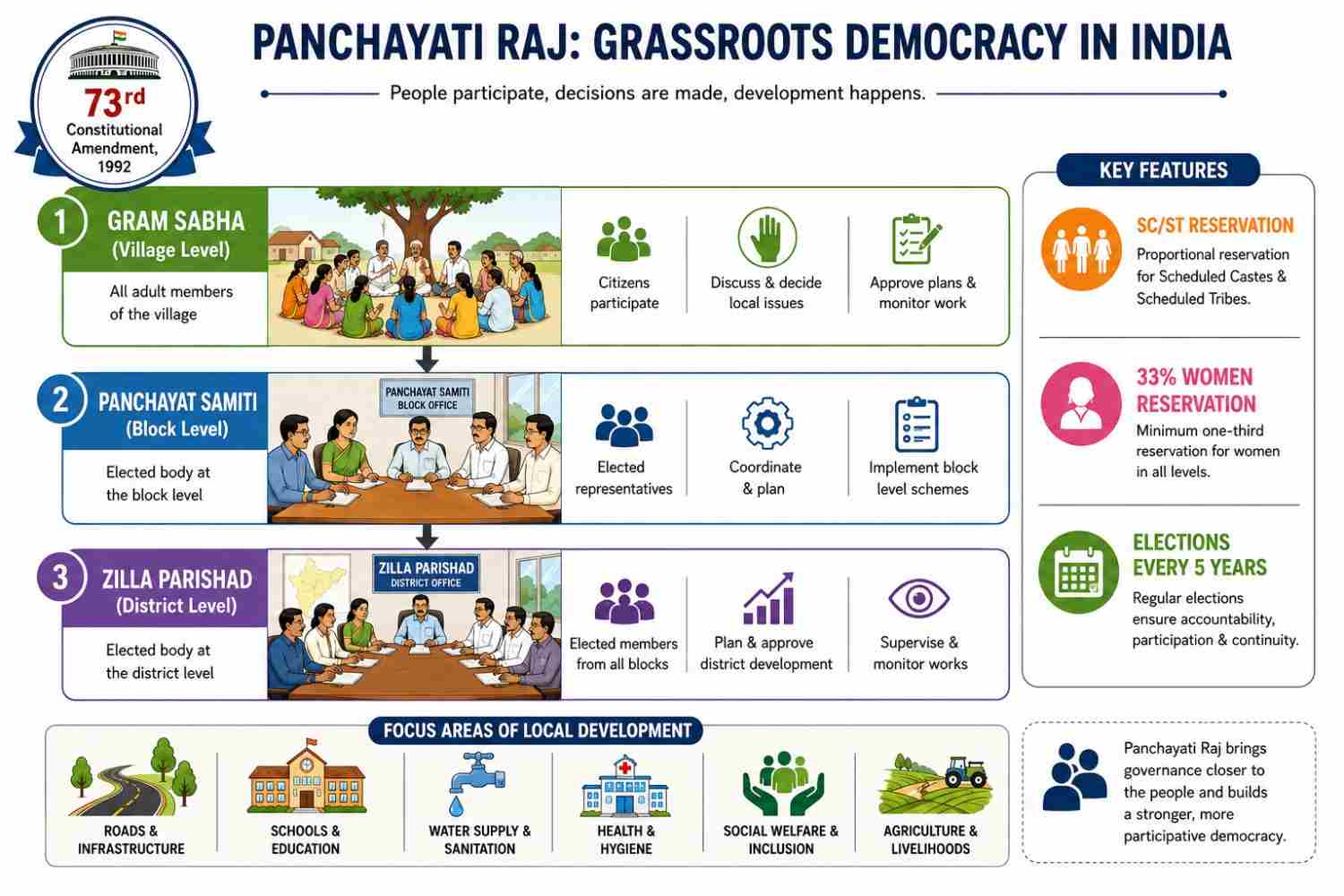
The 73rd Constitutional Amendment (1992): Ushered in grassroots democracy or decentralised governance. It gave constitutional status to Panchayati Raj Institutions (PRIs).
Key Features of the 73rd Amendment:
- Three-Tier System: For all states with a population of over twenty lakhs. Structure: Gram Sabha (village level) → Panchayat Samiti (block level) → Zilla Parishad (district level).
- Mandatory Elections: Elections to these bodies must be conducted every five years.
- Reservation of Seats: For Scheduled Castes, Scheduled Tribes, and 33% of seats for women. The 73rd and 74th Amendments mandated one-third reservation for women in rural and urban local bodies respectively.
- District Planning Committee: Constituted to prepare development plans for the district as a whole.
Constituent Assembly Debate: Initially, Panchayats were not mentioned. Dr. B.R. Ambedkar opposed the idea, arguing that local elites and upper castes would exploit the downtrodden. Gandhi ji, however, envisioned each village as a self-sufficient unit (gram-swarajya).
Powers & Responsibilities of Panchayats:
- Prepare plans for economic development and social justice.
- Levy, collect, and appropriate taxes, duties, tolls, and fees.
- Social Welfare: Maintenance of burning/burial grounds, child welfare & maternity centres, family planning, agricultural promotion.
- Development: Construction of roads, public buildings, wells, tanks, schools; promotion of cottage industries; minor irrigation works.
- Monitoring: Government schemes like IRDP (Integrated Rural Development Programme) and ICDS (Integrated Child Development Scheme).
- Income Sources: Taxes on property, profession, animals, vehicles, land revenue; grants from Zilla Panchayat.
- Transparency: Panchayats must publicly display financial details (Right to Information).
Nyaya Panchayats: Constituted in some states to hear petty civil and criminal cases. They can impose fines but cannot award sentences. Effective in mediating disputes and addressing issues like dowry and violence against women.
Panchayati Raj in Tribal Areas
Traditional Institutions: Many tribal areas have a rich tradition of grassroots democratic functioning. For example, in Meghalaya, the Khasis, Jaintias, and Garos have traditional political institutions (e.g., the Khasi 'Durbar Kur'—a clan council).
Exclusion from 73rd Amendment: A large chunk of tribal areas lie outside the provisions of the 73rd Amendment to avoid interfering with traditional institutions.
Critical View (Tiplut Nongbri): Tribal institutions need not necessarily be democratic in structure and functioning. They can show:
- Intolerance towards women.
- Elements of stratification (inequality).
- Distortions due to social change, making it hard to identify 'traditional' vs. 'modern'.
Challenges of Democratisation: In a society with deep inequalities based on caste, community, and gender, democratic participation is hindered. Gram Sabhas are often dominated by a small coterie of rich, upper-caste landlords.
Political Parties, Pressure Groups, and Interest Groups
In a democratic form of government, political parties are key actors. A political party is defined as an organisation oriented towards achieving legitimate control of government through an electoral process. Political parties are based on a certain understanding of society and how it ought to be.
Interest Groups: Organised to pursue specific interests in the political arena, operating primarily by lobbying members of legislative bodies.
Pressure Groups: When certain groups feel their interests are not being taken up by political parties, they may form pressure groups who lobby with the government.
Distinction:
- Political Parties: Seek to occupy office and are involved in policy-making.
- Interest/Pressure Groups: Seek to influence policy without ordinarily seeking to form the government.
Examples:
- Industrialists: FICCI (Federation of Indian Chambers and Commerce), ASSOCHAM.
- Workers: INTUC (Indian Trade Union Congress), CITU (Centre of Indian Trade Unions).
- Farmers: Shetkari Sangathan.
- Other: Tribal movements, environmental movements.
Max Weber on Parties: Parties live in a house of power. Their actions are always directed towards a goal (a 'cause' or 'personal' power/honour).
Common Mistakes
- Confusing the 73rd Amendment (Panchayati Raj, rural) with the 74th Amendment (Municipalities, urban). Both were passed in 1992.
- Assuming all tribal institutions are democratic; sociologist Tiplut Nongbri points out they may have stratification and gender inequality.
- Equating pressure groups with political parties; pressure groups seek to influence policy, while political parties seek to form the government.
- Thinking the Constitution directly solves all social problems; it provides a framework, but social change requires attitudinal shifts within society.