This chapter examines caste-based social movements in India, with a focus on the Dalit movement and the movement of the Backward Classes. It explores their historical roots, major concerns, ideologies, forms of mobilisation, and impact on India's social and political life.
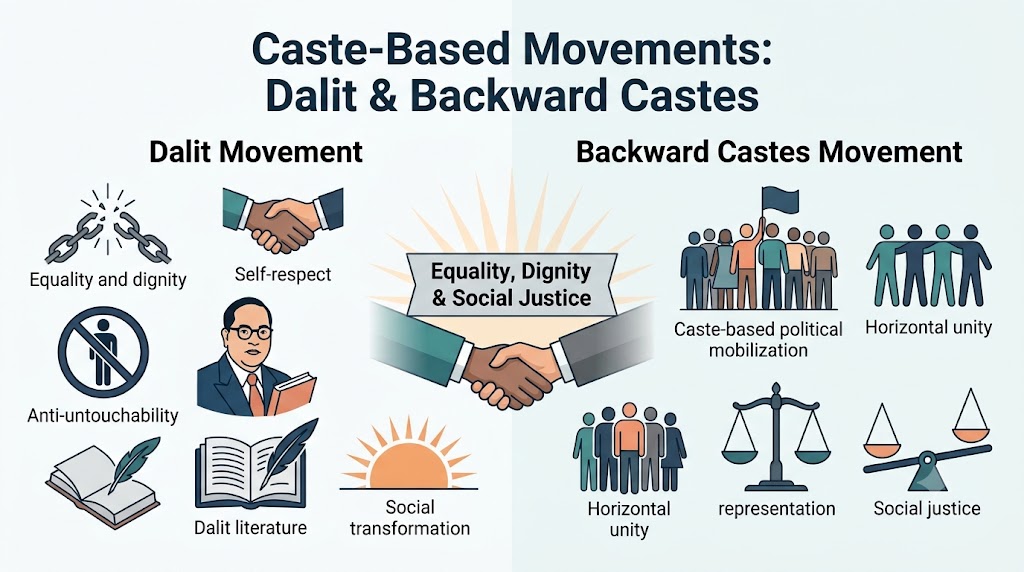
1. The Dalit Movement: A Struggle for Recognition and Dignity
The Dalit movement is a distinctive social movement that cannot be explained merely in terms of economic exploitation or political oppression. It is fundamentally a struggle for recognition as fellow human beings, self-confidence, self-respect and self-determination.
- Meaning of 'Dalit': The word 'Dalit' is used in Marathi, Hindi, Gujarati and several other Indian languages. It literally refers to people who are oppressed, broken or crushed. The term came to be used in its contemporary political sense by followers of Babasaheb Ambedkar, particularly neo-Buddhist activists, in the early 1970s. It rejects the ideas of pollution, karma and a supposedly justified caste hierarchy.
- Key Issues: The movement is a struggle against the stigma and humiliation associated with untouchability. It can therefore be understood as a struggle for social recognition and dignity.
- Diverse Movements, Common Quest: There has never been one single, unified Dalit movement. Different movements have raised different issues and followed different ideologies. However, they share a common quest for equality, self-dignity and the eradication of untouchability.
- Examples of Dalit Movements: Important examples include the Satnami Movement of the Chamars in the Chhattisgarh plains, the Adi Dharma Movement in Punjab, the Mahar Movement in Maharashtra, socio-political mobilisation among the Jatavas of Agra, and the Anti-Brahman Movement in South India.
2. Dalit Literature and its Role
In the contemporary period, the Dalit movement has acquired an important place in the public sphere. This has been accompanied by the growth of a significant body of Dalit literature.
- Opposition to Chaturvarna: Dalit literature strongly opposes the Chaturvarna system and caste hierarchy, which it regards as responsible for suppressing the creativity, dignity and existence of lower castes.
- Use of Own Imageries: Dalit writers insist on using their own imagery and forms of expression rooted in their lived experiences and perceptions. Many argue that the conventional, high-flown imagery of mainstream society can conceal rather than reveal the realities of Dalit life.
- Call for Social and Cultural Revolt: Dalit literature gives a call for social and cultural revolt. While some writers emphasise cultural struggle, dignity and identity, others also address the structural and economic dimensions of caste inequality.
3. Classification of Dalit Movements
Sociologists have classified Dalit movements into all three broad types of social movements: reformative, redemptive and revolutionary.
- Revolutionary and Redemptive: The anti-caste movement, which began in the 19th century under the inspiration of Jotiba Phule and developed further under the leadership of Dr. B.R. Ambedkar, was revolutionary in its attempt to transform society and redemptive in its effort to improve the lives and dignity of individuals.
- Post-Ambedkar Dalit Movement: Post-Ambedkar Dalit movements have provided alternative ways of living. These have included changes in everyday behaviour as well as religious conversion, and have aimed at transforming wider social relations.
- Overall Impact: The movement has brought about real, although limited, changes in Indian society, with important gains particularly among educated sections of Dalits. However, caste-based inequalities and severe poverty have continued to affect large sections of the Dalit population.
4. The Backward Castes Movement: Emergence and Significance
The emergence of Backward Classes as political entities took place in both the colonial and post-colonial periods.
- Colonial Patronage: The colonial state often distributed patronage on the basis of caste. This encouraged people to retain caste as an important basis of social and political identity. Similarly placed caste groups began to unite and form a 'horizontal stretch'. In this process, caste gradually lost some of its earlier ritual content and became increasingly secularised for political mobilisation.
- Growth of the Term: The term 'Backward Classes' began to be used widely in the Madras Presidency from 1872, in the princely state of Mysore from 1918, and in the Bombay Presidency from 1925.
- Organisations: From the 1920s, several organisations emerged around the issue of caste, including the United Provinces Hindu Backward Classes League, All-India Backward Classes Federation and All India Backward Classes League.
- G.B. Pant's Vision: G.B. Pant emphasised the need to bring the Depressed Classes, Scheduled Castes and Backward Classes up to the general level. His argument stressed that the strength of society depends upon the condition of its weakest sections.
5. Upper Caste Response and the Visibility of Caste
The increasing political and social visibility of Dalits and Backward Classes has sometimes led sections of the upper castes to feel that they are being disadvantaged. Sociologists, however, point out that this perception needs to be examined in the context of the historical dominance of upper castes in many social institutions.
- Why Caste was Invisible: For many generations growing up in post-independence, Nehruvian India, particularly among traditionally upper-caste urban and professional middle-class groups, caste appeared to be an archaic concept. It was often visible mainly in contexts such as marriage but appeared less relevant in everyday urban life.
- The Mandal Effect: The political developments associated with the Mandal Commission helped reveal why caste had appeared almost invisible in many urban middle-class settings. Such settings were often overwhelmingly dominated by upper castes. This homogeneity made caste less socially visible to those who benefited from it.
- Persistent Inequality: Although the condition of different social groups has improved since independence, substantial inequalities remain. Upper castes continue to be disproportionately represented in many preferred and prestigious occupations, while lower castes remain disproportionately represented in many menial and socially devalued occupations.
Common Mistakes
- Do not reduce the Dalit movement to economic exploitation alone; its central concern is recognition, dignity, equality and self-respect.
- Do not assume that there has been one single, unified Dalit movement; different movements have had different issues and ideologies.
- Do not confuse the reformative, redemptive and revolutionary classifications of social movements.
- Do not assume that caste was always equally visible in urban middle-class life; its apparent invisibility was partly related to upper-caste dominance in those settings.
- Do not assume that the Backward Classes movement emerged only after independence; caste-based mobilisation and the use of the term 'Backward Classes' have important colonial roots.
- Do not interpret the Mandal Commission simply as creating caste-based politics; it helped make existing caste inequalities and the political significance of caste more visible.
- Do not assume that social and economic inequalities based on caste have disappeared after independence; substantial inequalities continue to exist.