This topic examines how rural and urban India are structurally linked rather than separate worlds — tracing the economic, social, cultural, and political exchanges between the two, along with the tensions and gaps that uneven development creates.
Defining Rural and Urban India
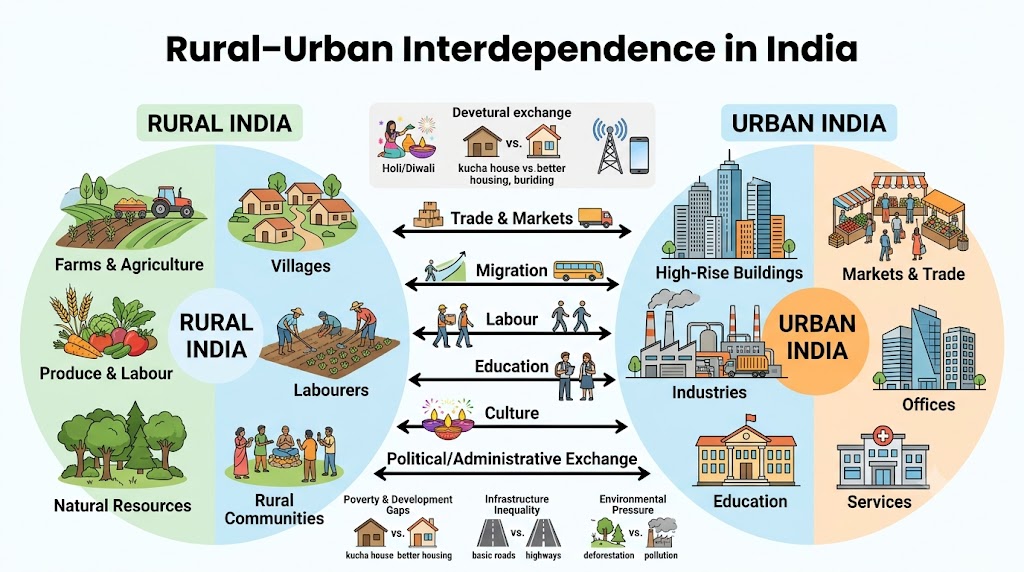
- Rural areas: low population density, sparse urbanisation, economy largely dependent on agriculture, forestry, and fishing — includes villages, small towns, and agricultural land.
- Urban centers: high population density, dominant industrial and service sectors, more diverse economic base — function as hubs of trade, education, and cultural activity.
- As per Census 2011 data: 68.8% of India's population lives in rural areas, while 31.2% lives in urban areas — rural India still holds the larger absolute share, even as the urban share rises.
- Metropolis vs Megapolis: a metropolis is a city with infrastructure where the surrounding suburbs remain distinct; a megapolis merges the city and its suburb region into one combined urban unit — NCR is the standard example of a megapolis.
- India has 5,161 towns and cities housing about 286 million people; more than two-thirds of the urban population is concentrated in just the 27 million-plus cities.
Economic Interdependence
- Rural areas supply agricultural produce, raw materials, and labour to urban industries.
- Urban centers act as markets for rural products and provide employment in manufacturing, services, and construction.
- Concrete example: farmers from villages near a city supply fresh produce directly to urban supermarkets, meeting city food demand.
- Agriculture — once the dominant contributor to India's economy — now contributes only about one-sixth of GDP, yet remains central to structuring rural economic and social life.
- Relationship is best understood as mutual/interdependent exchange, not one-sided exploitation or unilateral benefit — this is a common exam framing (rural and urban India need each other, they aren't isolated economies).
Migration: Causes and Consequences
Migration is the central mechanism linking rural and urban India. Key push factors (from rural areas):
- Insufficient work/employment opportunities in villages.
- Continuous decline of common property resources — ponds, forests, grazing lands — which previously allowed land-poor people to survive without owning land.
- Aspiration created by mass media exposure to urban lifestyles and consumption patterns.
Key pull factors / benefits of the city:
- Anonymity of urban life: for Scheduled Castes and Scheduled Tribes, city anonymity offers partial protection from the daily caste-based humiliation they may face in villages where everyone knows their caste identity.
- Anonymity also allows poorer members of socially dominant rural groups to take up low-status work in cities that they could not do in their own village without losing status.
- Better access to education, employment diversity, and public services.
Social and Cultural Exchange
- Migration drives cultural exchange and diversity in cities, as people bring rural customs into urban settings.
- Festivals often develop a hybrid character blending rural origin with urban adaptation.
- Case — Diwali: combines traditional rural customs (lighting diyas) with urban innovations (elaborate lights, decorations).
- Case — Holi: originated as a rural springtime ritual; in metropolitan cities it has been adapted with modern twists, showing how urbanisation reshapes tradition while preserving its essential meaning — a frequently tested example of cultural hybridity, not cultural erasure.
- Mass media and communication channels actively bring urban lifestyle imagery into rural areas, creating new consumption aspirations and making urban norms familiar even in remote villages.
Political, Administrative, and Educational Divides
- Political/administrative: rural-urban divisions shape political representation and governance — urban areas often have stronger, more resourced local governments and easier access to public services, while rural communities face challenges from geographical distance and infrastructure gaps.
- Education: urban centers have a far higher concentration of educational institutions offering diverse academic/vocational programmes; rural areas often struggle with inadequate facilities, contributing to lower literacy rates and skill disparities.
- Policy response: the Sarva Shiksha Abhiyan (SSA) was launched specifically to work toward universalising primary education in rural India, targeting this exact gap.
Divergences and Challenges of Rural-Urban Development
| Challenge | Description |
|---|---|
| Inequality & Poverty | Urban areas often show higher income disparities; rural regions face persistent poverty — this gap fuels social tension and migration |
| Infrastructure Gaps | Uneven development causes disparities in access to clean water, sanitation, healthcare, and transportation |
| Environmental Concerns | Urbanisation threatens rural ecosystems via deforestation, pollution, and changing land use |
| Cultural Homogenisation | Rapid urbanisation risks eroding traditional rural cultures as people assimilate into urban lifestyles |
Case example: In the 1980s, a large textile mill set up in a Maharashtra village transformed its economic landscape. While it created initial jobs, rapid industrialisation caused environmental degradation and social change — local farmers ended up facing competition from cheap mill-produced goods, hurting their traditional livelihoods. This illustrates that industrialisation's rural impact is not uniformly positive.
Strategies for Sustainable Rural-Urban Integration
- Equitable Development: policies promoting balanced growth so rural areas benefit from urban development and vice versa (not one-directional urbanisation).
- Rural-Urban Connectivity: improving transport networks, telecommunications, and digital infrastructure to connect remote villages with urban centers.
- Skill Development Programmes: vocational training/education in rural areas to build local skills and reduce migration driven purely by lack of local opportunity.
- Environmental Conservation: integrating sustainable practices into urban development and promoting eco-tourism in rural regions.
Common Mistakes
- Treating rural and urban India as isolated, self-contained economies rather than interdependent systems linked by trade, labour, and migration.
- Assuming urbanisation always erodes rural culture completely — the Holi and Diwali examples show hybridisation/adaptation, not simple erasure.
- Confusing 'Metropolis' and 'Megapolis' — a metropolis retains distinct suburbs, a megapolis merges city and suburb region into a single unit.
- Attributing rural-to-urban migration solely to 'better urban opportunity' while ignoring key rural push factors like the decline of common property resources (ponds, forests, grazing lands).
- Overlooking that anonymity in cities is a specific, documented benefit for socially oppressed groups (SC/ST) escaping caste-based village stigma — not just a generic 'freedom' benefit.
- Missing that education gap (SSA-targeted) is best framed as a consequence of rural-urban inequality feeding into further migration, not a standalone primary cause of social tension by itself.