India holds 1.4 billion people, 1,632 languages, and 6 major religions together — and somehow stays one country. This chapter is CUET's goldmine for precise definitions: Communalism, Regionalism, Secularism, Civil Society. Get the wording exact and this topic becomes free marks. Casteism & Patriarchy live in separate chapters — linked at the end.
🌏 India's Diversity, By the Numbers
'Diversity' = differences. NOT inequality. Don't conflate the two.
| Metric | Number |
|---|---|
| Population (2011 Census) | ~1.21 billion (then world's 2nd largest) |
| Languages/dialects spoken | ~1,632 |
| Officially recognised languages (8th Schedule) | 22 |
| Hindus | ~80% |
| Muslims | ~14.2% — world's 2nd-largest Muslim population |
| Christians / Sikhs / Buddhists / Jains | 2.3% / 1.7% / 0.7% / 0.4% |
💡 Diversity becomes a challenge only when cultural identity meets scarce resources (jobs, river water, government funds) or gets tangled with economic inequality. Cultural identity alone ≠ conflict; cultural identity + competition = conflict.
🆔 Community Identity: You Don't Earn It, You're Born Into It
| Ascribed (Community) Identity | Achieved Identity |
|---|---|
| Family, caste, religion, nation | Doctor, architect, athlete |
| No exam, no skill needed | Requires qualification/competence |
| 100% involuntary — you have zero choice | Chosen and worked for |
| Hard to shake off, even if disowned | Can be given up by simply quitting |
Why it matters: community identity is universal (everyone has a motherland, mother tongue, faith) and people are equally attached to theirs — which is exactly why identity conflicts turn ugly fast. Each side builds a 'mirror image': my side = heroes, their side = villains.
⚖️ Nation vs. State vs. Nation-State
State (Max Weber, exact quote — CUET loves this one):
'A body that successfully claims a monopoly of legitimate force in a particular territory.'
Nation = a 'community of communities' wanting political unity → usually wants its own state → hence nation-state.
🚫 No single feature (language/religion/ethnicity) defines every nation — always exceptions. The closest thing to a real test: does this community have (or want) its own state?
Weird-but-real exceptions to 'one nation = one state':
- USSR officially recognised 100+ internal 'nationalities'
- More Jamaicans live outside Jamaica than inside it
- Dual citizenship (e.g. Jewish Americans = US + Israeli citizens simultaneously)
🏛️ Assimilationist vs. Integrationist — The #1 Confusion Pair
⭐ PYQ ASKED (both terms, in separate real questions):
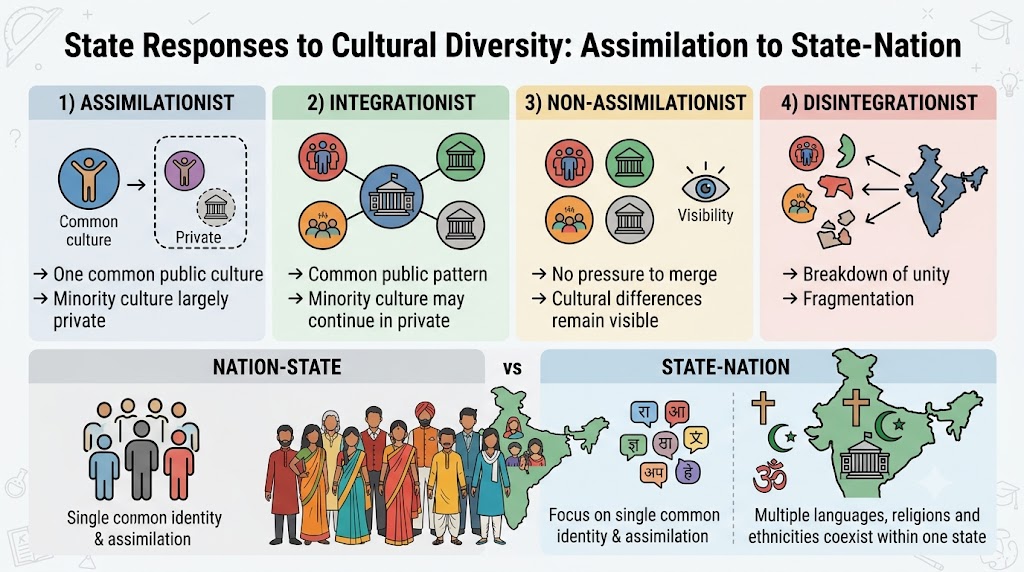
| Assimilationist | Integrationist | |
|---|---|---|
| Public life | Must conform | Must conform |
| Private life | Must also conform | Free to keep own culture |
| NCERT phrase | 'Persuading, encouraging, or forcing all citizens to adopt a uniform set of cultural values' | Public culture = 'a common national pattern'; non-national culture → 'relegated to the private sphere' |
🧠 Memory trick: Assimilation = All spheres, no exceptions. Integration = home is fine, but In-public you must match. Look for the phrase 'private sphere' in the question — that's always Integrationist, never Assimilationist.
How states enforce either: centralise power with the dominant group; one official language; dominant-group culture pushed via state media/schools; national holidays/street names honour only the dominant group's heroes; minority lands/forests seized as 'national resources'.
🇮🇳 India = Neither. It's a 'State-Nation'
India ruled out assimilation from day one, and — despite constant talk of 'national integration' — never went fully integrationist either (religion/language were never banished from public life).
State-Nation = the alternative model: multiple 'nations' (ethnic/religious/linguistic/indigenous) co-exist peacefully within one state, instead of one culture dominating.
✅ India = held up as a successful example.
⚠️ But NCERT flags a real, current threat: groups pushing a singular Hindu identity undermine this model and threaten minority inclusion.
🗺️ Regionalism: How India Avoided Becoming '15 Nations'
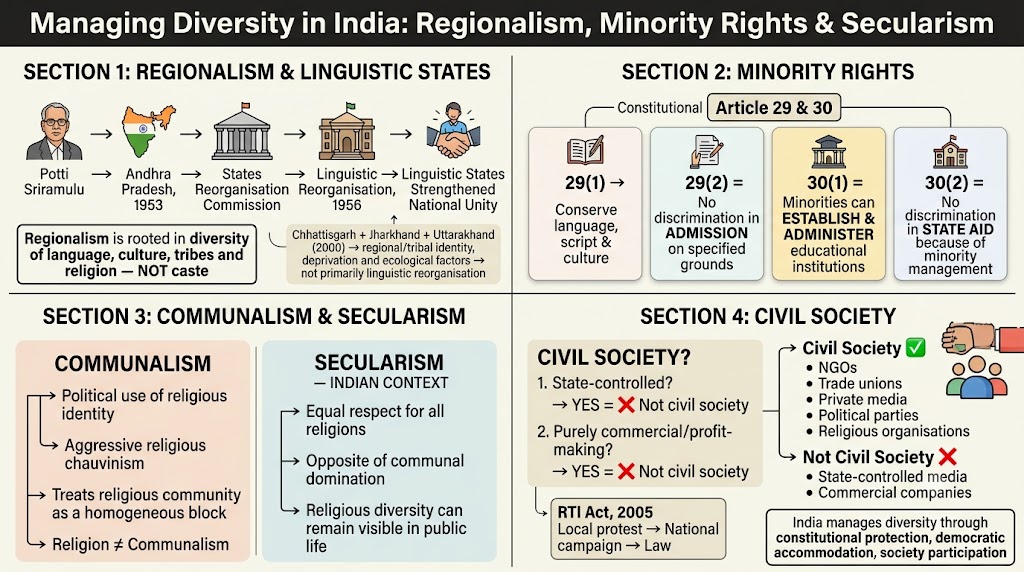
⭐ PYQ ASKED: Regionalism is rooted in diversity of languages, cultures, tribes, and religions — NOT caste. (If 'diversity of castes' appears as an option, it's the trap.)
The linguistic states story, in 5 beats:
- Post-Independence, India first kept British 'presidencies' (Madras/Bombay/Calcutta — all now renamed).
- Congress had promised linguistic provinces since the 1920s — but Nehru/Patel/Rajaji got cold feet after Partition, fearing more fragmentation.
- Potti Sriramulu died after a 7-week fast-unto-death (Oct 1953) → riots → birth of Andhra Pradesh.
- States Reorganisation Commission (SRC) implemented 1 Nov 1956 — formalised linguistic states nationwide.
- Result (Ramachandra Guha): linguistic states strengthened, not weakened, unity — 'Two languages, one nation' beat Sri Lanka's Sinhala-only path (civil war since 1983) and Pakistan's Bengali-suppression path (split 1971).
⚠️ Exception: Chhattisgarh, Uttarakhand, Jharkhand (2000) were formed via tribal identity + regional deprivation + ecology — NOT language.
📊 Today: 28 States + 8 Union Territories.
🕌 Minority Rights: Numbers + The Article 29/30 Trap
⭐⭐ PYQ ASKED — appeared across MULTIPLE separate papers. Highest priority in this whole chapter.
Sociological 'minority' ≠ just small numbers. It needs TWO things: (1) relative disadvantage, (2) a felt sense of collectivity/solidarity. Left-handed people are numerically few but NOT a sociological minority — no shared solidarity. Parsis/Sikhs can be wealthy yet still culturally 'minority' due to small numbers.
| Group | Share | Strongest Concentration |
|---|---|---|
| Muslims | 14.2% (172M) | Majority in J&K |
| Christians | 2.3% | Nagaland 88%, Mizoram 87%, Meghalaya 74% |
| Sikhs | 1.7% | Punjab 58% |
| Buddhists | 0.7% | Sikkim 27% |
| Jains | 0.4% | Maharashtra 1.3% |
🎯 The Article 29 vs 30 trap — memorise this exactly:
| Article | One-line meaning |
|---|---|
| 29(1) | Right to CONSERVE your language/script/culture |
| 29(2) | Can't be REFUSED ADMISSION to a state institution due to religion/caste/etc. |
| 30(1) | Minorities can ESTABLISH & ADMINISTER their own schools ⭐ (this exact clause = the repeat PYQ) |
| 30(2) | State can't discriminate in AID just because a school is minority-run |
Ambedkar, Constituent Assembly: 'Minorities are an explosive force which, if it erupts, can blow up the whole fabric of the state' — yet Indian minorities, unlike Ireland's Carson ('Damn your safeguards, we don't want to be ruled by you'), agreed to trust the majority.
🔥 Communalism: The Word That Means Something Totally Different in India
| English 'communal' | Indian 'communalism' |
|---|---|
| Neutral — just means 'related to a community' | Loaded — aggressive religious chauvinism |
3 facts CUET tests relentlessly:
- 🚫 It's about POLITICS, not religion. A devout person may or may not be communal — the two are independent.
- Communalism claims religion overrides everything — wealth, caste, occupation, politics, all irrelevant; only religion counts.
- Result: it flattens diverse groups into one fake-uniform block ('all Hindus think X', 'all Muslims think Y').
🕊️ Counter-tradition: India also has deep religious syncretism — Bhakti & Sufi movements, exemplified by Kabir Das: 'Moko Kahan Dhundhe re Bande, Mein To Tere Paas Mein...' (blending Hindu-Muslim devotion).
🕊️ Secularism: Western Meaning ≠ Indian Meaning
| Western sense | Indian sense |
|---|---|
| Separation of church and state | Opposite of communal |
| Religion retreats from public life | State shows EQUAL respect to all religions (not hostility, not distance) |
| Linked to rise of science/rationality | E.g., public holidays for every religion's festivals |
⚔️ The tension: protecting minorities means giving them special consideration → critics call this 'appeasement' (vote-bank politics) → supporters say without it, 'secular' becomes code for imposing majority values on everyone.
👥 Civil Society: The Two-Question Test
⭐ PYQ ASKED (exact example set below).
Ask 2 questions about any organisation:
- Is it state-controlled? If yes → NOT civil society.
- Is it purely commercial/profit-making? If yes → NOT civil society.
| ✅ IS Civil Society | ❌ NOT Civil Society |
|---|---|
| Private media | Doordarshan (state-controlled) |
| Trade unions | Car manufacturing company (commercial) |
| NGOs | |
| Political parties, religious orgs |
Real-world win — RTI Act, 2005: started as a village-level protest in rural Rajasthan over unreleased government spending records → grew into a national campaign → forced Parliament to pass the law (15 June 2005, in force 13 October 2005), overriding the old 1923 Official Secrets Act.
Other civil-society battlegrounds: tribal land rights, anti-VAW campaigns, dam-displacement rehab, hawker/pavement-dweller rights, slum-demolition resistance, Dalit land distribution.