This chapter traces India's journey from state-led planned industrialisation to the policy of liberalisation, highlighting how colonialism shaped the economy, how independent India sought to build a self-reliant industrial base, and how the 1991 reforms shifted the focus towards the market.
1. The Colonial Legacy: How it Shaped Indian Industrialisation
Understanding industrialisation in India requires looking back at the colonial period. The British did not develop a modern industrial economy in India; instead, they transformed it to serve their own capitalist interests.
- Deindustrialisation and Decline of Cities: As British manufacturing boomed, traditional exports of cotton and silk from India declined due to competition from Manchester. Old urban centres like Surat and Masulipatnam declined, while new colonial cities like Bombay (Mumbai) and Madras (Chennai) grew.
- Colonial Cities as Links: Coastal cities like Mumbai, Kolkata, and Chennai were favoured because they served as the prime link between the economic core (Britain) and the periphery (India). By 1900, over three-quarters of India's raw cotton were shipped through Bombay, while Calcutta exported jute and Madras sent coffee and cotton. These cities were the concrete expression of global capitalism.
- Unintended Consequences: The British introduced Western education to create a class of administrators, but instead, it led to the growth of a nationalist and anti-colonial consciousness. Indian nationalists used Western liberal ideas to challenge colonial rule.
- Migration and Movement: Colonialism led to the movement of people. People from present-day Jharkhand moved to Assam to work on tea plantations. Others were sent as indentured labourers to Mauritius and other colonies.
Key Example: The tea industry in Assam, which began in 1851, relied on labour imported from other provinces due to the sparse local population. The colonial government passed laws like the Transport of Native Labourers Act (1863) to help planters, using fraud and coercion to recruit labour, and ensuring the law protected the interests of the planter, not the labourer.
2. The Vision of Independent India: Planned Industrialisation
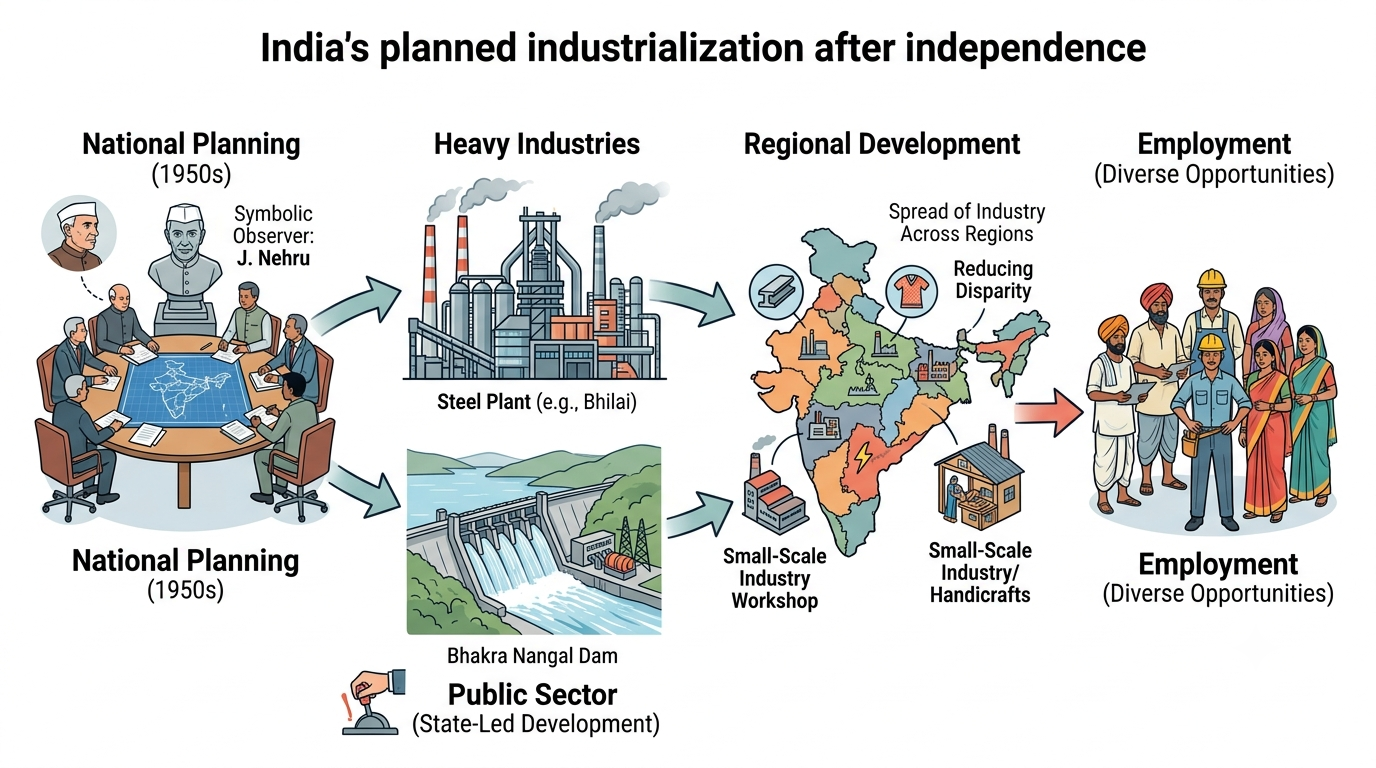
After independence, Indian nationalists saw rapid industrialisation as the path towards both growth and social equity. They wanted to break away from the colonial pattern of a dependent economy.
- Importance of Heavy Industry: Development of heavy and machine-making industries was considered very important. Jawaharlal Nehru envisioned a modern and prosperous India built on an edifice of giant steel plants and dams. He saw the Bhakra Nangal dam as a 'temple' where men worked for the good of mankind.
- Mixed Economy and Public Sector: India adopted a mixed economy policy. Some sectors were reserved for the government (the 'commanding heights of the economy'), like defence, transport, communication, power, and mining. The government also tried to encourage the small-scale sector through incentives.
- The Licensing Policy: The government used a licensing policy to control industrial development. Its key goal was to ensure that industries were spread over different regions, not just concentrated in port cities like Madras, Bombay, and Calcutta.
- Expansion of Job Opportunities: Government employment in India played a major role in overcoming boundaries of caste, religion, and region. For instance, the public sector Bhilai Steel Plant employed people from all over India who worked together.
National Planning Committee: In 1938, before independence, a National Planning Committee was set up with Jawaharlal Nehru as chairman. 29 sub-committees were set up to deal with agriculture, industry, human factor, exchange and finance, etc., showing that the idea of planned development was central to the nationalist vision.
3. Liberalisation and Globalisation (Post-1991)
From the 1990s, the Indian state decided to bring changes in its economic policy. These changes are termed as liberalisation policies.
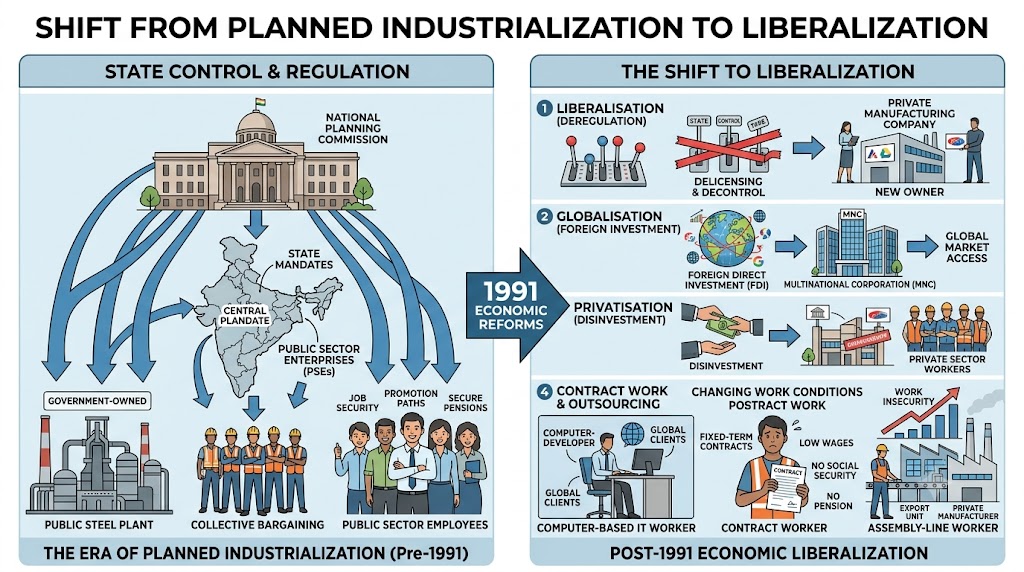
- What is Liberalisation? It refers to a range of policy decisions taken since 1991 to open up the Indian economy to the world market. This was a break from the earlier policy of state control. The underlying assumption was that greater integration into the global market would be beneficial.
- Removal of Regulations: Licenses were no longer required to open industries in most sectors. Private companies, especially foreign firms, were encouraged to invest in sectors earlier reserved for the government, including telecom, civil aviation, and power. All types of quantitative restrictions on imports were withdrawn from April 1, 2001.
- Transnational Corporations (TNCs): These are companies that produce goods or market services in more than one country. They are oriented to global markets and profits. Some Indian corporations are also becoming transnational.
- Disinvestment: The government has tried to sell its share in several public sector companies, a process known as disinvestment (privatisation of public sector companies). In Modern Foods, which was set up by the government and was the first company to be privatised, 60% of the workers were forced to retire in the first five years.
- Outsourcing and Contract Work: Companies are reducing the number of permanent employees and outsourcing their work to smaller companies or even homes. This is done globally, with developing countries like India providing cheap labour. Because small companies have to compete for orders, they keep wages low, and working conditions are often poor.
- Rising Inequalities: Liberalisation and privatisation worldwide appear to be associated with rising income inequality. Very few people in India have access to secure jobs, and even regular salaried employment is becoming more insecure due to contract labour.
4. How People Find Jobs: Formal and Informal Sectors
The nature of work in India is deeply divided into the organised and unorganised sectors.
- Organised Sector: Consists of units employing ten or more people throughout the year. These have to be registered with the government, and employees get proper salaries, pension, and other benefits. However, over 90% of the work in India is in the unorganised sector.
- Unorganised Sector: This is the informal sector where personal relationships determine many aspects of work. There is a lack of proper wages and working conditions. If the employer likes you, you may get a raise; if you fight, you may lose your job.
- Self-Employment: In India, over 50% of the population is self-employed. Only about 14% are in regular salaried employment, and about 30% are in casual labour.
- How Recruitments Happen:
- Only a small percentage get jobs through advertisements or employment exchanges.
- Many factory workers get jobs through contractors or jobbers (known as mistris in Kanpur textile mills). The jobber comes from the same region as the workers but has the owner's backing.
- Badli workers substitute for regular permanent workers who are on leave but are not given the same status and security.
Brickyard Example: In South Gujarat, approximately 30,000-40,000 workers are employed seasonally in brickyards. They work in gangs of nine to eleven members. Men knead mud and mould bricks, children carry them, and women carry them to the kiln. A quick gang makes 2500-3000 bricks a day, taking 10 hours, while a slow gang takes 14 hours.
5. How Work is Carried Out: Taylorism and Mechanisation
The way work is organised has changed significantly with industrialisation and mechanisation.
- Scientific Management (Taylorism): An American called Frederick Winslow Taylor invented a system in the 1890s called 'Scientific Management'. Under this system, all work was broken down into its smallest repetitive elements and divided between workers. Workers were timed with stopwatches and had to fulfil a target every day.
- Assembly Line: Production was speeded up by the introduction of the assembly line. Each worker sits along a conveyor belt and assembles one small part of the product. In Maruti Udyog Ltd, two cars roll off the assembly line every minute. Workers get only 45 minutes rest in the entire day, and most are exhausted by the age of 40.
- Machinery vs. Employment: Both Marx and Mahatma Gandhi saw mechanisation as a danger to employment. Gandhi argued that the craze for 'labour-saving' machinery leads to thousands being without work and starving.
- Flexi-time and IT Sector: In the services sector, especially IT, long working hours are central. The management legitimises extended working hours through 'flexi-time', which in theory gives employees freedom to choose their hours, but in practice means they have to work as long as necessary to finish the task.
- De-skilling: Sociologist Harry Braverman argues that the use of machinery actually de-skills workers. For example, earlier architects had to be skilled draughtsmen, now the computer does much of the work for them.
6. Working Conditions and Home-Based Work
Industrial work in India is often carried out in very poor conditions, and home-based work is a significant part of the economy.
- Mining: Coal mines alone employ 5.5 lakh workers. The Mines Act 1952 specifies maximum hours, overtime pay, and safety rules, but these are often not followed in smaller mines. Workers face dangerous conditions like flooding, fire, and emission of gases. Many develop respiratory problems like silicosis. The rate of mining accidents in India is very high.
- Home-Based Work: This includes making lace, zari, carpets, bidis, and agarbattis. This work is mainly done by women and children. An agent provides raw materials and picks up the finished product. Workers are paid on a piece-rate basis.
- Bidi Industry: The process starts with villagers plucking tendu leaves and selling them to the forest department or a contractor. The government then auctions the leaves to bidi factory owners who give them to contractors. The contractor supplies tobacco and leaves to home-based workers (mostly women) who roll the bidis. The contractor sells them to the manufacturer, who roasts them, brands them, and sells them to a distributor. The manufacturer gets the maximum amount of the value of the finished bidi because of brand image.
- Case Example: Madhu, a 15-year-old school dropout, rolls bidis with her mother. She enjoys sitting close to her mother and listening to the women chat, but suffers from backache due to long hours of sitting in the same posture.
7. Strikes and Unions: Workers' Resistance
Workers have always resisted harsh working conditions through trade unions and strikes.
- Problems Faced by Unions: Trade unions in India have to overcome problems like regionalism and casteism. Often, workers will sit with a colleague of a different caste but refuse to drink water from his hands.
- The Bombay Textile Strike (1982): This was a famous strike led by trade union leader Dr. Datta Samant, affecting nearly a quarter of a million workers and their families. The strike lasted nearly two years.
- Workers wanted better wages and the right to form their own union. According to the Bombay Industrial Relations Act (BIRA), a union had to be 'approved' and could only be approved if it gave up the idea of strikes.
- The Congress-led Rashtriya Mill Mazdoor Sangh (RMMS) was the only approved union and helped break the strike by bringing in other workers.
- Eventually, after two years, people went back to work because they were desperate. Nearly one lakh workers lost their jobs. Mill owners are now selling off the mill land to real estate dealers to build luxury apartments, leading to a battle over the future of Mumbai.
Common Mistakes
- Thinking that the licensing policy was to ensure profit for government officials. Its main goal was to ensure industries were spread over different regions of India.
- Confusing 'liberalisation' with 'globalisation'. Liberalisation is the policy of opening up the economy, while globalisation is the broader process of global interdependence.
- Assuming that the organised sector is the main source of employment in India. In reality, over 90% of the work in India is in the unorganised sector.
- Thinking that all industrialisation leads to better working conditions. In many cases, it leads to de-skilling, contract work, and poor working conditions, as seen in mines and brickyards.
- Believing that 'flexi-time' always benefits the employee. In the IT sector, it is often used to legitimise extended working hours.
- Confusing disinvestment with complete withdrawal of the government from the economy. Disinvestment refers specifically to the sale of government shares in public sector companies.
- Assuming that liberalisation means that the state has completely disappeared from economic activity. Liberalisation refers to reducing state controls and opening the economy to market forces.