This section covers the Panchayati Raj system and its role in rural social transformation. It focuses on constitutional provisions, key institutions like the Gram Sabha and Panchayats, and the challenges of democratisation in an unequal rural society.
1. Panchayati Raj: The Idea of Grassroots Democracy
The term Panchayati Raj literally translates to 'Governance by five individuals'. The goal is to ensure a functioning and vibrant democracy at the village or grassroots level.
- Inspiration: The idea of village self-governance, known as gram-swarajya, was dear to Mahatma Gandhi. He envisioned each village as a self-sufficient unit conducting its own affairs.
- Ambedkar's Skepticism: During the drafting of the Constitution, Dr. B.R. Ambedkar was skeptical about local self-government. He believed that local elites and upper castes were so well entrenched that local self-government could lead to the continuing exploitation of the downtrodden masses.
- Constitutional Status: In 1992, grassroots democracy was formally strengthened through the 73rd Constitutional Amendment, giving constitutional status to Panchayati Raj Institutions (PRIs).
2. The Three-Tier System and Key Provisions (73rd Amendment)
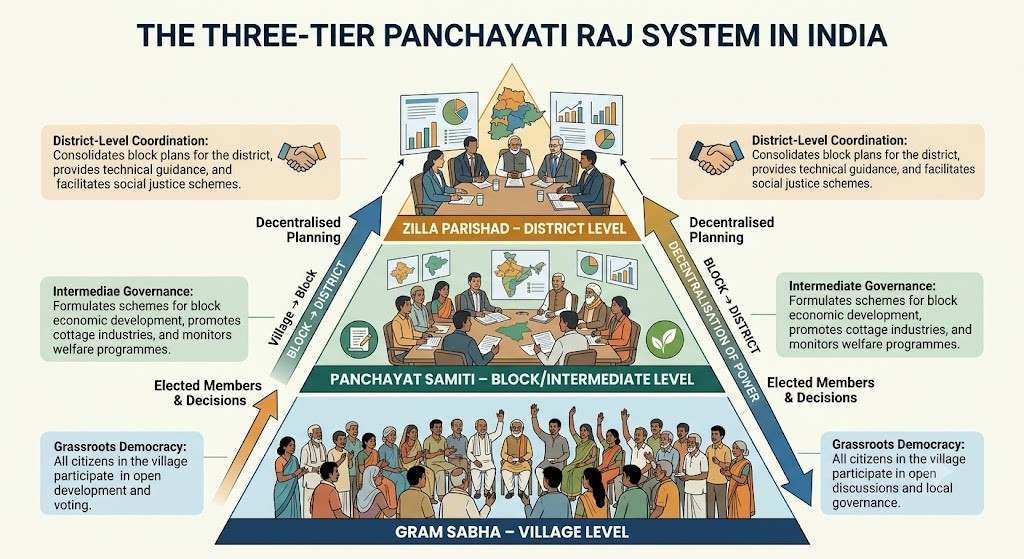
The 73rd Constitutional Amendment Act, 1992 provided the constitutional framework for Panchayati Raj Institutions and a three-tier system. However, states having a population not exceeding twenty lakhs may not have the intermediate level.
- Gram Sabha (The Base): At the base of the structure is the Gram Sabha. It consists of the entire body of citizens in a village (grama). It provides an open forum for discussions and village-level development activities.
- Compulsory Elections: Elections to Panchayati Raj bodies are conducted every five years.
- Reservation of Seats: The amendment provides reservation of seats for Scheduled Castes, Scheduled Tribes and not less than one-third of the total seats for women. Not less than one-third of the offices of chairpersons at each level are also reserved for women.
- 74th Amendment: The 73rd Amendment deals with rural local bodies, while the 74th Amendment deals with urban local bodies or municipalities.
| Amendment | Area | Local Bodies |
|---|---|---|
| 73rd Constitutional Amendment | Rural | Panchayati Raj Institutions |
| 74th Constitutional Amendment | Urban | Municipalities |
3. Powers and Responsibilities of Panchayats
According to the Constitution, Panchayats should be given powers and authority to function as institutions of self-government. The following powers were delegated to them:
- Planning and Development: To prepare plans and schemes for economic development.
- Social Justice: To promote schemes that will enhance social justice.
- Taxation: To levy, collect and appropriate taxes, duties, tolls and fees.
- Devolution of Finances: To help in the devolution of governmental responsibilities, especially finances, to local authorities.
Specific Responsibilities:
- Social Welfare: Maintenance of burning and burial grounds, recording births and deaths, establishing child welfare and maternity centres, and controlling cattle.
- Development Activities: Construction of roads, public buildings, wells, tanks, and schools. They also promote small cottage industries and minor irrigation works.
- Monitoring Schemes: Panchayats monitor government schemes like the Integrated Rural Development Programme (IRDP) and the Integrated Child Development Scheme (ICDS).
- Transparency: Panchayat offices put up boards listing the break-up of funds received and utilised. This enables people to scrutinise the allocation and use of money.
Nyaya Panchayats: In some states, village courts called Nyaya Panchayats have been constituted. They can hear petty civil and criminal cases and impose fines but cannot award a sentence.
4. Challenges: Democratisation and Inequality
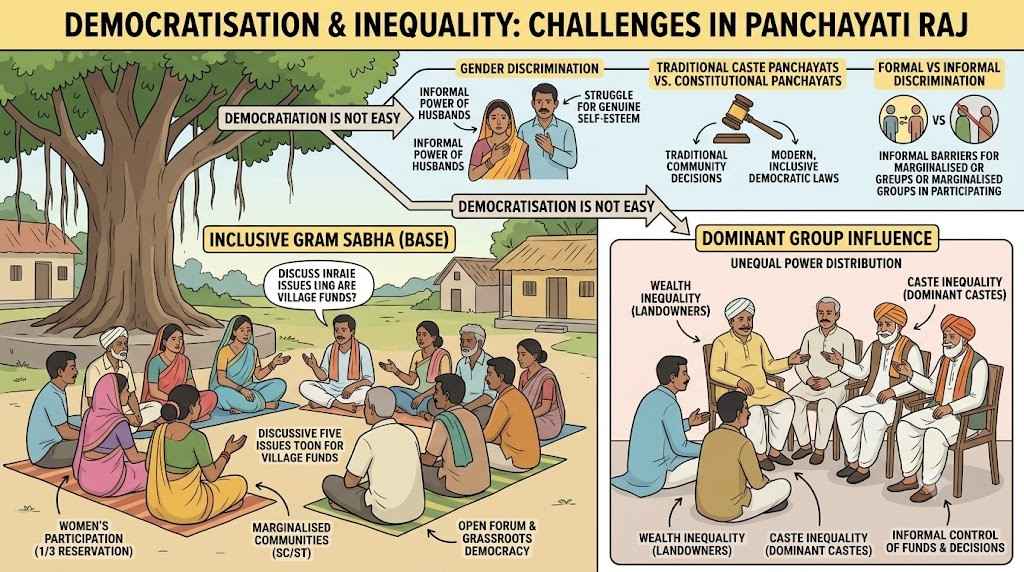
Democratisation is not easy in a society with a long history of inequality based on caste, community, and gender. The Panchayati Raj system faces several challenges:
- Dominant Castes: Gram Sabha members are often controlled by a small coterie of rich landlords, usually from upper castes or landed peasantry. They make decisions and allocate funds, leaving the silent majority as mere onlookers.
- Role of Wealth: In elections, wealth and privilege play a major role. Candidates may use distribution of alcohol and gur, and the use of jeeps, to influence voters.
- Women's Role: Even when seats are reserved for women, the contest is often between the candidates' husbands. However, women's participation has brought a sense of self-esteem and confidence. Kalavati, a Dalit Panchayat member, gained a name for herself through her participation.
- Caste Panchayats vs. Constitutional Panchayats: Traditional caste panchayats, such as the Rathi khap in Haryana, have reasserted themselves as guardians of village morality, sometimes taking decisions that go against democratic norms and procedures.
- Informal Gender Discrimination: Tribal institutions such as those of the Khasis in Meghalaya have traditions of grassroots democracy but may also be marked by intolerance towards women and internal stratification.
Common Mistakes
- Confusing the 73rd Amendment (Rural Panchayats) with the 74th Amendment (Urban Municipalities).
- Thinking that the three-tier system is compulsory without exception for every state; states with a population not exceeding twenty lakhs may not have the intermediate level.
- Thinking that Gram Sabha collects central taxes. Gram Sabha is the general body of citizens and an important forum for local participation and decision-making.
- Assuming that traditional tribal institutions are always democratic. As Tiplut Nongbri points out, they may have internal stratification and intolerance towards women.
- Forgetting that Ambedkar was skeptical of local self-government because of the entrenched power of local elites and upper castes.
- Confusing Panchayats with traditional caste panchayats. Constitutional Panchayats are democratic local government institutions, whereas caste panchayats are traditional community institutions.