Caste operates as India's most systematic and legally-documented form of social discrimination — this topic covers how prejudice, stereotype, and discrimination combine into caste-based exclusion, the specific mechanics of untouchability, and the constitutional and political history of Scheduled Caste and OBC recognition, all frequently tested through Assertion-Reasoning and multi-statement CUET questions.
Social Inequality and Stratification: Core Concepts
Social inequality and exclusion are social — about groups, not individuals — and are systematic and structured, following a definite pattern (though usually linked to economic inequality too).
Three forms of capital underlie social resources:
- Economic capital — material assets and income
- Cultural capital — educational qualifications and status
- Social capital — networks of contacts and social associations
Social stratification = a system ranking categories of people in a hierarchy, shaping identity, relationships, and access to resources/opportunities. Three key defining principles:
- Characteristic of society, not individuals: stratification is a society-wide system, not simply a function of individual differences.
- Persists across generations: closely tied to family and inheritance — a person's social position is ascribed; children assume their parents' social position.
- Supported by patterns of belief/ideology: e.g., the caste system is justified through the ideology of purity and pollution, with Brahmins as most superior and Dalits as most inferior by birth and occupation.
Prejudice, Stereotype, Discrimination, and Social Exclusion
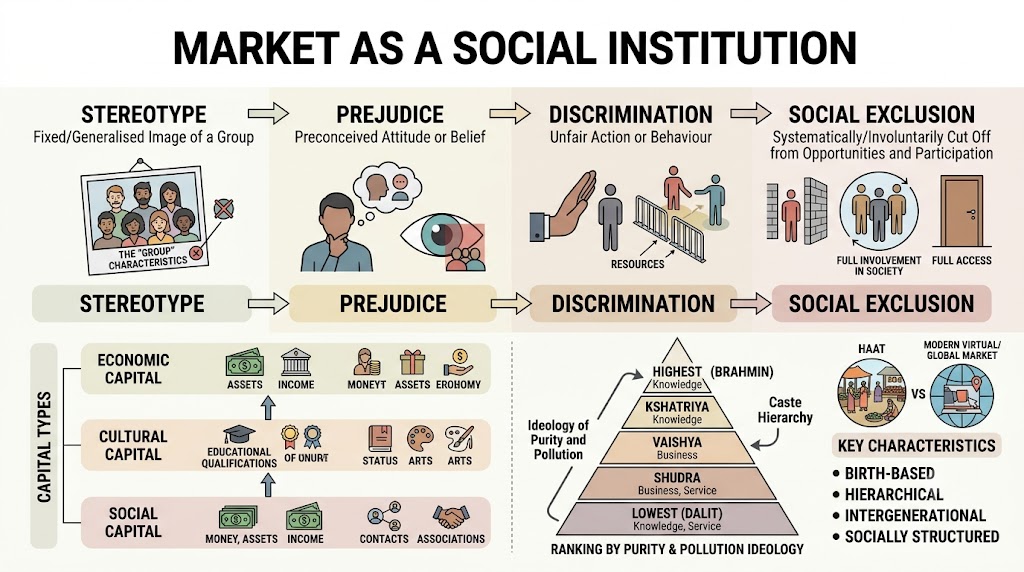
| Concept | Definition | Key Distinction |
|---|---|---|
| Prejudice | Pre-conceived opinions/attitudes held by one group toward another; resistant to change even with new evidence | An attitude — can be positive or negative, though usage is usually negative (e.g., 'kanjoos Marwaris', 'Rajputs are courageous') |
| Stereotype | A fixed, inflexible characterisation of a whole group as homogenous | The basis for prejudice; ignores individual variation; often applied to ethnic/racial groups and women |
| Discrimination | Actual behaviour/practices that unjustifiably exclude a group from access to goods, services, jobs, resources normally available to others | The behavioural component of prejudice — prejudice is belief, discrimination is action |
| Social Exclusion | Ways individuals/groups become cut off from full involvement in the wider society — combined outcome of deprivation and discrimination | Involuntary (practiced regardless of the excluded group's wishes) and structural (a result of social processes/institutions, not individual action) |
Important CUET nuance: social exclusion is sometimes wrongly 'justified' by claiming the excluded group itself doesn't want to participate — this logic doesn't hold when exclusion blocks access to something clearly desirable (education, water, social participation).
The Caste System as a Discriminatory System
The caste system is a distinct Indian social institution that legitimises and enforces discrimination against people born into particular castes — practices that are humiliating, exclusionary, and exploitative.
- Historically, caste determined occupation — persons were 'born into' their caste's associated occupation with no choice.
- Scriptural theory vs. practice: in strict scriptural terms, social (ritual) status and economic status were meant to be separate — e.g., Brahmins (ritually highest) were not supposed to amass wealth and were subordinate to Kshatriya kings' secular power. In actual historical practice, however, social and economic status tended to coincide — high castes were almost always high economic status, and vice versa.
- Contemporary examples of change at the macro level: K.R. Narayanan (Ex-President, from a Dalit community), Mira Kumar (Ex-Speaker of Parliament) — but this shift is not matched by mindset change at the micro/local level, where Brahmins may still be peons/clerks while Dalits become doctors, yet social attitudes lag behind these individual mobility cases.
Untouchability: Definition and Four Dimensions
Untouchability is an extreme, particularly vicious aspect of caste that prescribes stringent social sanctions against castes at the bottom of the purity-pollution scale — members are considered so ritually impure that mere touch causes pollution.
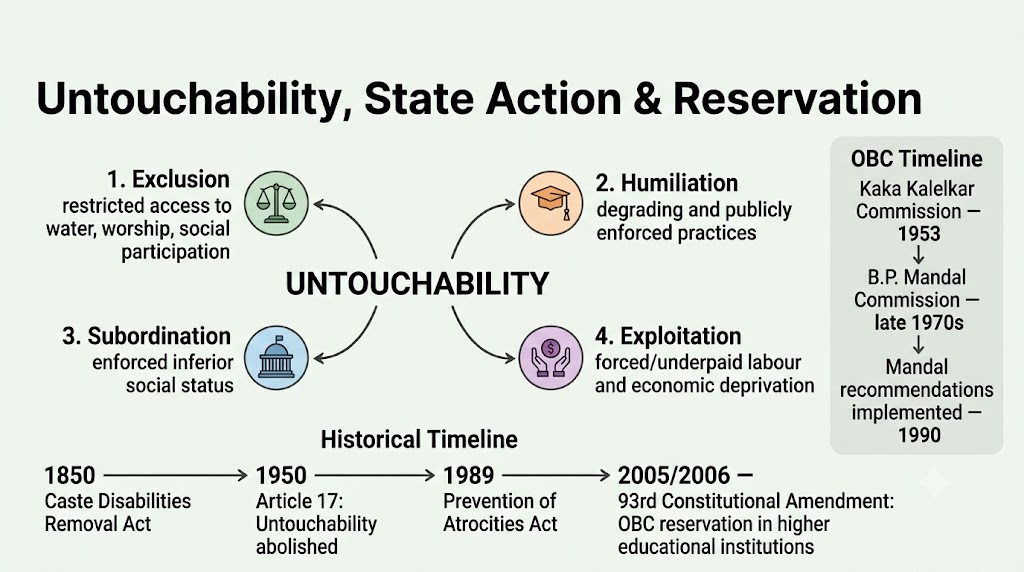
CUET tests four equally important dimensions that together define the phenomenon:
- Exclusion: unique forms not practised against other groups — e.g., prohibition from sharing drinking water sources, from participating in collective religious worship, social ceremonies, festivals; not allowed to draw water from wells/pumps used by Brahmins.
- Humiliation/Subordination: publicly visible acts of self-humiliation — e.g., restrictions on wearing bright/colourful clothes, walking with head bowed, not walking with footwear in front of upper castes, performing degrading tasks like cremation work from a distance.
- Exploitation: economic exploitation via forced, unpaid or under-paid labour, or confiscation of property — being assigned the lowest-paid, most degrading jobs.
Note: untouchability is a pan-Indian phenomenon, though its specific forms and intensity vary by region and socio-historical context.
Naming and Terminology: Harijan → Dalit
- 'Harijan' (literally 'children of God') — popularised by Mahatma Gandhi in the 1930s to counter the pejorative charge carried by caste names.
- 'Dalit' — the now generally-accepted term, coined by ex-untouchable communities and their leaders themselves. Literally means 'downtrodden', conveying a sense of an oppressed people actively asserting their own identity (rather than a name given by outsiders/reformers).
- Important nuance: the term 'Dalit' was neither coined by Dr. Ambedkar nor frequently used by him — though it resonates strongly with his philosophy and empowerment movement.
- The Dalit Panthers, a radical group that emerged in western India in the 1970s, used the term to assert identity in their struggle for rights and dignity.
- In response to discrimination, Dalits have historically responded with: (a) forming their own associations, and (b) religious conversion (to Buddhism, Christianity, Islam) as protest against caste oppression.
State Initiatives: Laws and Reservations for SC/ST
| Law/Act | Year | Purpose |
|---|---|---|
| Caste Disabilities Removal Act | 1850 | Disallowed curtailment of citizens' rights due solely to change of religion or caste — allowed Dalits' entry into government schools |
| Constitution — Article 17 | 1950 | Abolished untouchability; practice is punishable by law |
| Prevention of Atrocities Act | 1989 | Revised and strengthened legal provisions punishing violence/humiliation against Dalits and adivasis |
| Constitution (93rd Amendment) Act | 2005 (became law 23 Jan 2006) | Introduced reservation for OBCs in institutions of higher education |
Coincidence worth noting for CUET: both the 1850 Act and the 2006 (93rd) Amendment relate specifically to education.
Reservations = the most significant state initiative compensating for past/present caste discrimination — setting aside seats for SC/ST in: (a) state and central legislatures (state assemblies, Lok Sabha, Rajya Sabha), (b) government jobs across departments and PSUs, (c) educational institutions. The proportion of SC/ST reserved seats equals their percentage share of the total population; OBC reservation proportion is decided differently.
Historical political assertion: Jyotiba Phule, Iyothee Thass, Periyar, Ambedkar (pre-Independence) → Bahujan Samaj Party (Uttar Pradesh), Dalit Sangharsh Samiti (Karnataka) (contemporary). Dalits have also made major literary contributions, especially in Marathi, Kannada, Tamil, Telugu, and Hindi.
Other Backward Classes (OBCs)
- OBCs = groups (beyond SC/ST) constitutionally described as 'socially and educationally backward classes' — need not be caste-based alone, but are generally identified by caste. More diverse than Dalits or adivasis.
- First Backward Classes Commission, headed by Kaka Kalelkar, appointed by Nehru's government, submitted its report in 1953 — but was politically sidelined at the time.
- From the mid-1950s, OBC policy became primarily a state-level, not central, issue. Southern states had a long history of backward-caste political agitation dating to the early 20th century, so OBC-focused policy existed there long before most northern states engaged with it.
- OBC issue returned to the central level in the late 1970s, after the Emergency, when the Janata Party came to power — leading to the Second Backward Classes Commission, headed by B.P. Mandal.
- The Mandal Commission report sat for ten years before the central government implemented it in 1990, making the OBC issue a major national political flashpoint (V.P. Singh's government); implementation was uneven across states, triggering protests.
- OBCs constitute approximately 41% of the national population (per recent surveys) — their large numbers, once politicised nationally from 1990 onward, translated into significant political influence, unlike the earlier sidelined Kalelkar report.
- Politics of OBC reservation: politicians sometimes promise OBC reservation mainly to expand their vote-bank; there is internal stratification within OBCs too — 'upper OBCs' (relatively better off) vs. the lowest OBC category, whose conditions can be comparable to Dalits.
Common Mistakes
- Confusing prejudice (an attitude/belief) with discrimination (actual behaviour) — CUET frequently tests this attitude-vs-action distinction directly.
- Assuming social exclusion is accidental or occasional — NCERT explicitly frames it as involuntary and structural/systematic, not incidental.
- Treating untouchability as defined by only one dimension (e.g., only 'exclusion') — all four dimensions (exclusion, humiliation, subordination, exploitation) are equally definitional.
- Attributing the term 'Dalit' to Dr. Ambedkar — it was coined and popularised by ex-untouchable communities/leaders themselves (notably associated with the Dalit Panthers), not by Ambedkar, though it resonates with his movement.
- Mixing up the Kaka Kalelkar Commission (1953 report, first Backward Classes Commission, sidelined) with the B.P. Mandal Commission (later, implemented in 1990) — these are two distinct commissions with different outcomes and timelines.
- Assuming caste discrimination has disappeared because of visible macro-level examples (e.g., Dalit presidents) — NCERT stresses that mindset change lags behind at the micro/local level even amid formal/legal progress.
- Forgetting that OBC reservation proportions are NOT calculated the same way as SC/ST reservation (which directly mirrors population share) — this is a specific factual distinction CUET tests.