Process of Structural Change: Colonialism, Industrialisation, Urbanisation is a study of the major changes that transformed Indian society. Colonialism changed the economy and administration, industrialisation changed production and work, and urbanisation changed settlement patterns and social relationships. These processes were interconnected and produced both continuity and change.
1. Structural Change in Indian Society
Structural change refers to major changes in the basic organisation and institutions of society over time.
- Economy and occupations
- Family and kinship
- Social classes
- Villages and cities
- Patterns of migration
- Education and employment
- Political and administrative institutions
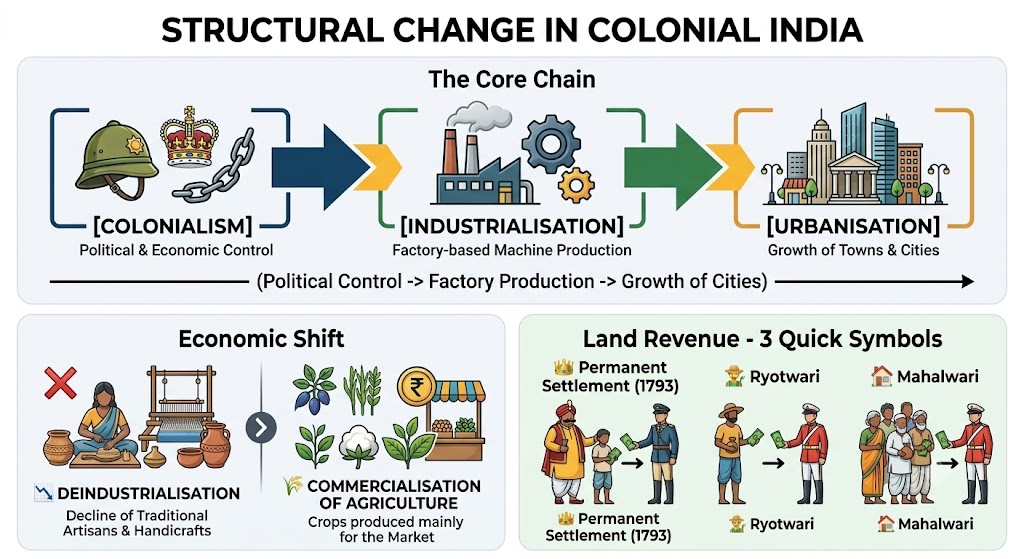
Three major processes that transformed Indian society were Colonialism → Industrialisation → Urbanisation.
2. Colonialism
Colonialism is a system in which one country establishes political and economic control over another territory and uses its resources for its own interests.
In India, British colonial rule produced deep changes in the economy, agriculture, industry, administration, transport, communication, education, law, cities and urban life.
Key Features:
- Political control by a foreign power
- Economic exploitation of the colonised country
- Use of local resources for colonial interests
- Changes in traditional industries and occupations
- Introduction of new administrative and legal institutions
- Development of railways, ports and communication mainly according to colonial economic needs
Colonialism did not simply replace Indian society with a completely new system. It interacted with existing social institutions and produced a mixture of continuity and change.
3. Colonialism and the Indian Economy
Before colonial rule, India had a diverse economy involving agriculture, handicrafts, textile production, metal work, trade and local and international markets.
Colonial economic policies significantly changed this structure.
Major Changes:
- Commercialisation of Agriculture: Farmers were increasingly encouraged or forced to produce crops for the market rather than only for local consumption. Important crops included indigo, cotton, opium, jute and tea.
- Decline of Traditional Handicrafts: Indian handicrafts, particularly textiles, faced severe competition from machine-made goods imported from Britain.
- India as a Supplier of Raw Materials: India increasingly supplied cotton, jute, indigo and tea to British industries.
- India as a Market for British Goods: British manufactured goods were sold extensively in Indian markets.
Colonial economic relations connected India closely to the requirements of the British industrial economy.
4. Deindustrialisation
Deindustrialisation refers to the decline of traditional manufacturing and handicraft production.
In colonial India, many traditional artisans suffered because machine-made British goods were cheaper, Indian handicrafts faced unequal competition, colonial policies favoured British manufactured goods and traditional markets declined.
Consequences:
- Decline of artisan occupations
- Loss of traditional skills and livelihoods
- Increased dependence on agriculture
- Movement of some artisans into agricultural labour
- Changes in the occupational structure
Key Phrase: Deindustrialisation = decline of traditional manufacturing and handicrafts.
5. Commercialisation of Agriculture
Commercialisation of agriculture means producing crops primarily for sale in the market rather than mainly for subsistence.
Important Commercial Crops: Indigo, cotton, jute, opium and tea.
Effects:
- Greater connection between agriculture and markets
- Increased dependence on market prices
- Changes in cropping patterns
- Greater vulnerability of peasants to economic fluctuations
- Expansion of cash-crop production
Important distinction: Subsistence agriculture means production mainly for consumption, while commercial agriculture means production mainly for the market.
6. Land Revenue Systems
Colonial rule introduced different systems of land revenue collection.
Permanent Settlement: Introduced in 1793 under Lord Cornwallis. Zamindars were recognised as land revenue collectors, revenue demand was fixed permanently, zamindars were expected to pay revenue to the colonial government, and zamindars gained greater control over land and peasants.
Ryotwari System: Revenue was collected directly from cultivators or ryots. Individual cultivators were recognised as revenue-paying occupants. It was used mainly in parts of southern and western India.
Mahalwari System: Revenue settlement was made with villages or groups of villages. It was used mainly in parts of northern and central India.
| System | Main Revenue Unit |
|---|---|
| Permanent Settlement | Zamindar |
| Ryotwari | Individual cultivator |
| Mahalwari | Village or group of villages |
7. Industrialisation
Industrialisation refers to the development of machine-based production, factories and large-scale industrial production.
It involves a shift from hand production → machine production and small-scale production → large-scale factory production.
Major Features:
- Use of machines
- Factory-based production
- Division of labour
- Wage labour
- Mass production
- Greater use of technology
- Expansion of markets
Industrialisation changed not only production but also social relationships and occupational structures.
8. Industrialisation in India
Indian industrialisation developed under colonial conditions.
Important Industries: Cotton textiles, jute, coal mining, iron and steel, and tea plantations.
Major Industrial Centres:
- Bombay/Mumbai: Cotton textile industry
- Calcutta/Kolkata: Jute industry
- Jamshedpur: Iron and steel industry
- Ahmedabad: Cotton textile industry
- Coal-producing regions: Mining industries
Industrial development encouraged the growth of a new industrial workforce.
9. Industrial Labour
Industrial labour refers to workers employed in factories, mines, plantations and other forms of large-scale production.
Industrial workers often came from rural areas.
Important Features:
- Wage-based employment
- Long working hours
- Poor working conditions in many industries
- Low wages
- Lack of job security
- Migration from villages to industrial centres
- Formation of workers' organisations and trade unions
Industrialisation created new class relationships between industrialists/owners and workers/labourers.
10. Division of Labour
Division of labour means dividing the production process into different tasks performed by different workers.
For example, in a textile factory, one worker may operate a machine, another may inspect the cloth and another may package the finished product.
Effects:
- Increased productivity
- Faster production
- Specialisation
- Greater dependence on wage employment
- More specialised forms of work
- Greater importance of relationships between workers and employers
11. Urbanisation
Urbanisation refers to the growth of towns and cities and the increasing proportion of people living in urban areas.
It is closely connected with industrialisation, migration, and expansion of trade and administration.
Causes:
- Growth of industries
- Employment opportunities
- Trade and commerce
- Government administration
- Transport development
- Educational opportunities
- Migration from rural areas
Effects:
- Growth of cities
- Expansion of markets
- New occupations
- Greater social mobility
- Increasing diversity
- Development of new social classes
- Changes in family and community relationships
12. Rural–Urban Migration
Rural–urban migration occurs when people move from villages or rural areas to towns and cities.
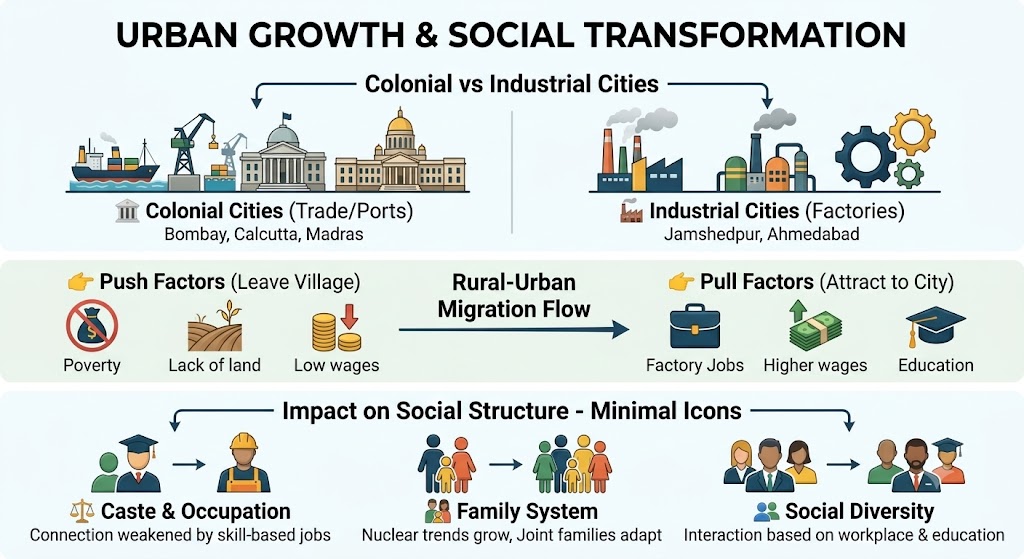
Push Factors: Lack of employment, poverty, agricultural difficulties, landlessness, low wages and limited opportunities.
Pull Factors: Jobs, higher wages, education, healthcare, better infrastructure and greater opportunities.
Migration does not always mean permanent settlement. People may migrate permanently, temporarily, seasonally or circularly.
13. Colonial Cities
Colonial rule transformed Indian cities. Important colonial cities included Bombay, Calcutta and Madras.
These cities developed as centres of trade, administration, industry, ports and communication.
Colonial Urban Structure: Colonial cities often showed clear differences between European or colonial areas and Indian or native areas.
European areas generally had better infrastructure and facilities, while Indian neighbourhoods were often more densely populated and had poorer infrastructure. This reflected the unequal social and racial structure of colonial rule.
14. Bombay as a Colonial Industrial City
Bombay became an important centre because of its natural harbour, international trade, cotton textile industry, port activities and railway connections.
Social Changes:
- Growth of an industrial working class
- Growth of business communities
- Expansion of middle classes
- Growth of migrant populations
- Development of new forms of urban culture
- Expansion of working-class neighbourhoods
Bombay became an important example of the relationship between industrialisation and urbanisation.
15. Cities and Social Diversity
Cities bring together people from different regions, languages, religions, castes, classes and occupational backgrounds. Therefore, urban areas tend to have greater social diversity.
Traditional village relationships may become weaker or less important in urban settings. People often interact with others based on occupation, economic interests, education, workplace and voluntary associations.
This can increase opportunities for social mobility.
16. Industrialisation, Urbanisation and Family
Industrialisation and urbanisation affected family life.
- Migration separated some families geographically.
- Wage employment increased individual economic independence.
- Women's participation in education and employment expanded.
- New forms of household arrangements developed.
- Traditional occupational links between caste and work weakened in many urban settings.
Important: Industrialisation did not simply destroy the joint family. Different forms of family continued to exist and adapted to changing economic conditions.
17. Changes in Occupational Structure
Traditional Indian society had strong links between caste → occupation.
Industrialisation and urbanisation encouraged occupational mobility.
People increasingly entered occupations based on education, skills, training, employment opportunities and individual choices.
The traditional relationship between caste and occupation became less rigid, although caste-based inequalities and networks continued to influence employment and opportunities.
18. Colonialism → Industrialisation → Urbanisation
These processes were interconnected.
| Process | Major Change |
|---|---|
| Colonialism | Foreign political and economic control |
| Industrialisation | Machine-based and factory production |
| Urbanisation | Growth of towns and cities |
| Migration | Movement of people, especially towards employment centres |
Simple Chain:
Colonial economic policies → Changes in agriculture and traditional industries → Growth of modern industries → Expansion of industrial employment → Migration towards cities → Urbanisation → Changes in family, occupations, classes and social relationships.
19. Important Concepts at a Glance
| Concept | Meaning |
|---|---|
| Colonialism | Political and economic domination of one country by another |
| Deindustrialisation | Decline of traditional manufacturing and handicrafts |
| Commercialisation of Agriculture | Production of crops mainly for the market |
| Industrialisation | Expansion of machine-based and factory production |
| Industrial Labour | Wage workers employed in industrial production |
| Division of Labour | Division of production into specialised tasks |
| Urbanisation | Growth of towns and cities and urban population |
| Migration | Movement of people from one place to another |
| Rural–Urban Migration | Movement from rural areas to urban areas |
| Occupational Mobility | Movement from one occupation to another |
20. Important Dates and Facts
| Year | Event |
|---|---|
| 1757 | Battle of Plassey |
| 1793 | Permanent Settlement |
| 1853 | First railway line in India: Bombay to Thane |
| 1857 | Revolt of 1857 |
| 1858 | Direct rule of the British Crown began |
| 1907 | Tata Iron and Steel Company began production at Jamshedpur |
| 1947 | Independence and Partition |
21. Key Concept Differences
Colonialism vs. Industrialisation
| Colonialism | Industrialisation |
|---|---|
| Political and economic domination | Transformation of production |
| Foreign control is central | Machines and factories are central |
| Resources are used for colonial interests | Large-scale production expands |
| Changes institutions and economy | Changes work and occupational structure |
Industrialisation vs. Urbanisation
| Industrialisation | Urbanisation |
|---|---|
| Growth of factories and machine production | Growth of towns and cities |
| Changes production | Changes settlement patterns |
| Creates industrial employment | Attracts migrants |
| Encourages wage labour | Expands urban population |
Subsistence vs. Commercial Agriculture
| Subsistence | Commercial |
|---|---|
| Mainly for self-consumption | Mainly for market |
| Limited market dependence | Greater market dependence |
| Food security is central | Sale and profit are important |
22. Key Points to Remember
- Colonialism changed India's political, economic and social structures.
- Colonial economic policies encouraged India to supply raw materials and serve as a market for British manufactured goods.
- Deindustrialisation affected many traditional artisans and handicraft producers.
- Commercialisation of agriculture increased production for markets.
- Industrialisation introduced machine-based factory production and wage labour.
- Urbanisation involved the growth of towns, cities and urban populations.
- Industrialisation and urbanisation encouraged migration.
- Colonial cities developed as centres of trade, administration, ports and industry.
- Industrialisation weakened the rigid connection between caste and occupation, but caste inequalities did not disappear.
- Structural change produces both continuity and change rather than completely replacing older social institutions.