This chapter explores the evolution of mass media in India, from the colonial press to the modern globalised media landscape, highlighting its role in social change, nation-building, and shaping cultural identity. It examines the complex interplay between the state, the market, and the audience in structuring media content and its impact on society.
1. The Beginnings of Mass Media: The Printing Press and Colonial India
The first modern mass media institution began with the development of the printing press by Johann Gutenberg in the fifteenth century. The press initially restricted itself to religious books but later expanded to newspapers with industrialisation, literacy, and better transport in the mid-19th century.
- Nation as an 'Imagined Community': The spread of mass media (newspapers) allowed people in different parts of a country to read the same news, fostering a sense of togetherness. Scholar Benedict Anderson argued that this helped the growth of nationalism, creating an 'imagined community' where people who never met each other felt like members of a community.
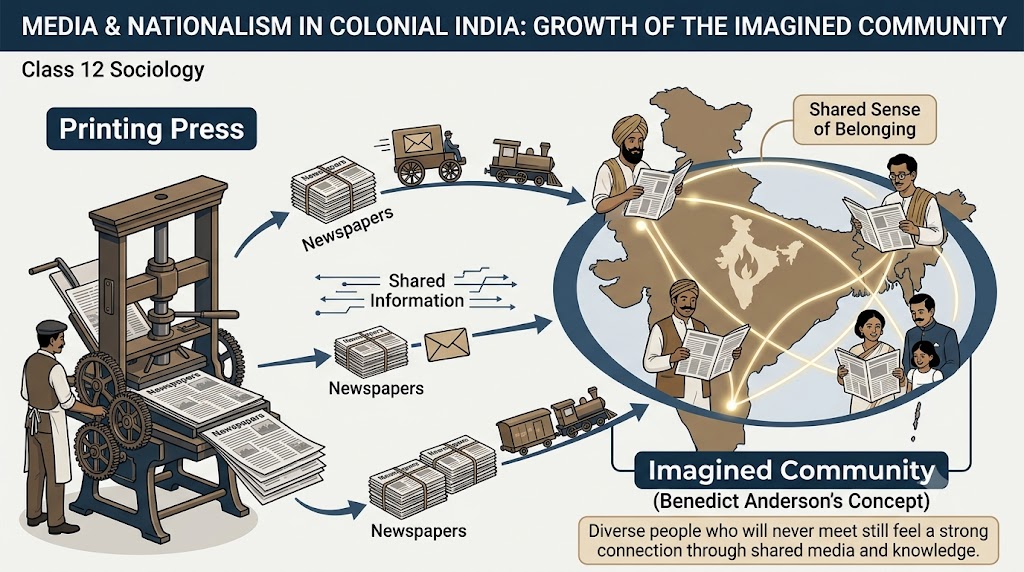
- Colonial Press and Nationalism: The growth of Indian nationalism was closely linked to the nationalist press, which opposed oppressive colonial measures. The colonial government clamped down on the press through censorship and other restrictions. Newspapers like Kesari (Marathi), Mathrubhumi (Malayalam), and Amrita Bazar Patrika (English) suffered the displeasure of the colonial state.
- Key Publications:
- Raja Rammohun Roy started Sambad-Kaumudi (Bengali, 1821) and Mirat-Ul-Akbar (Persian, 1822) with a distinct nationalist and democratic approach.
- Fardoonji Murzban started the Bombay Samachar (Gujarati, 1822).
- Ishwar Chandra Vidyasagar started Shome Prakash (Bengali, 1858).
- The Times of India (1861), The Pioneer (1865), The Madras Mail (1868), The Statesman (1875), and The Civil and Military Gazette (1876) were also founded.
2. Mass Media in Independent India: The State-Led Approach
After independence, Jawaharlal Nehru called upon the media to function as the 'watchdog of democracy'. The media was expected to spread self-reliance, national development, and fight against oppressive social practices like untouchability, child marriages, and ostracism of widows.
The Radio (AIR):
- At independence, there were only 6 radio stations in major cities and 280,000 radio receiver sets for a population of 350 million.
- The 'transistor revolution' in the 1960s made radios more accessible and mobile.
- In 1957, AIR acquired the hugely popular channel Vividh Bharati, which began carrying sponsored programmes and advertisements, growing into a money-spinning channel.
- Indian listeners tuned to Radio Ceylon and Radio Goa to enjoy Indian film music and commercials, as AIR initially considered them 'low-culture'.
- By 2000, about 110 million households (two-thirds of all Indian households) were listening to radio broadcasts in 24 languages and 146 dialects.
Television (Doordarshan):
- Television programming was introduced experimentally in India to promote rural development as early as 1959.
- The Satellite Instructional Television Experiment (SITE) broadcasted directly to community viewers in rural areas of six states between August 1975 and July 1976.
- The advent of colour broadcasting during the 1982 Asian Games in Delhi led to rapid commercialisation.
- Indigenous soap operas like Hum Log (1984-85) and Buniyaad (1986-87) attracted substantial advertising revenue for Doordarshan.
Hum Log: This was India's first long-running soap opera, utilising an entertainment-education strategy. It promoted social themes like gender equality, small family size, and national integration. Ashok Kumar summarised the educational lessons in an epilogue. It achieved high audience ratings in North India and was supported by a large number of letters from viewers.
3. Globalisation and the Media: The Market Takes Over
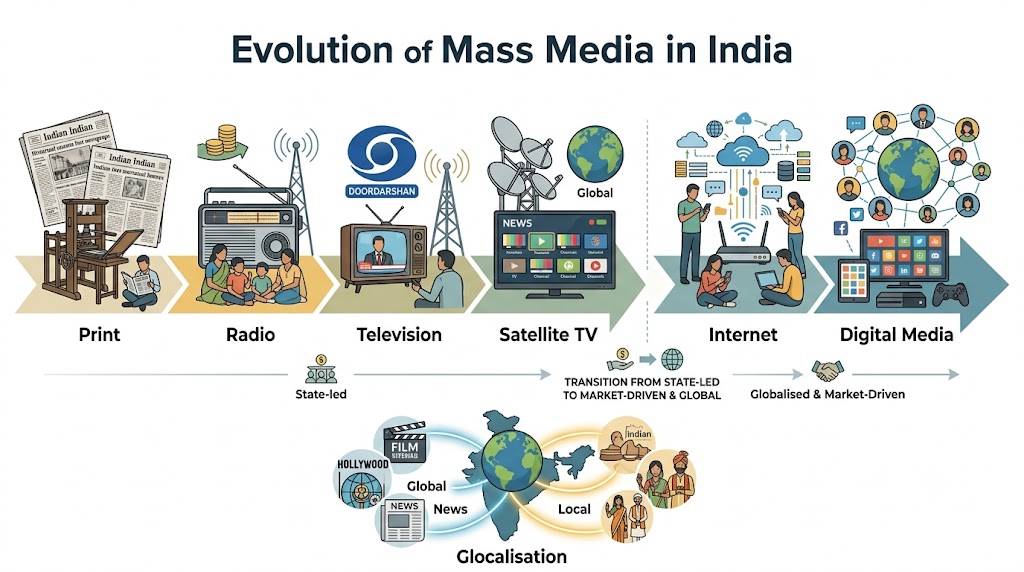
The last three decades have seen profound transformations in the media industry. National markets have given way to a more fluid global market, and new technologies have led to the fusion of media forms that were once distinct.
Television Expansion:
- In 1991, there was one state-controlled TV channel, Doordarshan. By 1998, there were almost 70 channels.
- The Gulf War of 1991 popularised CNN, and the launching of Star-TV in the same year signalled the arrival of private satellite channels in India.
- In 1992, Zee TV, a Hindi-based satellite channel, began beaming programmes to cable television viewers.
- By 2000, there were 40 private cable and satellite channels available, including several focusing on regional languages like Sun-TV, Eenadu-TV, and Asianet.
- The number of cable operators exploded from 100 in 1984 to 60,000 in 1999.
Glocalisation: Transnational channels realised that using the familiar is more effective. STAR TV converted its all-English channel to a Hindi channel in 1999 with the slogan 'Aapki Boli. Aapka Plus Point'. Many foreign networks introduced Hindi segments or entire Hindi channels.
Print Media:
- The rise of Indian language newspapers has been phenomenal. The Hindi daily Hindustan jumped from 64,000 copies in 2003 to 425,000 by 2005.
- As per the National Readership Study (NRS 2006), Indian language dailies grew from 191 million to 203.6 million readers, while English dailies stagnated at around 21 million.
- Newspapers have become consumer products, increasingly dependent on advertisers. This has led to a trend of 'infotainment' – a combination of information and entertainment to sustain reader interest.
4. The Dialectical Relationship: Media, Society, and the Digital Divide
The relationship between mass media and society is dialectical—both influence each other. However, there are sharp differences in how easily different sections of society can access and use mass media.
Digital Divide: The development of communication technologies like the internet and mobile phones has not been uniform. As of 2000, India had 3 million Internet subscribers and 15 million users, thanks to the proliferation of cyber cafes. However, rural areas with erratic power supply and widespread illiteracy remained largely unconnected.
Telecommunications Expansion:
- When India gained independence in 1947, there were 84,000 telephone lines for a population of 350 million.
- By 1999, India had over 25 million telephone lines, making its network the ninth largest in the world.
- By 2006, India had become the country with the fourth largest usage of cell phones globally.
Radio's Resurgence: The advent of privately owned FM radio stations in 2002 provided a boost to entertainment programmes. Many FM channels, like Radio Mirchi, Red FM, and Radio City, specialise in popular music to retain audiences.
Fusion of Media: The Internet allows music to be downloaded digitally, threatening the traditional music industry. This fusion of media forms has also led to phenomena like downloading ringtones for mobile phones and audience participation through SMS voting in television shows.
5. The Media and Social Change: Key Concerns
Mass media can be a powerful tool for social change, but it can also be used to perpetuate inequality and stereotypes. The media's role is shaped by the economic and political context in which it operates.
Commercialisation and Consumerism: Media promotes a culture where spending is important. Advertisements and programmes target the urban consuming class, creating a new cadre of superstars and shaping the growth of cities through shopping malls and multiplexes.
The Challenge of Profit vs. Public Service: Newspapers are increasingly dependent on advertisers, who become the primary customers. This can shift the focus from issues affecting the rural poor and small towns to catering to potential customers of advertisers. The media is expected to serve as a watchdog, but this role is often compromised by market pressures.
Cultural Homogenisation vs. Glocalisation: There is a fear that globalisation will lead to cultural homogenisation. However, a counter-trend is glocalisation – the mixing of the global with the local. This is not just a market strategy but also a genuine cultural synthesis, as seen in fusion music and Bollywood films set entirely outside India.
Television's Intrusion into Private Lives: Events like the rescue of Prince, a 5-year-old boy who fell into a borewell, were broadcast live, sparking debates about voyeurism and the role of media in highlighting the plight of the rural poor.
6. Key Figures in Indian Media History
| Individual / Event | Contribution / Milestone |
|---|---|
| Johann Gutenberg | Inventor of the printing press |
| Raja Rammohun Roy | Started Sambad-Kaumudi (Bengali, 1821) and Mirat-Ul-Akbar (Persian, 1822) |
| Fardoonji Murzban | Started the Bombay Samachar (Gujarati, 1822) |
| Ishwar Chandra Vidyasagar | Started Shome Prakash (Bengali, 1858) |
| Jawaharlal Nehru | Encouraged media to act as a watchdog of democracy |
| Benedict Anderson | Argued that the nation is an 'imagined community' |
| Vividh Bharati | Acquired by AIR in 1957 and became a popular, commercially successful channel |
Common Mistakes
- Confusing the roles of different media personalities. For example, Fardoonji Murzban started the Bombay Samachar, while Raja Rammohun Roy started Sambad-Kaumudi.
- Thinking that television programming was introduced to promote urban development. It was actually introduced to promote rural development.
- Assuming that the radio has died out. In India, radio continued to reach a large proportion of households, and FM radio saw a resurgence after 2002.
- Believing that globalisation leads to complete cultural homogenisation. The reality is more complex, with 'glocalisation' being an important counter-trend.
- Forgetting that print media has not simply declined with the rise of electronic media. Indian-language newspapers have expanded significantly, although newspapers are increasingly dependent on advertisers.
- Confusing liberalisation, globalisation and glocalisation. Liberalisation refers to reducing state restrictions, globalisation refers to increasing worldwide interconnectedness, while glocalisation refers to the adaptation or mixing of global and local elements.