This chapter explores the nature and evolution of class-based social movements in India, focusing on peasant and worker movements, their historical context, key issues, and the challenges they face in a changing political and economic landscape.
1. Peasant Movements: A Historical Overview
Peasant movements or agrarian struggles have been a persistent feature of Indian society. They range from localised, pre-colonial revolts to large-scale, organised movements.
Colonial Period (1858-1914): These movements were often localised, disjointed, and confined to particular grievances. Key examples include:
- Bengal Revolt (1859-62): A struggle against the indigo plantation system.
- Deccan Riots (1875): A revolt against moneylenders.
Gandhian Era: Some of these issues became linked to the Independence movement under the leadership of Mahatma Gandhi.
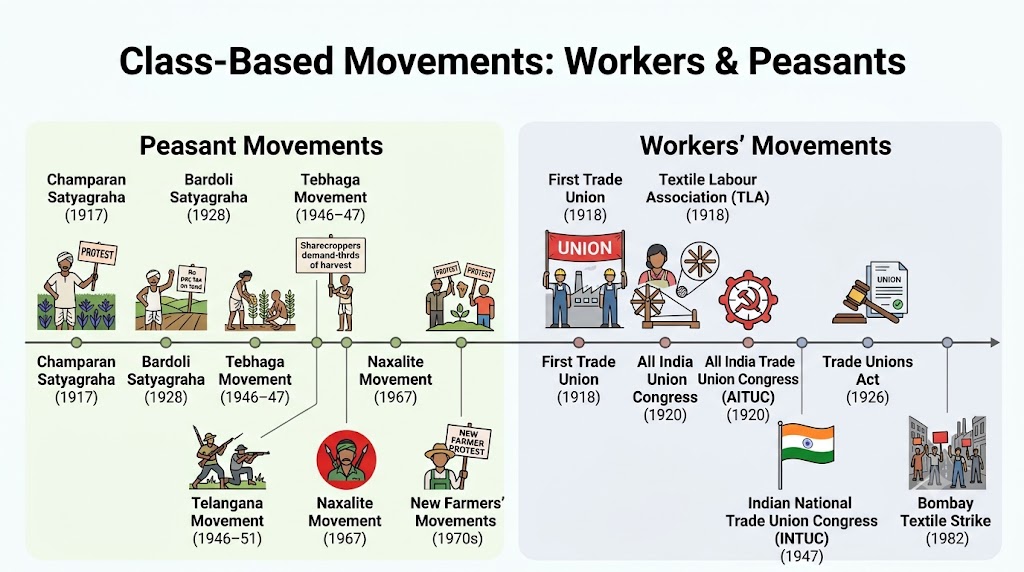
- Champaran Satyagraha (1917-18): Directed against the oppressive indigo plantation system.
- Bardoli Satyagraha (1928, Surat District): A 'no-tax' campaign against the enhanced land revenue assessment, led by Sardar Vallabhbhai Patel.
Organisation of Peasants (1920-1940): The first peasant organisation to be founded was the Bihar Provincial Kisan Sabha (1929), followed by the All India Kisan Sabha (1936). These organisations demanded freedom from economic exploitation for peasants, workers, and all other exploited classes.
Classical Peasant Movements at the Time of Independence:
- Tebhaga Movement (1946-47): A struggle of sharecroppers in Bengal and North Bihar for two-thirds share of their produce instead of the customary half. It had the support of the Kisan Sabha and the Communist Party of India (CPI).
- Telangana Movement (1946-51): Directed against the feudal conditions in the princely state of Hyderabad, led by the CPI.
2. The Naxalite Movement and 'New Farmer's Movements'
The post-1947 period saw the emergence of two major social movements, shaped by the changing agrarian structure and state policies.
Naxalite Movement: This started from the region of Naxalbari (1967) in Bengal.
- Issues: The central problem for peasants was land. The movement sought to remove oppressive landlords and state officials.
- Mode of Protest: It involved the formation of peasant committees, armed guards, and the setting up of a parallel administration.
- Impact: It is a growing force even today, highlighting the persistence of agrarian problems.
New Farmer's Movements: These began in the 1970s in Punjab and Tamil Nadu.
- Key Features: They were regionally organised, non-party, and involved farmers (market-involved) rather than peasants.
- Ideology: Strongly anti-state and anti-urban, focusing on issues like price procurement, remunerative prices, agricultural inputs, taxation, and non-repayment of loans.
- Methods of Agitation: Blocking roads and railways, and refusing politicians and bureaucrats entry to villages.
3. Workers' Movements: Emergence and Development
Factory production began in India in the early 1860s, primarily in port towns like Calcutta (Kolkata) and Bombay (Mumbai). The colonial regime did not regulate wages or working conditions, making labour very cheap.
Early Protests: Worker protests were initially more spontaneous than sustained. During the First World War, there were waves of strikes due to food shortages and sharp price increases. Around 30 recorded strikes occurred in the Bombay textile mills in September-October 1917.
Formation of Trade Unions:
- First Trade Union: The first trade union was established in April 1918 in Madras by B.P. Wadia, a social worker and member of the Theosophical Society.
- Textile Labour Association (TLA): Founded by Mahatma Gandhi in 1918.
- All India Trade Union Congress (AITUC): Formed in Bombay in 1920. It was a broad-based organisation with diverse ideologies, including communists (S.A. Dange, M.N. Roy), moderates (M. Joshi, V.V. Giri), and nationalists (Lala Lajpat Rai, Jawaharlal Nehru).
Key Legislation: In 1922, the fourth Factories Act reduced the working day to 10 hours. The Trade Unions Act was passed in 1926, providing for the registration of trade unions.
Political Splits: In 1947, the Indian National Congress formed the Indian National Trade Union Congress (INTUC). This was followed by further splits on the lines of political parties, with regional parties also forming their own unions from the late 1960s.
4. Major Workers' Struggles: The Bombay Textile Strike
The Bombay Textile Strike of 1982 is a landmark event in the history of the Indian working-class movement.
- Leadership: The strike was led by trade union leader Dr. Datta Samant.
- Scale: It affected nearly a quarter of a million workers and their families and lasted nearly two years.
- Demands: Workers wanted better wages and the right to form their own union. According to the Bombay Industrial Relations Act (BIRA), a union had to be 'approved', and could only be approved if it gave up the idea of strikes.
- Opposition: The Congress-led Rashtriya Mill Mazdoor Sangh (RMMS) was the only approved union and helped to break the strike by bringing in other workers.
- Outcome: After two years, workers went back to work because they were desperate. Nearly one lakh workers lost their jobs and went back to their villages or took up casual labour. Mill owners did not invest in modernisation and are now selling off mill land to real estate dealers to build luxury apartments.
Common Mistakes
- Confusing 'peasant movements' with 'new farmer's movements'. Peasant movements involve subsistence farmers and sharecroppers, while new farmer's movements involve market-involved farmers and focus on prices and related issues.
- Thinking that the Naxalite movement is a reformist movement. It is a revolutionary movement that seeks to radically transform social relations through armed struggle.
- Forgetting that the first trade union was established in 1918 in Madras by B.P. Wadia, not in Bombay.
- Assuming that the Bombay Textile Strike of 1982 succeeded in achieving its demands. In reality, workers lost their jobs and the strike ultimately failed.
- Believing that the INTUC was formed in 1920. It was formed by the Congress in 1947, while the AITUC was formed in 1920.