Caste is India's most distinctive and enduring form of social stratification — a birth-based, hierarchical, and endogamous system that has shaped social interaction, occupation, and access to resources for centuries, and remains a heavily tested CUET topic through its features, theories of origin, and key thinkers.
Meaning and Definition
The word 'Caste' comes from the Portuguese term 'Casta', meaning breed, race, or lineage. A caste is an ascribed status — an individual is born into it, and this status is normally permanent and unchangeable through personal achievement.
- G.S. Ghurye: Castes are small, complete social worlds in themselves, marked off definitely from one another though existing within the larger society.
- MacIver: When status is wholly predetermined so that people are born into their position without hope of change, class takes the extreme form of caste.
- A.W. Green: Caste is a system of stratification in which upward or downward mobility, at least ideally, may not occur.
Caste is largely a South Asian phenomenon — India, Pakistan, Bangladesh, and Nepal — though elements of caste-like stratification have appeared in other ancient societies too. In India, three institutions traditionally anchor the social system: caste, the joint family, and the village community — of these, caste is considered the most defining feature of Hindu society.
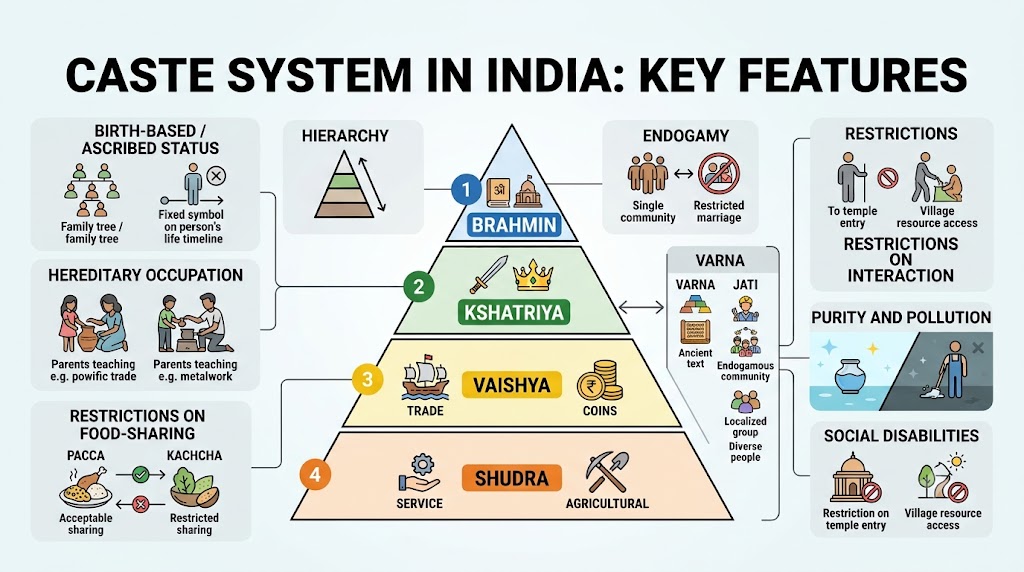
Key Features of the Caste System
- Segmental division of society: Society is broken into numerous small, well-developed social groups (castes), each with membership based on birth, its own name, and its own governing body — the caste council or 'jati panchayat' — that enforces internal rules.
- Hierarchy: Castes are ranked in a fixed order of superiority and inferiority. In the traditional Varna order, Brahmins (priests/scholars) sit at the top, followed by Kshatriyas (rulers/warriors), then Vaishyas (traders), with Shudras at the bottom.
- Restrictions on interaction: Members of different castes, especially superior and inferior ones, cannot freely mix; well-defined norms govern all inter-caste contact.
- Social and religious disabilities: Lower castes historically faced bans on entering temples, using common wells, living in certain localities, and studying religious texts.
- Restrictions on commensality (food-sharing): Rules govern who can eat what with whom. Unfried food is split into 'pacca' (cooked with ghee) and 'kachcha' (cooked with water) — kachcha food can only be accepted from one's own caste or a higher one.
- Ideology of purity and pollution: Higher castes are seen as pure, lower castes as polluting. This purity–pollution framework was theorised by anthropologist Louis Dumont.
- Restrictions on occupation: Each caste has a traditional occupation fixed by birth — e.g., a Shudra could not become a priest, and a Brahmin was barred from occupations seen as impure.
- Marital restrictions — endogamy: Members must marry within their own caste; inter-caste marriage is traditionally prohibited.
- Hereditary/ascribed status: Caste membership is fixed at birth and does not change regardless of an individual's qualifications or achievements later in life.
Castes, Sub-Castes (Jati), and Social Stratification
Each broad caste (Varna) is divided into numerous sub-castes or jatis, which often share a common traditional occupation or lineage but may differ in status within the wider caste framework.
- Example: The Brahmin caste includes sub-castes like Kayasth (scholars/bureaucrats); the Kshatriya caste includes groups like Rajputs.
- M.N. Srinivas argued that treating the four-fold Varna division as if it were the same as the caste system is an oversimplification — the real functioning unit of the caste system is the jati, an endogamous community with its own ritual status and traditionally linked occupation.
Because mobility between castes is restricted, the system perpetuates social inequality — higher castes retain privilege and access to resources, while lower castes face limited opportunity. Some inter-caste marriages occur, but strict endogamy remains the norm in most communities, reinforcing caste boundaries across generations.
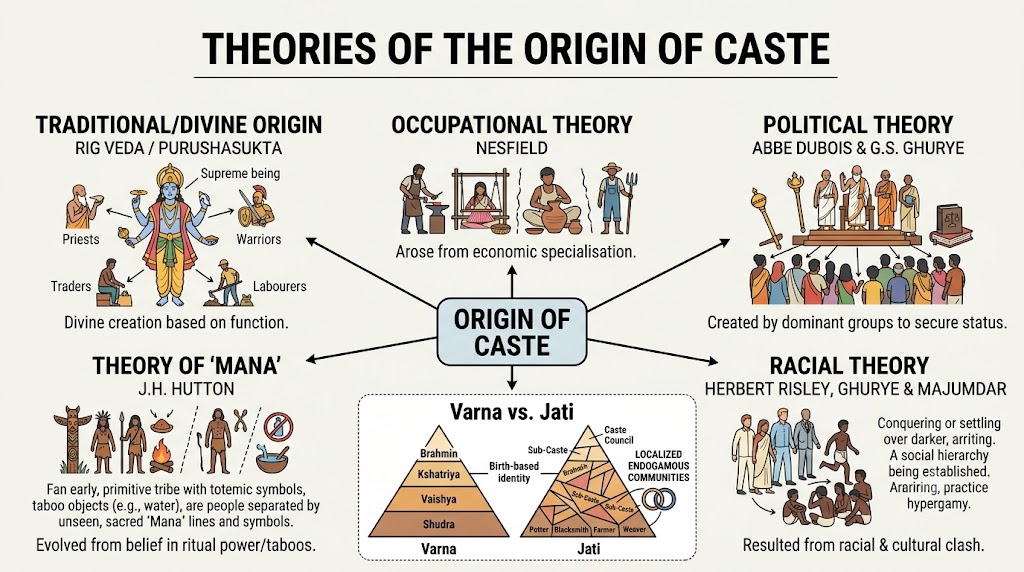
Theories of the Origin of Caste
| Theory | Key Proponent(s) | Core Argument |
|---|---|---|
| Traditional/Divine Origin | Rooted in Vedic literature (Purushasukta hymn, Rig Veda) | Brahma created the four Varnas from his body — Brahmin from the mouth, Kshatriya from the arms, Vaishya from the thighs, Shudra from the feet; explained through the doctrines of karma and dharma. |
| Occupational Theory | Nesfield | Caste arose purely from the occupational division of Hindu society — 'function and function alone' produced caste; noble occupations formed superior castes. |
| Political Theory | Abbe Dubois, G.S. Ghurye | Caste was a deliberate device created and maintained by Brahmins to retain religious and political authority and social privilege. |
| Theory of 'Mana' | J.H. Hutton | Caste elements existed even before the Aryan invasion; belief in an impersonal supernatural power ('Mana') attached to people/objects, protected by taboos on food-sharing, marriage, and contact, laid the groundwork for caste-like separation. |
| Racial Theory | Herbert Risley, Ghurye, Majumdar | Caste emerged from the clash of races and cultures when fair-skinned Aryan conquerors placed themselves above the darker non-Aryan natives, practising hypergamy but not hypogamy with them. |
Risley's six processes behind the growth of new castes: change of traditional occupation, migration, adoption of new customs, deliberate preservation of old customs, entry of tribal groups into the Hindu fold, and the rise of new sects around religious leaders.
Each theory has drawn criticism — e.g., the divine-origin theory is criticised for treating Varna and caste (jati) as identical, which Srinivas called an oversimplification; the racial theory is criticised because race-contact alone does not explain why untouchability specifically arose only in India.
Functions of the Caste System
- Social order and stability: Clearly defined roles for each caste reduce competition and conflict over status and resources.
- Social cohesion: Shared caste identity fosters cooperation, mutual support, and a strong sense of community among members.
- Division of labour: Fixed occupational roles historically produced specialisation and efficiency in economic activity.
- Cultural transmission: Skills, traditions, and knowledge are passed down within a caste through generations, preserving cultural continuity.
Caste, Inequality, and Contemporary Relevance
The caste system has been a major source of social inequality and discrimination. Lower castes, particularly Dalits (formerly termed 'untouchables'), have historically faced systemic exclusion from education, employment, and political power.
- Legal reform: Independent India enacted laws prohibiting caste-based discrimination and promoting equality, but eliminating deep-rooted social norms remains an ongoing challenge.
- Affirmative action: Reservation and education programmes target improved social mobility for disadvantaged castes.
- Global diaspora: Caste-based associations have emerged among diaspora communities abroad, both preserving cultural ties and continuing advocacy against caste discrimination.
Common Mistakes
- Treating 'Varna' and 'caste (jati)' as identical — Varna is the broad four-fold classification, while jati is the actual localised, endogamous caste group with its own occupation and status.
- Calling caste an 'achieved' status — it is strictly an ascribed (birth-based) status; CUET questions often test this ascribed-vs-achieved distinction directly.
- Assuming all theories of caste origin agree — each (traditional, occupational, political, Mana, racial) offers a different explanatory mechanism and each has been separately criticised.
- Confusing 'pacca' and 'kachcha' food rules — kachcha (water-cooked) food carries stricter caste-sharing restrictions than pacca (ghee-cooked) food.
- Forgetting that endogamy, not exogamy, is the marital rule enforced by caste.