Tribal communities in India — constitutionally recognised as Scheduled Tribes — have historically maintained a close, subsistence-based relationship with land and forests, but colonial exploitation and post-independence 'development' projects have repeatedly displaced and marginalised them, making this a key topic linking sociological theory (Sen's capability approach, cultural disintegration) with concrete legal frameworks (PESA, FRA, LARR) and empirical data (Fernandes's displacement research).
Defining Tribal Communities
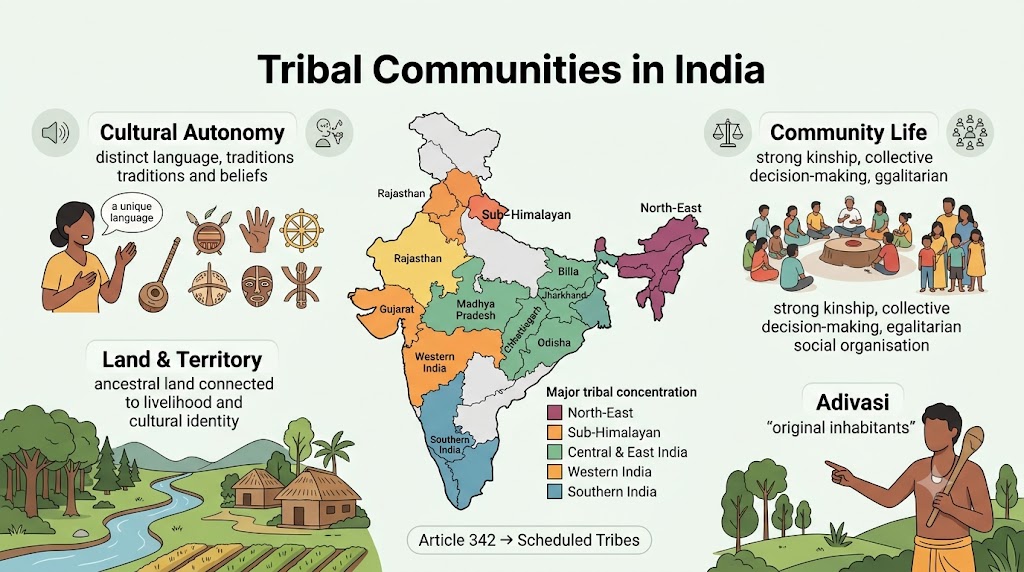
Tribal communities share a common cultural heritage, language, traditions, and often a distinct territory, with strong ancestral connections and unique social structures. Also called indigenous peoples — those permanently settled in an area for generations, with distinct cultures and ways of life.
- The Indian term 'Adivasi' (a modern Sanskrit word) specifically means 'original inhabitants' of a region.
- The Oxford Advanced Learner's Dictionary defines a tribe as a group of people of the same race, sharing customs, language, and religion, living in a particular area, often led by a chief. The English word traces back to the Latin/Roman 'Tribus', denoting a division within the state.
- Under Article 342 of the Indian Constitution, the President specifies which tribes/communities are deemed Scheduled Tribes for a given State/Union Territory; Parliament can subsequently include or exclude tribes from this list by law. There are over 600 Scheduled Tribes recognised under Article 342.
Key features of tribal social organisation:
- Cultural autonomy: distinct practices, beliefs, and customs setting them apart from mainstream society.
- Community-centric: strong social bonds, collective decision-making, deep sense of community; tribal societies are generally egalitarian — no institution based on caste, class, or sex (though the chief's position carries higher status).
- Land and territory: ancestral lands hold deep cultural AND economic significance — loss of land is not just economic loss but cultural rupture.
- Belief systems often centre on animism, magic, and spirits, with taboos governing daily life; tribes often prefer isolated terrain and resist outside intrusion.
Caste-Tribe Conceptual Overlap
The boundary between 'tribe' (janjati) and 'caste' (jati) is not sharply defined in India:
- The Indian Constitution does not define 'tribe', so there is no uniform definition among social scientists.
- Even colonial-era writers were unclear about the caste-tribe divide — many mixed castes were classified as tribes.
- 'Jan' means 'people', reflected in related terms like janjati (tribe) — the terminological closeness with 'jati' (caste) contributes to conceptual blurring.
- This ambiguity is compounded by the fact that tribes themselves have internal sub-divisions, similar to caste sub-divisions (jatis within varnas).
Geographic Distribution and Classification of Tribes
Anthropologist L.P. Vidyarthi identified four major tribal regions in India: Himalayan, Middle India, Western India, and Southern India.
| Region | States Covered | Example Tribes |
|---|---|---|
| North-Eastern region | Assam, Arunachal Pradesh, Mizoram, Nagaland, Tripura | Garo, Kuki, Mizo, Khasi, Monda, Nagas |
| Sub-Himalayan region | Himalayan belt states | Gurjar, Gaddi, Theru, Jaunsari |
| Central and East India | West Bengal, Odisha, Madhya Pradesh, Uttar Pradesh | Baiga, Bondo, Joang, Kol, Santhal, Munda, Bhils, Ho, Pahadiya |
| South India | Tamil Nadu, Kerala, Andhra Pradesh, Karnataka | Kadar, Tod, Gonds, Chenchu, Koya |
| Western India | Rajasthan, Maharashtra, Gujarat | Bhils, Gonds, Korku, Koli, Thakar, Warli, Munda, Katkari, Pardhans, Khond |
Language classification: Austric, Tibeto-Chinese, Dravidian, and Indo-European language groups.
Ethnic/racial classification: Mongoloid origin, Proto-Australoid, and Negrito.
Concentration by state (Census 2011):
- Highest concentration: Lakshadweep (94.8%), Mizoram (94.4%), Nagaland (86.5%)
- Lowest concentration: Uttar Pradesh (0.6%), Tamil Nadu (1.1%), Bihar (1.3%)
- States/UTs with no tribal population: Punjab, Haryana, Chandigarh, Delhi, Puducherry
Causes of Marginalisation: Historical and Structural
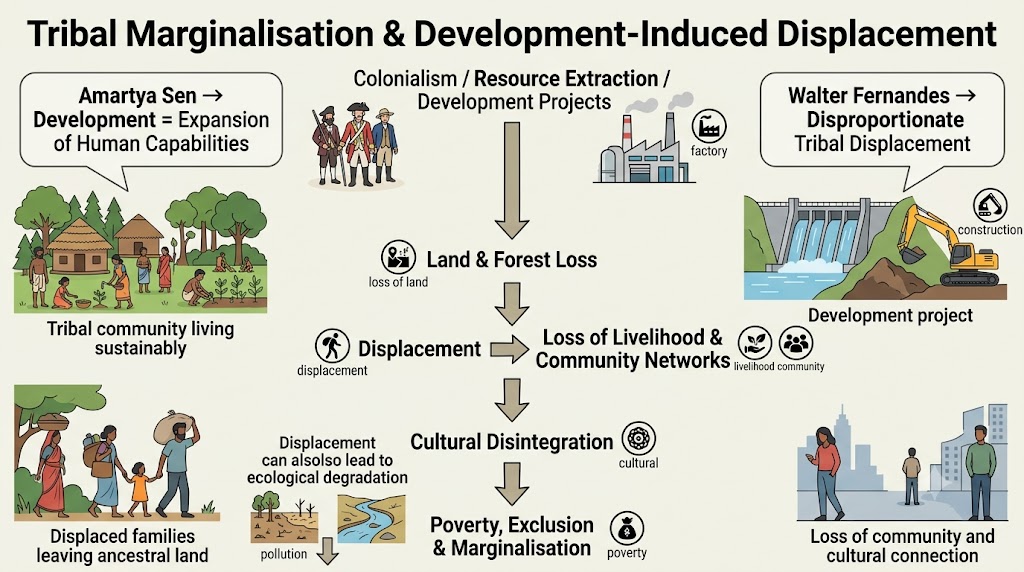
- Colonialism and imperialism: colonised tribal territories led to dispossession of land, disruption of traditional lifestyles, and forced assimilation.
- Cultural suppression: systematic attempts to erase indigenous cultures — discouraging native languages, traditions, and spiritual practices.
- Economic disparities: lack of access to quality education, healthcare, and employment perpetuates cycles of poverty.
- Legal and political exclusion: historical exclusion from political processes and decision-making bodies affecting tribal lives, producing powerlessness.
- Missionary influence: from the British period onward, tribal communities in several areas faced pressure to convert to Christianity — a continuing point of contention.
Contemporary drivers:
- Land rights and eviction: continued dispossession for development projects, agriculture, or resource extraction, often without adequate compensation or consultation.
- Discrimination in access to services: systemic bias and lack of cultural sensitivity in education, healthcare, social services.
- Stigma and stereotypes: negative societal perceptions reinforce discrimination and exclusion.
Important distinction (common exam trap): 'Resistance to cultural assimilation' is a response to marginalisation, NOT a root cause of it — the actual causes are structural/historical factors like colonialism, economic disparity, and legal exclusion.
Development-Induced Displacement: The Sociological Framing
Development-induced displacement is not merely physical relocation — it is a profound disruption of social structure, cultural identity, and economic systems. When tribal communities (marked by strong kinship ties, community ownership of resources, and subsistence economies) are displaced, sociologists term the resulting breakdown 'cultural disintegration'.
- Amartya Sen's capability approach: true development must enhance human capabilities, not merely increase economic output. Tribal displacement — causing loss of livelihood, food insecurity, and social alienation — directly contradicts this capability-centred view of development.
- Walter Fernandes's research: documented that a disproportionate share of India's displaced population is tribal, despite tribes forming only a small percentage of the total population — evidence of structural bias in development policy, where marginalised groups bear the cost of national progress without equitable compensation.
- Ecological contradiction: tribal communities have traditionally practised sustainable living, preserving biodiversity — yet development projects that displace them often cause environmental degradation, undermining the very justification (progress) used to displace them.
Rehabilitation, Resettlement, and Key Legal Frameworks
| Law/Act | Year | Purpose |
|---|---|---|
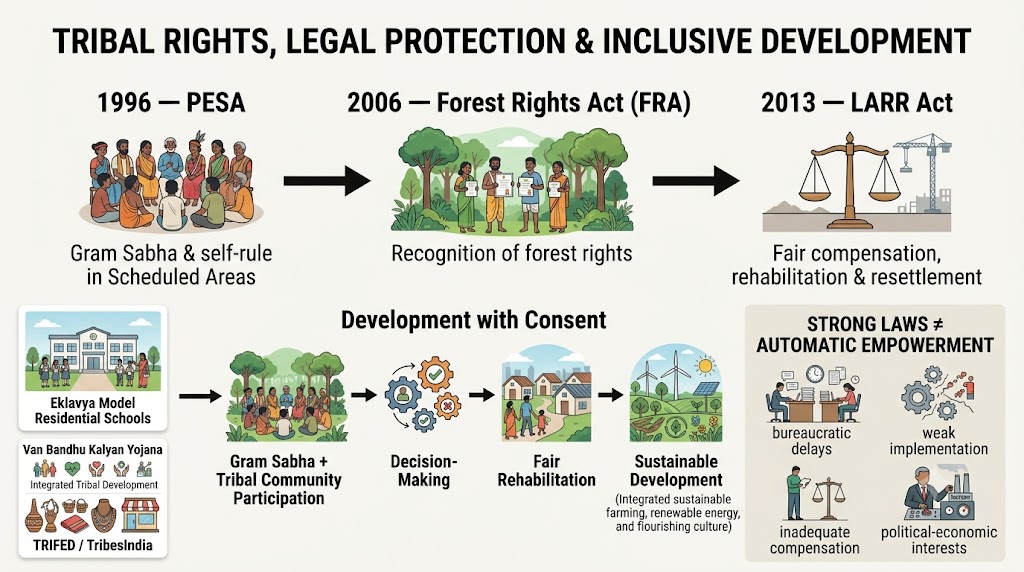
| Panchayats (Extension to Scheduled Areas) Act (PESA) | 1996 | Extends Part IX of the Constitution to Scheduled Areas; empowers Gram Sabhas as the central unit for self-rule; protects tribal customs, traditions, and cultural identity |
| Scheduled Tribes and Other Traditional Forest Dwellers (Recognition of Forest Rights) Act (FRA) | 2006 | Recognises tribal rights to hold and live on forest land under occupation for livelihood, including ownership rights |
| Right to Fair Compensation and Transparency in Land Acquisition, Rehabilitation and Resettlement Act (LARR) | 2013 | Legal framework for fair compensation during land acquisition — but implementation remains inconsistent |
| SC/ST (Prevention of Atrocities) Act — Amendment | 1989 (amended 1995, 2015, 2018) | Punishes crimes against Scheduled Castes/Tribes; provisions include no anticipatory bail, speedy proceedings, victim compensation |
Key implementation problems:
- Compensation under rehabilitation/resettlement (R&R) policy is often monetary only — failing to account for non-material losses like cultural heritage, community cohesion, and traditional knowledge systems.
- PESA and FRA remain underutilised due to bureaucratic inertia and political-economic interests, despite their strong legal design.
- Forest Pattas (ownership documentation): over 58 lakh applications were filed, but only about 14 lakh individual pattas have been issued (plus some community-level grants) — a major implementation gap.
- The 2018 Subhash Kashinath Mahajan vs. State of Maharashtra case raised concerns about misuse of the SC/ST Atrocities Act, leading to dilution of some protections — subsequently restored by a later amendment act.
Consequences of Marginalisation and Exclusion
Social and cultural impact:
- Cultural erosion: language loss, decline of traditional knowledge, disappearance of cultural practices.
- Social disintegration: weakened social structures, reduced community cohesion, increased interpersonal conflict under external pressure.
- Mental health impact: higher rates of depression, anxiety, and substance abuse linked to social exclusion and discrimination.
Economic and development impact:
- Poverty and unemployment: limited economic opportunity and resource access.
- Underdeveloped infrastructure: inadequate transport, communication, and basic services hinder market access.
- Dependency: exclusion from mainstream economies can create dependency on external aid rather than addressing underlying structural causes.
- Displaced tribals, once self-reliant within their ecosystems, are frequently pushed into urban peripheries or unfamiliar rural settings where they lack the skills to compete in market economies — compounding poverty, unemployment, and exploitation risk.
Strategies for Inclusion and Government Initiatives
Legal/policy frameworks: Indigenous rights laws, constitutional reforms explicitly recognising tribal rights, and strong policy implementation with community participation and monitoring.
Education and cultural preservation:
- Bilingual education incorporating indigenous languages and cultural content.
- Cultural revitalisation programmes for language, arts, and traditional knowledge.
- Community-based learning involving tribal elders for culturally relevant education.
Economic empowerment:
- Livelihood diversification (sustainable agriculture, ecotourism, artisanry) to reduce dependence on external aid.
- Microfinance and business support tailored to indigenous entrepreneurs.
- Land reform restoring ancestral lands and prioritising indigenous land-use rights.
Key government initiatives (India-specific):
- Ekalavya Model Residential Schools — notable alumna: mountaineer Poorna Malavath, who climbed Everest.
- Van Bandhu Kalyan Yojana — Central Government scheme for holistic tribal development and welfare.
- TRIFED's TribesIndia — chain of showrooms marketing tribal handicrafts, textiles, and jewellery.
Contemporary policy direction: growing advocacy for 'development with consent' and 'bottom-up planning' — involving tribal communities directly in decisions that affect them, aligning with democratic decentralisation and social justice principles.
Conservation nuance: research suggests local tribal communities protect ecosystems more effectively than outsider-led conservation; removing tribal people and fencing off land for 'protection' lacks strong basis — sometimes critiqued as 'bourgeois environmentalism' (urban-centric conservation disconnected from ground realities). Millions of tribal people have faced displacement/harassment specifically for tiger reserve and mining projects.
Common Mistakes
- Treating 'resistance to cultural assimilation' as a root cause of tribal marginalisation — it is a RESPONSE to marginalisation, not a cause; actual causes are structural/historical (colonialism, economic disparity, legal-political exclusion).
- Assuming forced relocation or removing tribal people from conservation areas is an effective inclusion/conservation strategy — both PYQ-style logic and sociological research indicate these are counterproductive, disrupting communities and lacking ecological basis ('bourgeois environmentalism').
- Confusing 'tribe' and 'caste' as cleanly distinct categories — the Indian Constitution does not define 'tribe', and even colonial writers struggled with this boundary; the concepts are historically porous, not neatly separate.
- Treating displacement compensation as adequate because it is monetary — NCERT/UPSC-level material stresses that monetary compensation fails to address non-material losses (cultural heritage, community cohesion, traditional knowledge).
- Assuming legal protections like PESA and FRA automatically translate into real tribal empowerment — both remain significantly underutilised due to bureaucratic inertia and political-economic interests, a key critique point for exam answers.
- Missing the specific numbers around Forest Pattas (58 lakh applied vs. ~14 lakh individually issued) — a concrete implementation-gap statistic that can appear in factual questions.
- Conflating Sen's capability approach with a purely economic definition of development — the entire point of citing Sen is to contrast capability-enhancement against mere output growth, which tribal displacement undermines.