Tribal communities are among the oldest inhabitants of the Indian subcontinent, traditionally defined by what they lacked — a written religious text, a state, sharp class divisions, and caste — making this a frequently tested CUET topic covering classification, identity formation, and the tension between tribal autonomy and national development.
Defining Tribes: A Negative Definition
'Tribe' is a modern term applied to communities that are among the oldest inhabitants of the subcontinent. Sociologically, tribes have traditionally been defined in terms of what they were not:
- Did not practice a religion with a written text
- Did not have a state or political form of the normal kind
- Did not have sharp class divisions
- Did not have caste, and were neither Hindu nor peasant
This 'negative' definition is itself a key CUET point — tribes are characterised relationally, by contrast with caste-based Hindu peasant society, rather than through a single positive defining feature.
Classification of Tribes: Permanent Traits
Tribes are classified using permanent traits — features that are relatively fixed and long-standing — including geography, language, and physical-racial type.
- Geographic distribution: About 85% of the tribal population lives in 'middle India' — a wide band from Gujarat and Rajasthan in the west to West Bengal and Odisha in the east, with Madhya Pradesh, Jharkhand, Chhattisgarh, and parts of Maharashtra and Andhra Pradesh at its core.
- Of the remaining population, over 11% lives in the North-Eastern states, and just over 3% live in the rest of India.
- North-Eastern states have the highest concentrations — every state except Assam has over 30% tribal concentration, with Arunachal Pradesh, Meghalaya, Mizoram, and Nagaland ranging from 60% up to 95%.
- Habitat: hills, forests, rural plains, and urban industrial areas.
| Language Group | Note |
|---|---|
| Indo-Aryan | Shared with rest of Indian population; tribes account for only ~1% of speakers |
| Dravidian | Shared with rest of population; tribes account for ~3% of speakers |
| Austric | Spoken almost entirely by tribals (100%) |
| Tibeto-Burman | Over 80% of speakers are tribal |
- Physical-racial classification: Negrito, Australoid, Mongoloid, Dravidian, and Aryan categories.
- Largest tribes (each at least a million strong): Gonds, Bhils, Santhals, Oraons, Minas, Bodos, and Mundas.
- Total tribal population: about 8.2% of India's population, roughly 84 million persons per the 2001 Census.
Classification of Tribes: Acquired Traits
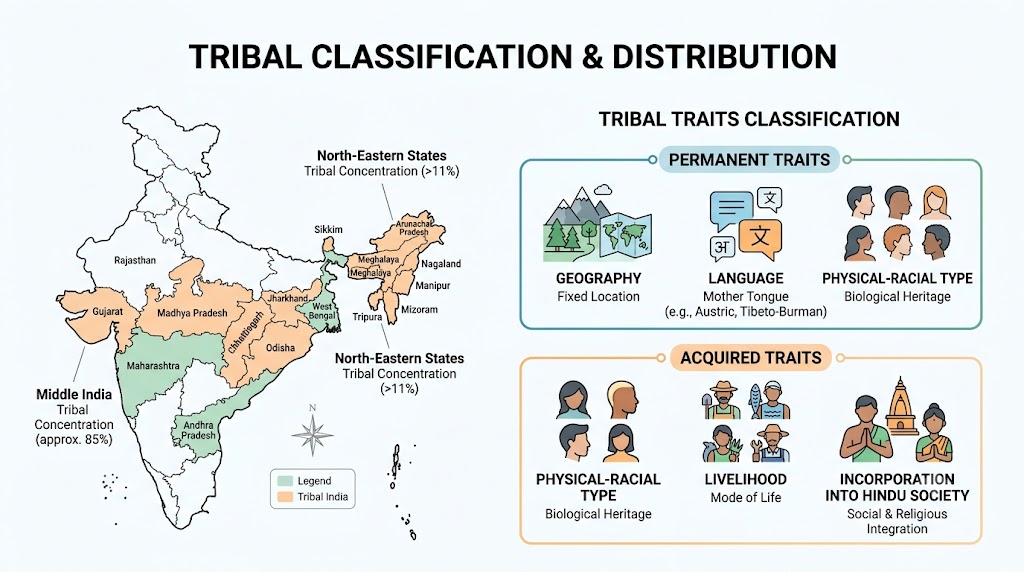
Unlike permanent traits, acquired traits classify tribes using two main criteria: mode of livelihood and extent of incorporation into Hindu society.
- By livelihood: fishermen, food gatherers and hunters, shifting cultivators, peasants, and plantation/industrial workers. (E.g., basket-making and oil-pressing are traditionally associated with the Birhor tribe.)
- By attitude to Hindu society: tribes differ in whether they are positively inclined towards Hinduism (moving toward assimilation) or resist/oppose it, maintaining distinct religious practice.
Tribal Identity
Tribal identities are formed through an interactional process — shaped by ongoing contact, conflict, and exchange with surrounding society — rather than by any fixed, primordial (original/ancient) characteristic unique to tribes. This is a key conceptual distinction tested in CUET.
- Successes: achievement of statehood for Jharkhand and Chhattisgarh after long struggles.
- Continuing problems: many North-Eastern states have lived for decades under special laws limiting civil liberties — e.g., citizens of Manipur or Nagaland do not have the same rights as other Indian citizens because their states have been declared 'disturbed areas'.
- Gradual emergence of an educated middle class among tribal communities has enabled political mobilisation and leadership.
Two broad issues drive tribal movements:
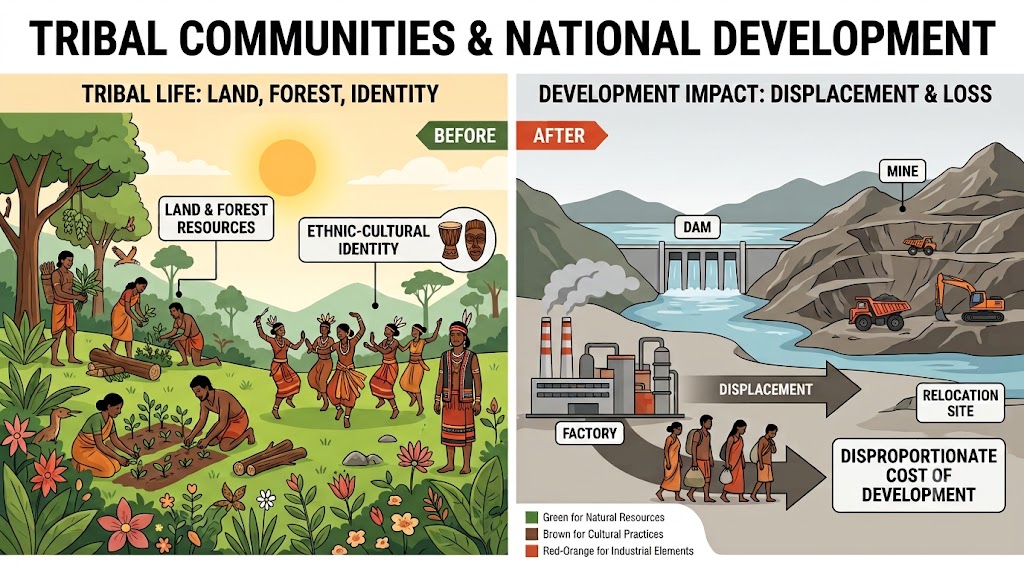
- Control over vital economic resources, especially land and forests
- Matters of ethnic-cultural identity
These two issues can reinforce each other, but as tribal society differentiates internally, they may also diverge.
Tribes, Caste, and Colonial/National Development
- Tribes historically occupied a special trade niche, trading forest produce, salt, and even elephants — showing they were often economically integrated rather than wholly isolated.
- Adivasis were not always the oppressed group they are today — some tribal groups exercised dominance over plains people through their capacity to raid them.
- Some tribes were gradually absorbed into Hindu society through Sanskritisation, blurring the tribe-caste boundary over time.
- National development's impact: tribal areas located in mineral-rich and forest-covered parts of the country paid a disproportionately high price for development — large dams, factories, and mines built especially in the Nehruvian era dispossessed tribals of land (e.g., for hydroelectric power plants) without proportionate benefit.
CUET Exam Focus: Assertion-Reasoning & Applied Questions
CUET frequently tests this chapter using Assertion-Reasoning format and applied/scenario questions. Key testable distinctions:
- Tribal identity = interactional, not primordial.
- Tribal movements are driven by both economic-resource control and ethnic-cultural identity — not by one alone.
- North-East special laws (e.g., in Manipur, Nagaland) limit civil liberties due to 'disturbed area' status — a recurring factual PYQ point.
- Development-tribal relationship is typically framed as disproportionate cost to tribals, not mutual benefit.
Common Mistakes
- Assuming tribal identity is fixed/primordial — CUET repeatedly tests that it is interactional, formed through contact with the wider society.
- Confusing 'permanent traits' (geography, language, physical-racial type) with 'acquired traits' (livelihood, degree of Hindu assimilation) when classifying tribes.
- Assuming Adivasis were always the oppressed/marginalised group historically — some tribes held dominance over plains populations and occupied active trade niches.
- Treating tribal movements as driven by only economic or only cultural grievances — CUET tests that both factors typically operate together.
- Forgetting that 'disturbed area' laws in the North-East (Manipur, Nagaland, etc.) specifically limit civil liberties — a recurring factual detail in PYQs.