This chapter explores tribal movements in India, focusing on their historical context, key actors, and the complex dynamics of identity, exploitation, and resistance. It highlights how adivasi societies have been transformed by colonialism, development, and integration, and how they have responded through various forms of collective action.
1. Introduction: The Context of Tribal Movements
Tribal movements in India are diverse and cannot be understood without examining their historical and political contexts.
- Diversity: Different tribal groups across the country may share common issues, but the distinctions between them are equally significant.
- Geographical Focus: Many tribal movements have been largely located in the so-called 'tribal belt' in middle India, such as the Santhals, Hos, Oraons, and Mundas in Chota Nagpur and the Santhal Parganas. This region constitutes the main part of what has come to be called Jharkhand.
- Colonial Impact: Colonial forest policy, which began with the advent of railways, transformed forests in Assam (then part of Bengal province) from an 'unproductive wilderness' into a lucrative source of revenue. Between 1861 and 1878, approximately 269 square miles were constituted as reserved forests, growing to 20,061 square miles by the end of the 19th century, which was 42.2% of the total area of the province. Large areas of these forests are located in hill areas occupied by tribal communities who depended on them.
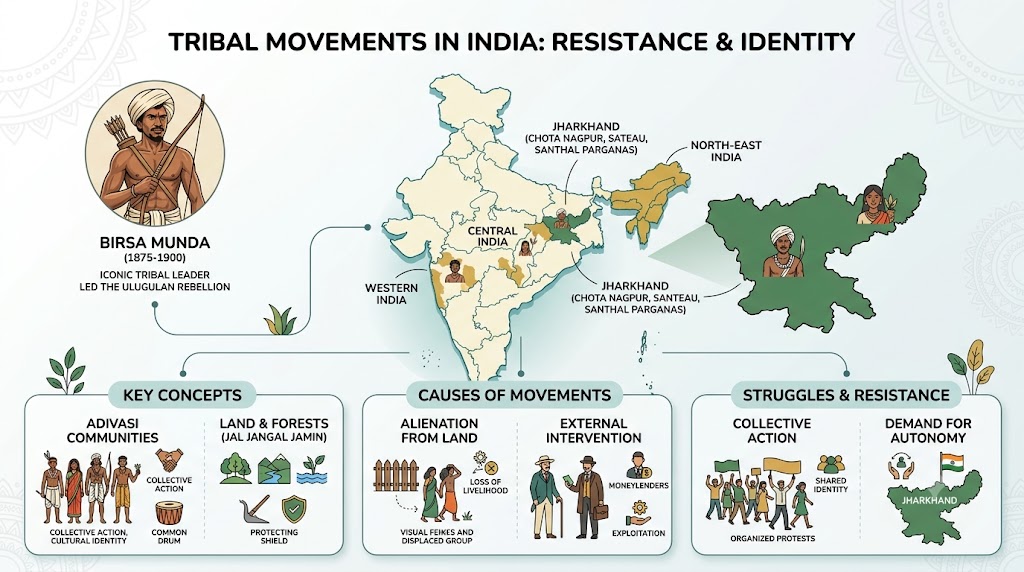
2. The Jharkhand Movement: A Case Study
Jharkhand is one of the newly formed states of India, carved out of South Bihar in the year 2000. Behind its formation lies more than a century of resistance.
- Leadership and Iconography: The movement had a charismatic leader in Birsa Munda, an adivasi who led a major uprising against the British. After his death, Birsa became an important icon of the movement.
- Role of Literacy: Christian missionaries working in South Bihar were responsible for spreading literacy in the area. Literate adivasis began to research and write about their history and myths, disseminating information about tribal customs and cultural practices. This helped create a unified ethnic consciousness and a shared identity as Jharkhandis.
- Emergence of Middle Class: Literate adivasis were also able to get government jobs, and over time, a middle-class adivasi intellectual leadership emerged that formulated the demand for a separate state and lobbied for it in India and abroad.
- The Role of 'Dikus': Within South Bihar, adivasis shared a common hostility towards dikus — outsiders such as migrant traders and moneylenders who had settled in the area and were seen as exploiting the local population. Most of the benefits from mining and industrial projects in this mineral-rich region went to outsiders even as adivasi lands were alienated.
- Key Issues: Adivasi experiences of marginalisation and their sense of injustice were mobilised to create a shared Jharkhandi identity and inspire collective action. The leaders agitated against:
- Acquisition of land for large irrigation projects and firing ranges.
- Survey and settlement operations, which were held up.
- Collection of loans, rent, and cooperative dues, which were resisted.
- Nationalisation of forest produce, which they boycotted.
3. The North East: State Formation and Ethnicity
The process of state formation initiated by the Indian government after independence generated disquieting trends in all the major hill districts of the North East.
- Disquieting Trends: Conscious of their distinct identity and traditional autonomy, the tribes were unsure of being incorporated within the administrative machinery of Assam.
- Rise of Ethnicity: The rise of ethnicity in the region is a response to the new situation that developed as a consequence of the tribe's contact with a powerful alien system. Long isolated from the Indian mainstream, the tribes were able to maintain their own worldview and social and cultural institutions.
- Shift in Trend: While the earlier phase showed a tendency towards secessionism, this trend has been replaced by a search for autonomy within the framework of the Indian Constitution.
- Tiplut Nongbri's Observation: Sociologist Tiplut Nongbri remarks that tribal institutions in themselves need not necessarily be democratic in their structure and functioning. She notes that notwithstanding the strong egalitarian ethos that characterised tribal societies, the element of stratification is not altogether absent. Tribal political institutions are not only marked by open intolerance to women, but the process of social change has also introduced sharp distortions in the system.
4. Key Themes and Issues in Tribal Movements
Tribal movements are often complex and involve a mix of economic, ecological, cultural, and identity issues.
- Alienation from Forest Lands: One of the key issues that bind tribal movements from different parts of the country is the alienation of tribals from forest lands. In this sense, ecological issues are central to tribal movements.
- Blurring of Old and New Social Movements: Just as cultural issues of identity and economic issues such as inequality are central, ecological issues are also important. This brings us back to the question about the blurring of old and new social movements in India.
- National Development and Tribal Dispossession: National development has impacted tribal development in complex ways. Tribal areas located in mineral-rich and forest-covered parts of the country paid a disproportionately high price for development. Large dams, factories, and mines were built in the Nehruvian era, and tribals were dispossessed of their land for setting up hydroelectric power plants.
- Positive Impacts of Interaction: Despite these negative impacts, interaction with mainstream society has also led to some positive impacts, such as the statehood of Jharkhand and Chhattisgarh and the rise of a middle class among tribes.
5. The Isolation vs. Integration Debate
The famous isolation versus integration debate of the 1940s is crucial to understanding the relationship between tribal societies and the Indian state.
- Isolationist Side: They argued that tribals needed protection from traders, moneylenders, and Hindu and Christian missionaries, all of whom were seen as capable of reducing tribals to detribalised landless labour. Protecting tribal communities from exploitation and land alienation was a key concern.
- Integrationist Side: They argued that tribals were merely backward Hindus, and their problems had to be addressed within the same framework as that of backward classes.
- Constituent Assembly Debates: This opposition dominated the Constituent Assembly debates, which were finally settled along the lines of a compromise that advocated welfare schemes to enable controlled integration.
- Subsequent Schemes: The subsequent schemes for tribal development — five-year plans, tribal sub-plans, tribal welfare blocks, and special multipurpose area schemes — all continued with this mode of thinking.
- Basic Issue: The integration of tribes has often neglected their own needs or desires; integration has been on the terms of the mainstream society and for its own benefit. Tribal societies have had their lands and forests taken away and their communities disrupted in the name of development.
6. Key Tribes and Movements
| Tribe/Group | Region | Movement/Context |
|---|---|---|
| Santhals | Chota Nagpur, Santhal Parganas (Jharkhand) | Santhal Hool; resistance against colonial exploitation |
| Mundas | Chota Nagpur (Jharkhand) | Ulgulan led by Birsa Munda |
| Oraons | Chota Nagpur (Jharkhand) | Jharkhand Movement |
| Birsa Munda | Chota Nagpur (Jharkhand) | Led a major uprising against the British; an iconic figure of the Jharkhand movement |
| Nagas | North East India | Movements for autonomy, secessionism, and later a search for autonomy within the Constitution |
| Adivasis (generic) | Various parts of India | Alienation from forest lands, dispossession due to development, and resistance against outsiders |
Common Mistakes
- Assuming that tribal movements are a purely post-independence phenomenon. Many tribal movements have a much longer history.
- Thinking that the Jharkhand movement was led solely by Birsa Munda. Literate adivasis and middle-class adivasi intellectual leadership also played an important role.
- Believing that 'dikus' are adivasis. Dikus refers to outsiders, especially traders and moneylenders, who were seen as exploiting tribal communities.
- Confusing the isolationist and integrationist positions. Isolationists emphasised protection of tribals from outsiders and exploitation, while integrationists favoured addressing tribal issues within the broader framework of backward classes.
- Forgetting that the isolation versus integration debate was settled through welfare-oriented schemes for controlled integration.
- Ignoring the role of land and forest alienation in tribal movements.
- Assuming that tribal societies are completely egalitarian and have no internal inequalities or stratification.