These notes cover the social reform movements and cultural change in India, focusing on the 19th-century reform efforts, key movements, and the laws and figures that shaped them.
The Colonial Context and the 'Mix of Ideas'
Colonialism brought not just structural change but also a cultural crisis. The 19th-century social reform movements were a direct response to the paradoxical experience of British rule — the clash of Western liberal ideas with traditional Indian practices.
- Key Paradox: Indians read about Western liberalism while living under a foreign, undemocratic colonial rule.
- Core Dynamic: Reformers used a creative mix of modern Western ideas and a reinterpretation of traditional texts.
- Concrete Examples of this Mix:
- Raja Ram Mohan Roy attacked sati by appealing to both humanitarian/natural rights doctrines AND Hindu shastras.
- M.G. Ranade wrote 'The Texts of the Hindu Law on the Lawfulness of the Remarriage of Widows' to find shastric sanction for widow remarriage.
- Sir Sayed Ahmed Khan emphasised ijtihad (free enquiry) and argued that Koranic revelations were compatible with modern science.
- Kandukiri Viresalingam blended traditional navya-nyaya logic with translations of Julius Huxley.
Satish Saberwal outlined the modern framework of change in colonial India as having three aspects:
- Modes of communication (e.g., the printing press, telegraph, steamship)
- Forms of organisation (e.g., modern groups like the Brahmo Samaj (Bengal) and Arya Samaj (Punjab))
- The nature of ideas (e.g., liberalism, new ideas of marriage and homemaking)
Key Organisations & Media:
- Brahmo Samaj: Founded by Raja Ram Mohun Roy (Bengal).
- Arya Samaj: Founded by Swami Dayanand Saraswati (Punjab).
- All-India Muslim Ladies Conference (Anjuman-E-Khawatn-E-Islam): Founded in 1914. A resolution against polygamy was proposed here by Jahanara Shah Nawas.
- New Technologies: The printing press sped up the movement of ideas, allowing reformers from different parts of India (e.g., Keshav Chandra Sen from Bengal visiting Madras) to exchange ideas.
Divergent Views within Reforms:
- Upper-caste concerns: Often focused on problems faced by upper-caste, middle-class women/men.
- Discriminated castes: Jotiba Phule and others argued caste and gender oppression was intrinsic to religion.
- Orthodox backlash: The Dharma Sabha was formed by orthodox members of the Hindu community to petition the British against the banning of sati.
- Radical Dalit view: A 13-year-old student in Phule's school, Muktabai, wrote of a total rejection of the Hindu fold.
Key Social Reformers and Their Contributions
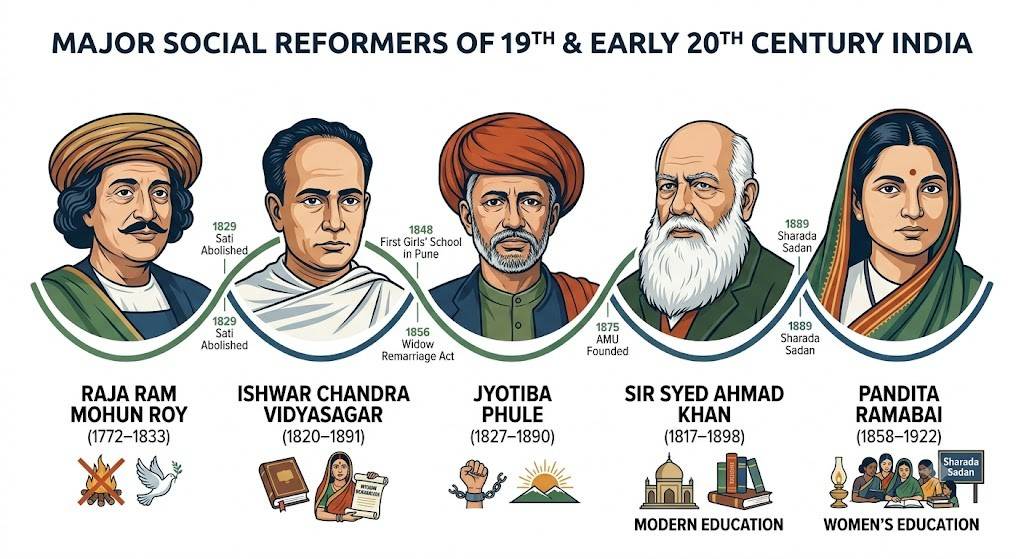
Pandita Ramabai
| Reformer | Key Contribution / Movement |
|---|---|
| Raja Ram Mohun Roy | Led the campaign to abolish sati. Founded Brahmo Samaj. Started the Sambad-Kaumudi (Bengali, 1821). |
| Ishwar Chandra Vidyasagar | Championed widow remarriage. Started the Shome Prakash (Bengali, 1858). |
| Jotiba (Jyotirao) Phule | Opened the first school for women in Pune. Led the anti-caste movement. Criticised the caste system and saw gender/caste oppression as intrinsic to religion. |
| Sir Sayed Ahmed Khan | Modernist interpretation of Islam. Promoted the idea of ijtihad (free enquiry) and compatibility with modern science. |
| Social reformer who travelled widely and wrote about women's issues. |
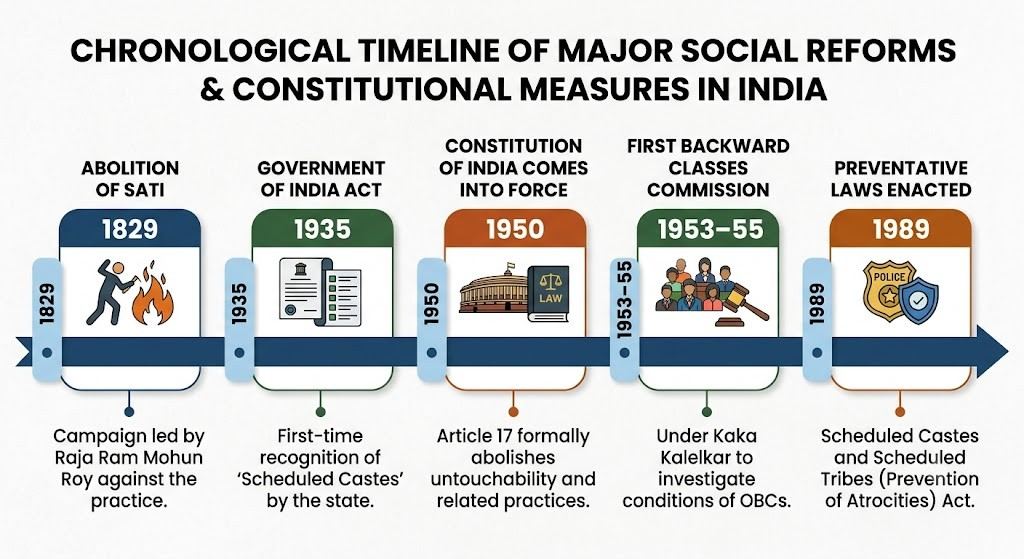
Colonial and Independent India: Key Laws and Acts (Chronology)
These are frequently tested in chronological ordering questions.
| Year | Event / Law |
|---|---|
| 1829 | Abolition of sati (a result of Raja Ram Mohun Roy's campaign). |
| 1935 | Government of India Act — Recognised 'Scheduled Castes' for the first time. |
| 1950 | Indian Constitution comes into force. Article 17 abolishes untouchability. |
| 1953-55 | First Backward Classes Commission (headed by Kaka Kalelkar) — started in 1953, submitted report in 1955. |
| 1989 | Passage of the Scheduled Castes and Scheduled Tribes (Prevention of Atrocities) Act. |
Social Reform and Change in Indian Society
- Active Questioning: Modernity led to a rethinking and reinterpretation of tradition.
- Example: The traditional sari was worn differently in different regions. The modern middle-class way of wearing it was a novel combination of the traditional unstitched cloth with a western 'petticoat' and 'blouse'.
- Continuing Debate: The debate on tradition and modernity is not a fixed mix. Even in the contemporary period, traditions are constantly being redefined.
- Example: Festivals in modern contexts, such as the 'Miss Festival' contest and formalised celebration committees, represent the process of modernisation and identity assertion within tribal communities.
Common Mistakes
- Confusing 'Modernisation' with 'Westernisation'. Modernisation is about a universal, rational, scientific outlook, while Westernisation is specifically about adopting Western cultural forms and ideas, which may not include modern democratic values.
- Forgetting that Sanskritisation leads to 'positional' change (movement within the same hierarchy) and not 'structural' change (a change in the system itself).
- Mixing up the key dates for laws. For example, confusing the Government of India Act (1935) with the Constitution of India (1950) or the Prevention of Atrocities Act (1989).