
Activities
Q1. Activity 9.1: Let us investigate Take two test tubes and label them as 'A' and 'B'. Take one teaspoonful of boiled rice in test tube A, and take a teaspoonful of boiled rice after chewing it for 30-60 seconds in test tube B. Add 3-4 mL of water in both the test tubes. Note the initial colour of the rice-water mixture in Table 9.1. Add 3-4 drops of iodine solution into each test tube with the help of a dropper. Mix the content of each test tube separately and observe. Record your observations in Table 9.1.
| Table 9.1: Action of saliva on starch | |||
|---|---|---|---|
| Test tube | Initial colour before adding iodine | Final colour after adding iodine | Possible reason for the change in colour, if any |
| A: Boiled rice | |||
| B: Chewed boiled rice | |||
Answer:
Completed Table 9.1:
| Test tube | Initial colour before adding iodine | Final colour after adding iodine | Possible reason for the change in colour, if any |
|---|---|---|---|
| A: Boiled rice | White/creamy | Blue-black | Starch is present in boiled rice; iodine reacts with starch to give blue-black colour |
| B: Chewed boiled rice | White/creamy | No change or very light blue-black | Saliva breaks down starch into sugars; starch is no longer present or present in very small amount |
Explanation:
- Test tube A: Blue-black colour indicates the presence of starch in boiled rice.
- Test tube B: No colour change or very light blue-black colour indicates that saliva has broken down starch into simpler sugars.
- Saliva contains the enzyme salivary amylase (ptyalin) which breaks down starch into maltose (a sugar).
If colour still appears in test tube B:
- Increase the chewing time to allow more saliva to act on the starch.
- Use more saliva or chew for a longer duration (e.g., 2-3 minutes).
- Grind the food more thoroughly to increase surface area for enzyme action.
Q2. Activity 9.2: Let us make a model Take a wide transparent plastic bottle with a lid. Remove its bottom. Make a hole in the lid of the bottle. Take a Y-shaped hollow tube, as shown in Fig. 9.9. Fix two deflated balloons to the forked end of the tube. Secure them with rubber bands to make them airtight. Insert the straight end of the tube tightly through the lid from the open base of the bottle and seal the lid with clay to make it airtight. To the open base of the bottle, attach a thin rubber sheet tightly using a large rubber band. 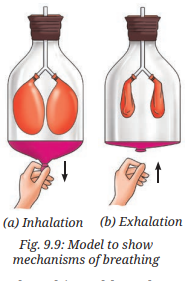 Pull the rubber sheet from the centre of the base downwards and watch the balloons (Fig. 9.9a). What do you observe? Now, release the rubber sheet upwards and observe the balloons (Fig. 9.9b). What changes do you see in the balloons? When you pull the rubber sheet downwards, the balloons inflate. Conversely, when you release the rubber sheet upwards, the balloons deflate. What do the balloons in the model mentioned in Fig. 9.9 represent? What does the rubber sheet represent? In this model, the balloons represent the lungs, and the rubber sheet represents the diaphragm.
Answer:
Observations:
- When the rubber sheet is pulled downwards, the balloons inflate.
- When the rubber sheet is released upwards, the balloons deflate.
Explanation:
- Rubber sheet represents the diaphragm.
- Balloons represent the lungs.
- Plastic bottle represents the chest cavity.
- When the rubber sheet is pulled down (diaphragm contracts and moves down), the space inside the bottle increases, causing air pressure to decrease and balloons to inflate (inhalation).
- When the rubber sheet is released (diaphragm relaxes and moves up), the space decreases, air pressure increases, and balloons deflate (exhalation).
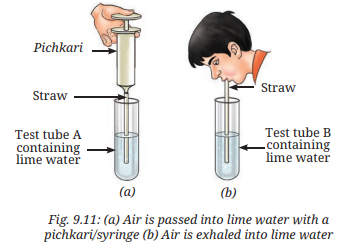
Q3. Activity 9.3: Let us explore To be demonstrated by the teacher Take an equal amount of freshly prepared lime water in two test tubes, A and B, as given in Fig. 9.11. In test tube A, pass the air using a syringe/pichkari (Fig. 9.11a). This is the same air that you inhale. In test tube B, repeatedly blow air through your mouth into the lime water using a straw (Fig. 9.11b). 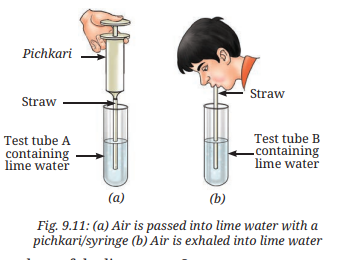 Do you observe any changes in the colour of the lime water? The lime water in test tube B turns milky (or cloudy), but the lime water in test tube A does not. What does this indicate? Lime water turns milky when it reacts with carbon dioxide. Therefore, this indicates that the exhaled air contains more carbon dioxide than the air we inhale.
Answer:
Observations:
- Test tube A (inhaled air): Lime water remains clear (no change).
- Test tube B (exhaled air): Lime water turns milky/cloudy.
Explanation:
- Lime water turns milky when it reacts with carbon dioxide to form calcium carbonate.
- Exhaled air contains a higher percentage of carbon dioxide (about 4-5%) compared to inhaled air (about 0.04%).
- This confirms that during respiration, we use oxygen and release carbon dioxide.
Conclusion: Exhaled air contains more carbon dioxide and less oxygen than inhaled air.
In-text Questions
Q1. What do you think is the role of saliva in your mouth? (From Section 9.1.1)
Answer:
Answer: Saliva has multiple important roles in the mouth:
- Digestion: Saliva contains the enzyme salivary amylase that breaks down starch into simpler sugars.
- Moistening: Saliva moistens food, making it soft and easy to swallow.
- Lubrication: Helps in the formation of a bolus (soft mass) of food for swallowing.
- Cleaning: Helps clean the mouth and teeth.
- Antibacterial: Contains enzymes and antibodies that help kill bacteria.
Q2. Have you ever wondered why this happens? (From Section 9.1.1 - referring to the sweet taste of chapati on chewing)
Answer:
Answer: Chapati or rice tastes sweet when chewed for a long time because saliva breaks down starch into sugar.
Explanation:
- Chapati and rice contain starch, which is a complex carbohydrate.
- Saliva contains the enzyme salivary amylase.
- This enzyme breaks down starch (complex) into maltose (a simple sugar).
- Maltose tastes sweet, so the food starts tasting sweet after sufficient chewing.
Q3. If the colour still appears in test tube B, what changes would you make in the activity to explore it further? Would the colour change if chewing time is increased? (From Activity 9.1)
Answer:
Answer: If the colour still appears in test tube B, the following changes can be made:
- Increase chewing time: Chew the food for a longer duration (e.g., 2-3 minutes) to allow more saliva to act on the starch.
- Use more saliva: Take a larger quantity of chewed food or add more saliva to the test tube.
- Wait longer: Leave the mixture for a longer time before adding iodine solution.
- Grind thoroughly: Chew the food more thoroughly to increase surface area for enzyme action.
Yes, the colour change would be reduced or eliminated if chewing time is increased because more starch would be broken down by saliva.
Q4. But how does the food move down? (From Section 9.1.1 - referring to the food pipe)
Answer:
Answer: Food moves down the food pipe (oesophagus) through peristalsis.
Explanation:
- The walls of the food pipe gently contract and relax in a wave-like motion.
- This wave-like movement is called peristalsis.
- Peristalsis pushes the food forward through the alimentary canal.
- This movement occurs throughout the alimentary canal, not just in the food pipe.
Q5. Guess how long it is. (From Section 9.1.1 - referring to the small intestine)
Answer:
Answer: The small intestine is about 6 metres long.
Explanation:
- This is almost twice the height of a classroom.
- Despite being called "small" intestine, it is the longest part of the alimentary canal.
- It is called "small" because it is narrower in diameter compared to the large intestine.
Q6. I have seen cows keep chewing the food even when they are not actively grazing or eating anything. Why? (From Section 9.1.2)
Answer:
Answer: Cows are ruminants, and they chew their food twice — once while grazing and again later when the food is brought back to the mouth.
Explanation:
- Grass-eating animals like cows, buffaloes, and goats are called ruminants.
- They partially chew grass and swallow it into their stomach.
- Partial digestion occurs in the stomach.
- The partially digested food is brought back to the mouth for thorough chewing.
- This process is called rumination.
- This helps break down the tough cellulose in grass more efficiently.
Q7. Are breathing and respiration different? (From Section 9.2.1)
Answer:
Answer: Yes, breathing and respiration are different processes.
| Breathing | Respiration |
|---|---|
| Physical process | Chemical process |
| Involves inhalation and exhalation of air | Involves breakdown of glucose using oxygen to release energy |
| Mechanical process (movement of air) | Biochemical process (occurs in cells) |
| Brings oxygen into the body and removes carbon dioxide | Uses oxygen to release energy from food |
| Occurs in respiratory organs (lungs, gills, etc.) | Occurs in cells (mitochondria) |
Q8. Why is that? (From Section 9.2.1 - referring to why we cannot survive without breathing for more than a few minutes)
Answer:
Answer: We cannot survive without breathing for more than a few minutes because oxygen is essential for energy production in our body.
Explanation:
- Our cells need oxygen for respiration to break down glucose and release energy.
- Without oxygen, energy production stops, and cells begin to die.
- The brain is especially sensitive to oxygen deprivation — even a few minutes without oxygen can cause brain damage.
- Unlike food and water, oxygen cannot be stored in the body, so we need a continuous supply.
Q9. What changes do you see in the balloons? (From Activity 9.2)
Answer:
Answer:
- When the rubber sheet is pulled downwards, the balloons inflate (expand).
- When the rubber sheet is released upwards, the balloons deflate (contract).
Q10. What do the balloons in the model mentioned in Fig. 9.9 represent? What does the rubber sheet represent? (From Activity 9.2) 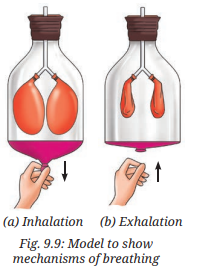
Answer:
Answer:
- The balloons represent the lungs.
- The rubber sheet represents the diaphragm.
- The plastic bottle represents the chest cavity (thoracic cavity).
- The Y-shaped tube represents the windpipe (trachea) and bronchi.
Q11. Do you observe any changes in the colour of the lime water? (From Activity 9.3) 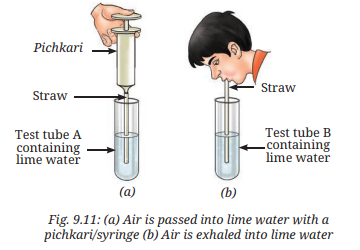
Answer:
Answer:
- Test tube A (inhaled air): No change — lime water remains clear.
- Test tube B (exhaled air): Lime water turns milky/cloudy.
Q12. What does this indicate? (From Activity 9.3) 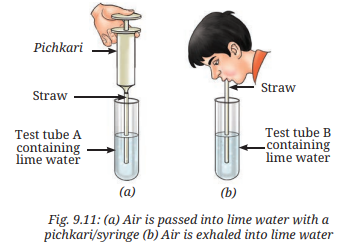
Answer:
Answer: This indicates that exhaled air contains more carbon dioxide than inhaled air.
Explanation:
- Lime water (calcium hydroxide) reacts with carbon dioxide to form calcium carbonate, which is insoluble and makes the water appear milky.
- Inhaled air has a very small amount of CO₂ (about 0.04%) and does not turn lime water milky.
- Exhaled air has about 4-5% CO₂, which is enough to turn lime water milky.
Exercises
Q1. Complete the journey of food through the alimentary canal by filling up the boxes with appropriate parts Food → Mouth → ______ → Stomach → ______ → ______ → Anus
Answer:
Answer:
Food → Mouth → Oesophagus (Food pipe) → Stomach → Small Intestine → Large Intestine → Anus
Complete pathway:
- Mouth: Mechanical digestion (chewing) and initial chemical digestion (saliva breaks starch).
- Oesophagus: Carries food from mouth to stomach by peristalsis.
- Stomach: Churning of food; acid and digestive juices break down proteins.
- Small Intestine: Main site of digestion and absorption of nutrients.
- Large Intestine: Absorption of water and salts; formation of stool.
- Anus: Egestion (removal of waste).
Q2. Sahil placed some pieces of chapati in test tube A. Neha placed chewed chapati in test tube B, and Santushti took boiled and mashed potato in test tube C. All of them added a few drops of iodine solution to their test tubes—A, B, and C, respectively. What would be their observations? Give reasons.
Answer:
Observations:
| Test tube | Sample | Observation | Reason |
|---|---|---|---|
| A | Chapati pieces (not chewed) | Turns blue-black | Chapati contains starch; iodine reacts with starch to give blue-black colour |
| B | Chewed chapati | No change or very light blue-black | Saliva has broken down starch into sugars; no starch or very little starch remains |
| C | Boiled and mashed potato | Turns blue-black | Potato contains starch; iodine reacts with starch to give blue-black colour |
Conclusion:
- Test tube B shows the action of saliva on starch.
- Iodine is a test for starch — it turns blue-black in the presence of starch.
- Saliva contains the enzyme salivary amylase that breaks down starch into sugars.
Q3. What is the role of the diaphragm in breathing? (i) To filter the air (ii) To produce sound (iii) To help in inhalation and exhalation (iv) To absorb oxygen
Answer:
Answer: (iii) To help in inhalation and exhalation
Explanation:
- The diaphragm is a dome-shaped muscle below the lungs.
- During inhalation, the diaphragm contracts and moves downwards, increasing the space in the chest cavity. This allows air to enter the lungs.
- During exhalation, the diaphragm relaxes and moves upwards, reducing the space and pushing air out of the lungs.
Q4. Match the following:
| Name of the part | Functions |
|---|---|
| (i) Nostrils | (a) fresh air from outside enters |
| (ii) Nasal passages | (b) exchange of gases occurs |
| (iii) Windpipe | (c) protects lungs |
| (iv) Alveoli | (d) tiny hair and mucus help to trap dust and dirt from the air we breathe |
| (v) Ribcage | (e) air reaches our lungs through this part |
Answer:
Correct matches:
| Name of the part | Functions |
|---|---|
| (i) Nostrils | (a) fresh air from outside enters |
| (ii) Nasal passages | (d) tiny hair and mucus help to trap dust and dirt from the air we breathe |
| (iii) Windpipe | (e) air reaches our lungs through this part |
| (iv) Alveoli | (b) exchange of gases occurs |
| (v) Ribcage | (c) protects lungs |
Explanation:
- Nostrils: Opening through which air enters.
- Nasal passages: Filter, warm, and moisten the air.
- Windpipe (Trachea): Passage for air to reach the lungs.
- Alveoli: Tiny air sacs where oxygen and carbon dioxide are exchanged.
- Ribcage: Protects the lungs and heart.
Q5. Anil claims to his friend Sanvi that respiration and breathing are the same process. What question(s) can Sanvi ask him to make him understand that he is not correct?
Answer:
Answer: Sanvi can ask the following questions to help Anil understand the difference:
- "Is breathing a physical process or a chemical process?" (Breathing is physical; respiration is chemical.)
- "What happens to the oxygen we breathe in?" (Oxygen is used in cells for respiration.)
- "Can we breathe without respiration occurring in our cells?" (Breathing brings oxygen, but respiration uses it to release energy.)
- "Where does respiration occur in the body — in the lungs or in the cells?" (Respiration occurs in cells, not in the lungs.)
- "What is the difference between the air we inhale and exhale?" (Inhaled air has more oxygen; exhaled air has more carbon dioxide — this shows respiration is happening.)
Q6. Which of the following statements is correct and why? Anu: We inhale air. Shanu: We inhale oxygen. Tanu: We inhale air rich in oxygen.
Answer:
Answer: Tanu's statement is the most correct — "We inhale air rich in oxygen."
Explanation:
- Anu: "We inhale air" — This is correct but incomplete. Inhaled air contains a mixture of gases.
- Shanu: "We inhale oxygen" — This is incorrect because we don't inhale pure oxygen; we inhale air that contains about 21% oxygen.
- Tanu: "We inhale air rich in oxygen" — This is the most correct statement because air contains about 21% oxygen, 78% nitrogen, and small amounts of other gases. It is "rich in oxygen" compared to exhaled air.
Inhaled air contains approximately: 21% O₂, 78% N₂, 0.04% CO₂, and other gases.
Exhaled air contains approximately: 16% O₂, 78% N₂, 4% CO₂, and other gases.
Q7. We often sneeze when we inhale a lot of dust-laden air. What can be possible explanations for this?
Answer:
Answer: Sneezing is a protective reflex action of the body to expel dust and foreign particles from the respiratory tract.
Possible explanations:
- Irritation: Dust particles irritate the sensitive lining of the nasal passages.
- Protective response: Sneezing forcefully expels the dust particles from the nose and respiratory tract.
- Reflex action: Sneezing is an involuntary (automatic) response to nasal irritation.
- Cleaning mechanism: Sneezing helps clear the nasal passages and prevents dust from entering the lungs.
- Role of hair and mucus: Tiny hair and mucus in the nasal passages trap dust, but when too much dust accumulates, sneezing helps remove it.
Q8. Paridhi and Anusha of Grade 7 started running for their morning workout. After they completed their running, they counted their breaths per minute. Anusha was breathing faster than Paridhi. Provide at least two possible explanations for why Anusha was breathing faster than Paridhi.
Answer:
Answer: Anusha was breathing faster than Paridhi for the following possible reasons:
- Physical fitness level: Paridhi may be more physically fit than Anusha. A fit person's body uses oxygen more efficiently, so they don't need to breathe as fast to get the same amount of oxygen.
- Running speed: Anusha might have been running faster than Paridhi. Faster running requires more energy and oxygen, leading to faster breathing.
- Body mass: Anusha might have a larger body mass, requiring more oxygen, thus breathing faster to meet the higher oxygen demand.
- Anaerobic activity: Anusha might have been less efficient at using oxygen, so her body started anaerobic respiration earlier, leading to faster breathing to repay the oxygen debt.
- Individual variation: People have different baseline breathing rates. Some people naturally breathe faster than others, even after the same level of activity.
Q9. Yadu conducted an experiment to test his idea. He took two test tubes, A and B, and added a pinch of rice flour to the test tubes, half-filled with water and stirred them properly. To test tube B, he added a few drops of saliva. He left the two test tubes for 35-45 min. After that, he added iodine solution into both the test tubes. Experimental results are as shown in Fig. 9.15. What do you think he wants to test? [IMAGE NEEDED: Two test tubes showing colour change: test tube A with blue-black colour, test tube B with no colour change]
Answer:
Answer: Yadu wants to test the action of saliva on starch.
Explanation:
- Test tube A (control): Contains rice flour + water. When iodine is added, it turns blue-black, indicating the presence of starch.
- Test tube B: Contains rice flour + water + saliva. When iodine is added, it shows no colour change or a very light colour, indicating that starch has been broken down by saliva.
- Conclusion: Saliva contains salivary amylase that breaks down starch into simpler sugars (maltose).
Thus, Yadu is testing the digestive action of saliva on starch.
Q10. Rakshita designed an experiment taking two clean test tubes, A and B and filled them with lime water as shown in the figure. In test tube A, the surrounding air that we inhale was passed on by sucking air from the pipe, and in test tube B, the exhaled air was blown through the pipe (Fig. 9.16). What do you think she is trying to investigate? How can she confirm her findings? 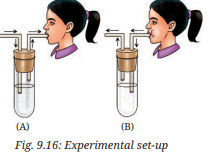
Answer:
Answer: Rakshita is trying to investigate whether exhaled air contains more carbon dioxide than inhaled air.
Her investigation:
- Test tube A: Inhaled air (from the surroundings) is passed through lime water.
- Test tube B: Exhaled air (from the mouth) is blown through lime water.
Expected findings:
- Test tube A: Lime water remains clear (inhaled air has very little CO₂).
- Test tube B: Lime water turns milky (exhaled air contains more CO₂).
How to confirm her findings:
- She can note the colour change in both test tubes — only test tube B should turn milky.
- She can compare the cloudiness of the lime water in both tubes.
- She can repeat the experiment multiple times to ensure the results are consistent.
- She can use a control test tube with just lime water (no air passed through) to compare.
Conclusion: This experiment confirms that exhaled air contains more carbon dioxide than inhaled air.
Exploratory Projects
Q1. What are the good practices for maintaining oral hygiene? Try to gather information on the same from books/newspapers/conversation with elders. Prepare a report.
Answer:
Project Report: Good Practices for Maintaining Oral Hygiene
Aim: To understand and document good practices for maintaining oral hygiene.
Good oral hygiene practices:
- Brush teeth twice daily: Brush in the morning and before bedtime to remove food particles and plaque.
- Use proper brushing technique: Brush gently in circular motions for at least 2 minutes.
- Clean the tongue: Use a tongue scraper or brush to clean the tongue to remove bacteria and prevent bad breath.
- Floss regularly: Floss between teeth to remove food particles stuck in between.
- Rinse mouth after meals: Rinse with water after eating to remove food particles.
- Use mouthwash: Use an antibacterial mouthwash to kill bacteria.
- Avoid sugary foods: Limit sweets and sugary drinks that cause tooth decay.
- Visit the dentist regularly: Get a dental check-up every 6 months.
- Use a soft-bristled toothbrush: Replace the toothbrush every 3 months.
Traditional oral hygiene practices from elders:
- Neem twigs (Datoon): Chewing neem twigs was a common practice for oral hygiene.
- Bark and roots: Some elders used the bark of babul or roots of certain plants as toothbrushes.
- Salt water rinse: Rinsing the mouth with warm salt water to prevent infections.
- Herbal powders: Using herbal tooth powders made from neem, clove, and other herbs.
- Oil pulling: Swishing oil (coconut or sesame) in the mouth to remove toxins.
- Baking soda: Used as a natural toothpaste for cleaning teeth.
Q2. Find out different ways to maintain a healthy digestive system. Suggest some food items that help to maintain good digestive health. Make a report and present it in class.
Answer:
Project Report: Maintaining a Healthy Digestive System
Aim: To understand ways to maintain a healthy digestive system and identify foods that promote digestive health.
Ways to maintain a healthy digestive system:
- Eat fibre-rich foods: Include fruits, vegetables, whole grains, and legumes in the diet.
- Drink plenty of water: Stay hydrated to help digestion and prevent constipation.
- Eat at regular times: Maintain a regular meal schedule.
- Chew food thoroughly: Proper chewing helps digestion.
- Avoid overeating: Eat in moderation.
- Include fermented foods: Curd, buttermilk, kanji, and pickles promote healthy gut bacteria.
- Limit oily and spicy foods: These can cause indigestion.
- Exercise regularly: Physical activity helps maintain a healthy digestive system.
- Manage stress: Stress can affect digestion negatively.
- Avoid smoking and alcohol: These damage the digestive system.
Foods that help maintain good digestive health:
| Food Item | Benefit |
|---|---|
| Curd/Yogurt | Contains probiotics; promotes healthy gut bacteria |
| Buttermilk | Probiotic; aids digestion |
| Fibre-rich fruits (Apple, Banana, Papaya) | Help in bowel movement; prevent constipation |
| Green leafy vegetables | Rich in fibre and vitamins; aid digestion |
| Whole grains (Wheat, Oats, Millets) | Rich in dietary fibre; promote healthy digestion |
| Ginger | Enhances digestion; reduces bloating |
| Black pepper | Stimulates digestive enzymes |
| Cumin (Jeera) | Aids digestion; reduces gas |
| Fennel seeds (Saunf) | Relieves bloating and indigestion |
| Lemon water | Helps flush out toxins; aids digestion |
Q3. Using coloured clay, prepare a 3-D model of the digestive system and label all parts of the digestive system using black paper strips.
Answer:
Project: 3-D Model of the Digestive System
Aim: To create a 3-dimensional model of the human digestive system using coloured clay.
Materials required:
- Coloured clay (various colours)
- Black paper strips for labelling
- Cardboard or base for the model
- Marker/pen for writing labels
- Glue
Parts to be included in the model:
| Part | Colour (Suggested) | Function |
|---|---|---|
| Mouth | Red/Pink | Begins digestion; mechanical breakdown of food |
| Oesophagus (Food pipe) | Pink | Carries food to stomach by peristalsis |
| Stomach | Yellow | Churning and partial digestion of food |
| Small Intestine | Orange | Main site of digestion and absorption |
| Large Intestine | Brown | Absorbs water and salts; forms stool |
| Liver | Dark Green | Secretes bile for fat digestion |
| Pancreas | Light Green | Secretes pancreatic juice |
| Gall Bladder | Dark Blue | Stores bile |
| Rectum | Brown | Stores stool |
| Anus | Dark Brown | Egestion of waste |
Instructions:
- Take a cardboard base to place the model.
- Using different coloured clay, mould each part of the digestive system.
- Place the parts in the correct anatomical order.
- Use black paper strips to cut out labels for each part.
- Write the name of each part on the black paper strip.
- Attach the labels to the model using glue or pins.
Q4. What is air quality and AQI? Find out the effect of air quality on the respiratory systems of people working in various fields — farmers, factory workers, or street vendors.
Answer:
Project Report: Air Quality and Its Effect on Respiratory Health
What is Air Quality?
- Air quality refers to the cleanliness or purity of the air in a particular area.
- Good air quality means the air has low levels of pollutants (dust, smoke, harmful gases).
- Poor air quality means the air contains high levels of pollutants that can harm health.
What is AQI (Air Quality Index)?
- AQI is a number used to communicate how polluted the air is.
- It ranges from 0 to 500.
- Higher AQI values indicate greater pollution and health risks.
| AQI Range | Category | Health Implications |
|---|---|---|
| 0-50 | Good | Air quality is satisfactory |
| 51-100 | Moderate | Acceptable; sensitive individuals may be affected |
| 101-200 | Unhealthy for sensitive groups | Children, elderly, and people with respiratory problems affected |
| 201-300 | Unhealthy | Everyone may experience health effects |
| 301-500 | Hazardous | Health emergency; serious health effects |
Effects of air quality on different workers:
| Worker | Pollutants exposed to | Health Effects |
|---|---|---|
| Farmers | Crop dust, pesticide sprays, smoke from crop burning | Respiratory allergies, asthma, bronchitis |
| Factory workers | Chemical fumes, smoke, dust particles | Lung damage, occupational asthma, respiratory diseases |
| Street vendors | Vehicle exhaust, dust, smoke | Breathing difficulties, coughing, increased risk of asthma |
Prevention measures:
- Wear protective masks (N95) when working in polluted areas.
- Use proper ventilation in factories.
- Reduce crop burning.
- Plant trees to improve air quality.
- Use cleaner fuels and vehicles.
Q5. Try to read about the box-breathing technique (Fig. 9.17). What are its benefits? 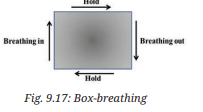
Answer:
Project: Box-Breathing Technique
What is Box Breathing?
Box breathing (also called square breathing) is a simple breathing technique with four equal steps. Each step is usually counted for 4 seconds.
Steps of Box Breathing:
- Inhale: Breathe in slowly through the nose for 4 seconds.
- Hold: Hold the breath for 4 seconds.
- Exhale: Breathe out slowly through the mouth for 4 seconds.
- Hold: Hold the breath for 4 seconds.
- Repeat the cycle 4-5 times.
Benefits of Box Breathing:
- Reduces stress and anxiety: Calms the nervous system.
- Improves focus and concentration: Helps in better attention.
- Regulates blood pressure: Helps lower high blood pressure.
- Improves lung function: Strengthens respiratory muscles.
- Promotes relaxation: Helps the body and mind relax.
- Enhances emotional control: Helps manage strong emotions.
- Improves sleep quality: Helps in falling asleep faster.
- Boosts immunity: Reduces stress hormones, strengthening the immune system.
When to practice:
- Before exams or stressful situations
- During meditation or yoga
- When feeling anxious or angry
- Before bedtime for better sleep
Q6. Both birds and mammals have lungs for breathing, but birds can fly at high altitudes where oxygen levels are low. How might their respiratory system be adapted to help them survive in such conditions?
Answer:
Answer: Birds have a highly efficient respiratory system that allows them to survive at high altitudes where oxygen levels are low.
Adaptations in birds for high-altitude breathing:
| Adaptation | How it helps |
|---|---|
| Efficient gas exchange | Birds have a more efficient gas exchange system than mammals. They extract more oxygen from each breath. |
| Air sacs | Birds have air sacs in addition to lungs. These store air and allow continuous flow of air through the lungs, even during exhalation. |
| Unidirectional airflow | Unlike mammals (where air flows in and out in two directions), birds have unidirectional airflow — air always moves in one direction through the lungs, increasing efficiency. |
| Thinner blood-gas barrier | Birds have a thinner barrier between air and blood in the lungs, allowing faster gas exchange. |
| Increased breathing rate | Birds can breathe faster when needed to take in more oxygen. |
| High haemoglobin affinity | Bird haemoglobin has a higher affinity for oxygen, allowing more oxygen to bind even at low oxygen concentrations. |
Comparison with mammals:
- Mammalian lungs have a tidal flow (air goes in and out the same way).
- Birds have a cross-current system that extracts oxygen more efficiently.
- Birds can extract oxygen even from thin air at high altitudes.
Science and Society
Q1. A healthy mouth requires good oral hygiene. We should brush our teeth and clean our tongue twice a day, and rinse our mouth with water after each meal to prevent tooth decay and bad smell in the mouth. Find out the ways our elders were maintaining oral hygiene.
Answer:
Answer: Our elders used several traditional methods to maintain oral hygiene:
- Neem twigs (Datoon): Neem has antibacterial properties. Chewing neem twigs cleaned teeth and prevented infections.
- Babul bark: The bark of the babul tree was used as a natural toothbrush.
- Salt water: Rinsing with warm salt water prevented gum infections.
- Herbal powders: Powders made from neem, clove, and other herbs were used as tooth powders.
- Oil pulling: Swishing coconut or sesame oil in the mouth to remove toxins and bacteria.
- Baking soda: Used as a natural abrasive to clean teeth.
- Chewing herbs: Chewing mint, fennel seeds, or cloves to freshen breath.
- Charcoal: Some elders used charcoal powder to clean teeth.
Q2. Celiac disease is a condition in which the body reacts to gluten, a protein found in wheat, barley, and rye. This reaction damages the inner lining of the small intestine, where nutrients are absorbed. As a result, the intestine cannot function properly. The only way to manage celiac disease is to avoid foods that contain gluten. Millets (like jowar, bajra, and ragi) are good alternatives because they are naturally gluten-free.
Answer:
Answer: Celiac disease is an autoimmune condition where the body's immune system reacts to gluten, damaging the small intestine.
Key points about Celiac disease:
- Gluten is a protein found in wheat, barley, and rye.
- The reaction damages the inner lining of the small intestine (villi).
- Damaged villi cannot absorb nutrients properly, leading to malnutrition.
- There is no cure for celiac disease; management is through a strict gluten-free diet.
Gluten-free alternatives:
- Millets: Jowar (sorghum), bajra (pearl millet), ragi (finger millet)
- Rice
- Maize (corn)
- Quinoa
- Buckwheat
- Amaranth
Why millets are good alternatives:
- Naturally gluten-free
- Rich in fibre, vitamins, and minerals
- Good for digestive health
- Readily available in India
Q3. While a lot of the dust is filtered out from the inhaled air, often small infectious particles can get through the lungs. For example, during the COVID-19 pandemic, the SARS-CoV-2 virus affected the respiratory system, leading to breathing difficulties and often causing serious lung problems.
Answer:
Answer: The COVID-19 pandemic highlighted the importance of respiratory health.
Key points about respiratory infections:
- While the nose filters dust and particles, small infectious particles can still enter the lungs.
- The SARS-CoV-2 virus (COVID-19) is a respiratory virus that affects the lungs.
- It causes inflammation of the airways and alveoli, leading to breathing difficulties.
- Severe cases can lead to pneumonia and acute respiratory distress syndrome (ARDS).
Protective measures:
- Wearing masks helps filter out infectious particles.
- Maintaining good hand hygiene prevents transmission.
- Ventilation of closed spaces reduces viral load.
- Vaccination helps prevent severe infection.
- Avoiding smoking and keeping lungs healthy reduces severity of respiratory infections.
Q4. Breathing exercises have been practised across different cultures in India and worldwide for centuries. Pranayama is well known for improving respiratory health, mind relaxation, and concentration. In Ladakh, people practise Tummo breathing, a technique that improves lung function and helps keep the body warm even in cold weather. Similarly, deep breathing techniques are used to promote well-being. Some traditions combine deep breathing with chanting, using rhythmic breath control to enhance relaxation and mental clarity.
Answer:
Answer: Breathing practices have been an integral part of many cultures for thousands of years.
Traditional breathing practices:
| Practice | Origin | Benefits |
|---|---|---|
| Pranayama | India (Yoga tradition) | Improves respiratory health, reduces stress, enhances concentration, balances energy |
| Tummo Breathing | Ladakh, India | Generates body heat, improves lung function, helps survive in cold weather |
| Deep breathing with chanting | Various cultures | Enhances relaxation, improves mental clarity, promotes well-being |
Scientific basis:
- Deep breathing increases oxygen intake.
- It activates the parasympathetic nervous system (rest and digest).
- It reduces stress hormones (cortisol).
- It improves lung capacity and efficiency.
- It enhances blood circulation and oxygen delivery to tissues.
Box breathing is a modern adaptation of these traditional techniques.
Q5. Smoking is extremely harmful to health. It damages the lungs and increases the risk of serious diseases, including lung cancer and other respiratory illnesses. It leads to persistent coughing and frequent infections. In addition to harming the smoker, smoking releases toxic chemicals into the air, putting others at risk. When non-smokers inhale this polluted air, they experience passive smoking, which can be especially dangerous for children, pregnant women, and the elderly. Due to these risks, avoiding smoking helps protect both personal health and the well-being of those around us.
Answer:
Answer: Smoking is one of the most harmful habits for respiratory health.
Effects of smoking on health:
- Damages the lungs and respiratory system.
- Increases risk of lung cancer, chronic bronchitis, and emphysema.
- Leads to persistent coughing and frequent respiratory infections.
- Damages the alveoli, reducing the surface area for gas exchange.
- Narrows the airways, making breathing difficult.
Passive smoking (Second-hand smoke):
- Non-smokers inhale toxic chemicals from cigarette smoke.
- It increases the risk of respiratory diseases in others.
- Children exposed to smoke have higher rates of asthma and ear infections.
- Pregnant women exposed to smoke have higher risks of complications.
- The elderly with existing respiratory conditions are especially vulnerable.
Prevention and quitting:
- Avoid smoking and exposure to second-hand smoke.
- Seek help to quit smoking (counselling, nicotine replacement).
- Create smoke-free environments at home and in public spaces.
- Educate others about the dangers of smoking.