
Activities
Q1. Activity 8.1: Let us construct Take a used transparent plastic bottle (1/2 litre or larger) with its cap. Cut it into two, roughly in the middle as shown in Fig. 8.5a. Using a drawing pin, make a small hole in the cap of the bottle (Fig. 8.5b). 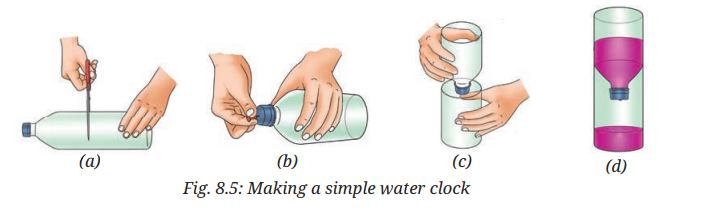 Place the upper part of the bottle in an inverted position over the lower half (Fig. 8.5c). Fill the upper part of the bottle with water. You may add a few drops of ink or colour to make the water level easily visible (Fig. 8.5d). The water will start dripping into the lower part of the bottle. Using a watch, mark the level of water after every one minute till all the water drips down. Your water clock is ready. Can you now guess how to use it? Pour the water from the lower part back into the top part and watch the level of water dripping into the lower part. Every time it touches a mark made by you, one more minute has passed.
Answer:
How to use the water clock:
- Pour the water collected in the lower part back into the upper part of the bottle.
- Start the water clock and observe the water level rising in the lower part.
- Each mark on the lower part indicates that one minute has passed.
- When the water reaches a mark, you know that the corresponding time has elapsed.
Explanation:
- This is a simple water clock based on the principle of water flowing out at a constant rate.
- The markings on the bottle indicate equal time intervals.
- However, water clocks are not very accurate because the flow rate decreases as the water level drops.
Q2. Activity 8.2: Let us experiment Collect a piece of string around 150 cm long, a heavy metal ball with hook/a stone (bob), a stopwatch/watch, and a ruler. Tie the bob at one end of the string. Fix the other end of the string to a rigid support such that the length of the string in between support and bob is around 100 cm. Wait for the bob to come to rest. Your pendulum is now ready.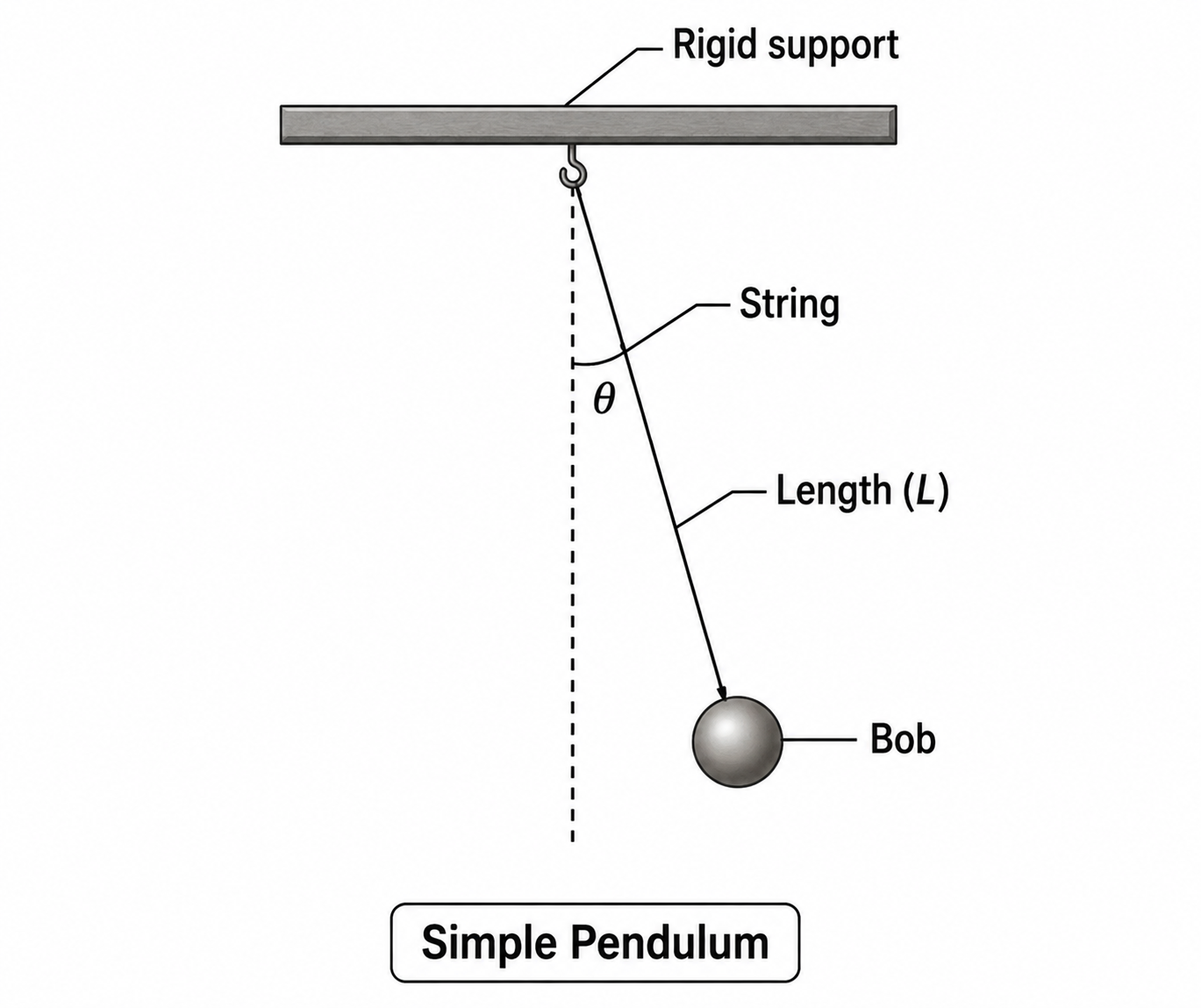 Gently hold the bob, move it slightly to one side and release it. Take care not to push the bob while releasing it and that the string is taut. Is your pendulum now oscillating? Using a watch, measure the time it takes for the pendulum to complete 10 oscillations. Record the time in Table 8.1. Repeat this activity 3-4 times. Divide the time taken for 10 oscillations by 10 to calculate the time period of your pendulum. Note it down in Table 8.1.
| S.No. | Time taken for 10 oscillations (seconds) | Time period (seconds) |
|---|---|---|
| 1. | ||
| 2. | ||
| 3. |
Answer:
Completed Table 8.1 (Sample data):
| S.No. | Time taken for 10 oscillations (seconds) | Time period (seconds) |
|---|---|---|
| 1. | 20.0 | 2.0 |
| 2. | 19.8 | 1.98 |
| 3. | 20.2 | 2.02 |
Conclusion:
- The time period of the pendulum is almost the same every time.
- This shows that the time period of a simple pendulum of a given length is constant at a given place.
- This property is used in pendulum clocks for time measurement.
Reasons for slight differences:
- Human error in starting/stopping the stopwatch
- Slight variations in the release of the bob
- Air resistance and friction at the support
Q3. Activity 8.3: Let us identify Look at the wall clock shown in Fig. 8.9 carefully. What is the smallest interval of time you can measure with it? 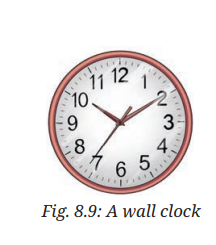
Answer:
Answer: One second is the smallest interval of time that we can measure using a wall clock.
Explanation:
- A wall clock has a second hand that moves continuously.
- Each tick of the second hand represents one second.
- Therefore, the smallest interval of time measurable with a wall clock is 1 second.
Q4. Activity 8.4: Let us calculate Look up at the railway timetable on the internet. Identify a train stopping at the railway station nearest to your place of stay. Find out the name of the next station where this train stops. Also, find the distance to that station as given in the timetable. Note the time at which the train departs from your station and arrives at the next station. Find the difference to calculate the time taken by the train to cover the distance till the next station. Calculate the speed of the train between the two stations and record it in Table 8.2. Repeat for 4-5 different types of trains (Passenger/Express/Superfast).
| Name of the train | Name of the next station | Distance till the next station (km) | Time taken till the next station (h) | Speed of the train between these two stations (km/h) |
|---|---|---|---|---|
Answer:
Completed Table 8.2 (Sample data):
| Name of the train | Name of the next station | Distance till the next station (km) | Time taken till the next station (h) | Speed of the train between these two stations (km/h) |
|---|---|---|---|---|
| Rajdhani Express | Delhi - Mathura | 140 | 1.5 | 93.3 |
| Passenger Train | Delhi - Ghaziabad | 20 | 0.75 | 26.7 |
| Superfast Express | Delhi - Agra | 200 | 2.0 | 100.0 |
| Shatabdi Express | Delhi - Chandigarh | 250 | 2.5 | 100.0 |
| Garib Rath | Delhi - Jaipur | 300 | 3.5 | 85.7 |
Analysis:
- The train with the highest speed is the Superfast Express and Shatabdi Express with a speed of 100 km/h.
- The Passenger train has the lowest speed (26.7 km/h) as it stops at many stations.
Note: Students should fill in the table with actual data from their nearest railway station.
In-text Questions
Q1. How was time measured when there were no clocks and watches? (From the opening scenario)
Answer:
Answer: In ancient times, people measured time using natural events that repeated themselves at regular intervals.
Methods used:
- Observing the Sun: Rising and setting of the Sun defined a day.
- Phases of the Moon: Used to measure months.
- Changing seasons: Used to measure years.
- Sundials: Used the position of the shadow cast by the Sun to tell time.
- Water clocks: Used the flow of water to measure time intervals.
- Hourglasses: Used the flow of sand to measure time.
- Candle clocks: Used candles with markings to indicate the passage of time.
Q2. Can you now guess how to use it? (From Activity 8.1)
Answer:
Answer: The water clock can be used to measure time intervals by observing the water level in the lower bottle.
How to use:
- Pour the water from the lower part back into the upper part.
- Mark the water level in the lower part at one-minute intervals using a watch.
- When the water reaches the first mark, one minute has passed.
- When it reaches the second mark, two minutes have passed, and so on.
- This helps measure time without using a modern watch.
Q3. Suppose you were Galileo experimenting with pendulums, what all would you investigate? What questions could you ask? Would all pendulums have the same time period? How would you test this? (From Think Like a Scientist! box)
Answer:
Answer: If I were Galileo experimenting with pendulums, I would investigate:
- Whether the time period depends on the length of the pendulum.
- Whether the time period depends on the mass of the bob.
- Whether the time period depends on the amplitude (angle of swing).
- Whether the time period is constant for a given pendulum.
Questions I would ask:
- Do all pendulums have the same time period?
- Does the time period change if I use a heavier bob?
- Does the time period change if I make the string longer?
- Does the time period change if I swing the bob more or less?
How to test:
- Use pendulums of different lengths with the same bob and compare time periods.
- Use pendulums of the same length with different bobs and compare time periods.
- Use the same pendulum with different amplitudes (small and large swings) and compare time periods.
Q4. Repeat Activity 8.2 using the same bob but with pendulums of two or three different lengths. Does the time period change? If so, how does the length affect it? (From Think Like a Scientist! box)
Answer:
Answer: Yes, the time period changes when the length of the pendulum is changed.
Observation:
- As the length of the pendulum increases, the time period increases.
- As the length of the pendulum decreases, the time period decreases.
- Longer pendulums take more time to complete one oscillation.
- Shorter pendulums take less time to complete one oscillation.
Example:
- A pendulum of length 50 cm may have a time period of about 1.4 seconds.
- A pendulum of length 100 cm may have a time period of about 2.0 seconds.
Q5. Test this by repeating Activity 8.2 with a fixed pendulum length but with bobs of different mass. Do you observe any change? (From Think Like a Scientist! box)
Answer:
Answer: No, there is no change in the time period when the mass of the bob is changed.
Observation:
- Using a fixed length, the time period remains the same for bobs of different masses (e.g., a heavy metal ball vs. a lighter stone).
- The time period depends on the length of the pendulum, not on the mass of the bob.
Conclusion:
- The time period of a simple pendulum depends on its length but not on the bob's mass.
- All pendulums of the same length have the same time period at a given location.
Q6. What is the smallest interval of time you can measure with it? (From Activity 8.3)
Answer:
Answer: The smallest interval of time we can measure with a wall clock is one second.
Explanation:
- Wall clocks have a second hand that moves in steps of one second.
- Each tick of the second hand represents exactly one second.
- Therefore, the smallest measurable interval is 1 second.
Q7. How do you decide who is running faster amongst them? (From Section 8.2)
Answer:
Answer: We decide who is running faster by comparing the distances covered by each runner in the same time interval.
Explanation:
- At any instant, the runner who is ahead of others has covered more distance.
- Someone who has covered more distance within the same time is running faster.
- The faster runner has a higher speed.
Q8. Which is the fastest train? (From Activity 8.4)
Answer:
Answer: The train which has covered the maximum distance in unit time is the fastest train, that is, the one with the highest speed.
Explanation:
- Speed = Distance ÷ Time
- The train with the highest speed value is the fastest.
- In the sample data, the Superfast Express and Shatabdi Express were the fastest.
Q9. How were their motion different? (From Section 8.3.1 - referring to marathon runners)
Answer:
Answer: The motion of the runners was different in terms of their speed.
Explanation:
- Some runners: Maintained the same speed throughout the distance (uniform motion).
- Other runners: Changed their speed, sometimes speeding up and sometimes slowing down (non-uniform motion).
Exercises
Q1. Calculate the speed of a car that travels 150 metres in 10 seconds. Express your answer in km/h.
Answer:
Given:
- Distance = 150 m
- Time = 10 s
Speed = Distance ÷ Time = 150 ÷ 10 = 15 m/s
Converting to km/h:
1 m/s = 3.6 km/h
15 m/s = 15 × 3.6 = 54 km/h
Answer: The speed of the car is 54 km/h.
Q2. A runner completes 400 metres in 50 seconds. Another runner completes the same distance in 45 seconds. Who has a greater speed and by how much?
Answer:
Given:
- Distance for both runners = 400 m
- Runner 1 time = 50 s
- Runner 2 time = 45 s
Speed of Runner 1: 400 ÷ 50 = 8 m/s
Speed of Runner 2: 400 ÷ 45 = 8.89 m/s
Difference: 8.89 - 8.00 = 0.89 m/s
Answer: The second runner (45 seconds) has greater speed by 0.89 m/s.
Q3. A train travels at a speed of 25 m/s and covers a distance of 360 km. How much time does it take?
Answer:
Given:
- Speed = 25 m/s
- Distance = 360 km = 360 × 1000 = 360,000 m
Time = Distance ÷ Speed = 360,000 ÷ 25 = 14,400 s
Converting to hours: 14,400 ÷ 3600 = 4 h
Answer: The train will take 4 hours (or 14,400 seconds).
Q4. A train travels 180 km in 3 h. Find its speed in: (i) km/h (ii) m/s (iii) What distance will it travel in 4 h if it maintains the same speed throughout the journey?
Answer:
Given:
- Distance = 180 km
- Time = 3 h
(i) Speed in km/h:
Speed = Distance ÷ Time = 180 ÷ 3 = 60 km/h
(ii) Speed in m/s:
60 km/h = 60 × (5/18) = 60 × 0.2777 = 16.67 m/s
(iii) Distance in 4 hours:
Distance = Speed × Time = 60 × 4 = 240 km
Answers:
- (i) 60 km/h
- (ii) 16.67 m/s
- (iii) 240 km
Q5. The fastest galloping horse can reach the speed of approximately 18 m/s. How does this compare to the speed of a train moving at 72 km/h?
Answer:
Given:
- Horse speed = 18 m/s
- Train speed = 72 km/h
Converting train speed to m/s:
72 km/h = 72 × (5/18) = 20 m/s
Comparison:
- Train speed = 20 m/s
- Horse speed = 18 m/s
- Difference = 20 - 18 = 2 m/s
Answer: The train moving at 72 km/h is faster than the horse (18 m/s) by 2 m/s. The train speed is 20 m/s while the horse speed is 18 m/s.
Q6. Distinguish between uniform and non-uniform motion using the example of a car moving on a straight highway with no traffic and a car moving in city traffic.
Answer:
Answer:
| Uniform Motion | Non-uniform Motion |
|---|---|
| Example: Car moving on a straight highway with no traffic | Example: Car moving in city traffic |
| Car moves with constant speed. | Car's speed keeps changing (speeds up, slows down, stops). |
| Covers equal distances in equal intervals of time. | Covers unequal distances in equal intervals of time. |
| Speed remains the same throughout the motion. | Speed varies at different times. |
| Example: A car moving at a steady 60 km/h on a highway. | Example: A car moving through traffic with frequent stops and starts. |
| Less common in real life. | More common in everyday life. |
Q7. Data for an object covering distances in different intervals of time are given in the following table. If the object is in uniform motion, fill in the gaps in the table.
| Time (s) | 0 | 10 | 20 | 30 | 50 | 70 |
|---|---|---|---|---|---|---|
| Distance (m) | 0 | 8 | 24 | 32 | 40 | 56 |
Answer:
Step 1: Check if motion is uniform
- 0 to 10 s: Distance = 8 m, Speed = 0.8 m/s
- 10 to 20 s: Distance = 24 - 8 = 16 m, Speed = 1.6 m/s
- 20 to 30 s: Distance = 32 - 24 = 8 m, Speed = 0.8 m/s
- 30 to 50 s: Distance = 40 - 32 = 8 m, Speed = 0.4 m/s
- 50 to 70 s: Distance = 56 - 40 = 16 m, Speed = 0.8 m/s
Since speeds are not equal, the motion is NOT uniform.
Corrected table for uniform motion:
- If uniform, speed should be constant at 0.8 m/s (from 0-10 s).
| Time (s) | 0 | 10 | 20 | 30 | 50 | 70 |
|---|---|---|---|---|---|---|
| Distance (m) | 0 | 8 | 16 | 24 | 40 | 56 |
Note: If speed is 0.8 m/s, distances should be: 0, 8, 16, 24, 40, 56.
However, the gaps cannot be filled as the given data does not represent uniform motion. The student should identify that the motion is non-uniform.
Q8. A car covers 60 km in the first hour, 70 km in the second hour, and 50 km in the third hour. Is the motion uniform? Justify your answer. Find the average speed of the car.
Answer:
Given:
- Hour 1: Distance = 60 km
- Hour 2: Distance = 70 km
- Hour 3: Distance = 50 km
Is the motion uniform?
- In uniform motion, equal distances should be covered in equal intervals of time.
- Here, the car covers different distances (60 km, 70 km, 50 km) in each hour.
- Therefore, the motion is NOT uniform — it is non-uniform.
Average speed:
Total distance = 60 + 70 + 50 = 180 km
Total time = 1 + 1 + 1 = 3 h
Average speed = Total distance ÷ Total time = 180 ÷ 3 = 60 km/h
Answer: The motion is non-uniform. The average speed of the car is 60 km/h.
Q9. Which type of motion is more common in daily life — uniform or non-uniform? Provide three examples from your experience to support your answer.
Answer:
Answer: Non-uniform motion is more common in daily life.
Explanation:
- In daily life, objects rarely move at a constant speed for long periods.
- Most objects change their speed due to various factors like traffic, obstacles, or personal choices.
Examples of non-uniform motion:
- A car in city traffic: The car frequently stops, starts, speeds up, and slows down due to traffic signals and congestion.
- A person walking: A person does not walk at a constant speed; they may slow down while climbing stairs or speed up when in a hurry.
- A school bus: A bus stops at multiple stops to pick up and drop off students, changing its speed throughout the journey.
Examples of uniform motion (rare):
- A train moving at constant speed on a straight track between stations.
- A conveyor belt moving at steady speed in a factory.
Q10. Data for the motion of an object are given in the following table. State whether the speed of the object is uniform or non-uniform. Find the average speed.
| Time (s) | 0 | 10 | 20 | 30 | 40 | 50 | 60 | 70 | 80 | 90 | 100 |
|---|---|---|---|---|---|---|---|---|---|---|---|
| Distance (m) | 0 | 6 | 10 | 16 | 21 | 29 | 35 | 42 | 45 | 55 | 60 |
Answer:
Step 1: Check if speeds are equal
- 0-10 s: Distance = 6 m, Speed = 0.6 m/s
- 10-20 s: Distance = 10 - 6 = 4 m, Speed = 0.4 m/s
- 20-30 s: Distance = 16 - 10 = 6 m, Speed = 0.6 m/s
- 30-40 s: Distance = 21 - 16 = 5 m, Speed = 0.5 m/s
- 40-50 s: Distance = 29 - 21 = 8 m, Speed = 0.8 m/s
- 50-60 s: Distance = 35 - 29 = 6 m, Speed = 0.6 m/s
- 60-70 s: Distance = 42 - 35 = 7 m, Speed = 0.7 m/s
- 70-80 s: Distance = 45 - 42 = 3 m, Speed = 0.3 m/s
- 80-90 s: Distance = 55 - 45 = 10 m, Speed = 1.0 m/s
- 90-100 s: Distance = 60 - 55 = 5 m, Speed = 0.5 m/s
Since speeds are not equal, the motion is non-uniform.
Average speed:
Total distance = 60 m
Total time = 100 s
Average speed = 60 ÷ 100 = 0.6 m/s
Answer: The motion is non-uniform. The average speed of the object is 0.6 m/s.
Q11. A vehicle moves along a straight line and covers a distance of 2 km. In the first 500 m, it moves with a speed of 10 m/s and in the next 500 m, it moves with a speed of 5 m/s. With what speed should it move the remaining distance so that the journey is complete in 200 s? What is the average speed of the vehicle for the entire journey?
Answer:
Given:
- Total distance = 2 km = 2000 m
- First 500 m: Speed = 10 m/s
- Next 500 m: Speed = 5 m/s
- Total time = 200 s
Step 1: Calculate time for first 500 m
Time₁ = Distance ÷ Speed = 500 ÷ 10 = 50 s
Step 2: Calculate time for next 500 m
Time₂ = Distance ÷ Speed = 500 ÷ 5 = 100 s
Step 3: Calculate remaining distance
Remaining distance = 2000 - 500 - 500 = 1000 m
Step 4: Calculate remaining time
Remaining time = Total time - Time₁ - Time₂ = 200 - 50 - 100 = 50 s
Step 5: Calculate speed for remaining distance
Speed = Remaining distance ÷ Remaining time = 1000 ÷ 50 = 20 m/s
Step 6: Calculate average speed
Average speed = Total distance ÷ Total time = 2000 ÷ 200 = 10 m/s
Answers:
- Speed for remaining distance: 20 m/s
- Average speed for entire journey: 10 m/s
Exploratory Projects
Q1. Construct a floating bowl-type water clock. Experiment by using bowls of different sizes and making holes of different sizes in them so that the sinking time of the bowl can be close to 24 minutes.
Answer:
Project: Floating Bowl Water Clock (Ghatika-yantra)
Aim: To construct a floating bowl-type water clock where the bowl sinks in approximately 24 minutes.
Materials required:
- A small metal or clay bowl with a small hole at the bottom
- A large container filled with water
- A stopwatch
- Water
Method:
- Take a small bowl and make a small hole at the bottom.
- Place the bowl in a large container filled with water.
- The bowl should float initially.
- Water enters through the hole, and the bowl gradually sinks.
- Measure the time taken for the bowl to sink completely.
- Adjust the hole size or use bowls of different sizes to achieve the desired sinking time.
Observations:
- With a larger hole, the bowl fills faster and sinks sooner.
- With a smaller hole, the bowl fills slower and sinks later.
- Bowls of different sizes affect the buoyancy and sinking time.
Goal: Adjust the hole size and bowl size to achieve a sinking time close to 24 minutes, which was the standard time unit (ghatika) in ancient India.
Q2. Design an activity for measuring the pulse rate (number of times the pulse of a person beats in 1 minute) of your friends. Think of an activity where you can use your pulse to measure time and develop a story over that idea.
Answer:
Project: Measuring Pulse Rate
Aim: To measure the pulse rate of friends and explore how pulse can be used as a primitive time-measuring tool.
Materials required:
- Stopwatch or watch
- Paper and pen for recording
Method:
- Ask a friend to sit quietly for a few minutes.
- Place two fingers (index and middle fingers) on the inside of the wrist, just below the thumb.
- Count the number of pulse beats for 60 seconds (1 minute).
- Record the pulse rate (beats per minute).
- Repeat for different friends and compare results.
- Test pulse rate after exercise (running/jumping) and compare with resting pulse rate.
Using pulse to measure time:
- If you know your pulse rate (say 72 beats per minute), you can count your pulse beats to estimate time.
- For example, 72 beats = 1 minute, so 36 beats = 30 seconds.
- This is how ancient people like Galileo used their pulse to measure time.
Story idea:
"In a small village without clocks, a young girl named Maya learned to use her pulse to time her baking. She knew that she could count her heartbeats to know when the bread was ready. Her grandmother had taught her this ancient technique. One day, Maya's pulse helped her win a village race — she timed her speed using her own heartbeat!"
Q3. What might be the reasons for the slight differences in the time periods of a pendulum of a given length in different readings taken in Activity 8.2. Think of ways to control those and repeat the activity to check if the difference in readings is reduced.
Answer:
Reasons for differences in time period readings:
- Human error: Starting and stopping the stopwatch may not be precise.
- Improper release: The bob may have been pushed instead of being gently released.
- Air resistance: Friction with air can slow down the pendulum slightly.
- Friction at support: The string rubbing against the support can affect motion.
- Parallax error: Difficulty in observing exactly when the pendulum completes an oscillation.
- Amplitude variations: The initial angle of swing may vary between trials.
Ways to control these factors:
- Use a digital stopwatch: More accurate than a manual watch.
- Release gently: Always release the bob without pushing it.
- Use a fixed amplitude: Release the bob from the same angle each time.
- Use a larger number of oscillations: Measure time for 20 or 30 oscillations instead of 10 to reduce percentage error.
- Reduce friction: Use a smooth support and a light, thin string.
- Take multiple readings: Take at least 5 readings and calculate the average.
- Use a pointer: Place a marker at the mean position to clearly observe when the bob passes it.
Q4. Visit a playground with a few swings. Measure the time taken by a swing for 10 oscillations and calculate its time period. Repeat it a few times with children of different weights to find out if its time period is almost the same. Repeat this with swings of different lengths. Find out how the time period changes with increasing length of the swings. Is the swing also an example of a pendulum?
Answer:
Project: Swings as Pendulums
Aim: To investigate whether swings behave like pendulums and to study how length affects the time period.
Observations:
- A swing is similar to a pendulum, with the child as the bob.
- The time period of a swing depends on its length (distance from the top support to the seat).
- The time period does not depend on the weight of the child (similar to a pendulum bob).
Recorded data (Sample):
| Swing Length (m) | Time for 10 oscillations (s) | Time Period (s) | Child's Weight (kg) |
|---|---|---|---|
| 1.5 | 25.0 | 2.5 | 25 |
| 1.5 | 24.8 | 2.48 | 35 |
| 1.5 | 25.2 | 2.52 | 45 |
| 2.0 | 28.0 | 2.8 | 30 |
| 2.5 | 32.0 | 3.2 | 28 |
Conclusion:
- Yes, a swing is an example of a pendulum.
- The time period increases as the length of the swing increases.
- The time period is almost the same for children of different weights on the same swing length.
Q5. Gather the timings of the winners of the races — 100 m, 200 m and 400 m for men and women in the last two Olympic games. Calculate and compare their speeds. In which event is the speed the fastest?
Answer:
Project: Olympic Race Speeds
Aim: To calculate and compare the speeds of Olympic winners in different races.
Sample data (2020 Tokyo Olympics):
| Event | Winner (Men) | Time (s) | Speed (m/s) | Winner (Women) | Time (s) | Speed (m/s) |
|---|---|---|---|---|---|---|
| 100 m | Marcell Jacobs (Italy) | 9.80 | 10.20 | Elaine Thompson (Jamaica) | 10.61 | 9.43 |
| 200 m | Andre De Grasse (Canada) | 19.62 | 10.19 | Elaine Thompson (Jamaica) | 21.53 | 9.29 |
| 400 m | Steven Gardiner (Bahamas) | 43.85 | 9.12 | Shaunae Miller-Uibo (Bahamas) | 48.36 | 8.27 |
Sample data (2016 Rio Olympics):
| Event | Winner (Men) | Time (s) | Speed (m/s) | Winner (Women) | Time (s) | Speed (m/s) |
|---|---|---|---|---|---|---|
| 100 m | Usain Bolt (Jamaica) | 9.81 | 10.19 | Elaine Thompson (Jamaica) | 10.71 | 9.34 |
| 200 m | Usain Bolt (Jamaica) | 19.78 | 10.11 | Elaine Thompson (Jamaica) | 21.78 | 9.18 |
| 400 m | Wayde van Niekerk (South Africa) | 43.03 | 9.30 | Shaunae Miller (Bahamas) | 49.44 | 8.09 |
Analysis:
- Fastest speed: 100 m race has the fastest speed (approximately 10.20 m/s for men and 9.43 m/s for women).
- As the race distance increases, the average speed generally decreases.
- This is because runners need to maintain speed over longer distances, which is more challenging.
Conclusion: The 100 m sprint has the fastest average speed among the three events.
Science and Society
Q1. In today's world, measuring tiny fractions of a second is very important! For example, in sports, timekeeping devices can record events down to one-hundredth or even one-thousandth of a second (a millisecond) to determine the winners in a race. In medicine, heart monitors like Electrocardiogram (ECG) machines measure the millisecond variations in heartbeats to detect health issues. In music, digital recordings capture sound thousands of times per second for smooth playback. Many devices use even shorter intervals, smartphones, and computers process signals in microseconds (one-millionth of a second), allowing them to operate very fast. Scientists continue to develop even more precise time-measuring tools for space exploration, medicine, and advanced science experiments. The faster and more accurate our clocks become, the more they help society in ways we may not even notice!
Answer:
Answer: Measuring tiny fractions of a second has become essential in modern society across many fields.
Applications of precise time measurement:
| Field | Example | Time Interval Measured |
|---|---|---|
| Sports | Timing race winners, photo-finish technology | 1/100th second, 1/1000th second (millisecond) |
| Medicine | ECG machines measuring heartbeat variations | Milliseconds (1/1000th of a second) |
| Music | Digital recordings capturing sound | 1/44,100th of a second (audio sampling) |
| Computers/Smartphones | Processing signals, CPU operations | Microseconds (1/1,000,000th of a second) |
| Space Exploration | Navigation, communication with spacecraft | Nanoseconds (1/1,000,000,000th of a second) |
Importance of precision:
- In sports, it determines the winner in close races.
- In medicine, it helps detect heart problems early.
- In technology, it enables fast and smooth functioning of devices.
- In space, it helps with navigation and communication.