
Think and Reflect
Q1. Let us think and reflect You might have observed various changes happening around you. Some of them are listed in Table 5.1, you may notice that something is changing in each case. Take a moment to reflect on the changes in each case. Record your observations in Table 5.1.
| S.No. | Change | Observation(s) |
|---|---|---|
| 1. | Melting ice cubes | |
| 2. | Chopping vegetables | |
| 3. | Boiling water | |
| 4. | Making popcorn from corn | |
| 5. | Cutting a piece of paper | |
| 6. | Adding beetroot extract to water | |
| 7. | Burning wood | |
| 8. | Drying wet clothes | |
| 9. | Making small balls of dough | |
| 10. | Rolling small balls of dough into chapatis | |
| 11. | Any other |
Answer:
Observations for Table 5.1:
| S.No. | Change | Observation(s) |
|---|---|---|
| 1. | Melting ice cubes | Solid ice changes to liquid water; no new substance formed; reversible |
| 2. | Chopping vegetables | Size and shape change; no new substance formed; irreversible |
| 3. | Boiling water | Liquid water changes to water vapour (gas); no new substance formed; reversible |
| 4. | Making popcorn from corn | Size, shape, and texture change; new substance formed (starch changes); irreversible |
| 5. | Cutting a piece of paper | Size and shape change; no new substance formed; irreversible |
| 6. | Adding beetroot extract to water | Colour of water changes; no new substance formed; can be reversed by dilution |
| 7. | Burning wood | Wood changes to ash, smoke, and gases; new substances formed; irreversible |
| 8. | Drying wet clothes | Water evaporates; no new substance formed; reversible (can get clothes wet again) |
| 9. | Making small balls of dough | Shape changes; no new substance formed; can be reversed |
| 10. | Rolling small balls of dough into chapatis | Shape changes; no new substance formed; can be reversed |
Other changes happening in surroundings:
- Ripening of fruits
- Curdling of milk
- Rusting of iron
- Germination of seeds
- Burning of candle
- Cooking of food
- Photosynthesis in plants
- Decay of organic matter
Activities
Q1. Activity 5.2: Let us create and discuss A. Creating some objects with paper Take a few sheets of paper and fold them to create new objects. Do you get the same paper back when you unfold these objects? 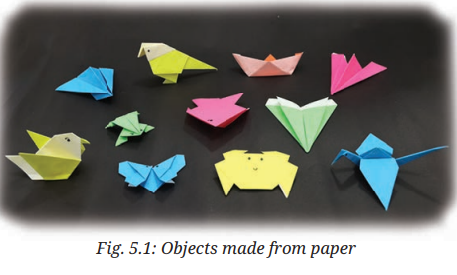 B. Playing with a balloon Take a balloon and inflate it. Now, loosen your grip and let the air escape out. Do you get the uninflated balloon back? Take another balloon; inflate it and grip the opening tightly. Now, prick it with a pin. Caution—Be careful while using a pin. What happens? Will you be able to get the uninflated balloon back? C. Crushing a piece of chalk Crush a small piece of chalk into powder. Can you get the chalk piece back from the powder? Is there any similarity in the changes listed in A, B, and C?
Answer:
Observations:
- A. Folding paper: When you unfold the paper, you get the same paper back. No new substance is formed; only shape changes.
- B. Inflating balloon: When you let air escape, you get the uninflated balloon back. When you prick it, the balloon bursts and you cannot get the original balloon back.
- C. Crushing chalk: You cannot get the chalk piece back from the powder.
Similarity: In all three changes, the material (paper, rubber, chalk) remains the same. Only the appearance (shape or size) changes. No new substance is formed.
Conclusion: Changes in which only physical properties like shape, size, and state change, and no new substance is formed, are called physical changes.
Q2. Activity 5.3: Let us explore Take two glass tumblers or small transparent bottles. Mark them A and B. Fill one-fourth of glass tumbler A with tap water and one-fourth of glass tumbler B with lime water. Now, blow air (exhale) into each glass tumbler, one at a time, using separate straws and observe them. Caution—Do not suck the water or lime water while doing this. 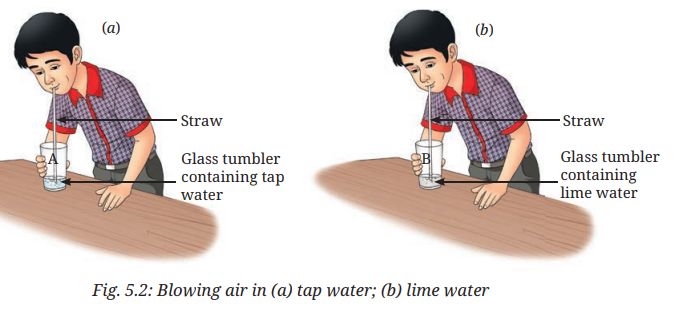 Do you notice any changes?
Answer:
Observations:
- Glass tumbler A (tap water): Blowing air creates bubbles only. There is no change in the appearance of the water.
- Glass tumbler B (lime water): Blowing air creates bubbles and turns the lime water milky (cloudy). If left for some time, a white substance settles at the bottom.
Explanation:
- Carbon dioxide from the exhaled air reacts with lime water (calcium hydroxide) to form a new white-coloured substance called calcium carbonate, which is insoluble in water.
- This formation of a new substance indicates a chemical change.
- Chemical equation: Calcium hydroxide + Carbon dioxide → Calcium carbonate + Water
Conclusion: Turning lime water milky is a test for carbon dioxide gas. This is a chemical change because a new substance is formed.
Q3. Activity 5.4: Let us experiment Take a teaspoonful of vinegar or lemon juice in a test tube. Add a pinch of baking soda (sodium hydrogen carbonate) to it. What do you observe? You would hear a fizzing bubbling sound and see the gas bubbles forming. Pass this gas through freshly prepared lime water kept in another test tube, as shown in Fig. 5.3a. What do you observe? The lime water turns milky. What do you infer about the gas formed by mixing vinegar and baking soda? This indicates that the gas formed is carbon dioxide. This activity can also be performed using two small used bottles instead of test tubes and a flexible straw, as shown in Fig. 5.3b. 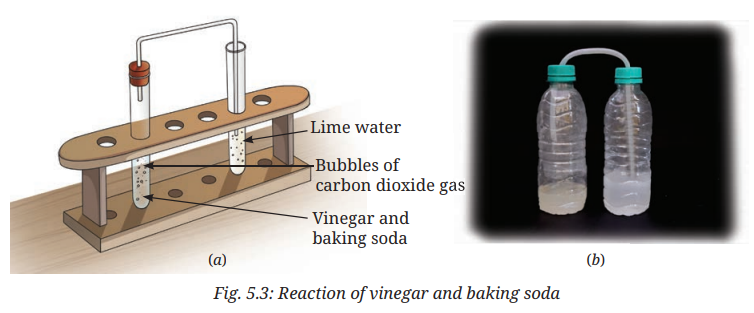 Since a new substance, carbon dioxide, is formed in this reaction, we say that a chemical change has occurred here as well. It can be represented as: Vinegar + Baking soda → Carbon dioxide + Other substances Repeat the above activity using baking soda and water. Do you observe any bubble formation? Is this a physical or a chemical change?
Answer:
Observations:
- When vinegar (or lemon juice) is added to baking soda, there is a fizzing bubbling sound and gas bubbles are formed.
- When this gas is passed through lime water, the lime water turns milky.
Inference:
- The gas formed is carbon dioxide.
- A new substance (carbon dioxide) is formed, so this is a chemical change.
When baking soda is mixed with water:
- No bubbles are formed and no new substance is created.
- This is a physical change because baking soda simply dissolves in water.
Conclusion: A chemical reaction occurs between vinegar (acid) and baking soda (base) producing carbon dioxide gas, water, and other substances. This is a chemical change.
Q4. Activity 5.5: Let us investigate Place two identical candles on two separate petri dishes and light them. Cover one of these with a glass tumbler, as shown in Fig. 5.6. What happens to the candle flames in the two cases? 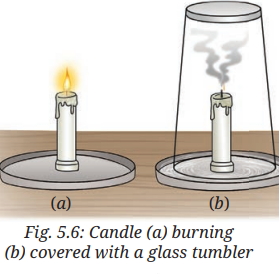 We observe that the candle that was not covered continues to burn, whereas the candle that was covered with a glass tumbler stops burning after some time. Why does this happen? Since the candle covered by the glass tumbler does not have a continuous supply of air, the flame gets extinguished soon. The component of air that supports combustion is oxygen. This can be confirmed by the presence of carbon dioxide in the glass tumbler inverted on the candle. How can you test the presence of carbon dioxide gas? You can test the carbon dioxide gas by adding a small amount of lime water in the petri dish. You will notice that it turns milky. This carbon dioxide was formed by the carbon from the wax and the oxygen from the air. In other words, oxygen is required for combustion.
Answer:
Observations:
- Candle without cover: Continues to burn.
- Candle covered with glass tumbler: Stops burning after some time.
Reason:
- The covered candle does not have a continuous supply of air (oxygen).
- Oxygen is the component of air that supports combustion.
- When oxygen is exhausted inside the glass tumbler, the flame gets extinguished.
Testing for carbon dioxide:
- Add a small amount of lime water in the petri dish after extinguishing the candle.
- Lime water turns milky, confirming the presence of carbon dioxide.
- This carbon dioxide was formed by the reaction of carbon from the wax with oxygen from the air.
Conclusion: Oxygen is required for combustion. Without oxygen, combustion cannot occur.
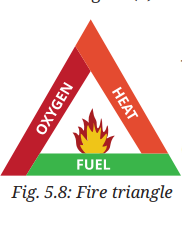
Q5. Is the Presence of Air Enough for Combustion? We learnt above that combustible substances and oxygen are necessary for combustion. We also know that paper is a combustible substance, but we can keep it in the air for any length of time without it catching fire. What else is needed to start combustion? Let us learn about this. Caution—Perform this activity under the supervision of your teacher or an adult. Hold a piece of paper with a pair of tongs and bring a lighted matchstick to it. It quickly catches fire. Do we say that we need a fire to start the burning process? Take another piece of paper. Using a magnifying glass, focus the sunrays to make the smallest and brightest spot on the paper, as shown in the Fig. 5.7a. Hold it there for some time. What do you observe? We observe that the paper starts to emit smoke, and then catches fire. Thus, we find that a substance can burn even without fire. How do we explain this change? Focusing sunrays on the paper heats it. The temperature of the paper increases with time. After some time, the paper becomes so hot that it starts burning. This minimum temperature at which a substance catches fire is called its ignition temperature. Since the temperature of the lighted matchstick was already higher than the ignition temperature of the paper, it caught fire almost immediately. So, we can conclude that for the combustion process to occur, there are three requirements (Fig. 5.8)— (i) A combustible substance, also called 'fuel' (ii) Oxygen (iii) Heat that allows the fuel to reach its ignition temperature. 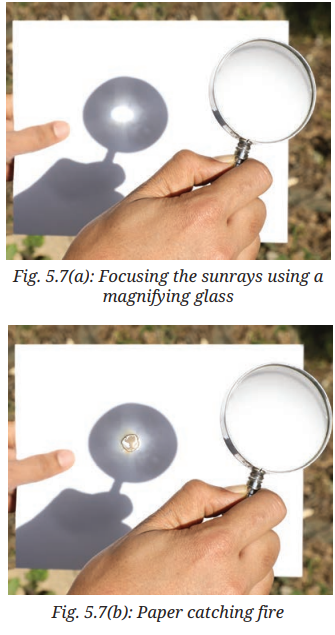
Answer:
Observations:
- Paper catches fire immediately when a lighted matchstick is brought near it.
- Paper also catches fire when sunlight is focused on it using a magnifying glass, after some time.
Explanation:
- A substance can burn even without fire if it gets enough heat.
- The minimum temperature at which a substance catches fire is called its ignition temperature.
- The lighted matchstick has a temperature higher than the ignition temperature of paper, so paper catches fire immediately.
- Focusing sunlight heats the paper until it reaches its ignition temperature, causing it to catch fire.
Three requirements for combustion (Fire Triangle):
- Fuel (combustible substance) — e.g., paper, wood, kerosene
- Oxygen — present in air
- Heat — to reach ignition temperature
Conclusion: For combustion to occur, fuel, oxygen, and heat (to reach ignition temperature) are all required.
Q6. Activity 5.8: Let us think Think again about all the changes that we have discussed or talked about so far. In which of these can we get back the object or substance in the form we started with? Record your observations in Table 5.2.
| S.No. | Change | The original state can be brought back (Yes/No) |
|---|---|---|
| 1. | Melting ice cubes | Yes |
| 2. | Chopping vegetables | No |
| 3. | Boiling water | Yes |
| 4. | Making popcorn from corn | No |
| 5. | Cutting a piece of paper | No |
| 6. | Adding beetroot extract to water | Yes |
| 7. | Burning wood | No |
| 8. | Drying wet clothes | Yes |
| 9. | Making small balls of dough | Yes |
| 10. | Rolling small balls of dough into chapatis | Yes |
| 11. | Ripening of fruits | No |
| 12. | Rusting of iron | No |
Answer:
Completed Table 5.2:
| S.No. | Change | The original state can be brought back (Yes/No) |
|---|---|---|
| 1. | Melting ice cubes | Yes |
| 2. | Chopping vegetables | No |
| 3. | Boiling water | Yes |
| 4. | Making popcorn from corn | No |
| 5. | Cutting a piece of paper | No |
| 6. | Adding beetroot extract to water | Yes |
| 7. | Burning wood | No |
| 8. | Drying wet clothes | Yes |
| 9. | Making small balls of dough | Yes |
| 10. | Rolling small balls of dough into chapatis | Yes |
| 11. | Ripening of fruits | No |
| 12. | Rusting of iron | No |
Conclusion:
- Reversible changes: Melting ice cubes, boiling water, adding beetroot extract to water, drying wet clothes, making balls of dough, rolling chapatis.
- Irreversible changes: Chopping vegetables, making popcorn, cutting paper, burning wood, ripening fruits, rusting of iron.
In-text Questions
Q1. What kinds of changes are they talking about? (From the opening scenario with students observing changes)
Answer:
Answer: The students are talking about different types of changes that occur around us:
- Ice melting to water: Physical change (change of state from solid to liquid)
- Bud becoming a flower: Biological change (growth and development)
- Cold water becoming warm: Physical change (temperature change)
- Banana developing brown spots and strong smell: Chemical change (ripening and decomposition)
These changes involve changes in size, shape, state, smell, or other properties of substances.
Q2. Can you think of some other changes that happen in your surroundings? (From Section 5.1 introduction)
Answer:
Answer: Other changes that happen in our surroundings include:
- Ripening of fruits (chemical change)
- Curdling of milk (chemical change)
- Rusting of iron (chemical change)
- Germination of seeds (biological/chemical change)
- Burning of a candle (both physical and chemical)
- Cooking of food (chemical change)
- Photosynthesis in plants (chemical change)
- Decay of organic matter (chemical change)
- Evaporation of water (physical change)
- Dissolving sugar in water (physical change)
- Changing of seasons
- Growth of plants and animals
- Weathering of rocks
Q3. Is there any similarity in the changes listed in A, B, and C? (From Activity 5.2)
Answer:
Answer: Yes, there is a similarity in all three changes:
- In all three cases, the material (paper, rubber of balloon, chalk) remains the same.
- Only the appearance (shape, size, or form) of the material changes.
- No new substance is formed in any of these changes.
- These are examples of physical changes.
Q4. Do you notice any changes? (From Activity 5.3)
Answer:
Answer: Yes, changes are observed:
- In tap water (A): Only bubbles are formed. No permanent change in the water.
- In lime water (B): The lime water turns milky (cloudy). A white substance settles at the bottom after some time.
These changes indicate a chemical reaction between carbon dioxide in exhaled air and lime water, forming calcium carbonate.
Q5. What do you infer about the gas formed by mixing vinegar and baking soda? (From Activity 5.4)
Answer:
Answer: The gas formed by mixing vinegar and baking soda is carbon dioxide.
Inference:
- The gas produced caused lime water to turn milky.
- Turning lime water milky is a characteristic test for carbon dioxide gas.
- Therefore, the gas formed is carbon dioxide.
- A new substance (carbon dioxide) is formed, indicating a chemical change.
Q6. Repeat the above activity using baking soda and water. Do you observe any bubble formation? Is this a physical or a chemical change? (From Activity 5.4)
Answer:
Answer:
- Observation: No bubbles are formed when baking soda is mixed with water.
- Conclusion: This is a physical change because baking soda simply dissolves in water without forming any new substance.
- No chemical reaction occurs; the baking soda can be recovered by evaporating the water.
Q7. Can you predict if this is a physical or a chemical change? (From Section 5.3.2 - referring to burning magnesium ribbon)
Answer:
Answer: Burning of magnesium ribbon is a chemical change.
Reason:
- When magnesium burns, a new substance called magnesium oxide is formed.
- The magnesium ribbon changes into a white powder.
- Heat and light are also produced.
- Since a new substance is formed, it is a chemical change.
Chemical equation: Magnesium + Oxygen → Magnesium oxide + Heat + Light
Q8. Why does this happen? (From Activity 5.5 - referring to candle extinguishing under glass tumbler)
Answer:
Answer: The candle extinguishes under the glass tumbler because:
- The glass tumbler cuts off the supply of air (oxygen) to the candle.
- Oxygen is essential for combustion.
- When the oxygen inside the glass tumbler is used up, the flame gets extinguished.
- This shows that oxygen is required for burning.
Q9. How can you test the presence of carbon dioxide gas? (From Activity 5.5)
Answer:
Answer: The presence of carbon dioxide gas can be tested using lime water.
Method:
- Take some freshly prepared lime water in a test tube or petri dish.
- Pass the gas to be tested through the lime water.
- If the lime water turns milky (cloudy), it indicates the presence of carbon dioxide gas.
Reason: Carbon dioxide reacts with lime water (calcium hydroxide) to form calcium carbonate, which is insoluble and makes the water appear milky.
Q10. Do we say that we need a fire to start the burning process? (From Section 5.3.2 - discussion on ignition temperature)
Answer:
Answer: No, we do not necessarily need a fire to start the burning process.
Explanation:
- A substance can start burning if it reaches its ignition temperature.
- This can happen through various means, such as focusing sunlight (as shown with a magnifying glass), friction, or electrical sparks.
- Fire (a flame) is just one way to provide the required heat to reach ignition temperature.
- The minimum temperature at which a substance catches fire is called its ignition temperature.
Q11. What do you think? (From Section 5.4 - referring to burning candle, with students discussing physical and chemical changes)
Answer:
Answer: The burning of a candle involves both physical and chemical changes.
Physical changes in burning candle:
- Melting of wax: Solid wax changes to liquid wax.
- Solidification of wax: Liquid wax solidifies when it cools.
- Evaporation of wax: Liquid wax changes to vapour.
Chemical changes in burning candle:
- Burning of wax vapour: The vapour reacts with oxygen to produce carbon dioxide, water vapour, heat, and light.
- New substances (carbon dioxide and water vapour) are formed.
Conclusion: Melting and evaporation of wax are physical changes, while burning of wax vapour is a chemical change.
Q12. Can you think of some other desirable changes happening around you? (From Section 5.6)
Answer:
Answer: Some other desirable changes happening around us include:
- Cooking of food: Makes food edible and digestible.
- Germination of seeds: Leads to plant growth and food production.
- Photosynthesis: Plants produce food and oxygen.
- Boiling water: Kills germs and makes water safe to drink.
- Fertilisation of soil: Helps plants grow better.
- Drying of grains: Preserves food for longer periods.
- Ripening of fruits: Makes them edible and nutritious.
- Formation of curd from milk: Increases nutritional value and shelf life.
- Filtration of water: Makes water clean.
- Recycling of materials: Reduces waste and conserves resources.
Q13. How have these formed? (From Section 5.7.1 - referring to sediments at the base of mountains)
Answer:
Answer: Sediments are formed by the weathering of rocks.
Process:
- Physical weathering: Temperature changes, growing roots of trees, and freezing of water within cracks cause rocks to break into smaller pieces.
- Chemical weathering: Water or chemicals present in water react with rocks, causing chemical changes in their composition.
- These physical and chemical changes in rocks are collectively called weathering.
- Weathering eventually leads to the formation of soil.
Q14. Is this a change that can be reversed? (From Exploratory Projects - referring to chameleons changing colour)
Answer:
Answer: Yes, the colour change in chameleons is a reversible change.
Explanation:
- Chameleons change colour to blend with their surroundings, when angry, or when sensing danger.
- When the situation changes, they can change back to their original colour.
- This is a biological reversible change controlled by the chameleon's nervous system.
- It is different from chemical changes where new substances are formed permanently.
Exercises
Q1. Which of the following statements are the characteristics of a physical change? (i) The state of the substance may or may not change. (ii) A substance with different properties is formed. (iii) No new substance is formed. (iv) The substance undergoes a chemical reaction. (a) (i) and (ii) (b) (ii) and (iii) (c) (i) and (iii) (d) (iii) and (iv)
Answer:
Answer: (c) (i) and (iii)
Explanation:
- (i) The state of the substance may or may not change: In physical changes, the state can change (e.g., melting ice) or remain the same (e.g., cutting paper).
- (ii) A substance with different properties is formed: This is NOT true for physical changes—no new substance is formed.
- (iii) No new substance is formed: This is the defining characteristic of a physical change.
- (iv) The substance undergoes a chemical reaction: This is NOT true for physical changes—no chemical reaction occurs.
Therefore, the correct characteristics are (i) and (iii).
Q2. Predict which of the following changes can be reversed and which cannot be reversed. If you are not sure, you may write that down. Why are you not sure about these? (i) Stitching cloth to a shirt (ii) Twisting of straight string (iii) Making idlis from a batter (iv) Dissolving sugar in water (v) Drawing water from a well (vi) Ripening of fruits (vii) Boiling water in an open pan (viii) Rolling up a mat (ix) Grinding wheat grains to flour (x) Forming of soil from rocks
Answer:
Answers:
| S.No. | Change | Reversible (Yes/No) | Reason |
|---|---|---|---|
| (i) | Stitching cloth to a shirt | Yes | Stitches can be removed and cloth can be separated |
| (ii) | Twisting of straight string | Yes | String can be untwisted back to its original form |
| (iii) | Making idlis from a batter | No | Chemical change occurs during steaming; cannot get batter back |
| (iv) | Dissolving sugar in water | Yes | Can recover sugar by evaporating water |
| (v) | Drawing water from a well | No | Water is removed from its source; cannot be put back easily (not sure - it's more of a transfer than a change) |
| (vi) | Ripening of fruits | No | Chemical changes occur; cannot get raw fruit back |
| (vii) | Boiling water in an open pan | Yes | Can condense water vapour back to liquid water |
| (viii) | Rolling up a mat | Yes | Mat can be unrolled back to its original state |
| (ix) | Grinding wheat grains to flour | No | Cannot get whole wheat grains back from flour |
| (x) | Forming of soil from rocks | No | Irreversible natural process over long time |
Not sure about (v) Drawing water from a well: This is not strictly a change in the substance itself—it's just moving water from one place to another. The water remains the same. If considering the water level in the well, it can be replenished by rain, but the specific water drawn cannot be put back.
Q3. State whether the following statements are True or False. In case a statement is False, write the correct statement. (i) Melting of wax is necessary for burning a candle. (True/False) (ii) Collecting water vapour by condensing involves a chemical change. (True/False) (iii) The process of converting leaves into compost is a chemical change. (True/False) (iv) Mixing baking soda with lemon juice is a chemical change. (True/False)
Answer:
(i) True
- Melting of wax is necessary for burning a candle because the liquid wax travels up the wick and evaporates to form vapour, which then burns.
(ii) False
- Correct statement: Collecting water vapour by condensing involves a physical change.
- Condensation is a change of state from gas to liquid, and no new substance is formed.
(iii) True
- Converting leaves into compost is a chemical change because bacteria and fungi break down the leaves into new substances.
(iv) True
- Mixing baking soda with lemon juice is a chemical change because it produces carbon dioxide gas and other new substances.
Q4. Fill in the blanks in the following statements: (i) Nalini observed that the handle of her cycle has got brown deposits. The brown deposits are due to ______ and this is a ______ change. (ii) Folding a handkerchief is a ______ change and can be ______. (iii) A chemical process in which a substance reacts with oxygen with evolution of heat is called ______, and this is a ______ change. (iv) Magnesium, when burnt in air, produces a substance called ______. The substance formed is ______ in nature. Burning of magnesium is a ______ change.
Answer:
Answers:
(i) Nalini observed that the handle of her cycle has got brown deposits. The brown deposits are due to rusting and this is a chemical change.
(ii) Folding a handkerchief is a physical change and can be reversed.
(iii) A chemical process in which a substance reacts with oxygen with evolution of heat is called combustion, and this is a chemical change.
(iv) Magnesium, when burnt in air, produces a substance called magnesium oxide. The substance formed is basic in nature. Burning of magnesium is a chemical change.
Q5. Are the changes of water to ice and water to steam, physical or chemical? Explain.
Answer:
Answer: Both changes are physical changes.
Explanation:
- Water to ice: Water changes from liquid to solid state (freezing).
- Water to steam: Water changes from liquid to gaseous state (boiling/evaporation).
- Reason:
- In both cases, water molecules remain the same (H₂O).
- No new substance is formed.
- Only the physical state changes.
- Both changes are reversible (ice can melt back to water; steam can condense back to water).
Conclusion: Changes in state are always physical changes because no new substance is formed.
Q6. Is curdling of milk a physical or chemical change? Justify your statement.
Answer:
Answer: Curdling of milk is a chemical change.
Justification:
- When milk curdles, the proteins (casein) in milk undergo chemical changes.
- A new substance (curd) is formed with different properties (taste, texture, smell) from the original milk.
- The change is irreversible—you cannot get back the original milk from curd.
- This is caused by the action of bacteria (or acids like lemon juice) on milk, which is a chemical reaction.
Conclusion: Since a new substance is formed that cannot be easily reversed, curdling of milk is a chemical change.
Q7. Natural factors, such as wind, rain, etc., help in the formation of soil from rocks. Is this change physical or chemical and why?
Answer:
Answer: The formation of soil from rocks involves both physical and chemical changes.
Physical changes involved:
- Weathering of rocks due to temperature changes causes them to crack and break into smaller pieces.
- Wind and water erosion break down rocks into smaller particles.
- These are physical changes because the rocks are broken down without changing their chemical composition.
Chemical changes involved:
- Water (or chemicals in water) reacts with minerals in rocks, causing chemical changes.
- For example, iron in basalt reacts with oxygen and water to form iron oxide (red colour).
- These chemical reactions form new substances.
Conclusion: The formation of soil involves both physical changes (breaking of rocks) and chemical changes (formation of new minerals). Collectively, these processes are called weathering.
Q8. Read the following story titled 'Eco-friendly Prithvi', and tick the most appropriate option(s) given in the brackets. Provide a suitable title of your choice for the story. Prithvi is preparing a meal in the kitchen. He chops vegetables, peels potatoes, and cuts fruits (physical changes/chemical changes). He collects the seeds, fruits, and vegetable peels into a clay pot (physical change/chemical change). The fruits, vegetable peels, and other materials begin to decompose due to the action of bacteria and fungi, forming compost (physical change/chemical change). He decides to plant seeds in the compost and water them regularly. After a few days, he notices that the seeds begin to germinate and small plants start to grow, eventually blooming into colourful flowers (physical change/chemical change). His efforts are appreciated by all his family members.
Answer:
Answers with ticks:
Prithvi is preparing a meal in the kitchen. He chops vegetables, peels potatoes, and cuts fruits (physical changes). He collects the seeds, fruits, and vegetable peels into a clay pot (physical change). The fruits, vegetable peels, and other materials begin to decompose due to the action of bacteria and fungi, forming compost (chemical change). He decides to plant seeds in the compost and water them regularly. After a few days, he notices that the seeds begin to germinate and small plants start to grow, eventually blooming into colourful flowers (chemical change).
Suitable titles for the story:
- "Prithvi's Eco-Friendly Kitchen"
- "From Waste to Wonder"
- "Prithvi's Green Steps"
- "Sustainable Living with Prithvi"
- "The Cycle of Life in Prithvi's Garden"
Explanation of choices:
- Chopping vegetables, peeling potatoes, cutting fruits: Physical changes (only size and shape change)
- Collecting waste into a pot: Physical change (just moving materials)
- Decomposition of waste: Chemical change (new substances formed by bacteria and fungi)
- Germination and growth of plants: Chemical change (photosynthesis, cellular changes, new substances formed)
Q9. Some changes are given here. Write physical changes in the area marked 'A' and chemical changes in the area marked 'B'. Enter the changes which are both physical and chemical in the area marked 'C'. Process of burning a candle; Tearing of paper; Rusting; Curdling of milk; Ripening of fruits; Melting of ice; Folding of clothes; Burning of magnesium; Mixing baking soda with vinegar.
Answer:
Answer:
Area A (Physical Changes only):
- Tearing of paper
- Melting of ice
- Folding of clothes
Area B (Chemical Changes only):
- Rusting
- Curdling of milk
- Ripening of fruits
- Burning of magnesium
- Mixing baking soda with vinegar
Area C (Both Physical and Chemical changes):
- Process of burning a candle (melting of wax - physical; burning of wax vapour - chemical)
Note: Tearing of paper is a physical change because the paper remains the same, just divided into pieces. However, tearing paper also creates new surfaces, but no new substance is formed.
Q10. The experiments shown in Fig. 5.11a, b, c, and d were performed. Find out in which case(s) did lime water turn milky and why? 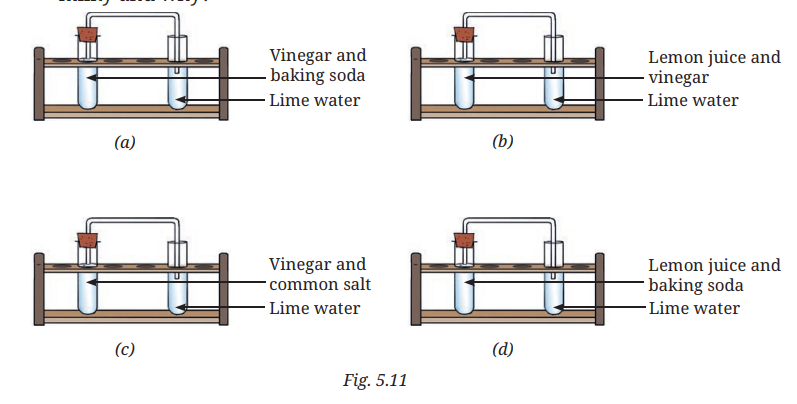
Answer:
Answer: Lime water turns milky in cases where carbon dioxide gas is produced during the reaction.
Possible cases:
- Case (a): If the experiment involves burning a candle, lime water will turn milky because carbon dioxide is produced during combustion.
- Case (b): If the experiment involves mixing vinegar and baking soda, lime water will turn milky because carbon dioxide gas is released.
- Case (c): If the experiment involves exhaling air into lime water, it will turn milky because exhaled air contains carbon dioxide.
- Case (d): If the experiment involves burning wood or any carbon-containing substance, lime water will turn milky due to carbon dioxide production.
Why lime water turns milky:
- Carbon dioxide reacts with lime water (calcium hydroxide) to form calcium carbonate.
- Calcium carbonate is insoluble in water and appears as a white precipitate (milky/cloudy appearance).
- Chemical equation: Ca(OH)₂ + CO₂ → CaCO₃ + H₂O
If a case does NOT produce carbon dioxide, lime water will NOT turn milky. For example, simply boiling water or heating a non-carbon-containing substance will not produce carbon dioxide.
Exploratory Projects
Q1. Write a message on a piece of paper using lemon juice as ink and let it dry. The message will become invisible. Now use a warm iron over the paper (or hold the paper over the flame of a candle, taking care that it does not catch fire). The invisible letters turn dark brown as the paper gets warm. Can any of these changes be reversed? Caution—Perform this activity under the supervision of an adult.
Answer:
Project Activity: Invisible Ink
Method:
- Write a message on paper using lemon juice as ink.
- Let the paper dry completely—the message becomes invisible.
- Apply heat using a warm iron or hold the paper over a candle flame (carefully).
- The invisible letters turn dark brown.
Observations:
- Lemon juice contains citric acid.
- When heated, the lemon juice oxidises and turns brown before the paper burns.
- The brown colour appears where the lemon juice was applied.
Can these changes be reversed?
- Drying of lemon juice: This is a physical change (evaporation of water). It can be reversed by adding water to the paper.
- Darkening/browning of the message: This is a chemical change (oxidation/decomposition of lemon juice). It cannot be reversed—you cannot make the paper white again.
Conclusion: The drying of lemon juice is a reversible physical change, but the browning of the message is an irreversible chemical change.
Q2. We hear a lot of news about landslides and breaking of rocks in hilly regions these days, causing a lot of damage to life and property. Discuss what steps we can take to reduce landslides and rock erosion.
Answer:
Project Activity: Reducing Landslides and Rock Erosion
Aim: To discuss and suggest measures to reduce landslides and rock erosion.
Causes of landslides and rock erosion:
- Deforestation (removal of trees)
- Heavy rainfall and flooding
- Earthquakes and natural disasters
- Mining and quarrying activities
- Construction activities (roads, buildings) on slopes
- Climate change (extreme weather events)
Steps to reduce landslides and rock erosion:
| Action | How it helps |
|---|---|
| Afforestation (planting trees) | Tree roots hold the soil together and prevent erosion |
| Building retaining walls | Provides structural support to slopes |
| Terracing on slopes | Reduces the speed of water flow and prevents soil erosion |
| Proper drainage systems | Prevents water from accumulating and weakening the soil |
| Avoiding construction on steep slopes | Reduces human-induced instability |
| Using vegetation cover (grass, shrubs) | Provides natural protection against erosion |
| Controlled mining and quarrying | Prevents destabilisation of hill slopes |
| Rockfall protection nets | Catches falling rocks and protects infrastructure |
| Early warning systems | Helps in evacuating people before a landslide occurs |
Conclusion: Landslides and erosion are natural processes, but human activities accelerate them. By adopting sustainable practices, we can reduce their frequency and impact.
Q3. Observe the activities going on in the kitchen and note any changes that can be reversed. Are these physical or chemical changes?
Answer:
Project Activity: Observing Changes in the Kitchen
Aim: To observe and classify changes that occur in the kitchen as physical or chemical changes, and identify reversible changes.
| Activity | Observation | Type of Change | Reversible (Yes/No) |
|---|---|---|---|
| Cutting vegetables | Size and shape change | Physical | No |
| Melting butter or ghee | Solid to liquid | Physical | Yes |
| Heating water | Water becomes hot, then boils | Physical | Yes |
| Cooking rice/dal | Food becomes soft, cooked | Chemical | No |
| Frying food | Colour, texture, and smell change | Chemical | No |
| Dissolving sugar in water | Sugar disappears, solution forms | Physical | Yes |
| Mixing spices with food | Colour and taste change | Physical | No |
| Making dough | Flour and water mix, changes form | Physical | Yes |
| Baking or steaming food | Food expands, becomes cooked | Chemical | No |
| Cooling hot food | Temperature decreases | Physical | Yes |
| Fermentation of idli/dosa batter | Batter rises, changes taste | Chemical | No |
Conclusion: Many activities in the kitchen involve physical changes (cutting, melting, dissolving) that may be reversible, and chemical changes (cooking, frying, fermentation) that are irreversible.
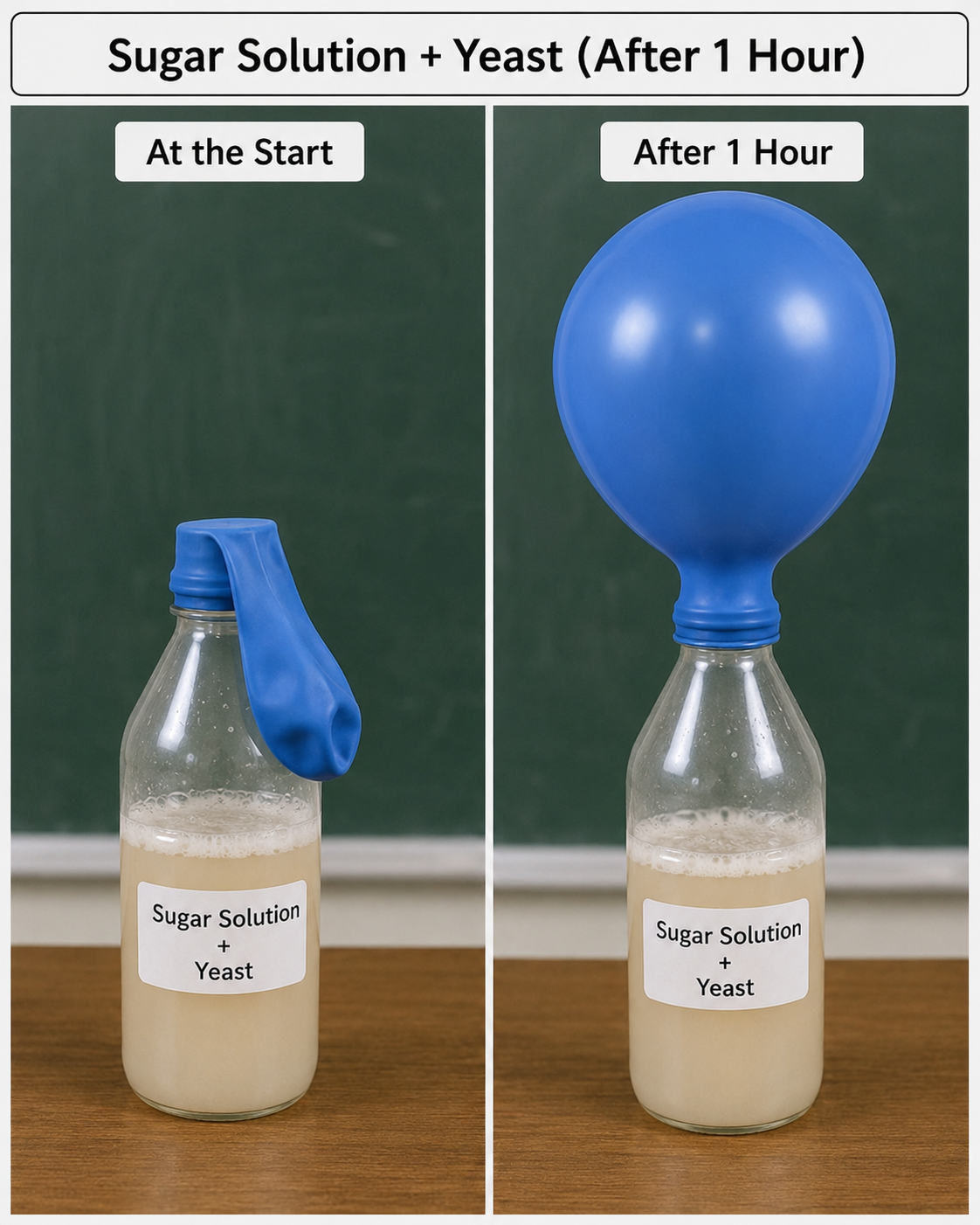
Q4. Yeast is added while baking bread to make it fluffy and soft. How does yeast work? Try and find out! Take a small bottle, some sugar, fresh yeast, water, and a balloon. Make a sugar solution in the bottle by mixing two teaspoons of sugar and a small amount of water. Now add a spoonful of yeast and cover the mouth of the bottle with a balloon. Leave it undisturbed for about an hour. What do you observe? Carefully take off the balloon, holding its mouth tightly closed and attach it to another small bottle containing freshly prepared lime water. Shake the bottle so that the contents of the balloon get mixed with lime water. What do you observe? What can you conclude from this experiment? Identify all the changes occurring in the experiment and state which of them are physical and chemical changes.
Answer:
Project Activity: Yeast and Sugar Experiment
Method:
- Take a small bottle and add water.
- Mix 2 teaspoons of sugar in the water to make a sugar solution.
- Add a spoonful of fresh yeast.
- Cover the mouth of the bottle with a balloon.
- Leave it undisturbed for about an hour.
Observations after one hour:
- The balloon inflates (expands).
- Bubbles are seen in the mixture.
- The mixture may have a smell of alcohol/fermentation.
Testing the gas:
- Carefully remove the balloon, keeping its mouth tightly closed.
- Attach the balloon to another bottle containing freshly prepared lime water.
- Shake the bottle so that the contents of the balloon mix with lime water.
Observation: Lime water turns milky.
Conclusion:
- The yeast uses sugar to grow and reproduce.
- During this process, yeast produces carbon dioxide gas (which inflated the balloon).
- Carbon dioxide is confirmed by the lime water turning milky.
- This is the same process used in baking bread—the carbon dioxide makes the bread fluffy and soft.
Changes occurring in the experiment:
| Change | Type of Change | Reason |
|---|---|---|
| Sugar dissolving in water | Physical change | No new substance formed; can recover sugar by evaporation |
| Yeast fermenting sugar | Chemical change | New substances formed (carbon dioxide, alcohol) |
| Inflation of balloon | Physical change | Gas fills the balloon, but no new substance in the balloon itself |
| Lime water turning milky | Chemical change | New substance (calcium carbonate) formed |
Overall conclusion: Yeast causes a chemical change (fermentation) in sugar solution, producing carbon dioxide and alcohol. This is a chemical change because new substances are formed.
Q5. Chameleons (Girgits) change colour to blend in with their surroundings and also when they are angry or sense danger. Is this a change that can be reversed? Explore from the internet or from your school library. 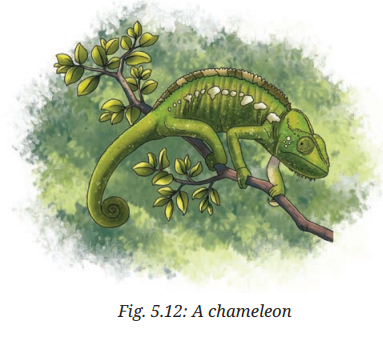
Answer:
Project Activity: Chameleon Colour Change
Aim: To understand whether a chameleon's colour change is reversible.
Information:
- Chameleons are reptiles known for their ability to change colour.
- They change colour for various reasons: camouflage (blending in with surroundings), communication (mating signals), temperature regulation, and expressing emotions (anger, fear).
How do they change colour?
- Chameleons have special skin cells called chromatophores that contain different pigments.
- They can expand or contract these cells, changing the distribution of pigments.
- This causes the reflected light to change, altering the perceived colour.
Is this change reversible?
- Yes, the colour change is reversible.
- When the chameleon moves to a different environment or its mood changes, it can change back to its original colour.
- This is a controlled biological process, not a permanent chemical change.
Conclusion:
- Chameleon colour change is a reversible biological change.
- It is not a chemical change because no new substance is formed—it's just the rearrangement of pigment cells.
- It is a physical change controlled by the chameleon's nervous system.
Comparison with other changes:
- Physical changes: Melting ice, folding paper (reversible).
- Chemical changes: Rusting, burning, curdling milk (irreversible).
- Chameleon colour change: Physical change (reversible).