
Activities
Q1. Activity 10.1: Let us test some explanations Take three earthen pots (or used bottles/containers) of the same size filled with garden soil. Plant saplings of similar sizes of a fast-growing plant like chilli or tomato in each pot. 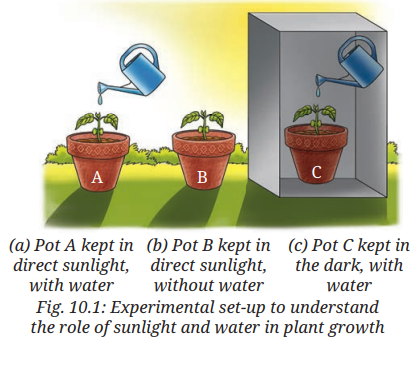 Label the pots A, B, and C. Count the number of leaves on each sapling and record your observations. Place pot A in direct sunlight. Keep the soil in this pot slightly moist by adding an adequate amount of water every day. Place pot B in direct sunlight, without adding water to the soil. Place pot C in the dark. Keep the soil in this pot slightly moist by adding an adequate amount of water every day. Observe the plants for two weeks and record changes in their height, number of leaves, colour of leaves, and any other changes that may appear. Record your observations in Table 10.1.
| Table 10.1: Effect of sunlight and water on plant growth | |||||||
|---|---|---|---|---|---|---|---|
| Pots kept under different conditions | Availability of | Height of plant (cm) | Number of leaves | Colour of leaves (Green/Yellow) | |||
| Sunlight | Water | Day 1 | After 2 weeks | Day 1 | After 2 weeks | ||
| Pot A: In direct sunlight, with water | Yes | Yes | |||||
| Pot B: In direct sunlight, without water | Yes | No | |||||
| Pot C: In the dark, with water | No | Yes | |||||
Answer:
Completed Table 10.1 (Sample observations):
| Table 10.1: Effect of sunlight and water on plant growth | |||||||
|---|---|---|---|---|---|---|---|
| Pots kept under different conditions | Availability of | Height of plant (cm) | Number of leaves | Colour of leaves (Green/Yellow) | |||
| Sunlight | Water | Day 1 | After 2 weeks | Day 1 | After 2 weeks | ||
| Pot A: In direct sunlight, with water | Yes | Yes | 8 | 18 | 6 | 15 | Green |
| Pot B: In direct sunlight, without water | Yes | No | 8 | 9 (wilted) | 6 | 3 (dropped) | Yellow/Brown (wilting) |
| Pot C: In the dark, with water | No | Yes | 8 | 12 | 6 | 8 | Yellow/Pale (etiolated) |
Observations:
- Pot A (sunlight + water): Maximum growth; healthy green leaves; increase in height and number of leaves.
- Pot B (sunlight, no water): Least growth; plant wilted; leaves turned yellow and dropped; may have died.
- Pot C (dark, with water): Some growth but less than Pot A; leaves turned pale yellow; plant was weak and spindly.
Which pot has maximum growth? Pot A (sunlight + water).
Which pot has least growth? Pot B (no water).
Inference: Plants require both sunlight and water for proper growth.
Q2. Activity 10.2: Let us test Take out the leaf and place it on a plate. Now, put a few drops of diluted iodine solution with the help of a dropper on the decolourised leaf. Wait for a few minutes and observe. If the colour of the leaf changes to blue-black, it indicates the presence of starch. Caution—Alcohol should never be placed near a heat source directly, as it is highly flammable and can easily lead to fire and burns. Did you wonder why we decolourise the leaf in the beginning of this activity? Decolourisation of a leaf enables us to easily observe colour change and, thus, the presence of starch.
Answer:
Answer: The iodine test is used to test for the presence of starch in leaves.
Procedure:
- Take a green leaf from a plant that has been in sunlight.
- Place the leaf in boiling water for a few minutes to kill the cells.
- Then, place the leaf in alcohol and heat it (in a water bath) to remove chlorophyll (decolourisation).
- Wash the decolourised leaf with water and place it on a plate.
- Add a few drops of diluted iodine solution on the leaf.
Observation:
- If the leaf turns blue-black, it indicates the presence of starch.
- If there is no colour change, starch is absent.
Why decolourise the leaf?
- Decolourisation removes the green pigment (chlorophyll) so that the blue-black colour change from iodine can be clearly seen.
- Without decolourisation, the green colour of the leaf would hide the colour change.
Q3. Activity 10.3: Let us check Bhaskar took a leaf having both green and non-green patches from each of two similar potted plants — one kept in sunlight and the other kept in the dark for 36 hours. He wanted to compare the leaves before and after the starch test. He made a sketch of the leaves to record the location of the green and the non-green patches on them with the help of a tracing paper. After that, he performed an iodine test (as shown in Activity 10.2) on the leaves. Bhaskar recorded his observations in Table 10.2.  In Table 10.2, Bhaskar recorded a blue-black colour (indicating the presence of starch) on the green patches of the leaf obtained from the plant placed in sunlight. Bhaskar also recorded that the leaf obtained from the plant kept in the dark does not show a blue-black colour, even on the green patches, indicating that no starch has been produced. Non-green patches of the leaf obtained from the plant placed in sunlight do not turn blue-black. Does it indicate that there is no chlorophyll present in those patches? The non-green patches may not have sufficient chlorophyll to prepare enough starch to be detected using the iodine test.
Answer:
Observations from Activity 10.3:
| Condition | Green patches of leaf | Non-green patches of leaf |
|---|---|---|
| Plant in sunlight | Turn blue-black (starch present) | Do not turn blue-black (no starch) |
| Plant in dark | Do not turn blue-black (no starch) | Do not turn blue-black (no starch) |
Inferences:
- Chlorophyll is necessary for starch production: Only green patches (which have chlorophyll) produced starch in sunlight.
- Sunlight is essential for photosynthesis: The plant kept in the dark did not produce starch even in green patches.
- Non-green patches lack chlorophyll: They could not perform photosynthesis even in sunlight.
Conclusion: Both chlorophyll and sunlight are essential for the production of starch (food) in plants.
Q4. Activity 10.4: Let us explore (demonstration activity) The teacher may demonstrate this activity. Take a potted green plant and keep it in the dark for two to three days to allow it to destarch (i.e., lose any stored starch). Then, locate one leaf of this plant for this experiment. Take a wide-mouthed bottle and pour some caustic soda (sodium hydroxide) into it (caustic soda absorbs carbon dioxide from the air). Caution—Caustic soda is a strong chemical that can cause skin burns; only teachers should handle it. Insert half of the destarched leaf into the bottle through a split cork, leaving the other half of the leaf outside, and place the bottle as shown in Fig. 10.3a. 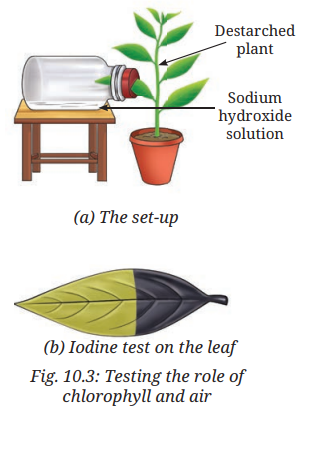 Place the set-up in sunlight for a few hours. Observe and record the availability of water, sunlight, chlorophyll, and carbon dioxide in Table 10.3. Remove the leaf and test it for starch using the iodine test, as was done in Activity 10.2. Record your observations in Table 10.3.
| Table 10.3: Role of air in the preparation of starch by plants | |||||
|---|---|---|---|---|---|
| Part of the leaf | Availability of Water | Availability of Sunlight | Availability of Chlorophyll | Availability of Carbon dioxide | Starch present (Yes/No) |
| Part of the leaf inside the bottle | |||||
| Part of the leaf outside the bottle | |||||
Answer:
Completed Table 10.3:
| Table 10.3: Role of air in the preparation of starch by plants | |||||
|---|---|---|---|---|---|
| Part of the leaf | Availability of Water | Availability of Sunlight | Availability of Chlorophyll | Availability of Carbon dioxide | Starch present (Yes/No) |
| Part of the leaf inside the bottle | Yes | Yes | Yes | No (absorbed by caustic soda) | No |
| Part of the leaf outside the bottle | Yes | Yes | Yes | Yes | Yes |
Observation:
- The part of the leaf outside the bottle (exposed to CO₂) turns blue-black — starch is present.
- The part of the leaf inside the bottle (no CO₂) does not turn blue-black — no starch is present.
Conclusion: Carbon dioxide (CO₂) from the air is essential for photosynthesis and the production of starch.
Q5. Activity 10.5: Let us explore Look at Fig. 10.4. Compare the two set-ups labelled as A and B, and analyse. In Fig. 10.4, set-up A is placed in sunlight, and set-up B is placed in the dark. What difference do you observe in the two set-ups? Do you observe air bubbles emerging in the inverted test tube in set-up A? The gas produced in this set-up caused bubbles to emerge and get accumulated in the inverted test tube. Which gas is this? 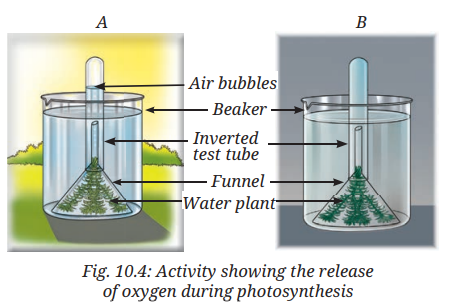 Based on Barkha didi's experiment, we can conclude that oxygen is released during photosynthesis.
Answer:
Observations:
- Set-up A (sunlight): Air bubbles are seen emerging from the water plant and collecting in the inverted test tube.
- Set-up B (dark): No air bubbles are seen.
Which gas is this?
- The gas produced is oxygen.
- This can be confirmed by testing the gas with a glowing splinter — it relights the splinter.
Conclusion:
- Oxygen is released during photosynthesis.
- Sunlight is essential for photosynthesis.
- In the dark, photosynthesis does not occur, so no oxygen is released.
Q6. Activity 10.6: Let us examine (demonstration activity) The teacher may demonstrate this activity. Collect a leaf from a plant such as rheo, money plant, onion, hibiscus, coleus, or any grass. Put it in a beaker filled with water. Carefully peel a thin layer from the lower surface of the leaf. Place the peel in a watch glass with water. Now, take a microscope slide and carefully put a drop of water on it. Using forceps, transfer the peel of the leaf from the watch glass to the slide with the help of forceps. Put a drop of ink on the leaf peel with the help of a dropper. Cover the peel with a coverslip and observe it under a microscope. What do you observe? Do you notice tiny pores on the peel, as shown in Fig. 10.6? These pores are called stomata. Stomata, present on the surface of leaves, help in the exchange of gases. 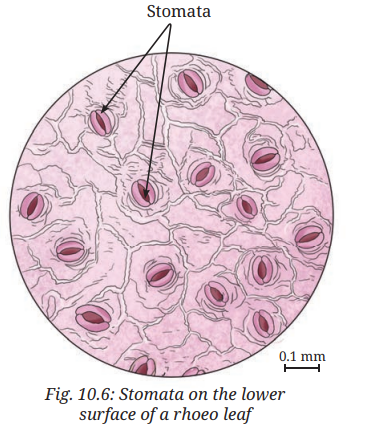
Answer:
Observation:
- Tiny pores called stomata are visible on the lower surface of the leaf.
- Stomata are surrounded by guard cells.
- They are present mainly on the lower surface of leaves (in most plants).
Function of stomata:
- Exchange of gases: Carbon dioxide enters the leaf through stomata for photosynthesis, and oxygen is released through them.
- Transpiration: Water vapour escapes through stomata.
Structure:
- Each stoma is a pore surrounded by two bean-shaped guard cells.
- Guard cells control the opening and closing of the stomata.
Q7. Activity 10.7: Let us investigate We can study water transport in plants by carrying out an activity. For this activity, we require two glass tumblers, some water, red ink, and twigs of two similar tender plants, preferably with white-coloured flowers (for example, white sadabahar, balsam), as shown in Fig. 10.7. 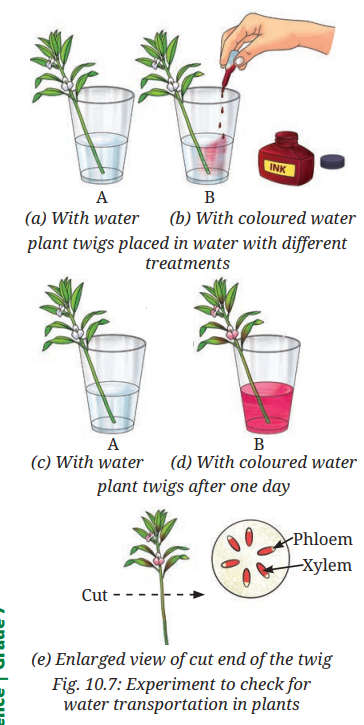
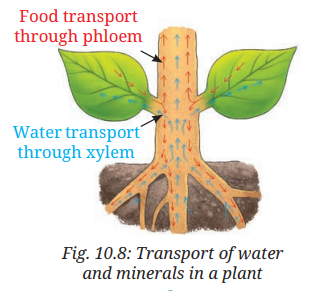 Take two tumblers and label them A and B. Fill one-third of each tumbler with water. Add a few drops of red ink to tumbler B. Obliquely cut the stems of both plants at their base while keeping them inside the water and immediately place one plant in each tumbler, as shown in Fig.10.7a and Fig.10.7b. Observe these plants the next day. What do you notice? Compare the plant stems placed in the tumblers. Do you observe red colour in the stem, leaves, and flowers of the plant from Tumbler B? Fig.10.7c and Fig.10.7d show the plants after one day. Compare the plant in Fig.10.7c with that in Fig.10.7d. A red colour is visible in the stem, leaves, and flowers of the plant in Fig.10.7d. How did different parts of the plant acquire this red colour? Cut the stem from the upper part of the plant that is not immersed in the red-coloured water. Observe the cut stem using a magnifying glass. Do you spot the red colour in the stem (Fig.10.7e)? How does the red colour ink move upwards? This is due to the thin tube-like structure called the xylem present in the stem, branches, and leaves of plants. Just like red ink, minerals dissolved in water also move up the stem through the xylem.
Answer:
Observation:
- In Tumbler B (with red ink), the stem, leaves, and flowers of the plant show red colouration after one day.
- In Tumbler A (plain water), no red colour is seen.
- When the stem is cut and observed under a magnifying glass, red colour is visible inside the stem.
Explanation:
- Red ink (along with water) is absorbed by the roots and travels upward through the stem.
- The red colour is seen in the xylem — thin tube-like structures present in the stem.
- Xylem transports water and minerals from the roots to all parts of the plant.
Conclusion:
- Water and minerals dissolved in water are transported through the xylem.
- The upward movement of water is called ascent of sap.
Q8. Activity 10.8: Let us find out (demonstration activity) Soak some moong bean seeds in water overnight. Put a layer of cotton in a conical flask and moisten the cotton with water to keep it wet. Place the soaked seeds over the wet cotton in the conical flask. Cover the mouth of the conical flask with a cork having two holes. Fit two tubes A and B through the two holes on the cork, as shown in Fig. 10.9. Leave it undisturbed for 24 hours in the dark. Take two test tubes and fill them with lime water. Cover the mouth of one test tube with a cork having one hole in it. Dip one glass tube in the test tube through a hole in the cork. Connect the flask and test tube with a rubber pipe as shown in Fig. 10.9. 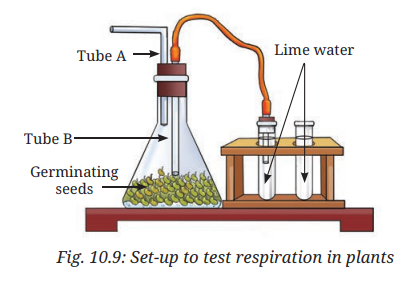 Compare both the test tubes for any change in colour. Does the lime water turn milky in both the test tubes? Why does the lime water turn milky in the test tube connected to the flask? Lime water turns milky due to the presence of more carbon dioxide in the flask. But where does this carbon dioxide come from? As we know, carbon dioxide is naturally present in very small quantities in the air. In the flask, additional carbon dioxide is produced by the seeds as they respire. During respiration, glucose is broken down in the presence of oxygen, releasing carbon dioxide, water, and energy. The word equation for the process of respiration, is as follows: Glucose + Oxygen → Carbon dioxide + Water + Energy The energy produced during respiration is used by plants for their growth and development. All parts of a plant, green or non-green, carry out respiration.
Answer:
Observations:
- Test tube connected to the flask: Lime water turns milky.
- Control test tube: Lime water remains clear.
Explanation:
- Germinating seeds in the flask are respiring.
- During respiration, seeds use oxygen and release carbon dioxide.
- The carbon dioxide passes into the test tube and reacts with lime water, turning it milky.
Conclusion:
- Plants respire just like animals.
- During respiration, glucose is broken down in the presence of oxygen to release carbon dioxide, water, and energy.
- All parts of the plant (green and non-green) carry out respiration.
In-text Questions
Q1. Have you ever seen plants eating food like animals do? (From the opening scenario)
Answer:
Answer: No, plants do not eat food like animals.
Explanation:
- Plants are autotrophs — they produce their own food through photosynthesis.
- Animals are heterotrophs — they obtain food by eating other organisms.
- Plants use sunlight, water, and carbon dioxide to synthesise their food.
Q2. What changes do you notice in plants when they grow? (From the opening scenario)
Answer:
Answer: When plants grow, the following changes are observed:
- New leaves and branches emerge.
- Height of the plant increases.
- Stem becomes thicker.
- Roots grow deeper and spread.
- Flowers, fruits, and seeds may appear.
- Colour of leaves may change (from light green to dark green).
Q3. What do you think causes these changes? (From Section 10.1 - referring to plant growth)
Answer:
Answer: The changes in plants are caused by:
- Water: Essential for all life processes, helps in photosynthesis and transportation.
- Sunlight: Provides energy for photosynthesis.
- Carbon dioxide: Raw material for photosynthesis.
- Nutrients (minerals): Obtained from soil, essential for growth.
- Photosynthesis: The process by which plants produce food (glucose).
Q4. What differences did you observe between the plants in the three pots? (From Activity 10.1)
Answer:
Answer:
- Pot A (sunlight + water): Plant grew well; healthy green leaves; maximum height and number of leaves.
- Pot B (sunlight, no water): Plant did not grow; leaves turned yellow and wilted; plant may have died.
- Pot C (dark, with water): Plant grew but was weak and pale; leaves were yellow; less growth compared to Pot A.
Q5. Which pot has the plant with the maximum growth? Which pot has the plant with the least growth? (From Activity 10.1)
Answer:
Answer:
- Maximum growth: Pot A (in direct sunlight, with water).
- Least growth: Pot B (in direct sunlight, without water). The plant may have died due to lack of water.
Q6. What do you infer from the observations made in this activity? (From Activity 10.1)
Answer:
Answer: The results indicate that plants require both sunlight and water for their growth.
Explanation:
- Without water (Pot B), the plant cannot survive.
- Without sunlight (Pot C), the plant grows poorly and becomes weak.
- Both sunlight and water are essential for photosynthesis and proper growth.
Q7. Did you wonder why we decolourise the leaf in the beginning of this activity? (From Activity 10.2)
Answer:
Answer: Decolourisation of the leaf enables us to easily observe colour change and, thus, the presence of starch.
Explanation:
- Chlorophyll gives leaves their green colour.
- The green colour would hide the blue-black colour change caused by iodine.
- By removing chlorophyll (using alcohol), the iodine colour change becomes clearly visible.
Q8. Does it indicate that there is no chlorophyll present in those patches? (From Activity 10.3)
Answer:
Answer: Yes, the non-green patches lack chlorophyll.
Explanation:
- Non-green patches do not have sufficient chlorophyll.
- Without chlorophyll, photosynthesis cannot occur.
- Therefore, no starch is produced in the non-green patches.
- This shows that chlorophyll is essential for photosynthesis.
Q9. What does this experiment show? (From Activity 10.4)
Answer:
Answer: This experiment shows that carbon dioxide is essential for photosynthesis.
Explanation:
- The part of the leaf inside the bottle (with caustic soda) had no carbon dioxide available.
- This part did not produce starch (no blue-black colour).
- The part outside the bottle had carbon dioxide available and produced starch (blue-black colour).
Q10. Based on Activities 10.3 and 10.4, what do you conclude? (From Section 10.2.2)
Answer:
Answer: Based on Activities 10.3 and 10.4, we conclude that:
- Sunlight is essential for photosynthesis (Activity 10.3).
- Chlorophyll is essential for photosynthesis (Activity 10.3).
- Carbon dioxide is essential for photosynthesis (Activity 10.4).
- Water is also essential for photosynthesis (as seen in Activity 10.1).
Therefore, the requirements for photosynthesis are: sunlight, chlorophyll, carbon dioxide, and water.
Q11. Which part of the plant is involved in the synthesis of starch? (From Section 10.2.2)
Answer:
Answer: The leaves are the primary site for the synthesis of starch (photosynthesis).
Explanation:
- Leaves contain chlorophyll, which captures sunlight.
- Leaves are broad and flat, providing a large surface area to capture sunlight.
- Other green parts of the plant (stems, green branches) also perform photosynthesis but leaves are the main site.
Q12. Do you observe air bubbles emerging in the inverted test tube in set-up A? Which gas is this? (From Activity 10.5)
Answer:
Answer: Yes, air bubbles emerge in the inverted test tube in set-up A.
The gas is oxygen.
Explanation:
- During photosynthesis, plants release oxygen as a by-product.
- In sunlight, the water plant (e.g., Hydrilla) produces oxygen bubbles.
- The gas can be tested by a glowing splinter — it relights the splinter, confirming it is oxygen.
Q13. What do you observe? Do you notice tiny pores on the peel? (From Activity 10.6)
Answer:
Answer: Yes, tiny pores called stomata are observed on the peel.
Details:
- Stomata are present on the surface of leaves, especially on the lower surface.
- Each stoma is surrounded by two bean-shaped guard cells.
- Stomata help in the exchange of gases (CO₂ enters, O₂ and water vapour leave).
Q14. Do you observe red colour in the stem, leaves, and flowers of the plant from Tumbler B? (From Activity 10.7)
Answer:
Answer: Yes, red colour is observed in the stem, leaves, and flowers of the plant from Tumbler B.
Explanation:
- The red ink was absorbed by the roots and transported upward.
- The red colour is visible because the dye moved through the xylem vessels.
- This shows that water and dissolved minerals are transported through the xylem.
Q15. How does the red colour ink move upwards? (From Activity 10.7)
Answer:
Answer: The red colour ink moves upward through xylem vessels.
Explanation:
- Xylem consists of thin tube-like structures present in the stem, branches, and leaves.
- Water and dissolved minerals (and dye) are pulled up through the xylem due to transpiration pull and cohesion of water molecules.
- This is how water and minerals are transported from roots to all parts of the plant.
Q16. Does the lime water turn milky in both the test tubes? Why does the lime water turn milky in the test tube connected to the flask? (From Activity 10.8)
Answer:
Answer: No, lime water turns milky only in the test tube connected to the flask.
Reason:
- Lime water turns milky when it reacts with carbon dioxide.
- Germinating seeds in the flask release carbon dioxide during respiration.
- This CO₂ passes into the test tube and turns the lime water milky.
Conclusion: Plants respire and release carbon dioxide.
Exercises
Q1. Complete the following table 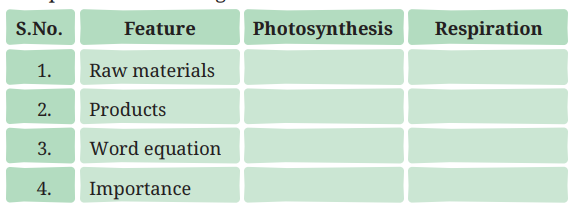
Answer:
Completed Table: Photosynthesis and Respiration
| Feature | Photosynthesis | Respiration |
|---|---|---|
| Occurs in | Green plants (leaves) | All living cells (plants and animals) |
| Requires | Sunlight, chlorophyll, CO₂, water | Glucose, oxygen |
| Produces | Glucose (food), oxygen | Carbon dioxide, water, energy |
| Energy change | Light energy → Chemical energy | Chemical energy → Energy for life processes |
| Type of process | Anabolic (building up) | Catabolic (breaking down) |
| Occurs in the presence of | Sunlight | Can occur in presence or absence of oxygen (aerobic/anaerobic) |
| Equation | 6CO₂ + 6H₂O → C₆H₁₂O₆ + 6O₂ | C₆H₁₂O₆ + 6O₂ → 6CO₂ + 6H₂O + Energy |
Q2. Imagine a situation where all the organisms that carry out photosynthesis on the earth have disappeared. What would be the impact of this on living organisms?
Answer:
Answer: If all photosynthetic organisms disappeared, the impact would be catastrophic for life on Earth.
Impacts:
- No oxygen production: Photosynthesis is the primary source of oxygen in the atmosphere. Without it, oxygen levels would decline, and most aerobic organisms (including humans) would suffocate.
- No food production: Plants are the primary producers in the food chain. Without plants, herbivores would starve, followed by carnivores and omnivores.
- Increase in CO₂ levels: Without photosynthesis to remove CO₂ from the atmosphere, carbon dioxide levels would rise drastically, leading to accelerated global warming.
- Ecosystem collapse: All ecosystems depend on plants directly or indirectly. The entire food web would collapse.
- Loss of biodiversity: Many species would become extinct.
Conclusion: Life on Earth would not survive without photosynthesis.
Q3. A potato slice shows the presence of starch with iodine solution. Where does the starch in potatoes come from? Where is the food synthesised in the plant, and how does it reach the potato?
Answer:
Answer:
- Where does starch in potatoes come from? Starch is the food (carbohydrate) synthesised in the leaves of the potato plant.
- Where is the food synthesised? Food (glucose) is synthesised in the leaves through photosynthesis.
- How does it reach the potato? The food (glucose) is transported from the leaves to other parts of the plant (including the underground stem — potato) through phloem tissue. In the potato, the glucose is converted into starch and stored.
Pathway: Leaves → Photosynthesis → Glucose → Phloem → Underground stem (potato) → Stored as starch.
Q4. Does the broad and flat structure of leaves make plants more efficient for photosynthesis? Justify your answer.
Answer:
Answer: Yes, the broad and flat structure of leaves makes plants more efficient for photosynthesis.
Justification:
- Larger surface area: Broad and flat leaves provide a large surface area to capture maximum sunlight.
- Absorption of light: More surface area allows more chlorophyll-containing cells to absorb sunlight.
- Efficient gas exchange: Broad and thin leaves allow carbon dioxide to diffuse easily into the leaf and oxygen to diffuse out.
- Stomata distribution: More stomata can be present on the surface, increasing the rate of gas exchange.
- Thin structure: Allows light to penetrate through the leaf, reaching deeper chlorophyll-containing cells.
Q5. X is broken down using Y to release carbon dioxide, Z, and energy. X + Y → Carbon dioxide + Z + Energy X, Y, and Z are three different components of the process. What do X, Y, and Z stand for?
Answer:
Answer:
- X = Glucose (or food/ sugar)
- Y = Oxygen
- Z = Water
Complete equation:
Glucose + Oxygen → Carbon dioxide + Water + Energy
This is the word equation for respiration.
Q6. Krishna set-up an experiment with two potted plants of same size and placed one of them in sunlight and the other in a dark room, as shown in Fig. 10.10. Answer the following questions — 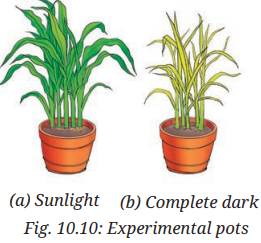 (i) What idea might she be testing through this experiment? (ii) What are the visible differences in plants in both the conditions? (iii) According to you, leaves of which plants confirm the iodine test for the presence of starch?
Answer:
(i) Idea being tested: Krishna is testing whether sunlight is essential for photosynthesis and the production of starch in plants.
(ii) Visible differences:
- Plant in sunlight: Healthy growth, green leaves, strong stem.
- Plant in dark: Weak growth, pale/yellow leaves (chlorosis), spindly stem (etiolation).
(iii) Which plant leaves confirm iodine test?
- The leaves of the plant kept in sunlight will turn blue-black with iodine, indicating the presence of starch.
- The leaves of the plant kept in dark will not turn blue-black (no starch), showing that sunlight is essential for photosynthesis.
Q7. Vani believes that 'carbon dioxide is essential for photosynthesis'. She puts an experimental set-up, as shown in Fig. 10.11, to collect evidence to support or reject her idea. 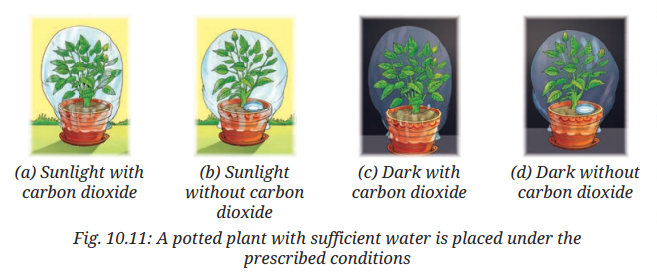 Answer the following questions — (i) In which plant(s) in the above set-up(s) will starch be formed? (ii) In which plant(s) in the above set-up(s) will starch not be formed? (iii) In which plant(s) in the above set-up(s) will oxygen be generated? (iv) In which plant(s) in the above set-up(s) will oxygen not be generated?
Answer:
(i) Starch will be formed in:
- Plants that have carbon dioxide available (exposed to air).
- Plants in sunlight with access to CO₂ will produce starch.
(ii) Starch will not be formed in:
- Plants kept in a CO₂-free environment (with caustic soda/limestone that absorbs CO₂).
- Plants in the dark (no sunlight).
(iii) Oxygen will be generated in:
- Plants that are performing photosynthesis (sunlight + CO₂ + water + chlorophyll).
(iv) Oxygen will not be generated in:
- Plants in the dark.
- Plants without CO₂.
- Plants that are dead/dying.
General rule: Oxygen is produced only during photosynthesis. Starch is produced only during photosynthesis. Both require sunlight, CO₂, water, and chlorophyll.
Q8. Ananya took four test tubes and filled three-fourth of each test tube with water. She labelled them A, B, C, and D (Fig. 10.12). In test tube A, she kept a snail; in test tube B, she kept a water plant; in test tube C, she kept both a snail and a plant. In test tube D, she kept only water. Ananya added a carbon dioxide indicator to all the test tubes. She recorded the initial colour of water and observed if there are any colour changes in the test tubes after 2-3 hours. What do you think she wants to find out? How will she know if she is correct? 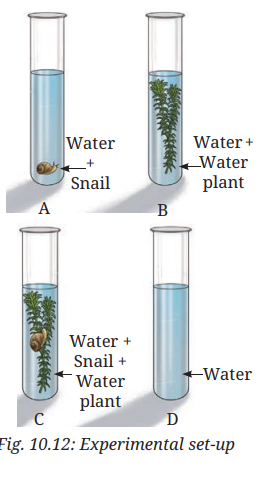
Answer:
What Ananya wants to find out:
- She wants to investigate the relationship between plants and animals in terms of gas exchange (oxygen and carbon dioxide).
- Specifically, she wants to see if the plant provides oxygen for the snail and if the snail provides carbon dioxide for the plant.
Expected observations:
- Test tube A (snail only): CO₂ level increases (snail respires), oxygen decreases.
- Test tube B (plant only): In sunlight, CO₂ decreases (plant uses it for photosynthesis), oxygen increases.
- Test tube C (snail + plant): The snail's CO₂ is used by the plant for photosynthesis; the plant's oxygen is used by the snail for respiration. Both survive.
- Test tube D (control): No change; no living organism.
How she will know if she is correct:
- The carbon dioxide indicator changes colour based on CO₂ concentration.
- If the indicator colour changes, it shows that gas exchange is occurring.
- In test tube C, if both organisms survive and the indicator shows a balance (no extreme colour change), her idea is confirmed.
Conclusion: This experiment shows the interdependence of plants and animals in exchanging gases.
Q9. Design an experiment to observe if water transportation in plants is quicker in warm or cold conditions.
Answer:
Experiment Design: Effect of Temperature on Water Transport in Plants
Aim: To observe if water transportation in plants is quicker in warm or cold conditions.
Materials required:
- Two similar potted plants of the same species and size
- Two glass tumblers
- Water
- Red ink or any coloured dye
- Thermometer
- Stopwatch
- Ruler
Procedure:
- Take two glass tumblers and label them W (warm) and C (cold).
- Fill both tumblers with equal amounts of water.
- Add the same amount of red ink to both tumblers.
- Place Tumbler W in a warm place (e.g., near a heater, or in sunlight).
- Place Tumbler C in a cold place (e.g., refrigerator or ice bath).
- Measure the temperature of water in both tumblers and record.
- Cut the stems of two similar plants obliquely and place one in each tumbler.
- Observe the movement of red colour in the stem, leaves, and flowers at regular intervals (e.g., every 30 minutes).
- Record the time taken for the red colour to reach the leaves in both conditions.
- In the warm condition, the red colour will move faster and reach the leaves earlier.
- In the cold condition, the red colour will move slower.
- Plants take in carbon dioxide from the atmosphere.
- They release oxygen as a by-product.
- They convert solar energy into chemical energy (food).
- All living organisms (plants and animals) take in oxygen.
- They release carbon dioxide as a by-product.
- They break down glucose to release energy for life processes.
- CO₂/O₂ balance: Plants remove CO₂ from the air and add O₂. Animals and plants (during respiration) remove O₂ from the air and add CO₂. This keeps the levels of these gases in the atmosphere balanced.
- Food chain: Plants produce food (glucose). This food is used by herbivores, which are eaten by carnivores. Decomposers break down dead matter, returning nutrients to the soil.
- Energy flow: Solar energy is captured by plants and passed on through the food chain.
- Large transparent glass bottle or jar
- Spider plant or jade plant sapling
- Soil
- Water
- Cork or lid to seal the bottle
- Place a layer of soil at the bottom of the bottle.
- Plant the sapling in the soil and add water.
- Seal the mouth of the bottle with a cork or lid.
- Place the bottle in a location with adequate sunlight.
- Observe the growth of the plant over several weeks.
- If the plant grows well, it indicates that a balanced exchange of gases is occurring inside the bottle.
- During photosynthesis, the plant uses CO₂ and releases O₂.
- During respiration, the plant uses O₂ and releases CO₂.
- The plant recycles its own gases, creating a self-sustaining miniature ecosystem.
- Light regulation: Greenhouses use shade nets or artificial lights to control the amount of light plants receive.
- Temperature control: Ventilation, heating, and cooling systems maintain optimal temperatures for photosynthesis.
- Water management: Drip irrigation and misting systems provide adequate water.
- CO₂ enrichment: Some greenhouses add extra CO₂ to enhance photosynthesis and increase crop yield.
- Protection: Greenhouses protect crops from pests, diseases, and extreme weather.
- It is based on practical experiences and observations of nature.
- It contains knowledge about plant growth, soil health, and agricultural practices.
- It provides methods for organic manure preparation using natural ingredients.
- Examples include mixing water, barley, and various seeds (green gram, black gram, horse gram) to make organic manure.
- These ancient practices are similar to modern organic farming methods.
- They promote sustainable agriculture without harmful chemicals.
- They highlight the importance of soil health and natural fertilisers.
Expected observation:
Conclusion: Water transportation in plants is quicker in warm conditions because transpiration and water movement increase with temperature.
Q10. Photosynthesis and respiration are essential to maintain balance in nature. Discuss.
Answer:
Answer: Photosynthesis and respiration work together to maintain balance in nature.
Role of Photosynthesis:
Role of Respiration:
Balance in nature:
Conclusion: Without photosynthesis, oxygen levels would drop and CO₂ levels would rise. Without respiration, energy could not be released from food. Both processes are essential for life and maintain a natural balance.
Exploratory Projects
Q1. Develop a bottle garden by planting a growing plant like spider plant or jade plant in a large transparent bottle. After growing the plant properly for some time, seal the mouth of the bottle. 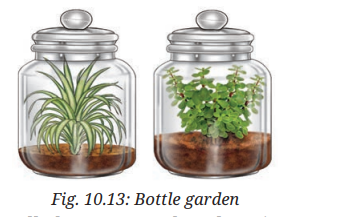 Observe the growth of the plant. If the plant is growing well that means the plant is maintaining the exchange of gases, that is, carbon dioxide produced in the process of respiration of the plant is utilised for performing photosynthesis, and oxygen generated in photosynthesis is utilised in respiration by the plant inside the bottle.
Answer:
Project: Bottle Garden
Aim: To demonstrate that plants can maintain their own gas exchange in a sealed environment.
Materials required:
Method:
Observations:
Conclusion: This experiment demonstrates that photosynthesis and respiration are interconnected and can maintain a balance in a closed environment.
Q2. How are plant processes like photosynthesis, respiration, and water and food transportation crucial for crop production? Visit a greenhouse, if there is one near your place. Observe how people grow plants in a greenhouse. Find out how they regulate the amount of light, water, and carbon dioxide used to grow plants.
Answer:
Project: Understanding Greenhouse Cultivation
Aim: To understand how plant processes are crucial for crop production and how greenhouses regulate growth conditions.
Importance of plant processes for crop production:
| Process | Role in Crop Production |
|---|---|
| Photosynthesis | Produces food (carbohydrates) for plant growth and yield |
| Respiration | Provides energy for growth, metabolism, and reproduction |
| Water transport (Xylem) | Carries water and minerals from roots to all parts |
| Food transport (Phloem) | Carries food from leaves to fruits, seeds, and storage organs |
Greenhouse observations:
Conclusion: Understanding plant processes allows farmers to optimise growth conditions, increase crop production, and ensure food security.
Science and Society
Q1. The knowledge in the text Vrikshayurveda seems to be based on practical experiences and patterns seen over time. These ideas were then systematically documented to guide farming practices. For instance, there are references to different methods of organic manure preparation, such as mixing water, barley, and various seeds, like green, black, and horse grams.
Answer:
Answer: Vrikshayurveda is an ancient Indian text that records useful observations about plant growth, soil, and agricultural practices.
Key points about Vrikshayurveda:
Relevance today: