
Activities
Q1. Activity 11.1: Let us investigate Take three matchboxes and make a hole in the inner tray of each matchbox, exactly at the same position. Arrange these three matchboxes in a straight line. Make sure that all three holes are exactly at the same height and are in a line as shown in Fig. 11.4. Place a torch light on one side of the matchboxes, ensuring that its lamp is at the height of the holes. Place a cardboard (screen) on the other side of the matchboxes and obtain a bright spot on it. (You may need to slightly adjust the heights of boxes.) Move one of the matchboxes slightly to a side or up and down. Are you able to obtain the light spot on the screen now? 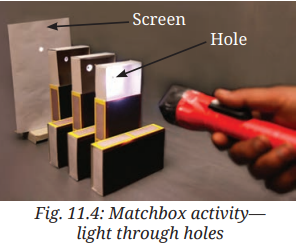 When all the three holes are not in the same line, we could not obtain the light spot on the screen. These observations suggest that light travels in a straight line.
Answer:
Observations:
- When all three holes are in a straight line, a bright spot of light is seen on the screen.
- When one matchbox is moved slightly to the side or up/down, the light spot disappears from the screen.
Conclusion: Light travels in a straight line. This property of light is called rectilinear propagation of light.
Q2. Activity 11.2: Let us explore Caution—Use a lighted candle under adult supervision only. Take a long hollow pipe of some flexible material and align it so that you can see the candle flame as shown in Fig. 11.5a. Now, bend the pipe and try to see the candle flame again (Fig. 11.5b). Can you still see it? 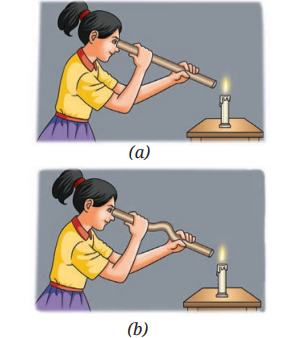 You could see the candle flame through a straight pipe but not through a bent pipe. This shows that light travels in a straight line.
Answer:
Observations:
- Through a straight pipe, the candle flame is clearly visible.
- Through a bent pipe, the candle flame is not visible.
Conclusion: Light travels in a straight line and cannot bend around corners.
Note: A laser beam passing through water also shows a straight path, confirming that light travels in straight lines.
Q3. Activity 11.3: Let us experiment Collect objects made of different materials. Also, you will need a torch.
| Material | Transparent/ Translucent/ Opaque | Light will pass fully/partially/not at all | |
|---|---|---|---|
| My prediction | My observation | ||
| Cardboard | |||
| Paper | |||
| Glass | |||
| Tracing paper | |||
| Thick cloth | |||
| ... | |||
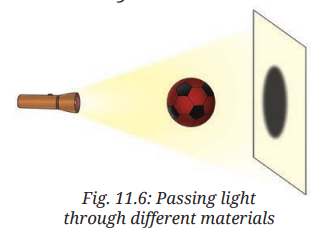 We will now conduct this activity in two parts—prediction and observation. Predict what will happen if you hold an object in front of the light coming out of the torch. Would you continue to see the spot of light on the screen? Note your prediction in Table 11.1. Now, actually place the object between the torch and the screen. Does light pass through the object? Note your observation in Table 11.1. Repeat this for all the objects. Was your observation the same as your prediction? What conclusions could you draw? Light passes almost completely through transparent materials. Light passes partially through translucent materials. Light does not pass through opaque materials.
Answer:
Completed Table 11.1:
| Material | Transparent/ Translucent/ Opaque | Light will pass fully/partially/not at all | |
|---|---|---|---|
| Prediction | Observation | ||
| Cardboard | Opaque | Not at all | Not at all |
| Paper | Translucent | Partially | Partially |
| Glass | Transparent | Fully | Fully |
| Tracing paper | Translucent | Partially | Partially |
| Thick cloth | Opaque | Not at all | Not at all |
| Plastic sheet | Transparent | Fully | Fully |
| Wooden block | Opaque | Not at all | Not at all |
Conclusion:
- Transparent materials: Light passes almost completely through them.
- Translucent materials: Light passes partially through them.
- Opaque materials: Light does not pass through them.
Q4. Activity 11.4: Let us explore Collect some opaque objects of different shapes and sizes. Repeat Activity 11.3, but this time, carry out the actions mentioned in the first column of Table 11.2. Observe the shape and size of the shadow on the screen for each of the actions.
| Action | Observations regarding shadow |
|---|---|
| The screen is removed. | |
| The object is removed. | |
| The torch is switched off. | |
| The object is moved closer to the screen, keeping the torch and the screen fixed. | |
| The object is moved closer to the torch, keeping the torch and the screen fixed. | |
| The object is tilted, keeping the torch and the screen fixed. | |
| The colour of the object is changed. |
Answer:
Completed Table 11.2:
| Action | Observations regarding shadow |
|---|---|
| The screen is removed. | No shadow is seen (screen is needed to observe the shadow). |
| The object is removed. | No shadow is seen (no object to block light). |
| The torch is switched off. | No shadow is seen (no light source). |
| Object moved closer to the screen. | Shadow becomes smaller and sharper. |
| Object moved closer to the torch. | Shadow becomes larger and blurrier. |
| Object is tilted. | Shape of the shadow changes according to the tilt. |
| Colour of the object is changed. | No change in the colour of the shadow (shadows are always dark/black). |
Conclusion:
- To observe a shadow, we need: a source of light, an opaque object, and a screen.
- The shape, size, and sharpness of the shadow depend on the position of the object relative to the light source and screen.
- Changing the colour of the object does not change the colour of the shadow — shadows are always dark.
Q5. Activity 11.5: Let us investigate Find a shiny flat steel plate or a plane mirror, that is, a mirror that is flat and not curved. Take it outside and let the sunlight fall on the shiny surface. What can you do to redirect light on the wall on which the sunlight is not falling directly? 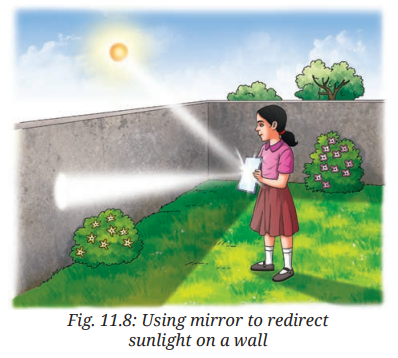 Turn the shiny plate or mirror in different directions to redirect the light onto a wall or a nearby surface. Do you see a spot of light on the wall? Does it mean that the shiny plate or mirror has changed the direction of light? Now, tilt the shiny plate or mirror in different ways and observe the light spot on the wall. Does it change position? Notice how light always travels in straight lines and changes direction when it falls on the shiny plate or mirror.
Answer:
Observations:
- When the mirror is turned in different directions, a spot of light appears on different walls/surfaces.
- Tilting the mirror changes the position of the light spot.
Conclusion:
- A shiny surface or a mirror changes the direction of light that falls upon it.
- This change in direction of light by a mirror is called the reflection of light.
Q6. Activity 11.6: Let us experiment Take a plane mirror with stand, a torch, a comb, a sheet of white paper, and a strip of black paper. Using the black paper, close all openings of the comb, except for one to make a thin slit. Spread a white paper on a table, hold the comb perpendicular to the sheet of paper and shine the torch light on the slit. Adjust the comb and torch slightly till you see a thin beam of light along the paper which has passed through the slit (Fig. 11.9a). 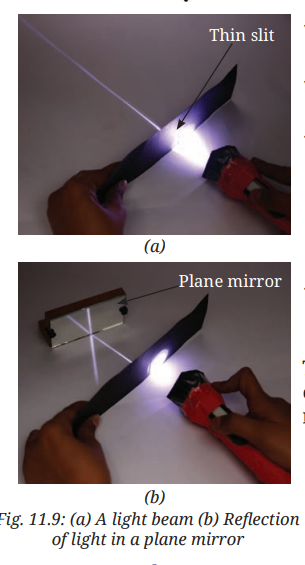 Now, place the mirror in the path of the light beam while keeping the comb steady (Fig. 11.9b). What do you observe? The path of the light beam is changed after falling on the mirror. The reflection of light occurs at the mirror.
Answer:
Observations:
- A thin beam of light passes through the slit in the comb and travels in a straight line.
- When the mirror is placed in the path of the light beam, the beam changes direction.
Conclusion:
- The mirror reflects the light beam, changing its direction.
- This shows that light reflects from shiny surfaces.
Q7. Activity 11.7: Let us experiment Take a plane mirror and a pen or some other object. Place the pen in front of the mirror as shown in Fig. 11.10. 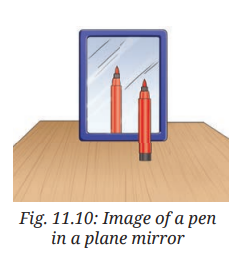 What do you see in the mirror? It appears as if a similar pen is placed behind the mirror. The pen which appears behind the mirror is the image of the pen formed by the mirror. The pen itself is the object. Now, move the pen to different positions in front of the mirror and compare the sizes of the images of the pen at each position. Are the two sizes the same? The image formed by a plane mirror is of the same size as the object. Again, move the pen to different positions in front of the mirror and observe if the image is upright at each position. Does the tip of the pen appear on top at each position? An upright image is called erect. An image formed by a plane mirror is erect. Now, place a screen vertically behind the mirror. Move it around. Do you get the image on the screen? Repeat this by placing the screen in front of the mirror. The image formed by a plane mirror cannot be obtained on a screen.
Answer:
Observations:
- An image of the pen is seen behind the mirror.
- The size of the image is the same as the size of the object (pen) at all positions.
- The image is erect (upright) at all positions.
- The image cannot be obtained on a screen (whether placed behind or in front of the mirror).
Conclusion — Characteristics of image formed by a plane mirror:
- Same size as the object.
- Erect (upright).
- Virtual (cannot be obtained on a screen).
- Laterally inverted (left-right reversal).
- Distance of image from mirror = Distance of object from mirror.
Q8. Activity 11.8: Let us experiment Stand in front of a plane mirror and look at your image (Fig. 11.11). Notice how far it appears to be from the mirror. Now, stand close to the mirror. Is the image also closer to the mirror? Stand at different distances from the mirror and notice how far the image appears to be from the mirror in each case. Do you find any relation between your distance from the mirror and the distance of your image from the mirror? 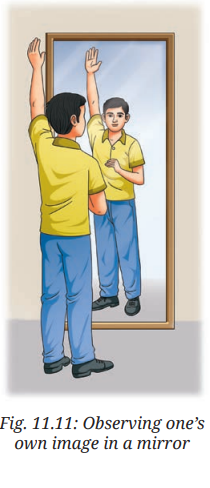 You might have noticed that when you stand close to the plane mirror, the image also appears to be close to the mirror. The image appears to be far from the mirror when you stand far from the plane mirror. Raise your left arm. Which arm does your image raise? Touch your right ear. Which ear does your image touch? You find that your left appears right in your image and your right appears left in your image. This type of perceived left-right reversal is called lateral inversion. There is lateral inversion in the images formed by a plane mirror.
Answer:
Observations:
- The image appears to be at the same distance behind the mirror as the object is in front.
- When you stand closer, the image appears closer; when you stand farther, the image appears farther.
- Left-right reversal (lateral inversion): When you raise your left arm, the image raises its right arm. When you touch your right ear, the image touches its left ear.
Conclusions:
- Object distance from mirror = Image distance from mirror.
- Plane mirror produces lateral inversion (left-right reversal).
- This is why "AMBULANCE" is written backwards on ambulances — it reads correctly in the rear-view mirror of vehicles ahead.
Q9. Activity 11.9: Let us explore Caution—Use a lighted candle under adult supervision only. Take a piece of cardboard and a candle. Make a small hole in the cardboard. In a dimly lit room, position the cardboard at a short distance from a screen. Place a lighted candle in front of it as shown in Fig. 11.12a. 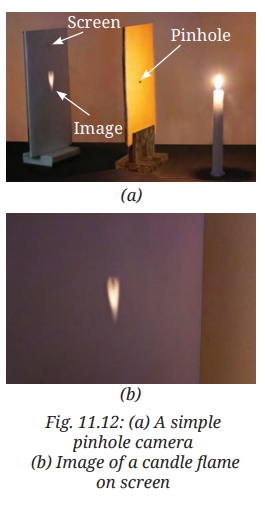 What do you see on the screen? Light coming from the flame passes through the hole on the cardboard and forms an image of the candle flame on the screen. Do you notice anything surprising? The image of the candle flame is upside down, that is, inverted (Fig. 11.12b).
Answer:
Observation:
- An image of the candle flame is formed on the screen.
- The image is upside down (inverted).
Explanation:
- Light from the top of the flame passes through the pinhole and travels in a straight line to the bottom of the screen.
- Light from the bottom of the flame travels to the top of the screen.
- This crossing of light rays causes the image to be inverted.
- This shows that light travels in a straight line.
Q10. Activity 11.10: Let us construct Take two boxes of cardboard such that one can slide into another with very little gap in between them. Cut open one side of each box. On the opposite face of the larger box, make a small hole in the middle (Fig. 11.13a). On the opposite face of the smaller box, cut out a square from the middle with a side of about 5-6 cm. Cover this opening with a thin translucent paper (like a tracing paper) to form a screen (Fig. 11.13b). Slide the smaller box inside the larger one in such a way that the side with the tracing paper is inside (Fig. 11.13c). 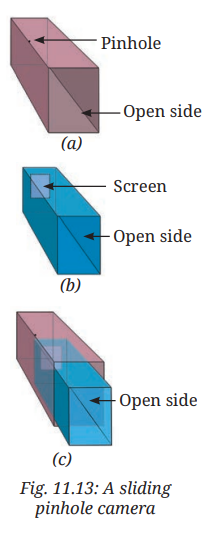 Hold the pinhole camera with the pinhole facing the object and look through the open side of the smaller box. Cover your head and the camera with a dark cloth. Look at a distant object, like a tree or building, in bright sunlight and move the smaller box forward or backward until an image appears on the tracing paper. Do the images seen in the camera show the colours of the objects on the other side? Are the images erect or upside down?
Answer:
Observations:
- An image of the distant object (tree/building) is formed on the tracing paper screen.
- The image shows the colours of the object.
- The image is upside down (inverted).
Explanation:
- Light from the object passes through the pinhole and travels in straight lines.
- The image is formed on the screen.
- Just like the candle experiment, the image is inverted because light rays cross at the pinhole.
How to adjust:
- Slide the smaller box forward or backward to focus the image clearly.
In-text Questions
Q1. Does the Moon actually produce its own light? (From the opening scenario)
Answer:
Answer: No, the Moon does not produce its own light.
Explanation:
- The Moon is a non-luminous object.
- It reflects the light of the Sun that falls on it.
- Moonlight is actually reflected sunlight.
Q2. Which objects give off their own light? (From the opening scenario)
Answer:
Answer: Objects that give off their own light are called luminous objects.
Examples:
- Sun
- Stars
- Lightning
- Fire
- Fireflies
- Electric bulbs
- LED lamps
Q3. Are you able to obtain the light spot on the screen now? (From Activity 11.1)
Answer:
Answer: No, the light spot is not obtained on the screen when one of the matchboxes is moved.
Reason: The holes are no longer in a straight line, so light cannot pass through all three holes.
Q4. Can you still see it? (From Activity 11.2)
Answer:
Answer: No, the candle flame is not visible through a bent pipe.
Reason: Light travels in a straight line and cannot bend around the curve of the pipe.
Q5. Was your observation the same as your prediction? (From Activity 11.3)
Answer:
Answer: (Student-specific response)
Generally, observations should match predictions for common materials:
- Transparent materials (glass) allow light to pass fully.
- Translucent materials (tracing paper, paper) allow light to pass partially.
- Opaque materials (cardboard, wood) block light completely.
Q6. What conclusions could you draw? (From Activity 11.3)
Answer:
Answer:
- Transparent materials: Light passes almost completely through them.
- Translucent materials: Light passes partially through them.
- Opaque materials: Light does not pass through them.
Q7. What did you see on the screen in Activity 11.3 when an opaque object was placed in the path of light? (From Section 11.4)
Answer:
Answer: A dark patch (shadow) was seen on the screen.
Reason: The opaque object blocked the light, and since light travels in a straight line, the light could not reach the screen behind the object.
Q8. Why was this dark patch formed? (From Section 11.4)
Answer:
Answer: The dark patch (shadow) was formed because the opaque object blocked the path of light.
Explanation:
- Light travels in straight lines.
- When an opaque object is placed in the path of light, it prevents light from reaching the screen.
- The region where light does not reach appears dark — this is the shadow.
Q9. Did the shadow form in all cases? Was the shape and size of the shadow the same as the object? (From Activity 11.4)
Answer:
Answer: Shadows formed in all cases with opaque objects, but the shape and size varied.
- Shape: The shadow shows the outline of the object, but the shape can change if the object is tilted.
- Size: The size of the shadow changes depending on the distance of the object from the light source and the screen.
Q10. Does the colour of the shadow change when the colour of the object is changed? (From Activity 11.4)
Answer:
Answer: No, the colour of the shadow does not change when the colour of the object is changed.
Reason: Shadows are always dark/black because they are formed by the absence of light, not by the colour of the object.
Q11. What conclusion do you draw from your observations? (From Activity 11.5)
Answer:
Answer: A shiny surface or a mirror changes the direction of light that falls upon it.
Conclusion: This change in direction of light by a mirror is called the reflection of light.
Q12. What do you observe? (From Activity 11.6)
Answer:
Answer: The path of the light beam is changed after falling on the mirror.
Observation: The light beam reflects from the mirror and travels in a new direction.
Q13. What do you see in the mirror? (From Activity 11.7)
Answer:
Answer: An image of the pen is seen behind the mirror.
The image appears to be the same size as the object and is located behind the mirror.
Q14. Are the two sizes the same? (From Activity 11.7)
Answer:
Answer: Yes, the size of the image is the same as the size of the object.
Conclusion: The image formed by a plane mirror is of the same size as the object.
Q15. Does the tip of the pen appear on top at each position? (From Activity 11.7)
Answer:
Answer: Yes, the tip of the pen appears on top in the image.
Conclusion: The image formed by a plane mirror is erect (upright).
Q16. Do you get the image on the screen? (From Activity 11.7)
Answer:
Answer: No, the image is not obtained on a screen.
Conclusion: The image formed by a plane mirror is virtual and cannot be captured on a screen.
Q17. Do you find any relation between your distance from the mirror and the distance of your image from the mirror? (From Activity 11.8)
Answer:
Answer: Yes, the distance of the image from the mirror is equal to the distance of the object from the mirror.
When you stand close to the mirror, the image appears close; when you stand far, the image appears far.
Q18. Which arm does your image raise? Touch your right ear. Which ear does your image touch? (From Activity 11.8)
Answer:
Answer:
- When you raise your left arm, the image raises its right arm.
- When you touch your right ear, the image touches its left ear.
Conclusion: This is called lateral inversion — left-right reversal in the image formed by a plane mirror.
Q19. Do the images seen in the camera show the colours of the objects on the other side? (From Activity 11.10)
Answer:
Answer: Yes, the images seen in the pinhole camera show the colours of the objects.
Reason: The pinhole camera does not change the colour of the light — it only forms an image.
Q20. Are the images erect or upside down? (From Activity 11.10)
Answer:
Answer: The images are upside down (inverted).
Reason: Light rays from the top and bottom of the object cross at the pinhole, causing the image to be inverted.
Exercises
Q1. Which of the following are luminous objects? Mars, Moon, Pole Star, Sun, Venus, Mirror
Answer:
Answer: Luminous objects: Pole Star, Sun
Explanation:
- Luminous objects emit their own light: Pole Star, Sun.
- Non-luminous objects do not emit their own light: Mars, Moon, Venus (they reflect sunlight), Mirror (reflects light but does not emit).
Q2. Match the items in Column A with those in Column B.
| Column A | Column B |
|---|---|
| Pinhole camera | Blocks light completely |
| Opaque object | The dark region formed behind the object |
| Transparent object | Forms an inverted image |
| Shadow | Light passes almost completely through it |
Answer:
Correct matches:
| Column A | Column B |
|---|---|
| Pinhole camera | Forms an inverted image |
| Opaque object | Blocks light completely |
| Transparent object | Light passes almost completely through it |
| Shadow | The dark region formed behind the object |
Q3. Sahil, Rekha, Patrick, and Qasima are trying to observe the candle flame through the pipe as shown in Fig. 11.16. Who can see the flame? [IMAGE NEEDED: Four people with pipes of different shapes trying to see a candle flame]
Answer:
Answer: The person with the straight pipe can see the candle flame.
Explanation:
- Light travels in a straight line.
- Only a straight pipe allows light to pass directly from the flame to the eye.
- Bent pipes block the path of light, so the flame is not visible through them.
Q4. Look at the images shown in Fig. 11.17 and select the correct image showing the shadow formation of the boy. 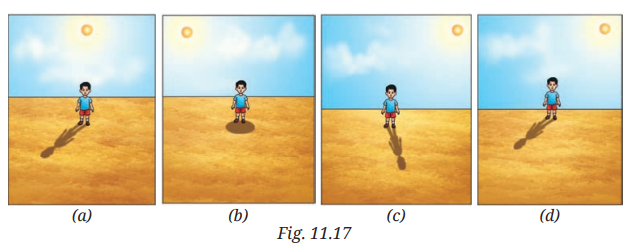
Answer:
Answer: The correct image will show the shadow on the opposite side of the light source.
Explanation:
- Shadow is formed on the side opposite to the light source.
- The shadow should be of the same outline as the boy.
Q5. The shadow of a ball is formed on a wall by placing the ball in front of a fixed torch as shown in Fig. 11.18. In scenario (i) the ball is closer to the torch, while in scenario (ii) the ball is closer to the wall. Choose the most accurate representation of the shadows formed in both scenarios from the options provided (a and b). 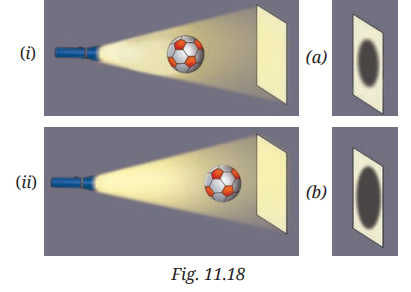
Answer:
Answer:
- Scenario (i) — Ball closer to torch: Shadow will be larger.
- Scenario (ii) — Ball closer to wall: Shadow will be smaller and sharper.
Explanation:
- When the object is closer to the light source, it blocks more light, creating a larger shadow.
- When the object is closer to the screen, the shadow is smaller and sharper.
Q6. Based on Fig. 11.18, match the position of the torch in Column A with the characteristics of the ball's shadow in Column B.
| Column A | Column B |
|---|---|
| If the torch is close to the ball | The shadow would be smaller |
| If the torch is far away | The shadow would be larger |
| If the ball is removed from the set-up | Two shadows would appear on the screen |
| If two torches are present in the set-up on the left side of the ball | A bright spot would appear on the screen |
Answer:
Correct matches:
| Column A | Column B |
|---|---|
| If the torch is close to the ball | The shadow would be larger |
| If the torch is far away | The shadow would be smaller |
| If the ball is removed from the set-up | A bright spot would appear on the screen |
| If two torches are present in the set-up on the left side of the ball | Two shadows would appear on the screen |
Q7. Suppose you view the tree shown in Fig. 11.19 through a pinhole camera. Sketch the outline of the image of the tree formed in the pinhole camera. 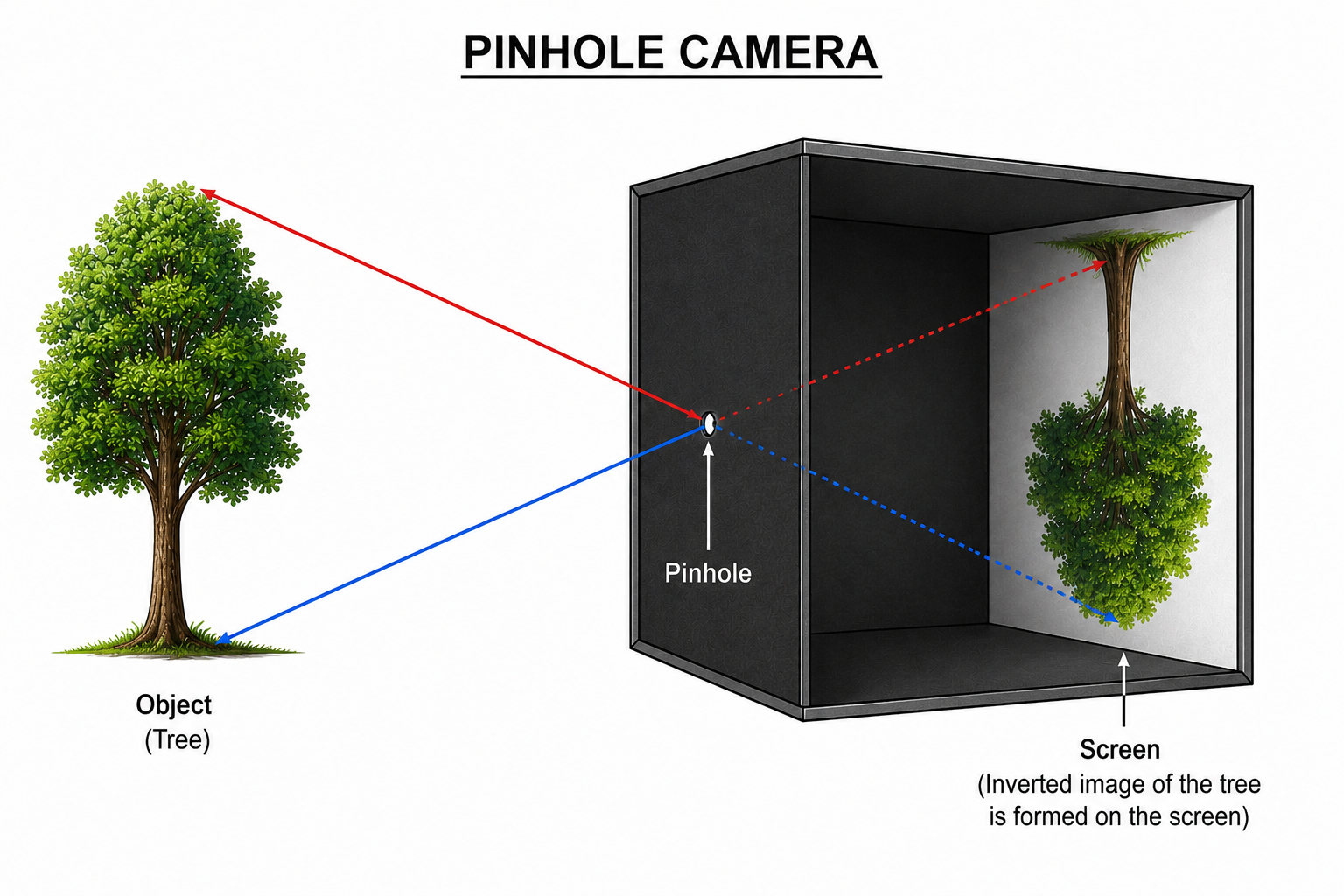
Answer:
Answer: The image formed by a pinhole camera is inverted (upside down).
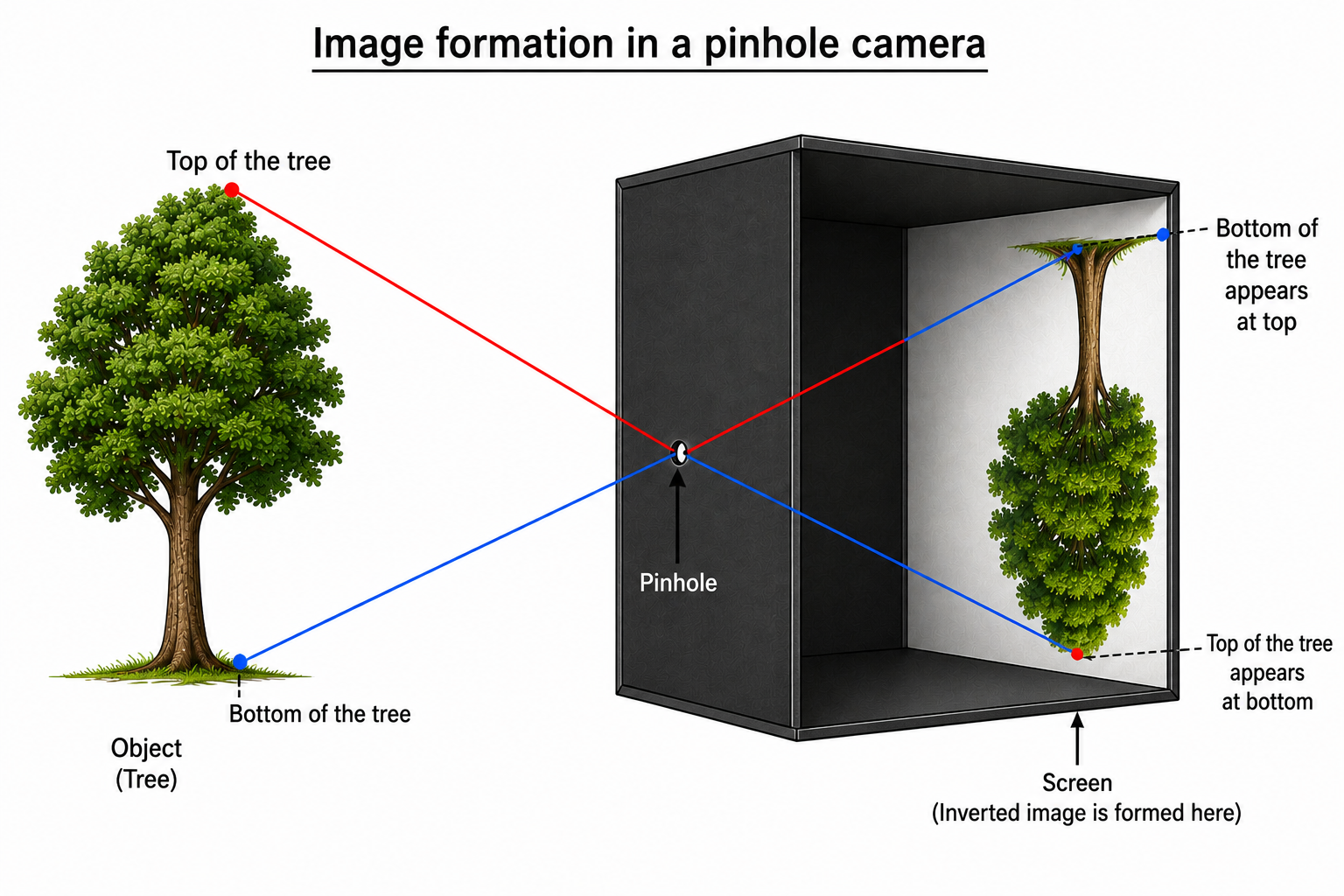
Explanation:
- Light from the top of the tree travels in a straight line through the pinhole and forms an image at the bottom of the screen.
- Light from the bottom of the tree forms an image at the top of the screen.
- Thus, the image is inverted.
Q8. Write your name on a piece of paper and hold it in front of a plane mirror such that the paper is parallel to the mirror. Sketch the image. What difference do you notice? Explain the reason for the difference.
Answer:
Answer: The image of your name in the mirror shows lateral inversion.
Example: If you write "RAM", the image shows "MAR".
Sketch:
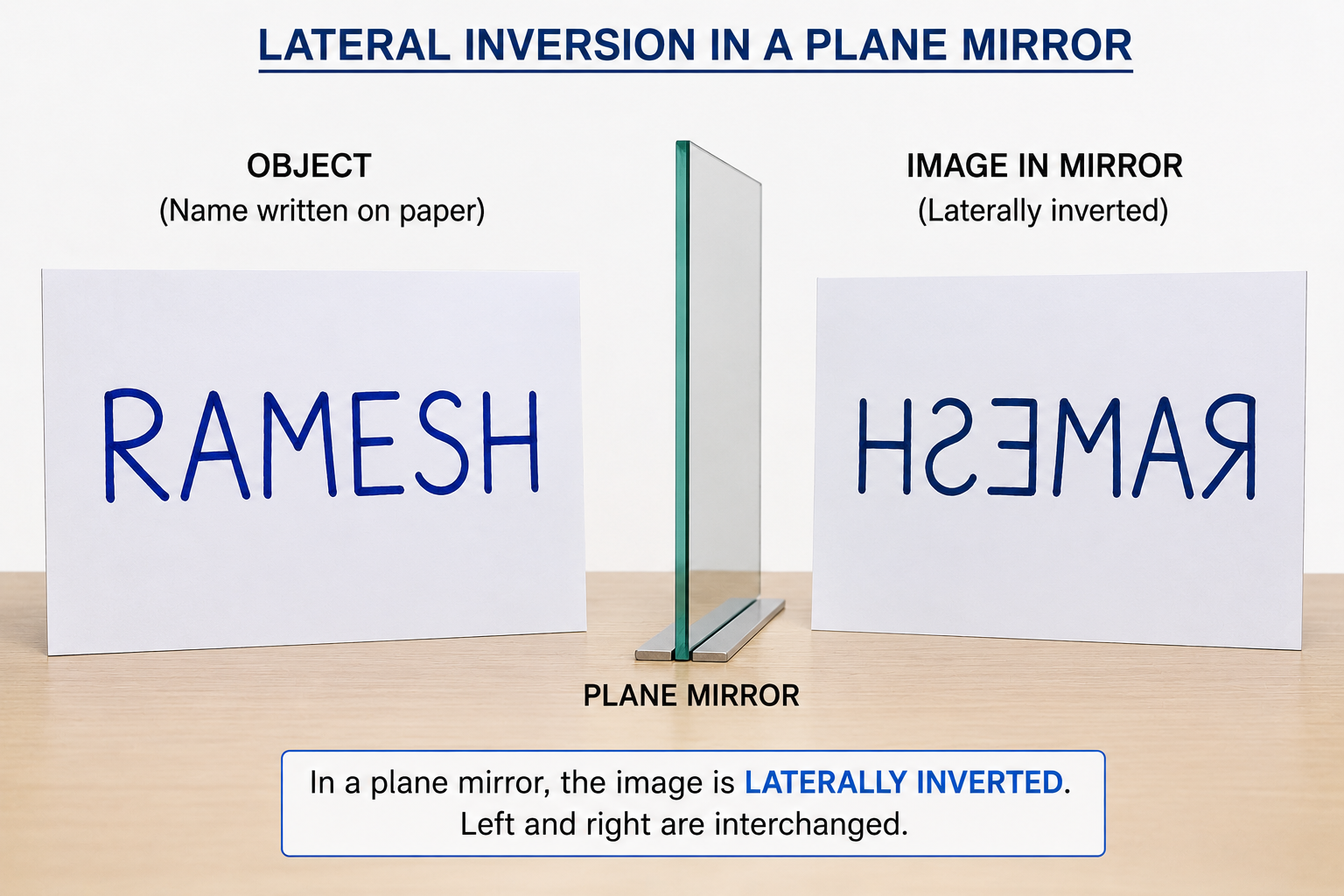
Reason:
- A plane mirror produces lateral inversion — left appears right and right appears left.
- This happens because the mirror reverses the image along the left-right axis.
- This is why "AMBULANCE" is written backwards on ambulances — it reads correctly in the rear-view mirror of vehicles ahead.
Q9. Measure the length of your shadow at 9 AM, 12 PM, and 4 PM with the help of your friend. Write down your observations: (i) At which of the given times is your shadow the shortest? (ii) Why do you think this happens?
Answer:
Answer:
(i) Shadow is shortest at 12 PM (noon).
(ii) Why this happens:
- At 12 PM, the Sun is at the highest point in the sky (overhead).
- The Sun's rays fall vertically on the Earth.
- This causes the shadow to be shortest (almost directly below the person).
- At 9 AM and 4 PM, the Sun is at an angle (lower in the sky).
- The Sun's rays are inclined, so the shadow is longer.
Observations (Sample):
- 9 AM — Shadow is long (towards the west).
- 12 PM — Shadow is shortest (almost directly below).
- 4 PM — Shadow is long (towards the east).
Q10. On the basis of following statements, choose the correct option. Statement A: Image formed by a plane mirror is laterally inverted. Statement B: Images of alphabets T and O appear identical to themselves in a plane mirror. (i) Both statements are true (ii) Both statements are false (iii) Statement A is true, but statement B is false (iv) Statement A is false, but statement B is true
Answer:
Answer: (i) Both statements are true
Explanation:
- Statement A is true: Plane mirrors always produce lateral inversion (left-right reversal).
- Statement B is true: Alphabets T and O are symmetrical along the vertical axis. When reflected, they appear identical to themselves.
- Other symmetrical alphabets include A, H, I, M, U, V, W, X, Y (when written in certain fonts).
Q11. Suppose you are given a tube of the shape shown in the Fig. 11.20 and two plane mirrors smaller than the diameter of the tube. Can this tube be used to make a periscope? If yes, mark where you will fix the plane mirrors. 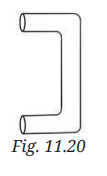
Answer:
Answer: Yes, this Z-shaped tube can be used to make a periscope.
Where to fix the mirrors:
- Place one mirror at the top bend of the Z-tube at 45° angle.
- Place the second mirror at the bottom bend of the Z-tube at 45° angle.
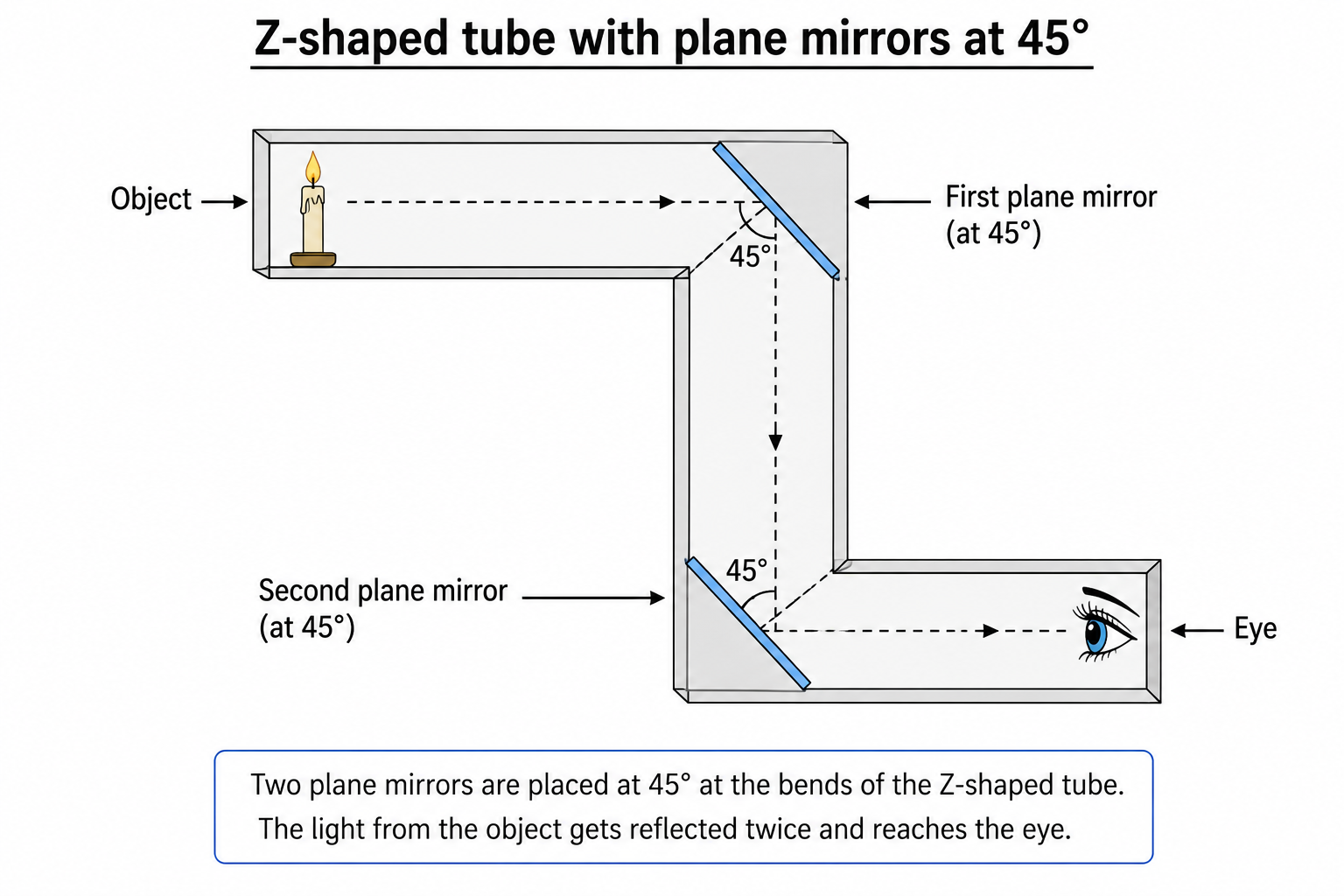
How it works:
- Light from the object enters through the top opening.
- It reflects from the top mirror (45°), travels down the tube.
- It reflects from the bottom mirror (45°), and comes out through the bottom opening.
- This allows you to see objects that are not in direct line of sight.
Q12. We do not see the shadow on the ground of a bird flying high in the sky. However, the shadow is seen on the ground when the bird swoops near the ground. Think and explain why it is so.
Answer:
Answer:
- A shadow is formed when an opaque object blocks light from reaching a screen.
- When a bird is flying high, the light rays from the Sun are almost parallel.
- The bird is too small compared to the distance from the Sun, so the shadow is too faint and spread out to be seen clearly on the ground.
- The shadow also falls on a very large area, making it less visible.
- When the bird is near the ground, the shadow is sharper and more concentrated because the object is closer to the screen.
- Additionally, the bird covers a larger portion of the light reaching the ground when it is closer.
Exploratory Projects
Q1. Have you ever seen a firefly where you live? If no, ask your elders if fireflies were seen earlier in your region. If yes, find out the reasons for their not being seen anymore. Develop a story about it.
Answer:
Project: Fireflies — Nature's Living Lanterns
What are fireflies?
- Fireflies are insects that produce light through a chemical reaction called bioluminescence.
- They use their light to communicate, attract mates, and warn predators.
- They are seen mainly during summer nights in rural and forest areas.
Reasons why fireflies are decreasing:
- Light pollution: Artificial lights from cities confuse fireflies and disrupt their mating signals.
- Loss of habitat: Deforestation and urbanisation destroy their natural homes.
- Pesticides and chemicals: Use of chemicals in farming kills fireflies and their larvae.
- Climate change: Changes in temperature and rainfall patterns affect their life cycle.
- Excessive tourism: Disturbance to natural habitats.
Story idea:
"In a small village surrounded by forests, children used to catch fireflies in glass jars and watch them light up the night. The fireflies danced like twinkling stars. But over the years, the village grew into a town. Streetlights were installed, and the forests were cut down for buildings. The fireflies slowly disappeared. One day, a young girl named Ananya decided to bring them back. She planted trees, reduced the use of lights at night, and convinced the villagers to stop using harmful chemicals. After many years, the fireflies returned, and the night sky was once again magical."
Q2. Repeat Activity 11.4, but this time cover the face of the torch with a coloured transparent paper and observe the colour of the shadow. Repeat this using transparent paper of different colours. Report your conclusions.
Answer:
Experiment: Colour of Shadows
Method:
- Repeat Activity 11.4 (shadow formation) but cover the torch with coloured transparent paper (red, blue, green, etc.).
- Observe the colour of the shadow formed on the screen.
- Repeat with different colours.
Observations:
- The shadow remains dark/black regardless of the colour of the light.
- The shadow is still the same shape as the object.
- The area around the shadow may appear coloured (light of that colour), but the shadow itself is dark.
Conclusion:
- The colour of the shadow does not change with the colour of the light.
- Shadows are always dark because they are formed by the absence of light.
- The light that is blocked by the object cannot reach the screen, so no colour is seen in the shadow region.
Q3. A plane mirror forms only a single image of an object. But what will happen if two or more mirrors are kept at an angle with each other or parallel to each other? Find out by placing two mirrors as shown in Fig. 11.21. 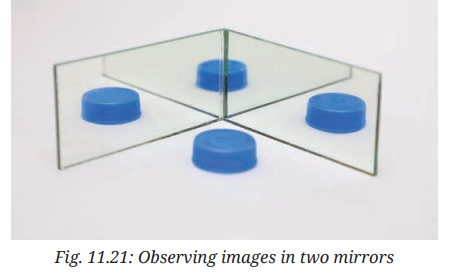
Answer:
Experiment: Multiple Images with Two Mirrors
Observations:
- When two plane mirrors are placed at an angle, multiple images of an object are formed.
- When mirrors are placed parallel to each other, an infinite number of images are formed (images get smaller and fainter).
- When mirrors are placed at 90° (right angle), 3 images are formed.
- When mirrors are placed at 60°, 5 images are formed.
Formula: Number of images = (360° ÷ Angle between mirrors) - 1
- For 90°: (360/90) - 1 = 4 - 1 = 3 images
- For 60°: (360/60) - 1 = 6 - 1 = 5 images
Why multiple images?
- Light reflects back and forth between the two mirrors.
- Each reflection produces a new image.
- The number of images depends on the angle between the mirrors.
Q4. You are given a small piece of a plane mirror. Can this piece form an image of an object much larger than the mirror, like a large tree? Think and predict. Then carry out the activity.
Answer:
Experiment: Small Mirror, Large Object
Prediction: A small mirror can form an image of a large object.
Activity:
- Take a small plane mirror (like a pocket mirror or a small piece).
- Stand in front of a large tree or building.
- Hold the mirror and observe the image of the tree in it.
Observation:
- Yes, a small mirror can form an image of a large tree.
- The tree appears smaller in the mirror because the mirror has a limited field of view.
- You will see only a part of the tree at a time, or the entire tree if you stand far away.
Explanation:
- A plane mirror reflects light from the tree to your eyes.
- Even a small mirror can reflect light from large objects.
- However, the image of a large object will appear smaller because the mirror's size limits the amount of reflected light that reaches your eyes.
Science and Society
Q1. Light Emitting Diode (LED) lamps are modern light sources that consume much less power, are brighter and last longer than traditional lamps. This not only reduces electricity bills but is also better for environment. Recognising their advantages, the Indian government has made substantial efforts to promote the use of LED lamps nationwide. At their end of life, LED lamps must be appropriately disposed or recycled, and not thrown in the garbage.
Answer:
Answer: LED lamps are an environmentally friendly and cost-effective lighting solution.
Advantages of LED lamps:
- Energy efficient: Consume much less power than traditional incandescent bulbs.
- Brighter: Produce more light per unit of electricity.
- Longer lasting: Last much longer than traditional lamps (up to 50,000 hours).
- Environmentally friendly: Reduce electricity consumption, lowering carbon emissions.
- Cost-effective: Lower electricity bills and less frequent replacement.
Government initiatives:
- Indian government has promoted LED lamps through schemes like UJALA (Unnat Jyoti by Affordable LEDs for All).
- LED bulbs are provided at subsidised rates.
- This has resulted in significant energy savings and reduced electricity bills for households.
Disposal:
- LED lamps contain small amounts of electronics and should be recycled properly.
- They should not be thrown in regular garbage as they contain components that can be harmful to the environment.