
Activities
Q1. Activity 12.1: Let us explore Sit on a merry-go-round facing towards the outer side as shown in Fig. 12.1. 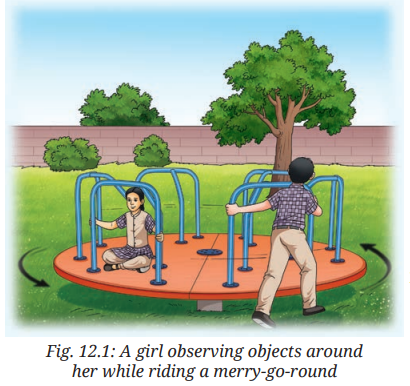 Ask someone to turn the merry-go-round slowly in the anti-clockwise direction as shown in Fig. 12.1. While you are sitting on the moving merry-go-round, look around you. Do the objects around you appear to be moving? In which direction do they appear to be moving? While you turn in the anti-clockwise direction, the objects appear to turn around you in the opposite direction, that is, in the clockwise direction. Now fix your gaze at a particular tree (or a building) ahead of you while sitting on the merry-go-round turning around in anti-clockwise direction. In which direction do you find the tree turning around you? Is it in your view all the time? The tree appears to turn around you in the opposite direction, that is, the clockwise direction. The tree appears in your view from your left-hand side and then moves out of your view on the right-hand side when you view it from a merry-go-round turning around in anti-clockwise direction. Using the observations made by us while riding a merry-go-round, let us now think. When we view from the Earth, the Sun appears in the East, moves across the sky from the East to the West and disappears in the West. Does it indicate that the Sun is moving in the sky? Or might it be that the Earth itself is turning around and the Sun just appears to move? The fact is that the Sun appears to be moving because we view it from the Earth, which is turning around itself.
Answer:
Observations:
- When sitting on a merry-go-round turning anti-clockwise, objects around appear to move in the clockwise direction.
- A fixed tree appears to move from the left to right (clockwise) and eventually goes out of view.
Analogy to Earth's rotation:
- Just like on the merry-go-round, when we are on the rotating Earth, the Sun appears to move across the sky from East to West.
- However, this is an apparent motion caused by the Earth rotating on its own axis.
- The Earth rotates from West to East (anti-clockwise when viewed from above the North Pole).
Conclusion: The Sun appears to move in the sky because the Earth is rotating, not because the Sun is moving around the Earth.
Q2. Activity 12.2: Let us explore Use a globe to represent the Earth and place a small sticker to mark your location on it (Fig. 12.4a). While viewing from above the North Pole, slowly rotate the globe on its axis in anti-clockwise direction. Observe how your location turns around and finally comes back to its original position completing one rotation. 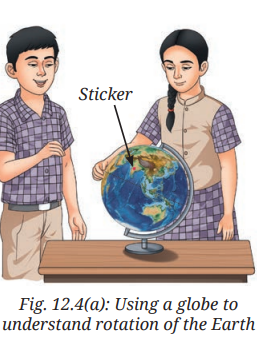 Use a torch to represent the Sun. Go to a relatively dark room to carry out the further steps of the activity. Now, shine light from the torch placed at some distance, say 1.5 metres, on the globe as shown in Fig. 12.4b. Do you notice how half of the globe receives the light from the torch, while the other half stays dark?
 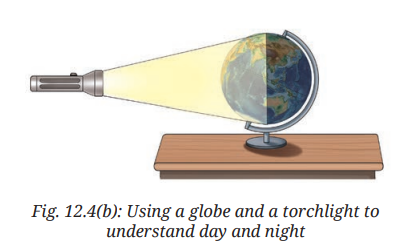 It is day time in that half of the globe which receives light, and night time in the other half. In India, sunrise first occurs in the eastern part and then in other parts. While looking at the eastern part of India on the globe, rotate the globe in one direction and then in the opposite direction. What is the direction of rotation when light falls on the eastern part of India first? The light falls on the eastern part of India first when the globe rotates from West to East with respect to the North-South axis of the globe. Now while rotating the globe from West to East, observe your location on the Earth. Does it go through a cycle of day and night? Sunrise occurs as your location moves into light and sunset occurs as it moves into darkness.
Answer:
Observations:
- Half of the globe receives light (daytime) while the other half is dark (nighttime).
- When rotating the globe from West to East, the eastern part of India receives light first.
- As the globe rotates, any location goes through a complete cycle of day and night.
Conclusion:
- The Earth's rotation from West to East causes the day-night cycle.
- Sunrise occurs when a location moves into the illuminated half; sunset occurs when it moves into darkness.
Q3. Activity 12.3: Let us investigate On an early evening between March and May, identify the Big Dipper (Saptarishi), and the Pole Star (Dhruva Tara), if visible, as you did in the chapter 'Beyond Earth' in the Grade 6 Science textbook Curiosity. 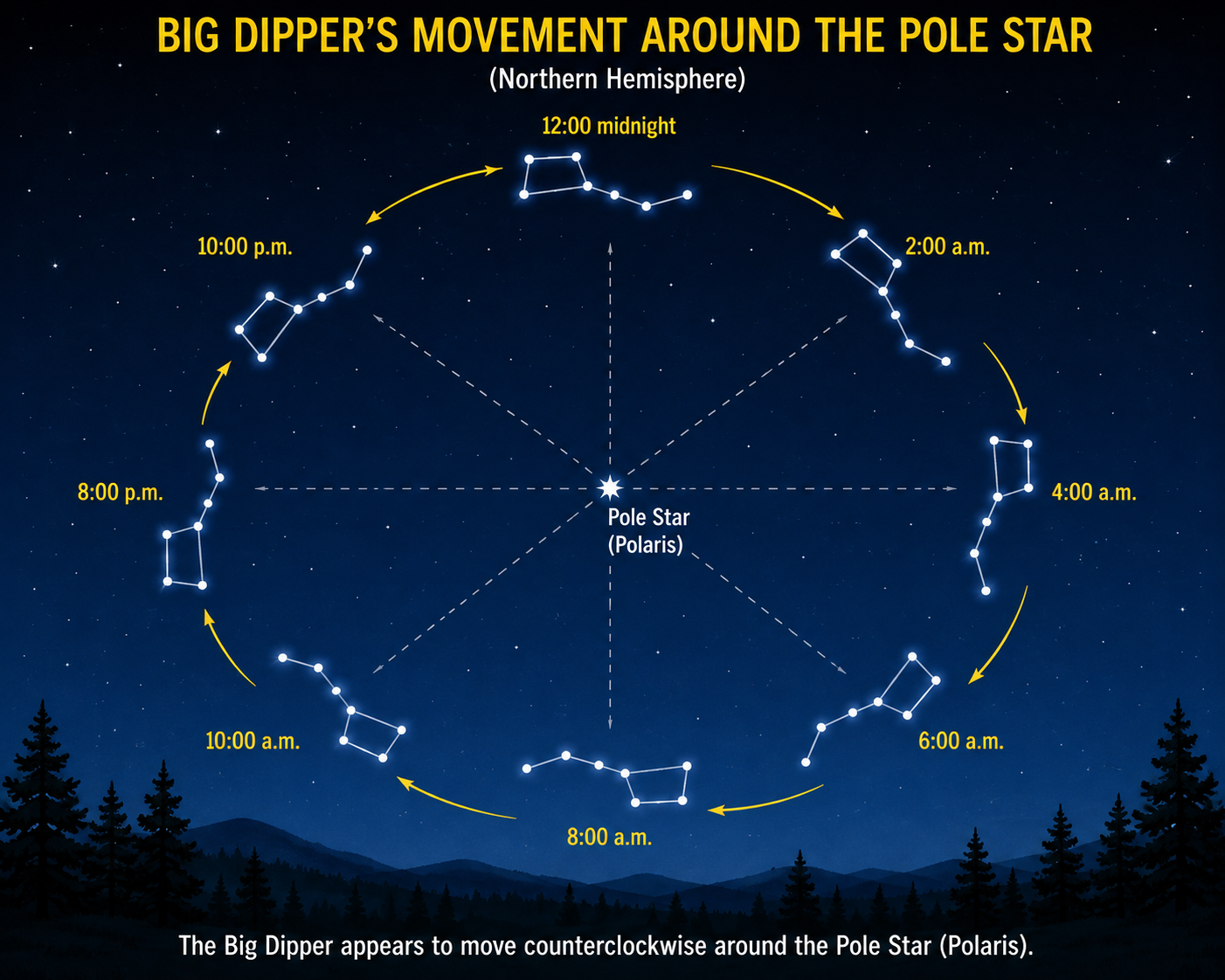 Note down your location and date of your night sky observations. The activity must be carried out on the same night. Draw the orientation of the Big Dipper in the sky with respect to the Pole Star (or a fixed tree/building on the ground in a direction towards the Big Dipper if you cannot see the Pole Star). Mark the time of your observation along with your sketch as shown in Fig. 12.7. After two hours, observe the Big Dipper again. Has it moved? Again, draw its orientation and note down the time. Repeat the above step after two hours. Do you observe that the Big Dipper appears to move around the Pole Star (notice just the movement even if you cannot see the Pole Star)?
Answer:
Observations:
- The Big Dipper appears to move around the Pole Star over time.
- Its orientation changes gradually over a few hours.
- The Pole Star remains stationary (appears fixed in position).
Conclusion:
- The apparent motion of stars (including the Big Dipper) is due to the Earth's rotation.
- The Pole Star appears fixed because the Earth's axis points towards it.
- All other stars appear to move in circular paths around the Pole Star.
- This is evidence of the Earth's rotation.
Q4. Activity 12.4: Let us explore Ask your friend to stand in front of you at a distance of about 5 metres. Consider his head to be the Sun. Now close one eye and show a thumbs up with your outstretched hand towards your friend as shown in Fig.12.12. Are you able to cover the entire head of your friend with your thumb? 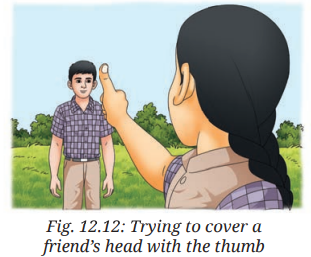 You can cover the entire head of your friend with the help of your thumb, even though your thumb is much smaller than the actual size of your friend's head. How could it be? The size of any object as seen by your eye—also known as apparent size—depends upon both its actual physical size and its distance from you. The thumb being much closer to you as compared to your friend, the apparent sizes of your thumb and your friend's head as seen by you in Activity 12.4 are similar. The apparent sizes of the Moon and the Sun in the sky are similar when viewed from the Earth. This is so because though the Moon is much smaller in physical size than the Sun, the Moon is much closer to us compared to the Sun. Therefore, the Moon can appear to cover the entire Sun as viewed from the Earth.
Answer:
Observations:
- Your thumb can cover the entire head of your friend even though your thumb is much smaller.
Explanation:
- The apparent size of an object depends on both its actual size and its distance from the observer.
- Your thumb is close to your eye, so it appears large.
- Your friend's head is farther away, so it appears smaller.
- Even though the thumb is physically smaller, it can appear to be the same size as the head.
Application to solar eclipse:
- The Moon is much smaller than the Sun (physical size).
- But the Moon is much closer to Earth than the Sun.
- So their apparent sizes in the sky are almost the same.
- That is why the Moon can completely cover the Sun during a total solar eclipse.
In-text Questions
Q1. She wondered—does the Sun move in the sky? Or does the Earth move? (From the opening scenario)
Answer:
Answer: The Sun appears to move in the sky, but actually the Earth moves.
Explanation:
- The Earth rotates on its axis from West to East.
- This rotation makes the Sun appear to rise in the East and set in the West.
- The Sun itself does not move across our sky — the Earth's rotation creates this illusion.
Q2. Do the objects around you appear to be moving? In which direction do they appear to be moving? (From Activity 12.1)
Answer:
Answer: Yes, objects around appear to be moving.
When the merry-go-round turns anti-clockwise, the objects appear to move in the clockwise direction.
Q3. In which direction do you find the tree turning around you? Is it in your view all the time? (From Activity 12.1)
Answer:
Answer: The tree appears to turn around in the clockwise direction.
No, the tree is not in view all the time. It appears from the left side and moves out of view on the right side.
Q4. Does it indicate that the Sun is moving in the sky? Or might it be that the Earth itself is turning around and the Sun just appears to move? (From Activity 12.1)
Answer:
Answer: The Sun appears to move because the Earth is rotating.
Explanation:
- Just like on the merry-go-round, when we are on the rotating Earth, objects (like the Sun) appear to move in the opposite direction.
- The Earth rotates from West to East, making the Sun appear to move from East to West.
Q5. What is the direction of rotation when light falls on the eastern part of India first? (From Activity 12.2)
Answer:
Answer: The light falls on the eastern part of India first when the globe rotates from West to East.
Q6. Does it go through a cycle of day and night? (From Activity 12.2)
Answer:
Answer: Yes, as the globe rotates, the location goes through a complete cycle of day and night.
Explanation:
- When the location is in the illuminated half, it experiences daytime.
- When it rotates into the dark half, it experiences nighttime.
- This cycle continues with each rotation of the Earth.
Q7. Has it moved? (From Activity 12.3)
Answer:
Answer: Yes, the Big Dipper appears to have moved.
Explanation:
- After two hours, the orientation of the Big Dipper has changed.
- It appears to have moved around the Pole Star.
- This is due to the Earth's rotation.
Q8. Do you observe that the Big Dipper appears to move around the Pole Star? (From Activity 12.3)
Answer:
Answer: Yes, the Big Dipper appears to move around the Pole Star.
Explanation:
- The Pole Star appears stationary because the Earth's axis points towards it.
- Other stars appear to move in circular paths around the Pole Star.
- This is evidence of the Earth's rotation.
Q9. Are you able to cover the entire head of your friend with your thumb? (From Activity 12.4)
Answer:
Answer: Yes, your thumb can cover the entire head of your friend.
Reason: This is due to apparent size — your thumb is very close to your eye, so it appears large enough to cover a distant object.
Exercises
Q1. In Fig. 12.17, how many hours of sunlight do the North Pole and the South Pole receive during one rotation of the Earth? 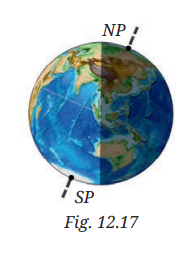
Answer:
Answer: During one rotation of the Earth (24 hours):
- North Pole: If it is summer (June), the North Pole receives 24 hours of sunlight (continuous daylight).
- South Pole: During the same time, the South Pole receives 0 hours of sunlight (continuous darkness).
Note: The situation reverses in December (winter in Northern Hemisphere).
Q2. Fill in the blanks (i) Stars rise in the ______ and set in the ______. (ii) Day and night are caused by the Earth's ______. (iii) When the Moon fully covers the Sun from our view, it is called a ______ solar eclipse.
Answer:
Answers:
(i) Stars rise in the East and set in the West.
(ii) Day and night are caused by the Earth's rotation.
(iii) When the Moon fully covers the Sun from our view, it is called a total solar eclipse.
Q3. State whether True or False (i) Lunar eclipse occurs when the Sun comes between the Earth and the Moon. (ii) Sunrise happens earlier in Gujarat than in Jharkhand. (iii) In Chennai, the longest day occurs on the summer solstice. (iv) We should watch the solar eclipse directly with our naked eye. (v) Seasons occur due to the tilt of Earth's axis of rotation and its spherical shape. (vi) The Earth's revolution around the Sun causes day and night.
Answer:
Answers:
(i) False — Lunar eclipse occurs when the Earth comes between the Sun and the Moon.
(ii) False — Sunrise happens earlier in Jharkhand (eastern part) than in Gujarat (western part).
(iii) True — The longest day in the Northern Hemisphere occurs on the summer solstice (21 June).
(iv) False — We should never watch a solar eclipse directly with our naked eye. It can cause permanent eye damage.
(v) True — Seasons occur due to the tilt of Earth's axis of rotation and its spherical shape.
(vi) False — The Earth's rotation causes day and night. The Earth's revolution around the Sun (along with axial tilt) causes seasons.
Q4. Padmashree saw the Orion constellation nearly overhead at 8 pm yesterday. When will she see Orion overhead today?
Answer:
Answer: She will see Orion overhead at 7:56 pm today.
Explanation:
- The Earth completes one rotation in about 24 hours (actually 23 hours 56 minutes 4.1 seconds).
- This means stars rise about 4 minutes earlier each day.
- Therefore, from 8:00 pm yesterday, subtract 4 minutes = 7:56 pm.
Note: This is why different stars appear at different times throughout the year.
Q5. Nandhini saw a group of stars rising at midnight on 21 June. When will she see the same group of stars rising at midnight next year?
Answer:
Answer: She will see the same group of stars rising at midnight on 21 June next year.
Explanation:
- The Earth completes one revolution around the Sun in about 365 days and 6 hours.
- After one year, the Earth returns to the same position in its orbit.
- Therefore, the night sky appears the same at the same date and time each year.
Note: The stars rising at midnight on 21 June will be seen again at midnight on 21 June the following year.
Q6. Abhay noticed that when it was daytime in India, his uncle who was in the USA was generally sleeping as it was night-time there. What is the reason behind this difference?
Answer:
Answer: This difference is due to the Earth's rotation and the different time zones.
Explanation:
- The Earth rotates from West to East.
- As the Earth rotates, different parts of the Earth face the Sun at different times.
- India is located to the east of the USA.
- So India experiences sunrise and daytime earlier than the USA.
- When it is daytime in India, the USA is on the dark side of the Earth, experiencing night.
Q7. Four friends used the following ways to see the solar eclipse. Who among them was being careless? (i) Ravikiran used a solar eclipse goggle. (ii) Jyothi used a mirror to project the Sun's image. (iii) Adithya saw the Sun directly with his eyes. (iv) Aruna attended a programme arranged by a planetarium.
Answer:
Answer: Adithya was being careless.
Explanation:
- Ravikiran: Used proper solar eclipse goggles — safe.
- Jyothi: Used a mirror to project the Sun's image — safe.
- Adithya: Saw the Sun directly with his eyes — dangerous and careless. This can cause permanent eye damage or blindness.
- Aruna: Attended a planetarium programme — safe and educational.
Q8. Fill in the circles in Fig. 12.18 appropriately with one of the following: Sun, Moon, Earth. 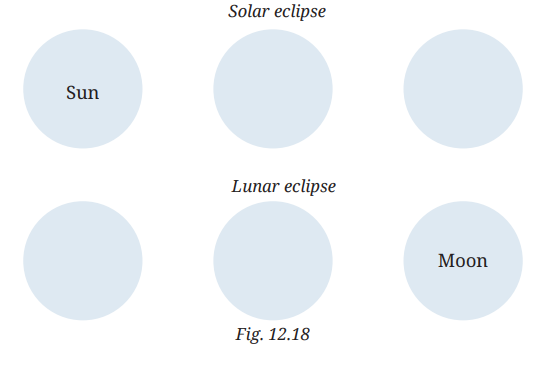
Answer:
Answer:
For a solar eclipse (Sun → Moon → Earth in a line):
- Circle 1 (left): Sun
- Circle 2 (middle): Moon
- Circle 3 (right): Earth
For a lunar eclipse (Sun → Earth → Moon in a line):
- Circle 1 (left): Sun
- Circle 2 (middle): Earth
- Circle 3 (right): Moon
Note: The correct arrangement depends on the context of the diagram in the textbook.
Q9. The Moon is much smaller than the Sun, yet it can block the Sun completely from our view during a total solar eclipse. Why is it possible?
Answer:
Answer: The Moon can block the Sun completely due to apparent size.
Explanation:
- The Sun is much larger than the Moon (physical size).
- However, the Sun is also much farther away from Earth than the Moon.
- The Moon is much closer to Earth.
- Because of this difference in distance, the apparent sizes of the Sun and the Moon as seen from Earth are almost the same.
- Therefore, the Moon can appear to cover the entire Sun during a total solar eclipse.
Analogy: Your thumb (small but close) can cover a friend's head (large but far).
Q10. The Indian cricket team matches in Australia are often held in December. Should they pack winter or summer clothes for their trip?
Answer:
Answer: They should pack summer clothes.
Explanation:
- Australia is in the Southern Hemisphere.
- In December, the Southern Hemisphere is tilted towards the Sun.
- So December is summer in Australia.
- In contrast, December is winter in India (Northern Hemisphere).
- The seasons are reversed in the two hemispheres.
Q11. Why do you think lunar eclipses can be seen from a large part of the Earth when they happen, but total solar eclipse can be seen by only a small part of the Earth?
Answer:
Answer: The difference is due to the size of the shadows cast.
Explanation:
- Solar eclipse: The Moon casts a small shadow on Earth. The Moon is much smaller than Earth, so only a small area falls within the Moon's shadow (umbra). Only people in this small area see a total solar eclipse.
- Lunar eclipse: The Earth casts a large shadow on the Moon. The Earth is much larger than the Moon, so its shadow covers the entire Moon. Anyone on the night side of Earth can see the lunar eclipse.
Comparison:
- Total solar eclipse: Visible from a narrow path on Earth.
- Lunar eclipse: Visible from the entire night side of Earth.
Q12. If the Earth's axis were not tilted with respect to the axis of revolution, explain what would be the effect on seasons?
Answer:
Answer: If the Earth's axis were not tilted (i.e., perpendicular to the orbit), there would be no seasons.
Explanation:
- Seasons are caused by the tilt of the Earth's axis (23.5°) and its spherical shape.
- If there were no tilt:
- The Sun would always be directly over the equator.
- Every place on Earth would receive the same amount of sunlight throughout the year.
- There would be no variation in temperature and daylight hours.
- The entire Earth would have the same climate year-round (no summers or winters).
- Day and night would be 12 hours each, every day, everywhere on Earth.
- This shows how important the axial tilt is for creating seasons and climate variations on Earth.
Exploratory Projects
Q1. Repeat Activity 12.2 but replace the torch with an electric lamp. Then place the globe at different positions on a circle around the lamp while maintaining the tilt of the globe. (i) Note down your observations regarding how much of the Northern and Southern hemispheres of the globe are illuminated at different positions. (ii) Rotate the globe and take a note of the length of the day and night on different parts of the globe. (iii) Repeat (ii) for different positions of globe on the circle.
Answer:
Experiment: Modelling Seasons with a Globe and Lamp
Aim: To understand how the tilt of the Earth's axis and its revolution around the Sun cause seasons.
Set-up:
- Place an electric lamp (representing the Sun) at the centre.
- Place the globe at different positions around the lamp, maintaining its 23.5° tilt.
Observations:
| Position | Northern Hemisphere | Southern Hemisphere |
|---|---|---|
| June position (tilted towards Sun) | More illumination, longer day (summer) | Less illumination, shorter day (winter) |
| December position (tilted away from Sun) | Less illumination, shorter day (winter) | More illumination, longer day (summer) |
| March/September position (sideways) | Equal illumination (12 hours day/night) — spring/autumn equinox | Equal illumination (12 hours day/night) — spring/autumn equinox |
Conclusion:
- The tilt of the Earth's axis causes different amounts of sunlight to fall on different parts of the Earth.
- This leads to seasons, with longer days in summer and shorter days in winter.
Q2. The Earth goes around the Sun in an oval-shaped path. Draw two circles with the same centre, one with a radius of 14.7 cm, and another one with a radius of 15.2 cm. If 1 cm corresponds to 10 million km, the two circles represent the closest and farthest distances from the Sun. Note how small is the difference between these two distances.
Answer:
Project: Earth's Orbital Distance
Aim: To visualise how small the difference is between Earth's closest and farthest distances from the Sun.
Calculations:
- Radius 1 = 14.7 cm → 147 million km (closest distance)
- Radius 2 = 15.2 cm → 152 million km (farthest distance)
- Difference in radii = 15.2 - 14.7 = 0.5 cm
- Difference in actual distance = 0.5 × 10 million = 5 million km
Observation:
- On paper, the two circles are very close to each other (only 0.5 cm apart).
- The difference in distance (5 million km) is small compared to the average distance (about 150 million km).
Conclusion:
- Earth's orbit is nearly circular, not highly oval.
- The small difference in distance is NOT the cause of seasons.
- The tilt of Earth's axis is the main reason for seasons.
Q3. Suppose the tilt of the Earth's axis of rotation increases. Will it cause more extreme seasons? Find out if the tilt of Uranus is more than the Earth and about the seasons there. Write an interesting article for a newspaper or your school magazine about it.
Answer:
Article: If Earth's Tilt Increased — Seasons on Steroids!
Did you know that the Earth is tilted at 23.5°? This tilt is what gives us our seasons — summer, winter, spring, and autumn. But what if the tilt increased? Let's explore!
What if the tilt increased to 45°?
- More extreme seasons: Summers would be hotter and winters would be colder.
- Longer days in summer: Days would be much longer, and nights would be much shorter.
- Shorter days in winter: Days would be very short, and nights would be very long.
- Impact on life: Agriculture would be difficult; some regions may become uninhabitable.
What about Uranus?
- Uranus has an extreme tilt of about 98° — it rotates almost on its side!
- Seasons on Uranus are extremely extreme:
- Each pole gets 42 years of continuous sunlight followed by 42 years of darkness.
- Temperatures vary wildly.
Conclusion: Earth's 23.5° tilt is perfect for life. If it increased, seasons would be more extreme, making life much harder. If it decreased, seasons would be milder, and some areas may never have winter! So be thankful for our perfectly tilted planet!
Science and Society
Q1. Using the computer version of Stellarium app, which is free, you may get information about the upcoming solar and lunar eclipses (if any) which may be visible from your location.
Answer:
Answer: Stellarium is a free, open-source planetarium software that allows users to explore the night sky.
How to use Stellarium for eclipse information:
- Install the Stellarium app on your computer or mobile device.
- Set your location (city) so the app shows the sky visible from your place.
- Use the search function to find upcoming astronomical events.
- Look for dates and times of future solar and lunar eclipses.
- You can also see simulations of what the eclipse will look like from your location.
Why this is useful:
- Helps plan to observe eclipses safely.
- Provides scientific knowledge about celestial events.
- Encourages interest in astronomy.