Activities
Q1. Activity 4.1: Let us explore Caution—Conduct this activity under the supervision of your teacher or an adult. Collect some waste pieces of copper and aluminium, an iron nail, a piece of coal, a pea-sized lump of sulfur (gandhak), and a block of wood. Recall the chapter 'Materials Around Us' in the Grade 6 Science textbook Curiosity and observe the appearances of the above items. Are they lustrous? Also, note whether they are hard or soft and record your observations in Table 4.1. 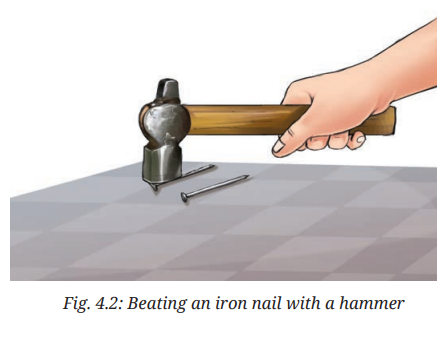 Now, place each of these items one by one on any hard surface and beat them with a hammer. What do you think will happen? Do the objects become slightly flattened or do they break into pieces? Record your observations in Table 4.1.
| S.No. | Object/Material | Appearance (lustrous/non-lustrous) | Hard/Soft | Effect of hammering (flattens/breaks into pieces) |
|---|---|---|---|---|
| 1. | Piece of copper | |||
| 2. | Piece of aluminium | |||
| 3. | Iron nail | |||
| 4. | Piece of coal | |||
| 5. | Lump of sulfur (pea-sized) | |||
| 6. | Block of wood |
Answer:
Observations for Table 4.1:
| S.No. | Object/Material | Appearance (lustrous/non-lustrous) | Hard/Soft | Effect of hammering (flattens/breaks into pieces) |
|---|---|---|---|---|
| 1. | Piece of copper | Lustrous | Hard | Flattens |
| 2. | Piece of aluminium | Lustrous | Hard | Flattens |
| 3. | Iron nail | Lustrous | Hard | Flattens |
| 4. | Piece of coal | Non-lustrous | Soft/Brittle | Breaks into pieces |
| 5. | Lump of sulfur | Non-lustrous | Soft/Brittle | Breaks into pieces |
| 6. | Block of wood | Non-lustrous | Hard | Neither flattens nor breaks |
Analysis:
- Objects made from copper, aluminium, and iron are lustrous in appearance and are hard. They become flat on beating. These are metals.
- Coal, sulfur, and wood are non-lustrous. Coal and sulfur break into pieces on hammering (brittle), while wood neither flattens nor breaks.
- The property by which materials can be beaten into thin sheets is called malleability. Most metals possess this property.
- Gold and silver are the most malleable metals.
Q2. Activity 4.2: Let us investigate Caution—Be careful while dropping the objects. Take a few objects, such as a metal spoon, a coin, a piece of coal, and a block of wood. Drop them one by one from a certain height. Do you notice any difference in the sound produced by these objects?
Answer:
Observations:
- Metal spoon and metal coin: Produce a ringing sound when dropped.
- Coal and wood: Produce dull sounds when dropped.
Conclusion:
- Metals produce a ringing sound when struck. This property is called sonority, and metals are said to be sonorous in nature.
- Non-metals (like coal and wood) do not produce a ringing sound; they produce dull sounds.
Q3. Activity 4.3: Let us investigate Caution—This activity must be performed under the supervision of your teacher or an adult. Be careful while handling hot water. 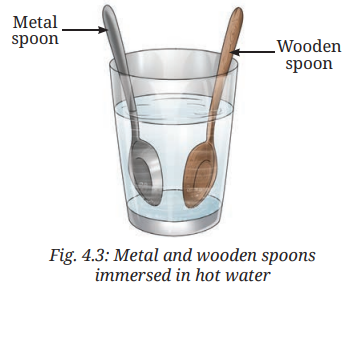 Place a glass tumbler on a table. Fill it with hot water. Take a metal spoon and a wooden spoon of almost the same size and thickness. Immerse both the spoons simultaneously into the hot water and leave them undisturbed for a few minutes. Now, carefully touch the upper end of each spoon. Some discussion points: Which of the spoons get hotter? What does this experiment tell us about heat transfer along the two spoons?
Answer:
Observations:
- The metal spoon becomes hotter to touch than the wooden spoon, even though both are immersed in water of the same temperature for the same time.
Conclusion:
- Heat transfers through the metal spoon (making it hot), but transfers poorly through the wooden spoon.
- The transfer of heat from one point to another of a material is called conduction.
- Metals are good conductors of heat, whereas wood is a poor conductor of heat.
- This explains why cooking vessels are made of metals, while their handles are made of wood or other materials that do not conduct heat well.
Q4. Activity 4.4: Let us design and create Design an electric circuit, like the 'tester' circuit in the chapter 'Electricity: Circuits and their Components'. Repeat the same activity using the materials listed below and record your observations in Table 4.2. You may collect a few objects, such as a piece of aluminium foil, an iron nail, a lump of sulfur (pea-sized), a copper wire, a piece of coal, a piece of dry wood, a stone, an eraser made of rubber and a piece of nylon rope. Predict which of these could make the bulb of the tester glow and which could not.
| S.No. | Object/Material | Observation (bulb glows/does not glow) | Good conductor of electricity or poor conductor of electricity |
|---|---|---|---|
| 1. | Piece of aluminium foil | ||
| 2. | Iron nail | ||
| 3. | Lump of sulfur (pea-sized) | ||
| 4. | Copper wire | ||
| 5. | Piece of coal | ||
| 6. | Piece of dry wood | ||
| 7. | Stone | ||
| 8. | Eraser (rubber) | ||
| 9. | Piece of nylon rope |
Answer:
Observations for Table 4.2:
| S.No. | Object/Material | Observation (bulb glows/does not glow) | Good conductor of electricity or poor conductor of electricity |
|---|---|---|---|
| 1. | Piece of aluminium foil | Glows | Good conductor |
| 2. | Iron nail | Glows | Good conductor |
| 3. | Lump of sulfur | Does not glow | Poor conductor |
| 4. | Copper wire | Glows | Good conductor |
| 5. | Piece of coal | Does not glow | Poor conductor |
| 6. | Piece of dry wood | Does not glow | Poor conductor |
| 7. | Stone | Does not glow | Poor conductor |
| 8. | Eraser (rubber) | Does not glow | Poor conductor |
| 9. | Piece of nylon rope | Does not glow | Poor conductor |
Conclusion:
- Objects made of aluminium, iron, and copper (all metals) make the bulb glow.
- Sulfur, coal, wood, stone, rubber, and nylon rope do not make the bulb glow.
- Metals are good conductors of electricity. Non-metals are generally poor conductors of electricity.
- This explains why plastic covering on screwdrivers and rubber gloves protect electricians from electric shock—these materials are poor conductors of electricity.
Q5. Activity 4.5: Let us experiment Caution—Be careful while handling iron nails. Take a few shining iron nails. If you are using old iron nails, make sure to remove brown deposits from their surface by scrubbing them with the help of a small piece of sandpaper. Take three clean, dry glass bottles or test tubes with tight-fitting caps or stoppers. Label them A, B, and C. Take three iron nails and tie each iron nail with a thread. Place one iron nail and some silica gel in the glass bottle 'A', and tighten the cap or stopper. Silica gel makes the air dry. It is the substance that is used in small pouches in some medicine bottles, water bottles, shoe boxes, etc., to keep them dry. 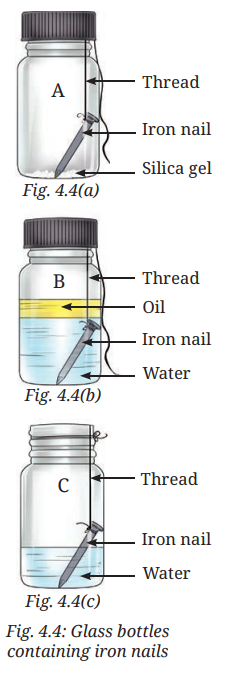 Place one iron nail in the glass bottle 'B'. Pour freshly boiled and cooled water (to remove dissolved gases) into it until the iron nail is completely dipped in it. Now, pour some oil to form a layer over the surface of the water. The layer of oil on the surface of the water prevents the air from dissolving in the water. Cap the glass bottle tightly. Place one iron nail in the glass bottle 'C', and pour some water so that the iron nail is partially dipped. Keep this glass bottle unstoppered. This allows the iron nail to come into contact with both water and air. Place all the glass bottles undisturbed at room temperature and observe the changes for 8-10 days. Record your observations in Table 4.3.
| Glass Bottle | Conditions | Observations | |
|---|---|---|---|
| Presence of water (Yes/No) | Presence of air (Yes/No) | ||
| A | No | Yes | |
| B | |||
| C | |||
Answer:
Observations for Table 4.3:
| Glass Bottle | Conditions | Observations | |
|---|---|---|---|
| Presence of water (Yes/No) | Presence of air (Yes/No) | ||
| A | No | Yes (dry air) | No brown deposits (no rusting) |
| B | Yes (boiled water with oil layer) | No (oil prevents air contact) | No brown deposits (no rusting) |
| C | Yes (partially dipped) | Yes | Brown deposits appear (rusting occurs) |
Conclusion:
- In bottle A (dry air only) and bottle B (water only, no air), the iron nails do not show any brown deposits.
- In bottle C (both water and air), the iron nail shows brown deposits (rust).
- Both water and air are essential for rusting to occur.
- The brown deposit formed is called rust, and the process is called rusting.
- Moist air (water + air) is responsible for rusting of iron.
Q6. Activity 4.6: Let us investigate (demonstration activity) The teacher may demonstrate this activity. Caution—It is advisable for students to wear protective eyeglasses and keep safe distance. Take a magnesium ribbon about 3-4 centimetres long. Clean it by rubbing with a piece of sandpaper. Hold it with a pair of tongs. Ignite the other end using a spirit lamp or a candle. Let the magnesium ribbon burn. What do you observe? 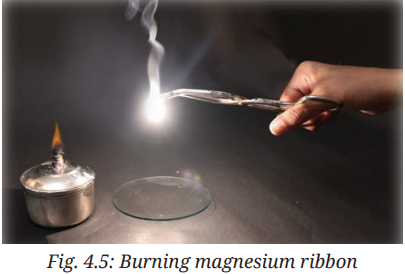 You must have observed that magnesium ribbon burns with a dazzling white flame and changes into a white powder. Collect it on a watch glass. This powder is magnesium oxide. It is formed due to the reaction between magnesium and oxygen present in the air. Add a few drops of warm water to this white powder, stir it well, and check its nature. Recall the chapter 'Exploring Substances: Acidic, Basic, and Neutral'. Find out whether the solution of magnesium oxide is acidic or basic or neutral in nature. You can use any acid-base indicator.
 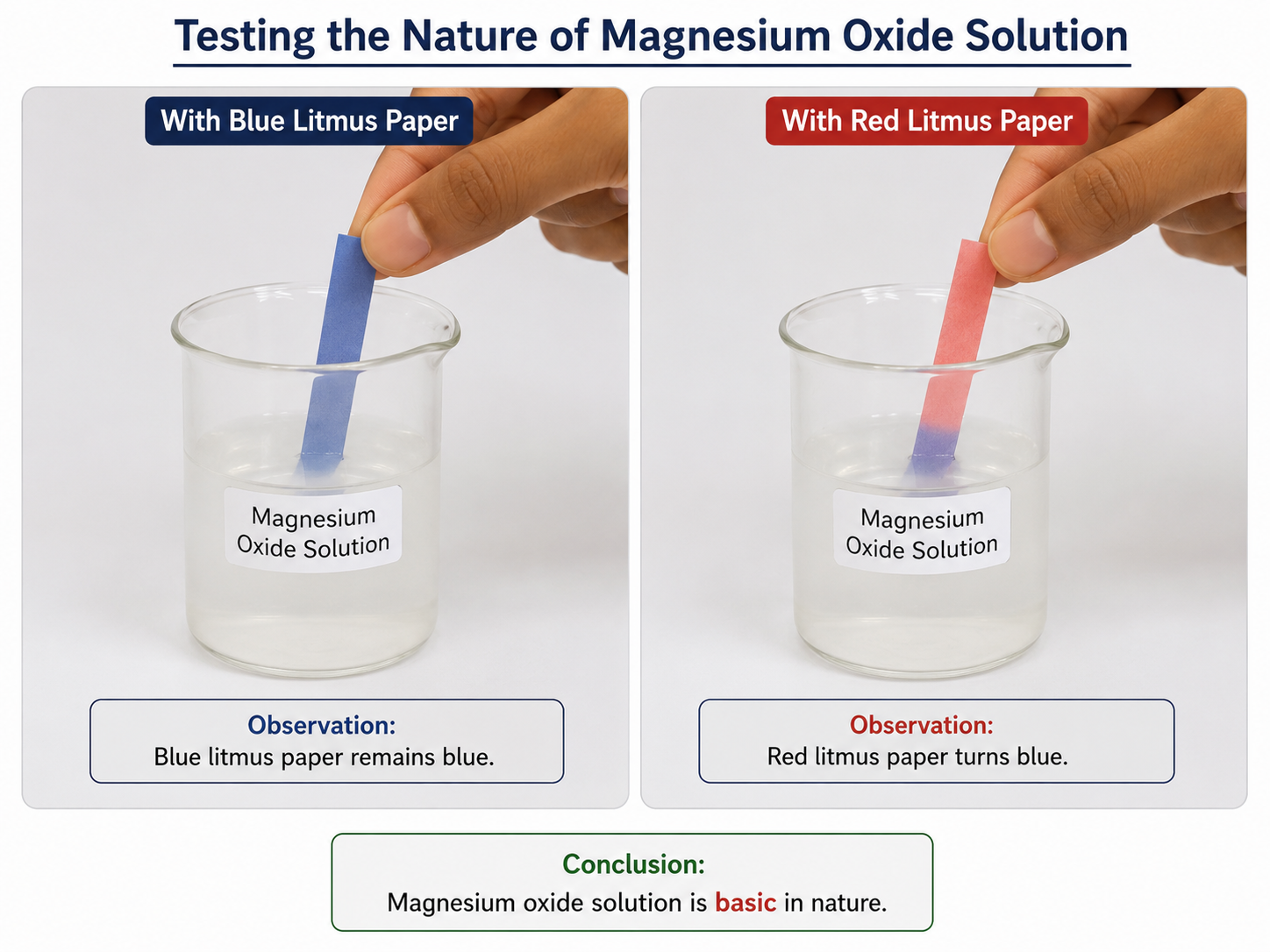 What effect does this solution have on blue and red litmus papers?
Answer:
Observations:
- Magnesium ribbon burns with a dazzling white flame and forms a white powder (magnesium oxide).
- When water is added to magnesium oxide and stirred, it forms magnesium hydroxide solution.
- This solution turns red litmus paper to blue and does not change blue litmus paper.
Conclusion:
- Magnesium oxide is basic in nature.
- Metal oxides are generally basic in nature.
- Reaction: 2Mg + O₂ → 2MgO (magnesium oxide); MgO + H₂O → Mg(OH)₂ (magnesium hydroxide)
Q7. Activity 4.7: Burning of sulfur (demonstration activity) The teacher may demonstrate this activity. Caution—This activity must be performed in a fume hood or well-ventilated area. Burning sulfur produces gases, which can be harmful if inhaled. Take a small amount of powdered sulfur in a deflagrating spoon (it is a long-handled metal spoon used in experiments to safely heat and burn substances). If a deflagrating spoon is not available, you may take a metallic cap of any bottle, wrap a metallic wire around it and give it the shape as shown in Fig. 4.7b. Heat it on a flame, and as soon as the sulfur starts burning, introduce the deflagrating spoon into a gas jar or glass tumbler. Cover the gas jar or glass tumbler with a lid to ensure that the gas produced does not escape. Remove the lid after 3-4 minutes and take out the deflagrating spoon. Add a small quantity of water into the gas jar, quickly place the lid back and shake it so that the gas dissolves. Again, recall the chapter 'Exploring Substances: Acidic, Basic, and Neutral'. Using an acid-base indicator, check whether the solution obtained after the addition of water to the gas jar is acidic or basic or neutral. What do you observe? Does sulfur behave in water the same way metals do? 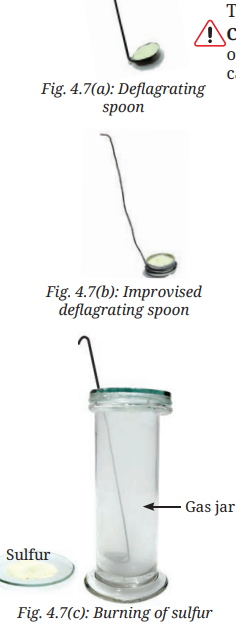
Answer:
Observations:
- Sulfur burns with a blue flame and forms a gas (sulfur dioxide).
- When sulfur dioxide dissolves in water, it forms sulfurous acid.
- This solution turns blue litmus paper to red and does not change red litmus paper.
Conclusion:
- Sulfur dioxide (and its solution in water) is acidic in nature.
- Non-metal oxides are generally acidic in nature.
- Reaction: S + O₂ → SO₂ (sulfur dioxide); SO₂ + H₂O → H₂SO₃ (sulfurous acid)
- Metals and non-metals behave differently with air and water. Metals form basic oxides, while non-metals form acidic oxides.
Q8. Activity 4.8: Let us explore Take some sulfur powder in a glass tumbler. Add a small amount of water to it. What do you observe?
Answer:
Observation:
- There is no reaction when sulfur is placed in water.
Conclusion:
- Sulfur (a non-metal) does not react with water.
- Generally, non-metals do not react with water.
- This is another difference between metals and non-metals. Some metals (like sodium, magnesium) react with water, while non-metals generally do not.
In-text Questions
Q1. Which objects did you find become flat on beating with a hammer? (From Activity 4.1)
Answer:
Answer: Copper, aluminium, and iron (objects made of metals) became flat on beating with a hammer.
Explanation:
- Copper, aluminium, and iron are metals. They possess the property of malleability, which means they can be beaten into thin sheets.
- Coal, sulfur, and wood did not flatten; coal and sulfur broke into pieces (brittle), while wood neither flattened nor broke.
Q2. Can you give some examples of metal sheets? (From Activity 4.1)
Answer:
Answer: Examples of metal sheets include:
- Silver foil used on sweets and food items.
- Aluminium foil used for wrapping food items, packaging, and cooking.
- Gold foil used for decoration and in some traditional foods.
- Copper sheets used in utensils and decorative items.
- Iron sheets used in roofing, construction, and making of various items.
Q3. Where do you find the use of metal wires? (From Section 4.1.2)
Answer:
Answer: Metal wires are used in various applications:
- Electrical fittings: Copper and aluminium wires are used for electrical wiring in homes, buildings, and appliances.
- Ornaments: Gold, silver, and copper wires are used to make jewellery like bangles, necklaces, and earrings.
- Musical instruments: Stringed instruments like veena, sitar, violin, and guitar use metal wires (strings) made of steel, brass, or bronze.
- Construction: Steel wires are used in suspension bridges, cranes, and to lift heavy objects.
- Household items: Metal wires are used in springs, paper clips, and various other items.
Q4. Have you ever seen wires made of coal or sulfur? (From Section 4.1.2)
Answer:
Answer: No, we have never seen wires made of coal or sulfur.
Explanation:
- Wires are made of materials that are ductile (can be drawn into wires).
- Coal and sulfur are non-metals and are not ductile.
- Coal is brittle and breaks easily, while sulfur is also brittle and cannot be drawn into wires.
- Only metals possess the property of ductility.
Q5. Have you ever noticed the sound produced when a metal spoon, or a metal plate, or a metal coin is dropped on the floor? How is it different from the sound produced when a piece of coal or wood is dropped on the floor? (From Section 4.1.3)
Answer:
Answer:
- Metal spoon, metal plate, or metal coin: Produce a clear, ringing sound when dropped on the floor.
- Piece of coal or wood: Produce a dull, thudding sound when dropped on the floor.
Explanation:
- Metals are sonorous—they produce a ringing sound when struck or dropped.
- Non-metals (like coal and wood) are not sonorous—they produce dull sounds.
- This sonority property of metals is used in making musical instruments like bells, cymbals, and gongs.
Q6. Can you name some metals that are used for making cooking vessels? (From Section 4.1.4)
Answer:
Answer: Metals used for making cooking vessels include:
- Copper - Good conductor of heat, used for cookware and utensils.
- Aluminium - Lightweight, good conductor, used for pressure cookers, tawa, and utensils.
- Iron - Used for cast iron pans, tawas, and kadhai.
- Stainless steel (an alloy of iron, chromium, and other metals) - Widely used for modern cookware.
- Brass (copper-zinc alloy) - Used for traditional utensils in some regions.
Reason: Metals are good conductors of heat, so they transfer heat quickly from the flame to the food, making cooking efficient.
Q7. Do you know why these metals are used for this purpose? (From Section 4.1.4 - referring to cooking vessels)
Answer:
Answer: Metals are used for making cooking vessels because:
- Good conductors of heat: Metals transfer heat quickly and evenly from the flame to the food, cooking it efficiently.
- High melting points: Metals can withstand high temperatures without melting or deforming.
- Durability: Metals are strong and can withstand regular use without breaking easily.
- Malleability: Metals can be shaped into various forms (pans, kadhai, pressure cookers) as needed.
- Non-reactive with food (mostly): Some metals like stainless steel are relatively unreactive with food.
Q8. Have you ever seen an electrician using a screwdriver? What type of material is used for making its handle? (From Section 4.1.5)
Answer:
Answer: The handle of an electrician's screwdriver is made of plastic or wood.
Explanation:
- Plastic and wood are insulators (poor conductors of electricity).
- They prevent electric current from passing through the handle to the electrician's body, protecting them from electric shocks.
- Electricians also wear rubber gloves and rubber-soled shoes for the same reason—rubber is a poor conductor of electricity.
Q9. What can be the reason for this? (From Section 4.1.5 - referring to electricians wearing rubber gloves and shoes)
Answer:
Answer: Electricians wear rubber gloves and rubber-soled shoes because rubber is a poor conductor of electricity (an insulator).
Explanation:
- If an electrician accidentally touches a live wire, the rubber gloves and shoes prevent the electric current from passing through their body to the ground.
- This protects them from severe electric shocks and injuries.
- Insulators like rubber, plastic, and wood are used in all electrical safety equipment.
Q10. In which conditions would an iron object develop brown deposits? (From Section 4.2)
Answer:
Answer: An iron object develops brown deposits (rust) when it comes into contact with both air and water (moist air).
Explanation:
- Rusting requires both oxygen (from air) and moisture (water) to occur.
- In dry air alone, rusting does not occur.
- In water alone (without air), rusting does not occur.
- When both air and water are present (as in moist air), rusting occurs rapidly.
Conditions where rusting does NOT occur:
- Dry air only → No rust
- Water only (no air) → No rust
- Oiled or greased surface → No rust (prevents contact with air and water)
Q11. What can you conclude from this experiment? (From Activity 4.5)
Answer:
Answer: From Activity 4.5, we can conclude that:
- Iron nails in dry air (bottle A) and in water without air (bottle B) do not show any brown deposits (rusting).
- Iron nails exposed to both water and air (bottle C) develop brown deposits (rust).
- Both water and air (oxygen) are essential for rusting to occur.
- Moist air is responsible for the rusting of iron.
- The brown deposit formed on iron is called rust (iron oxide).
Q12. Does sulfur behave in water the same way metals do? (From Activity 4.7)
Answer:
Answer: No, sulfur does not behave in water the same way metals do.
Explanation:
- Metals: Some metals (like sodium, magnesium) react with water to form metal hydroxides and release hydrogen gas. Metal oxides are basic in nature.
- Sulfur (non-metal): Sulfur does not react with water. When sulfur burns in air, it forms sulfur dioxide, which dissolves in water to form an acid (sulfurous acid).
- Key differences:
- Metal oxides + water → Basic solutions (turn red litmus blue).
- Non-metal oxides + water → Acidic solutions (turn blue litmus red).
- Therefore, metals and non-metals show different behaviour with water and air.
Q13. Can you think of any other uses of oxygen? (From Section 4.5)
Answer:
Answer: Oxygen has many other uses besides respiration:
- Combustion: Oxygen supports burning. It is essential for burning fuels (wood, coal, petrol, etc.).
- Medical use: Oxygen is used in hospitals for patients having breathing difficulties, in oxygen masks, and in emergency care.
- Industrial use: Oxygen is used in steel-making (removes carbon and other impurities from iron), welding, and cutting metals.
- Water treatment: Oxygen is used in water purification and treatment plants.
- Aerospace: Liquid oxygen is used as an oxidiser in rocket fuel.
- Chemical industry: Oxygen is used in the production of various chemicals and compounds.
Exercises
Q1. Which metal is commonly used to make food packaging materials as it is cheaper, and its thin sheets can be folded easily into any shape? (i) Aluminium (ii) Copper (iii) Iron (iv) Gold
Answer:
Answer: (i) Aluminium
Reason:
- Aluminium is lightweight, cheap, and highly malleable (can be beaten into thin sheets).
- Its thin sheets can be folded easily, making it ideal for food packaging materials like aluminium foil.
- Copper and iron are heavier and more expensive; gold is too expensive for packaging.
Q2. Which of the following metal catches fire when it comes in contact with water? (i) Copper (ii) Aluminium (iii) Zinc (iv) Sodium
Answer:
Answer: (iv) Sodium
Reason:
- Sodium is a highly reactive metal that reacts vigorously with water, producing hydrogen gas and a lot of heat. The heat generated can cause the hydrogen gas to catch fire.
- This is why sodium is stored in kerosene to prevent its exposure to moisture and air.
- Copper, aluminium, and zinc do not react vigorously with water at room temperature.
Q3. State with reason(s) whether the following statements are True [T] or False [F]. (i) Aluminium and copper are examples of non-metals used for making utensils and statues. [ ] (ii) Metals form oxides when combined with oxygen, the solution of which turns blue litmus paper to red. [ ] (iii) Oxygen is a non-metal essential for respiration. [ ] (iv) Copper vessels are used for boiling water because they are good conductors of electricity. [ ]
Answer:
(i) False [F]
- Aluminium and copper are metals, not non-metals. They are used for making utensils and statues because they are malleable, ductile, and good conductors of heat.
(ii) False [F]
- Metal oxides are basic in nature. When dissolved in water, they turn red litmus paper to blue, not blue litmus to red. Non-metal oxides are acidic and turn blue litmus to red.
(iii) True [T]
- Oxygen is a non-metal and is essential for respiration in all living organisms. Without oxygen, life would not be possible.
(iv) False [F]
- Copper vessels are used for boiling water because copper is a good conductor of heat, not electricity. Conducting electricity is not a requirement for boiling water.
Q4. Why are only a few metals suitable for making jewellery?
Answer:
Answer: Only a few metals are suitable for making jewellery because they must possess a specific combination of properties.
Properties required for jewellery:
- Lustre: Metals must have a shiny, attractive appearance.
- Malleability and Ductility: Metals must be easily shaped into intricate designs and drawn into thin wires.
- Non-reactivity: Metals must not react with air, water, or sweat, as this would cause corrosion and tarnishing.
- Rarity and value: Precious metals like gold, silver, and platinum are valued for their scarcity.
Metals suitable for jewellery:
- Gold: Highly malleable, ductile, lustrous, and does not corrode easily.
- Silver: Lustrous and malleable, but tarnishes (forms black coating) with air.
- Platinum: Lustrous, corrosion-resistant, and valuable.
- Copper and aluminium: Not suitable for jewellery because they react with air and moisture, forming dull coatings and are less valuable.
Conclusion: Only a few metals possess the ideal combination of beauty, workability, and durability required for jewellery.
Q5. Match the uses of metals and non-metals given in Column I with the jumbled names of metals and non-metals given in Column II.
| Column I | Column II |
|---|---|
| (i) Used in electrical wiring | (a) ENXYGO |
| (ii) Most malleable and ductile | (b) NECOHIRL |
| (iii) Living organisms cannot survive without it. | (c) PEPORC |
| (iv) Plants grow healthy when fertilisers containing it are added to the soil. | (d) TENGOINR |
| (v) Used in water purification | (e) OGD L |
Answer:
Answers:
| Column I | Jumbled Name (Column II) | Unscrambled Name |
|---|---|---|
| (i) Used in electrical wiring | (a) ENXYGO | COPPER |
| (ii) Most malleable and ductile | (b) NECOHIRL | CHLORINE |
| (iii) Living organisms cannot survive without it. | (c) PEPORC | OXYGEN |
| (iv) Plants grow healthy when fertilisers containing it are added to the soil. | (d) TENGOINR | NITROGEN |
| (v) Used in water purification | (e) OGD L | GOLD |
Let us verify the matches:
- (i) Used in electrical wiring → COPPER: Copper is a good conductor of electricity and is commonly used for electrical wiring.
- (ii) Most malleable and ductile → GOLD: Gold is the most malleable and ductile metal.
- (iii) Living organisms cannot survive without it → OXYGEN: Oxygen is essential for respiration.
- (iv) Plants grow healthy when fertilisers containing it are added to the soil → NITROGEN: Nitrogen is a key component of fertilisers and is essential for plant growth.
- (v) Used in water purification → CHLORINE: Chlorine is used to purify water.
Q6. What happens when oxygen reacts with magnesium and sulfur. What are the main differences in the nature of products formed?
Answer:
Answer:
Reaction of magnesium with oxygen:
- Magnesium burns in oxygen with a dazzling white flame and forms magnesium oxide (a white powder).
- Equation: 2Mg + O₂ → 2MgO
- Nature of product: Magnesium oxide is basic in nature. It turns red litmus paper to blue.
Reaction of sulfur with oxygen:
- Sulfur burns in oxygen with a blue flame and forms sulfur dioxide gas.
- Equation: S + O₂ → SO₂
- Nature of product: Sulfur dioxide dissolves in water to form sulfurous acid, which is acidic in nature. It turns blue litmus paper to red.
Main differences in the nature of products:
| Property | Magnesium Oxide (Metal Oxide) | Sulfur Dioxide (Non-metal Oxide) |
|---|---|---|
| Nature | Basic | Acidic |
| Effect on litmus | Turns red litmus to blue | Turns blue litmus to red |
| pH | Greater than 7 (basic) | Less than 7 (acidic) |
| Reaction with water | Forms magnesium hydroxide (basic) | Forms sulfurous acid (acidic) |
Conclusion: Metal oxides are generally basic in nature, while non-metal oxides are generally acidic in nature.
Q7. Complete the following flow chart: 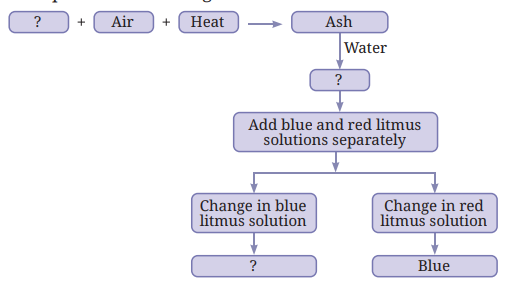
Answer:
Completed Flowchart:
The flowchart should show the classification of materials into Metals and Non-metals based on their properties.
| Property | Metals | Non-metals |
|---|---|---|
| Appearance (Lustre) | Lustrous (shiny) | Non-lustrous (dull) (except graphite, iodine) |
| Malleability | Malleable (can be beaten into thin sheets) | Not malleable (brittle) |
| Ductility | Ductile (can be drawn into wires) | Not ductile |
| Sonority | Sonorous (produce ringing sound) | Not sonorous (produce dull sound) |
| Conduction of heat | Good conductors of heat | Poor conductors of heat (except graphite) |
| Conduction of electricity | Good conductors of electricity | Poor conductors of electricity (except graphite) |
| Reaction with oxygen | Form metal oxides (basic in nature) | Form non-metal oxides (acidic in nature) |
| Reaction with water | Some metals react with water (e.g., sodium, magnesium) | Generally do not react with water |
| Physical state | Solid at room temperature (except mercury which is liquid) | Solid, liquid, or gas at room temperature |
Examples:
- Metals: Iron, copper, aluminium, gold, silver, sodium, magnesium
- Non-metals: Oxygen, hydrogen, nitrogen, sulfur, chlorine, phosphorus, carbon
Q8. You are provided with the following materials. Discuss which material would be your choice to make a pan that is most suitable for boiling water and why? Iron, copper, sulfur, coal, plastic, wood, cardboard
Answer:
Answer: Copper or iron would be the most suitable choice for making a pan to boil water.
Reason:
- Good conductor of heat: Both copper and iron are good conductors of heat, which allows heat to transfer quickly from the flame to the water, making boiling efficient.
- High melting point: Metals have high melting points, so they can withstand the high temperatures of a stove without melting or getting damaged.
- Durable and strong: Metals are strong and durable, making them suitable for everyday use in the kitchen.
Why other materials are not suitable:
| Material | Why not suitable |
|---|---|
| Sulfur | Low melting point, brittle, poor conductor of heat, reacts with air on heating |
| Coal | Cannot be shaped into a pan, poor conductor of heat, burns |
| Plastic | Melts at high temperatures, poor conductor of heat |
| Wood | Burns at high temperatures, poor conductor of heat |
| Cardboard | Burns at high temperatures, not durable, poor conductor of heat |
Comparison of iron and copper:
- Copper is a better conductor of heat than iron, but it is more expensive and can react with acidic foods (forming green coating).
- Iron is cheaper but may rust if not properly coated (e.g., with tin or enamel).
- Both are suitable, but copper is preferred for better heat conduction, while iron is preferred for cost-effectiveness.
Q9. You are provided with three iron nails, each dipped in oil, water and vinegar. Which iron nail will not rust, and why?
Answer:
Answer: The iron nail dipped in oil will not rust.
Reason:
- Rusting requires both water and air (oxygen) to be present.
- Oil: Forms a protective layer over the iron nail, preventing both air and moisture from coming into contact with the iron. Thus, rusting is prevented.
- Water: The nail in water will rust because water contains dissolved oxygen (air), providing both water and air needed for rusting.
- Vinegar: Vinegar is acidic (contains acetic acid). It will react with the iron, causing corrosion and possibly dissolving the nail over time, but this is not rusting (which is specifically the formation of iron oxide). The nail in vinegar will corrode but may or may not show typical rust formation.
Conclusion: The nail dipped in oil will not rust because the oil prevents contact with air and moisture. The nail in water will rust because it is exposed to both water and air. The nail in vinegar will corrode due to the acid.
Q10. How do the different properties of metals and non-metals determine their uses in everyday life?
Answer:
Answer: The properties of metals and non-metals determine their specific uses in daily life.
Properties and uses of metals:
| Property | Use | Example |
|---|---|---|
| Malleability | Can be beaten into thin sheets | Aluminium foil for wrapping food, gold and silver foil for decoration |
| Ductility | Can be drawn into wires | Copper and aluminium wires for electrical wiring |
| Good conductor of heat | Used for cooking vessels | Copper and iron utensils, aluminium cookware |
| Good conductor of electricity | Used for electrical connections | Copper wires in circuits, aluminium wires in power lines |
| Sonority | Used for musical instruments | Bells, cymbals, strings of veena, sitar, guitar |
| Lustre | Used for jewellery and decoration | Gold, silver, platinum ornaments |
| Strength and durability | Used for construction and tools | Iron for buildings, bridges, agricultural tools |
Properties and uses of non-metals:
| Property | Use | Example |
|---|---|---|
| Oxygen (supports respiration) | Essential for breathing | Used in medical oxygen cylinders, supports combustion |
| Nitrogen (essential nutrient) | Used in fertilisers | Ammonia and urea fertilisers for plant growth |
| Chlorine (disinfectant) | Used for water purification | Drinking water treatment, swimming pools |
| Iodine (antiseptic) | Applied on wounds | Iodine solution, tincture of iodine |
| Carbon (building block of life) | Present in all living organisms | Proteins, fats, carbohydrates |
| Graphite (a form of carbon) | Used in pencils, as a lubricant, in batteries | Pencil lead, lubricant for locks |
| Sulfur | Used in medicines, matches, gunpowder | Medicines, fireworks |
Conclusion: The unique properties of metals (like conductivity, malleability, strength) make them suitable for structural, electrical, and decorative purposes, while the specific properties of non-metals (like oxygen supporting life, nitrogen in fertilisers, chlorine as a disinfectant) make them essential for biological and chemical applications.
Q11. One of the methods of protecting iron from getting rusted is to put a thin coating of zinc metal over it. Since sulfur does not react with water, can it be used for this purpose? Justify your answer.
Answer:
Answer: No, sulfur cannot be used to protect iron from rusting.
Justification:
- Purpose of coating: To prevent rusting, the coating must provide a barrier that protects iron from coming into contact with air and moisture.
- Zinc coating (galvanisation): Zinc is a metal that forms a protective layer on iron. Even if the zinc layer is scratched, it acts as a sacrificial anode (zinc reacts with oxygen instead of iron), preventing rusting.
- Sulfur is a non-metal:
- Sulfur is not malleable and cannot be applied as a thin protective coating on iron.
- Sulfur is a poor conductor of heat and electricity, but that is not relevant for rust prevention.
- While sulfur does not react with water, it does not form a protective barrier on iron.
- Sulfur in contact with iron may react to form iron sulfide, which is not protective and can make the iron brittle.
- Conclusion: Sulfur cannot be used for protecting iron from rusting because it does not form a protective coating and does not have the necessary properties (like zinc) to prevent corrosion.
Q12. An ironsmith heats iron before making tools. Why is heating necessary in this process?
Answer:
Answer: Heating iron makes it soft and malleable, allowing the ironsmith to shape it into tools.
Reason:
- Increased malleability: When iron is heated, its atoms gain energy and can move more freely, making the metal softer and more malleable. This allows the ironsmith to hammer, bend, and shape the iron into desired forms like axes, ploughs, and tongs.
- Easier shaping: Cold iron is hard and difficult to shape; it may even crack when hammered. Heating makes it ductile and workable.
- Ability to form complex shapes: Heating allows the ironsmith to create complex and precise shapes required for various tools and agricultural implements.
- Annealing and stress relief: Heating also helps relieve internal stresses in the metal, making the final product stronger and more durable.
Process of working with heated iron:
- Iron is heated in a furnace until it becomes red hot (glowing).
- The heated iron is placed on an anvil and beaten with a hammer to shape it.
- The metal is reheated periodically as it cools down to maintain malleability.
- After shaping, the tool is cooled (quenched) to harden it.
Conclusion: Heating is essential because it temporarily changes the properties of iron, making it easier to shape into useful tools and implements.
Exploratory Projects
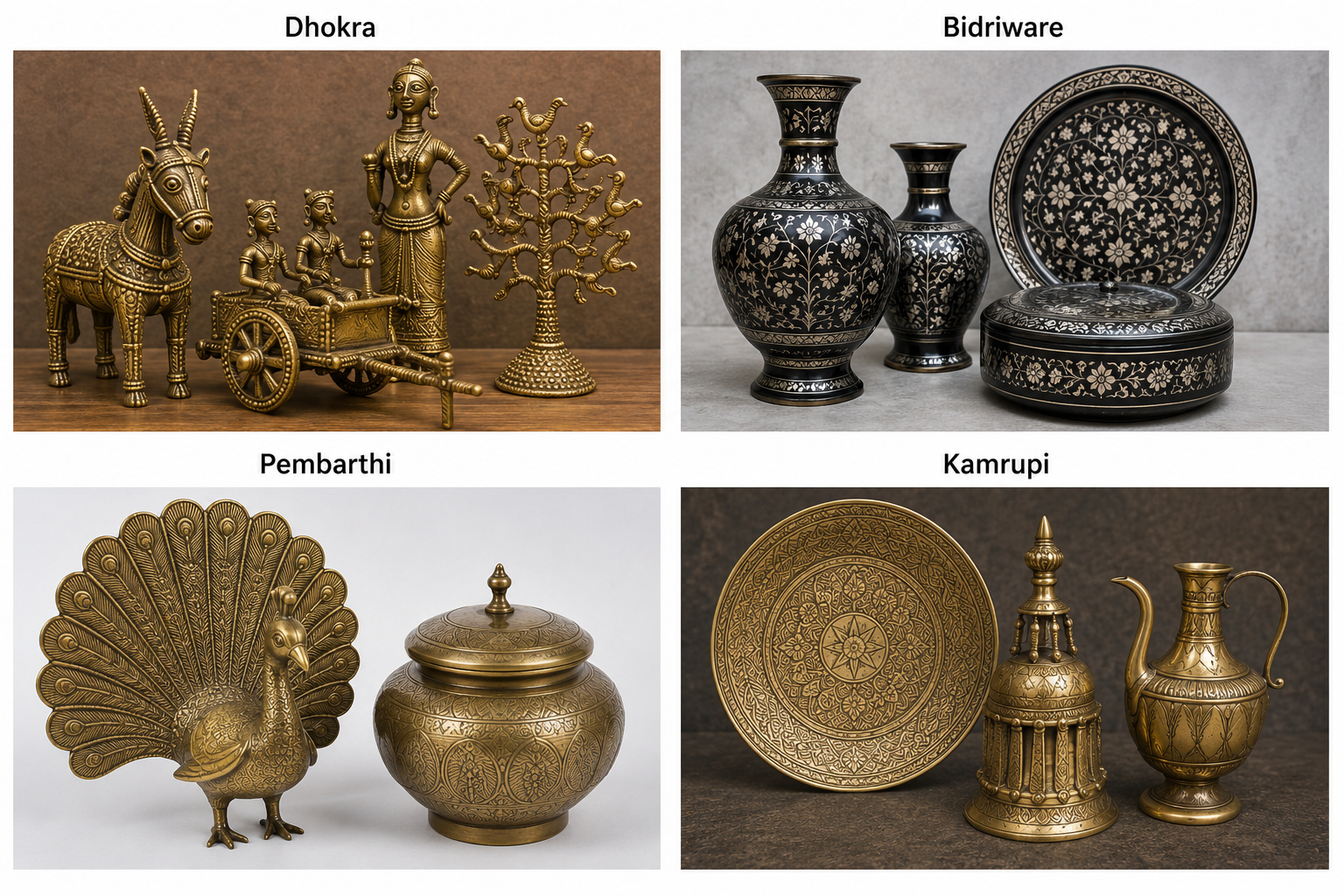
Q1. Dhokra, Bidriware, Pembarthi, and Kamrupi are some of India's famous metal art styles. Find out the states where these artworks are made. Also, make a collage of their photographs.
Answer:
Project Activity: Indian Metal Art Styles
Aim: To research and document famous metal art styles of India, their states of origin, and create a visual collage.
Method: Research online, in books, or by visiting local artisans to gather information about these metal art forms.
| Metal Art Style | State | Materials Used | Key Features |
|---|---|---|---|
| Dhokra | Chhattisgarh, West Bengal, Odisha, Jharkhand | Brass, bronze (lost-wax casting technique) | Unique tribal designs, intricate patterns, natural motifs, no two pieces identical |
| Bidriware | Karnataka (Bidar district) | Zinc alloy inlaid with silver | Black background with intricate silver designs, floral patterns |
| Pembarthi | Telangana (Pembarthi village, Warangal district) | Brass, copper, silver | Intricate metal engraving, traditional folk designs, mythological figures |
| Kamrupi | Assam (Kamrup district) | Bronze, brass, bell metal | Traditional utensils, bell metal craft, unique casting techniques |
Additional metal art forms in India:
- Kondapalli: Andhra Pradesh (wooden toys with metal detailing)
- Kerala Bell Metal: Kerala (vessels and lamps)
- Moradabad Brassware: Uttar Pradesh (brass utensils, decorative items)
- Kashmir Silverware: Jammu and Kashmir (silver carving, jewellery)
- Tanjore Gold Leaf: Tamil Nadu (gold foil on paintings)
Project output: Create a collage with photographs of these art styles, along with brief descriptions of their origin, materials, and significance.
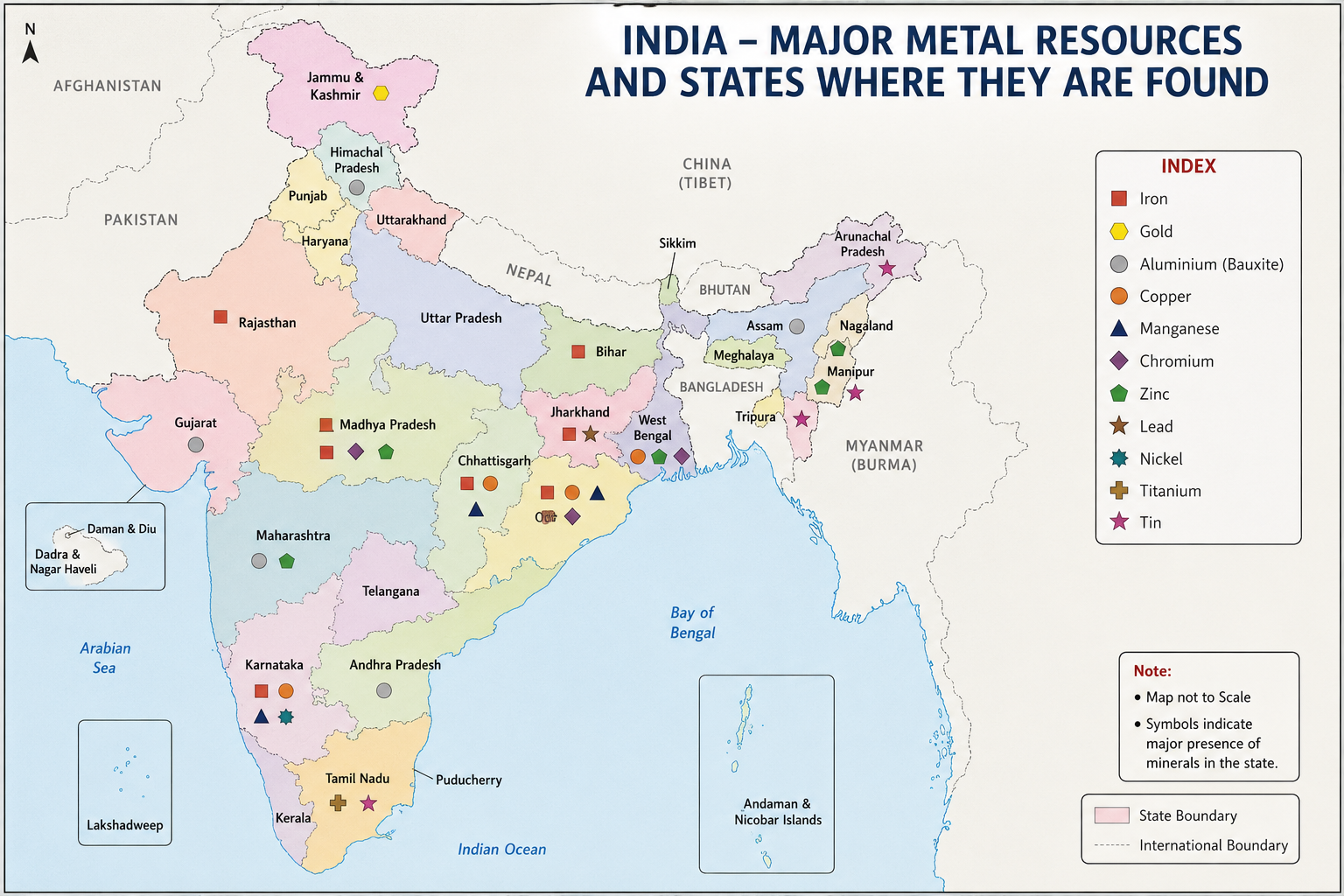
Q2. On a map of India, mark the states where iron, gold, aluminium and other metals are found.
Answer:
Project Activity: Metal Deposits in India
Aim: To identify and mark on a map of India the states where major metals are found.
Method: Use a political map of India and mark the states where different metals are mined.
| Metal | States Where Found | Key Mining Locations |
|---|---|---|
| Iron | Odisha, Jharkhand, Chhattisgarh, Karnataka, Goa, West Bengal | Odisha (Keonjhar, Mayurbhanj); Jharkhand (Noamundi, Gua); Chhattisgarh (Bailadila); Karnataka (Bellary) |
| Gold | Karnataka, Andhra Pradesh, Jharkhand | Karnataka (Kolar Gold Fields, Hutti); Andhra Pradesh (Ramagiri) |
| Aluminium (Bauxite) | Odisha, Gujarat, Jharkhand, Maharashtra, Chhattisgarh, Madhya Pradesh | Odisha (Koraput, Kalahandi); Gujarat (Jamnagar); Jharkhand (Lohardaga) |
| Copper | Rajasthan, Madhya Pradesh, Jharkhand, Gujarat | Rajasthan (Khetri, Jhunjhunu); Madhya Pradesh (Malajkhand); Jharkhand (Singhbhum) |
| Lead and Zinc | Rajasthan | Rajasthan (Zawar mines, Udaipur) |
| Silver | Rajasthan, Gujarat | Rajasthan (Zawar) |
| Manganese | Odisha, Maharashtra, Madhya Pradesh, Karnataka | Odisha; Maharashtra (Nagpur); Madhya Pradesh (Balaghat) |
| Nickel | Odisha, Jharkhand | Odisha (Sukinda) |
| Tin | Chhattisgarh, Rajasthan | Chhattisgarh (Bastar) |
Instructions for the map:
- Take a blank political map of India.
- Use different colours or symbols to mark the states where each metal is found.
- Prepare a legend explaining the colours/symbols.
- Mark the major mining regions within the states.
Q3. Explore the metals and non-metals found in smartphones and find out how they help the phone work properly.
Answer:
Project Activity: Materials in Smartphones
Aim: To identify the metals and non-metals used in smartphones and understand their functions.
Method: Research the materials used in smartphones and their purposes.
| Component | Material | Type (Metal/Non-metal) | Function |
|---|---|---|---|
| Circuit boards | Copper | Metal | Conducts electricity, connects components |
| Wiring | Copper, Gold, Silver | Metal | Transmits electrical signals efficiently |
| Battery | Lithium, Cobalt, Nickel | Metal | Stores and provides electrical energy |
| Screen (display) | Indium, Tin (ITO - Indium Tin Oxide) | Metal | Conducts electricity while being transparent (touchscreen) |
| Semiconductors | Silicon | Non-metal (metalloid) | Controls the flow of electricity in the processor |
| Housing/casing | Aluminium, Magnesium (or plastic) | Metal (or plastic) | Provides structure, durability, and heat dissipation |
| Connector pins | Gold (plating) | Metal | Prevents corrosion and ensures good connection |
| Camera lens | Glass (silica/silicon dioxide) | Non-metal | Allows light to pass through, focuses images |
| LED backlight | Gallium, Arsenic, Phosphorus | Metal/Non-metal | Produces light for the display |
| Magnet (speaker) | Iron, Neodymium | Metal | Converts electrical signals to sound |
| Insulation | Plastic, Rubber | Non-metal | Prevents short circuits, protects components |
Rare and precious metals in smartphones:
- Gold: Used in connectors and circuit boards due to excellent conductivity and resistance to corrosion.
- Silver: Used in circuit boards and switches due to high conductivity.
- Platinum and Palladium: Used in certain electronic components and sensors.
- Rare Earth Elements: Used in speakers, vibration motors, and display screens.
Non-metals in smartphones:
- Oxygen and Silicon: In the glass screen and semiconductor chips.
- Carbon: Used in various forms (plastics, fibres).
- Nitrogen: In certain electronic components.
- Chlorine: In plastic casings and circuit boards.
Conclusion: Smartphones use a combination of metals and non-metals, each chosen for specific properties. Metals provide conductivity, strength, and thermal management, while non-metals provide insulation, semiconductor properties, and structural elements.
Q4. Organise a classroom debate on whether the use of metals for comfort and luxury should be increased or decreased.
Answer:
Debate Activity: Metals for Comfort and Luxury
Topic: Should the use of metals for comfort and luxury be increased or decreased?
Objective: To understand the benefits and drawbacks of using metals for luxury items and to develop critical thinking skills.
Points for the 'Increase' side:
- Metals like gold, silver, and platinum have cultural and traditional significance.
- Metals are durable and long-lasting, creating items that can be passed down generations.
- Metals used in jewellery and luxury items contribute to economic growth and employment in the craft sector.
- Metals like copper and brass are used in home décor and utensils, providing functional beauty.
- Innovative metal alloys allow for unique, customised designs.
Points for the 'Decrease' side:
- Mining metals causes environmental damage, including deforestation, soil erosion, and water pollution.
- Extracting and processing metals consumes large amounts of energy, contributing to greenhouse gas emissions.
- Metals are finite resources; excessive use for luxury depletes reserves needed for essential purposes.
- Production of luxury metal items generates significant waste and pollution.
- Using metals for luxury creates economic disparities and resource distribution issues.
- Alternative materials (like recycled materials, sustainable options) can reduce environmental impact.
Debate format:
- Opening statements (2 minutes each side).
- Main arguments (3 minutes each side).
- Rebuttals (2 minutes each side).
- Closing statements (1 minute each side).
- Open floor for questions and discussion.
- Vote or conclusion.
Conclusion to aim for:
- While metals have important uses, the focus should be on sustainable and responsible use.
- Encourage recycling of metals for luxury items.
- Promote the use of ethically sourced metals.
- Balance luxury with environmental responsibility.