
Activities
Q1. Activity 7.1: Let us investigate What will happen to the pins? Will they remain attached to the strip or will they fall? Predict the order in which the pins will fall from the strip. Record your observations in Table 7.1. 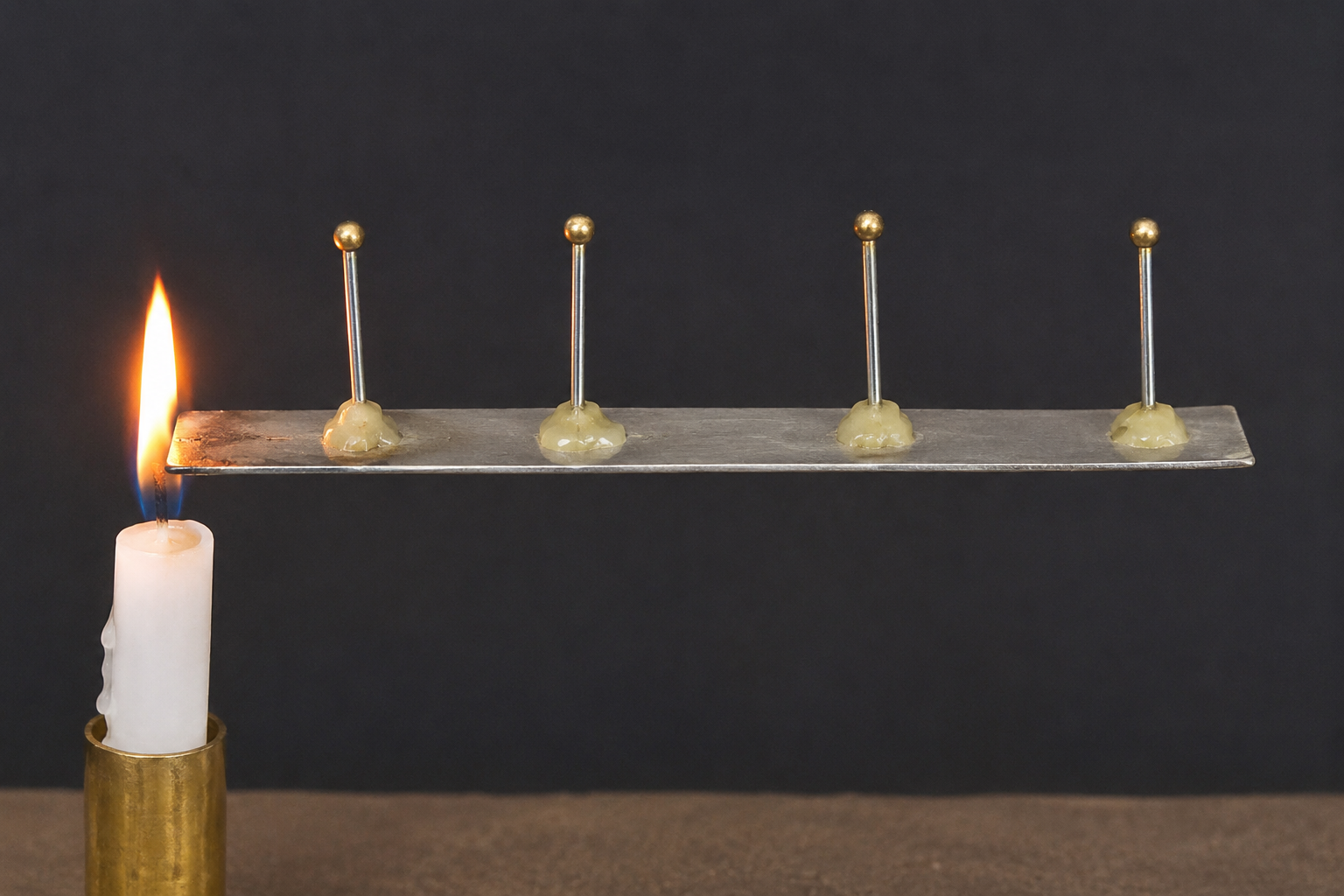
| Pin falling first | Reasons for what you observed | |
|---|---|---|
| Prediction | Observation | |
Answer:
Observations for Table 7.1:
| Pin falling first | Reasons for what you observed | |
|---|---|---|
| Prediction | Observation | |
| Pin I (closest to flame) | Pin I falls first | Heat travels along the metal strip from the hot end to the cold end; the pin closest to the flame melts its wax first |
Explanation:
- Pin I (closest to candle flame) falls first, followed by pins II, III, and IV.
- Heat is transferred along the metal strip from the end being heated to the colder end.
- As heat travels along the strip and reaches each pin, the wax holding it melts and the pin falls.
- This process of heat transfer from the hotter part to the colder part is called conduction.
- In conduction, particles pass heat to their neighbours but do not move from their positions.
- Metals are good conductors of heat, which is why cooking utensils are made of metals.
Q2. Activity 7.2: Let us investigate Take two identical paper cups. Hang them using threads of equal length in an inverted position on the two ends of a wooden stick, as shown in Fig. 7.3a. Now, adjust the positions of the cups, so that the stick is horizontal. Place a burning candle below one of the cups (Fig. 7.3b). Observe what happens to the cup. Record your observations in Table 7.3 and think of probable reasons. 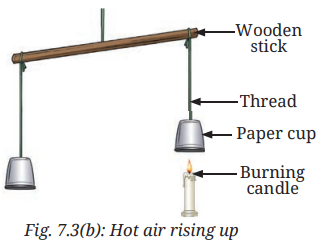
| Observation about the cups | Probable reasons for the observation |
|---|---|
Answer:
Completed Table 7.3:
| Observation about the cups | Probable reasons for the observation |
|---|---|
| The cup under which the candle was placed rises up. | The air around the candle flame heats up and expands, becoming lighter and rising up. This pushes the cup upward. |
Explanation:
- Air around the candle flame gets heated and expands.
- Hot air becomes lighter (less dense) and rises up.
- This is why smoke from a burning incense stick also rises upward.
- Heat transfer by the actual movement of particles in gases is called convection.
Q3. Activity 7.3: Let us find out Caution—This activity should be carried out under the supervision of a teacher or an adult. Take a 500 mL beaker, half-filled with water as shown in Fig. 7.5a. With the help of a straw, place a grain of potassium permanganate at the centre of the beaker's base (Fig. 7.5a). Place a candle right below the centre of the base of the beaker. 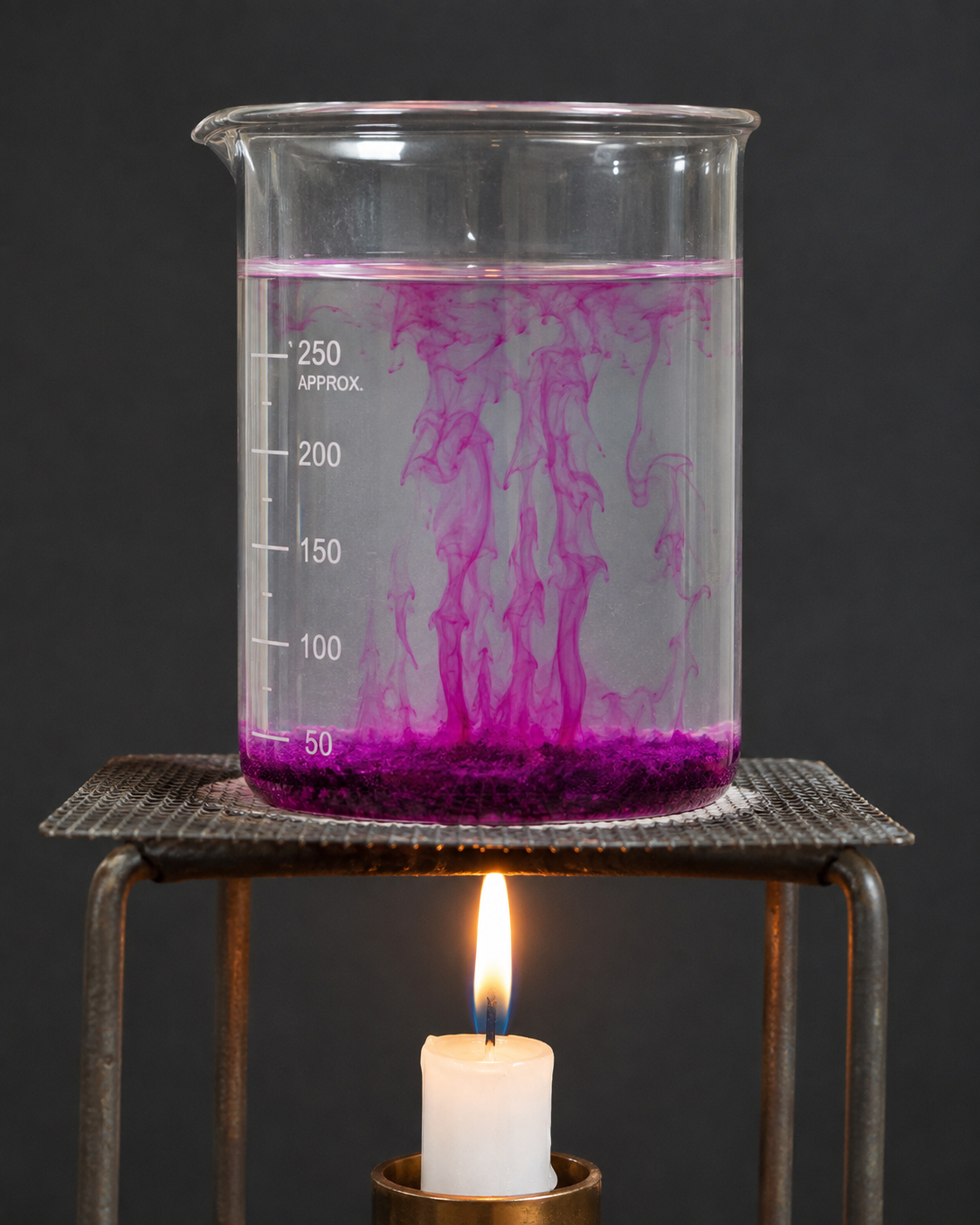 Observe the movement of the coloured streak in the water. As you supply heat, a streak of colour starts moving up and then coming down from the sides. Why does the streak of coloured water go up in the middle and come down from the sides?
Answer:
Explanation:
- Water at the bottom of the beaker gets heated by the candle flame.
- Hot water expands, becomes lighter, and rises upward.
- Water on the sides is comparatively cooler and heavier, and sinks down to take the place of the rising water.
- This creates a circulation pattern: hot water rises in the middle, cools at the top, and comes down from the sides.
- This cycle continues until the entire volume of water gets heated.
- Heat transfer by the actual movement of particles in liquids is called convection.
Conclusion: Both liquids and gases get heated by the process of convection, where heat transfer takes place by the actual movement of particles.
Q4. Activity 7.4: Let us investigate Caution—This activity should be carried out on a clear, sunny day under the supervision of a teacher or an adult. Take two identical bowls as shown in Fig. 7.6. Fill one bowl halfway with soil and the other bowl halfway with water. Fix a laboratory thermometer in each bowl as shown in Fig. 7.6. Make sure that the bulbs of the thermometer are immersed in soil and water, and do not touch the bottoms or the sides of the bowls. Place the set-up in sunlight. 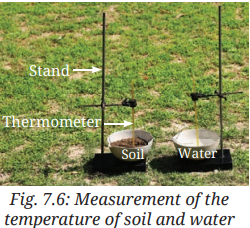 Measure the temperature of soil and water every 5 minutes and record the data in Table 7.4.
| S.No. | Time (min) | Temperature of soil (°C) | Temperature of water (°C) |
|---|---|---|---|
| 1. | 0 | ||
| 2. | 5 | ||
| 3. | 10 | ||
| 4. | 15 | ||
| 5. | 20 |
Answer:
Completed Table 7.4 (Sample data):
| S.No. | Time (min) | Temperature of soil (°C) | Temperature of water (°C) |
|---|---|---|---|
| 1. | 0 | 25 | 25 |
| 2. | 5 | 30 | 27 |
| 3. | 10 | 35 | 29 |
| 4. | 15 | 39 | 31 |
| 5. | 20 | 42 | 33 |
Analysis:
- No, the temperature did not rise by the same amount for both soil and water.
- Soil heated faster than water.
- Rise in temperature of soil in 20 minutes: 42°C - 25°C = 17°C
- Rise in temperature of water in 20 minutes: 33°C - 25°C = 8°C
- Soil also cools faster than water.
Conclusion:
- Land (soil) heats up and cools down faster than water.
- This difference in heating and cooling rates causes land and sea breezes.
Q5. Activity 7.5: Let us investigate Take three transparent, used plastic bottles of 1 L capacity. Cut them in the middle and make a small hole in the cap of each bottle. Keep them inverted and put some clay in one bottle, sand in the second, and gravel in the third, as shown in Fig. 7.10. Place three identical beakers below each bottle. Add 200 mL of water to each bottle. Predict the amount of water flowing out of each bottle. Collect the water that flows through each bottle for 10 minutes. Compare the amount of water that comes through each bottle. 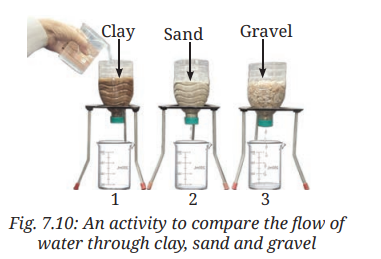
| Bottles filled with | Seepage of water (very slow/slow/fast) | ||
|---|---|---|---|
| Prediction | Observation | Prediction | Observation |
| Bottle 1 (Clay) | |||
| Bottle 2 (Sand) | |||
| Bottle 3 (Gravel) | |||
Answer:
Completed Table 7.5:
| Bottles filled with | Seepage of water (very slow/slow/fast) | ||
|---|---|---|---|
| Prediction | Observation | Prediction | Observation |
| Bottle 1 (Clay) | Very slow | Very slow | Very slow |
| Bottle 2 (Sand) | Slow | Slow | Slow |
| Bottle 3 (Gravel) | Fast | Fast | Fast |
Explanation:
- Water seeps fastest through gravel, slower through sand, and slowest through clay.
- The spaces between gravel particles are wider compared to sand and clay.
- Water can seep more easily through materials with wider, open, and interconnected spaces.
- This process of surface water seeping through soil and rocks is called infiltration.
- Water that seeps through gets stored in pore spaces as groundwater.
In-text Questions
Q1. Why are cooking utensils generally made of metals? (From opening scenario)
Answer:
Answer: Cooking utensils are generally made of metals because metals are good conductors of heat.
Explanation:
- Metals allow heat to pass through them easily (conduction).
- This allows heat from the flame to transfer quickly to the food being cooked.
- This makes cooking faster and more efficient.
- Poor conductors (insulators) like wood or plastic would not transfer heat effectively.
Q2. What will happen to the pins? Will they remain attached to the strip or will they fall? (From Activity 7.1)
Answer:
Answer: The pins will fall from the metal strip.
Explanation:
- Heat from the candle travels along the metal strip (conduction).
- As the heat reaches each pin, the wax holding it melts.
- When the wax melts, the pin falls.
- Pin closest to the flame falls first, followed by others in sequence.
Q3. Predict the order in which the pins will fall from the strip. (From Activity 7.1)
Answer:
Answer: The pins will fall in the following order: Pin I (closest to flame) → Pin II → Pin III → Pin IV (farthest from flame).
Reason: Heat travels along the metal strip from the hot end to the cold end. The pin closest to the flame receives heat first, so its wax melts first and it falls first. The farthest pin receives heat last and falls last.
Q4. Why does pin I fall before pin II? Why did all the pins not fall together? (From Activity 7.1)
Answer:
Answer:
- Pin I falls before pin II because pin I is closer to the candle flame. Heat travels along the metal strip gradually from the hot end to the colder end. Pin I receives heat earlier than pin II.
- All pins did not fall together because heat transfer through conduction takes time to travel from one end to the other. Different parts of the strip reach the melting point of wax at different times.
Q5. Do you think that heat is being transferred along the metal strip from the end that is being heated? (From Activity 7.1)
Answer:
Answer: Yes, heat is being transferred along the metal strip from the end that is being heated.
Explanation:
- This is the process of conduction.
- Heat energy is transferred from the hotter end (near the flame) to the colder end (away from the flame) through the metal strip.
- Particles near the flame gain heat and transfer it to neighbouring particles, and so on.
- The particles themselves do not move from their positions.
Q6. If we use a strip made of a material like wood or glass in place of a metal strip to perform Activity 7.1, the pins will not fall. Can you think of the reason for this? (From Section 7.1)
Answer:
Answer: Pins will not fall because wood and glass are poor conductors of heat (insulators).
Explanation:
- Wood and glass do not allow heat to pass through them easily.
- Heat from the candle flame does not travel along the strip to melt the wax.
- Since the wax does not melt, the pins do not fall.
- This confirms that metals are good conductors, while materials like wood and glass are poor conductors (insulators).
Q7. Does your list include air? If it is there on the list, where have you placed it? (From Table 7.2)
Answer:
Answer: Yes, air is included in the list.
Air is placed under poor conductors of heat (insulators).
Explanation:
- Air is a poor conductor of heat.
- This is why air trapped in woolen fabrics, blankets, or hollow bricks prevents heat loss and keeps us warm or cool.
- Woolen clothes keep us warm in winter because trapped air reduces heat flow from our body to the surroundings.
Q8. Why is the smoke going up? (From Section 7.2 introduction)
Answer:
Answer: Smoke rises up because hot air is lighter than cold air.
Explanation:
- Air around the fire gets heated and expands.
- Hot air becomes less dense (lighter) and rises upward.
- Smoke is carried upward along with the rising hot air.
- This is due to the process of convection.
Q9. How does heat transfer take place in liquids? Do liquids also rise up when heated like air? (From Section 7.2)
Answer:
Answer: Yes, liquids also rise up when heated, similar to air.
Explanation:
- When a liquid is heated, it expands and becomes less dense (lighter).
- Hot liquid rises upward, while cooler, denser liquid sinks down.
- This creates a circulation pattern called convection currents.
- This process of heat transfer is called convection.
- In Activity 7.3, the potassium permanganate streak moved up in the middle and came down from the sides, showing convection in water.
Q10. Why does the streak of coloured water go up in the middle and come down from the sides? (From Activity 7.3)
Answer:
Answer: The coloured streak goes up in the middle and comes down from the sides due to convection currents in water.
Explanation:
- Water at the bottom (middle) gets heated by the candle and becomes hot.
- Hot water expands, becomes lighter, and rises upward.
- Water on the sides is cooler and heavier, and sinks down.
- This creates a circular movement: hot water rises in the middle, cools at the top, and comes down from the sides.
- This cycle continues until all the water is heated.
Q11. Did the temperature rise by the same amount for both the soil and the water at the same time? (From Activity 7.4)
Answer:
Answer: No, the temperature did not rise by the same amount for both soil and water at the same time.
Explanation:
- Soil heated up faster than water.
- Soil shows a greater rise in temperature than water for the same duration.
- This shows that land heats up faster than water.
- Similarly, soil also cools faster than water.
Q12. If not, which one got heated faster? (From Activity 7.4)
Answer:
Answer: Soil (land) got heated faster than water.
Explanation:
- Soil absorbs heat and its temperature rises more quickly than water.
- This is why land near coastal areas gets hotter than the sea during the day.
Q13. How much was the rise in temperature of the soil and the water in 20 minutes? (From Activity 7.4)
Answer:
Answer: (Based on sample data)
- Rise in temperature of soil: 42°C - 25°C = 17°C
- Rise in temperature of water: 33°C - 25°C = 8°C
Conclusion: Soil shows a greater rise in temperature (17°C) compared to water (8°C) over the same 20-minute period.
Q14. Does the soil also cool faster than water? (From Activity 7.4)
Answer:
Answer: Yes, soil also cools faster than water.
Explanation:
- After bringing the set-up indoors, soil cools down more quickly than water.
- This is because soil loses heat faster than water.
- This difference in cooling rates causes land and sea breezes.
Q15. I wonder how heat from the fire reaches us? (From Section 7.3)
Answer:
Answer: Heat from the fire reaches us through the process of radiation.
Explanation:
- Heat transfer by radiation does not require any medium (air, water, etc.).
- Heat travels directly from the hot object (fire) to us in the form of electromagnetic waves.
- This is the same process by which heat from the Sun reaches the Earth.
- All objects radiate heat.
Q16. What is the reason for it? (From Section 7.3 - referring to hot utensil cooling down)
Answer:
Answer: A hot utensil cools down because it radiates heat to its surroundings.
Explanation:
- All objects radiate heat to their surroundings.
- Hotter objects radiate more heat than cooler objects.
- A hot utensil loses heat to the cooler surrounding air and objects through radiation, causing it to cool down.
Q17. Why is it more comfortable to wear white or light-coloured clothes during summers and dark-coloured clothes during winters? (From Section 7.3)
Answer:
Answer:
- Light-coloured clothes: Reflect most of the heat that falls on them, keeping us cooler in summer.
- Dark-coloured clothes: Absorb more heat, making us feel warmer in winter.
Explanation:
- Dark surfaces absorb more heat from sunlight and radiation.
- Light surfaces reflect more heat.
- This is why people prefer white/light clothes in hot weather and dark clothes in cold weather.
Q18. Do your findings match with your predictions? (From Activity 7.5)
Answer:
Answer: (Student-specific response)
Generally, the findings match the predictions:
- Water seeps fastest through gravel, slower through sand, and slowest through clay.
- This is because gravel has the widest spaces between particles, followed by sand, and then clay with the smallest spaces.
Exercises
Q1. Choose the correct option in each case. (i) Your father bought a saucepan made of two different materials, A and B, as shown in Fig. 7.14. The materials A and B have the following properties— (a) Both A and B are good conductors of heat (b) Both A and B are poor conductors of heat (c) A is a good conductor and B is a poor conductor of heat (d) A is a poor conductor and B is a good conductor of heat [IMAGE NEEDED: A saucepan with a metal body (A) and a wooden/plastic handle (B)] (ii) Pins are stuck to a metal strip with wax and a burning candle is kept below the rod, as shown in Fig. 7.15. Which of the following will happen? (a) All the pins will fall almost at the same time (b) Pins I and II will fall earlier than pins III and IV (c) Pins I and II will fall later than pins III and IV (d) Pins II and III will fall almost at the same time [IMAGE NEEDED: A metal strip with pins I, II, III, IV stuck with wax, candle at one end] (iii) A smoke detector is a device that detects smoke and sounds an alarm. Suppose you are fitting a smoke detector in your room. The most suitable place for this device will be: (a) Near the floor (b) In the middle of a wall (c) On the ceiling (d) Anywhere in the room
Answer:
(i) Answer: (c) A is a good conductor and B is a poor conductor of heat
- The body of the saucepan (A) is made of metal — a good conductor of heat — so that heat transfers efficiently to cook food.
- The handle (B) is made of wood or plastic — a poor conductor of heat (insulator) — so that it stays cool and can be held safely.
(ii) Answer: (b) Pins I and II will fall earlier than pins III and IV
- Heat travels along the metal strip from the hot end (near the candle) to the cold end.
- Pins I and II are closer to the flame, so they receive heat first and fall earlier.
- Pins III and IV are farther away and will fall later.
(iii) Answer: (c) On the ceiling
- Smoke rises because hot air containing smoke is lighter and moves upward (convection).
- A smoke detector placed on the ceiling will detect smoke earlier.
- Smoke near the floor would be less effective.
Q2. A shopkeeper serves you cold lassi in a tumbler. By chance, the tumbler had a small leak. You were given another tumbler by the shopkeeper to put the leaky tumbler in it. Will this arrangement help to keep the lassi cold for a longer time? Explain.
Answer:
Answer: Yes, this arrangement will help keep the lassi cold for a longer time.
Explanation:
- The leaky tumbler contains the cold lassi.
- The outer tumbler contains air trapped between the two tumblers.
- Air is a poor conductor of heat (insulator).
- The trapped air prevents heat from the surroundings from reaching the lassi quickly.
- This reduces the rate of heat transfer, keeping the lassi cold for a longer time.
- This is similar to how a thermos flask works.
Q3. State with reason(s) whether the following statements are True [T] or False [F]. (i) Heat transfer takes place in solids through convection. [ ] (ii) Heat transfer through convection takes place by the actual movement of particles. [ ] (iii) Areas with clay materials allow more seepage of water than those with sandy materials. [ ] (iv) The movement of cooler air from land to sea is called land breeze. [ ]
Answer:
(i) False [F]
- Correct statement: Heat transfer takes place in solids through conduction.
- Convection occurs in liquids and gases, where particles can move freely.
(ii) True [T]
- In convection, heat transfer takes place by the actual movement of particles (in liquids and gases).
(iii) False [F]
- Correct statement: Areas with sandy materials allow more seepage of water than those with clay materials.
- Sand has larger spaces between particles, allowing faster water seepage.
(iv) True [T]
- The movement of cooler air from land to sea is called land breeze (occurs at night).
Q4. Some ice cubes placed in a dish melt into water after sometime. Where do the ice cubes get heat for this transformation?
Answer:
Answer: The ice cubes get heat from the surroundings (the dish, the air, and the environment).
Explanation:
- Ice melts when it absorbs heat energy.
- This heat is transferred to the ice from the surrounding warmer objects through radiation (from the air and environment) and conduction (from the dish).
- The ice absorbs the heat, causing its particles to gain energy and change from solid to liquid state.
Q5. A burning incense stick is fixed, pointing downwards. In which direction would the smoke from the incense stick move? Show the movement of smoke with a diagram.
Answer:
Answer: The smoke from a burning incense stick, even when fixed pointing downwards, will move upward.
Explanation:
- Smoke is a mixture of hot gases and tiny solid particles.
- Hot air (and smoke) is lighter than the surrounding cooler air.
- Regardless of the direction the incense stick is pointing, the hot smoke will rise upward due to convection.
Q6. Two test tubes with water are heated by a candle flame as shown in Fig. 7.16. Which thermometers (Fig. 7.16a or Fig. 7.16b) will record a higher temperature? Explain. 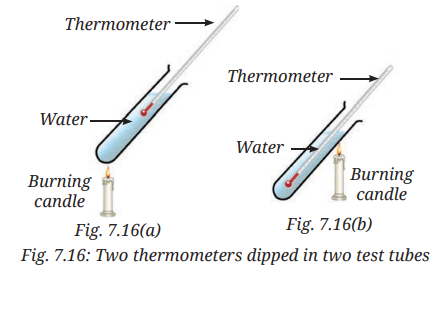
Answer:
Answer: The thermometer in Fig. 7.16(b) will record a higher temperature.
Explanation:
- In Fig. 7.16(a), water is heated at the top. Heat is transferred only by conduction (slow) and some radiation.
- In Fig. 7.16(b), water is heated at the bottom. Heat is transferred by convection.
- Convection is more efficient because hot water rises (convection currents) and distributes heat throughout the water.
- The thermometer in (b) is closer to the heated water and receives heat faster through convection.
Q7. Why are hollow bricks used to construct the outer walls of houses in hot regions?
Answer:
Answer: Hollow bricks are used to construct outer walls of houses in hot regions because air trapped in the hollow spaces acts as an insulator.
Explanation:
- Air is a poor conductor of heat.
- The air trapped in hollow bricks prevents heat from the outside (from the Sun) from entering the house.
- This keeps the inside of the house cool in hot regions.
- Similarly, in cold regions, hollow bricks keep the house warm by preventing heat from escaping.
Q8. Explain how large water bodies prevent extreme temperature in areas around them.
Answer:
Answer: Large water bodies (like oceans and lakes) prevent extreme temperatures in surrounding areas because water heats up and cools down slower than land.
Explanation:
- Water has a higher specific heat capacity than land.
- It takes longer for water to heat up and cool down compared to land.
- In summer: Water remains cooler than the land, keeping coastal areas cooler.
- In winter: Water releases heat slowly, keeping coastal areas warmer.
- This is why coastal areas have a moderate climate (not too hot, not too cold), while inland areas experience extreme temperatures.
- Examples: Mumbai (coastal) has moderate temperatures, while Delhi (inland) has extreme temperatures.
Q9. Explain how water seeps through the surface of the Earth and gets stored as groundwater.
Answer:
Answer: Water seeps through the surface of the Earth and gets stored as groundwater through the process of infiltration.
Process:
- Rainfall: Rainwater falls on the Earth's surface.
- Infiltration: Water seeps through the soil and rocks. This process of surface water seeping through soil and rocks is called infiltration.
- Factors affecting infiltration:
- Water seeps faster through materials with wider spaces (gravel) and slower through materials with smaller spaces (clay).
- Vegetation cover and soil type affect how quickly water seeps.
- Storage: Water that seeps through gets stored in pore spaces of sediments and openings in rocks beneath the surface.
- Aquifers: Underground layers of sediments and rocks that store water in pore spaces are called aquifers.
- Groundwater extraction: We dig wells or drill bore wells into aquifers to access groundwater.
Q10. The water cycle helps in the redistribution and replenishment of water on the Earth. Justify the statement.
Answer:
Answer: The water cycle helps in the redistribution and replenishment of water on Earth through a continuous movement of water.
Justification:
- Evaporation: Water from oceans, rivers, and lakes evaporates due to the Sun's heat, forming water vapour.
- Transpiration: Water also evaporates from trees and plants (transpiration).
- Condensation: Water vapour rises, cools down, and condenses to form clouds.
- Precipitation: Clouds bring rain, snow, and hail (precipitation).
- Distribution: Rainwater flows into rivers, lakes, and oceans or seeps into the ground as groundwater.
- Replenishment:
- Rivers and lakes are replenished by rainfall.
- Groundwater is replenished through infiltration of rainwater.
- Melting snow and ice in mountains also contribute to rivers.
- Conservation: The water cycle ensures that the total amount of water on Earth remains conserved and redistributed.
Conclusion: Without the water cycle, water would not be redistributed, and many regions would face severe water scarcity. The water cycle ensures that water is available for all living organisms.
Exploratory Projects
Q1. Visit a site of water harvesting or a recharge pit. Find out from people how they are constructed and how they work. Prepare a report with illustrations.
Answer:
Project Report: Water Harvesting and Recharge Pits
Aim: To study how water harvesting structures and recharge pits are constructed and how they work.
What is rainwater harvesting?
- Rainwater harvesting is the collection and storage of rainwater for future use.
- It helps in recharging groundwater.
How is a recharge pit constructed?
- Location: Dig a pit near the house or building where rainwater can be collected.
- Size: The pit is typically 1-2 metres deep and 1-2 metres wide.
- Layers:
- Top layer: Gravel or pebbles to filter large particles.
- Middle layer: Sand to filter smaller particles.
- Bottom layer: Coarse gravel or broken bricks for water storage.
- Pipes: Connect the rooftop or catchment area to the pit using pipes.
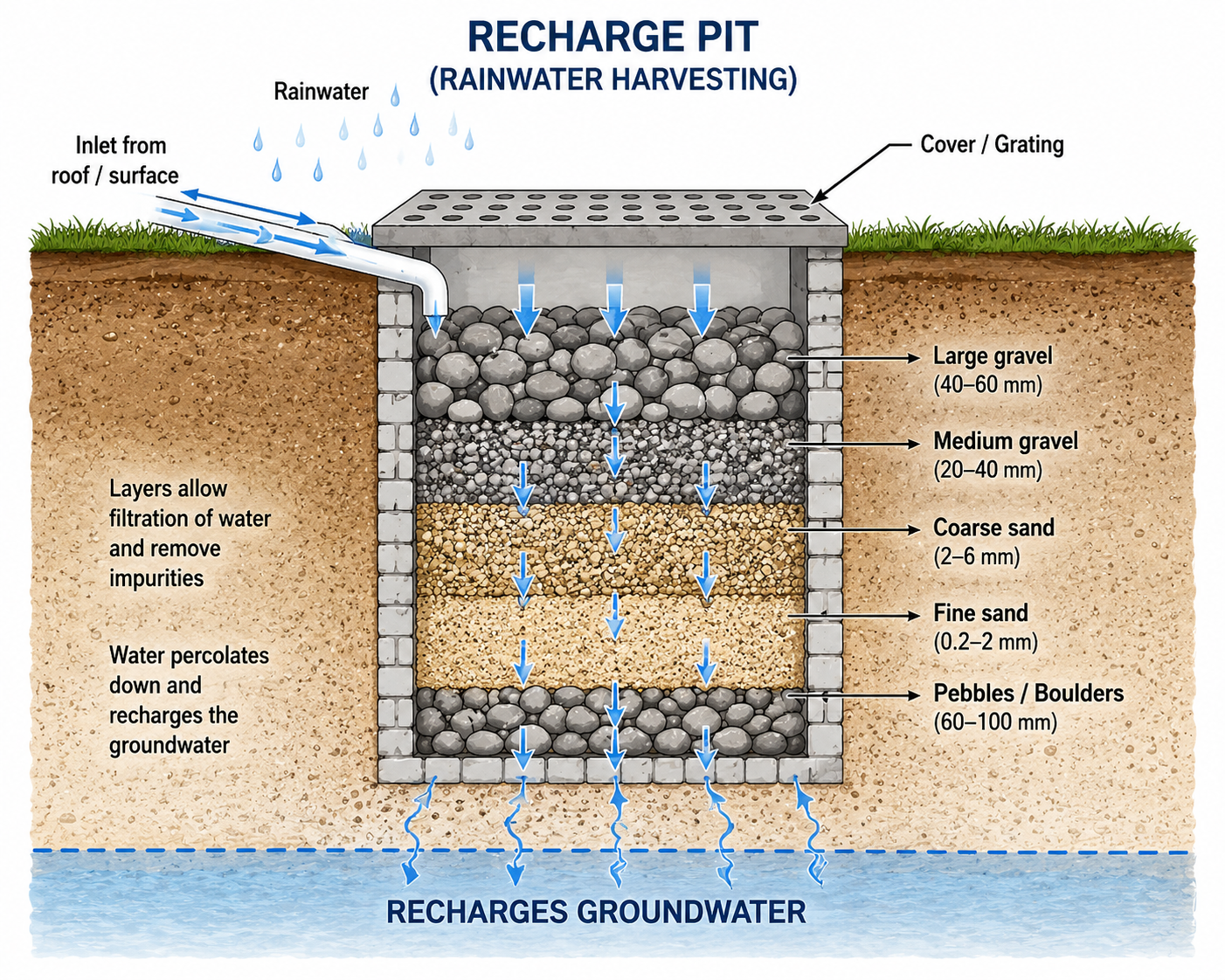
- Cover: A perforated cover is placed on top for safety.
How does it work?
- Rainwater falls on the roof (catchment area).
- Water flows through pipes into the recharge pit.
- Water passes through layers of gravel and sand, which filter out dirt and debris.
- Clean water seeps into the ground, recharging the groundwater.
Benefits of rainwater harvesting:
- Recharges groundwater
- Prevents waterlogging
- Reduces water scarcity
- Environmentally friendly
Q2. Tightly wrap a thin paper strip around a metallic rod. Try to burn the paper with a candle while rotating the rod continuously. Does the paper burn? Explain your observations.
Answer:
Activity: Burning Paper on a Metallic Rod
Observations: The paper does not burn even when exposed to the candle flame.
Explanation:
- The metallic rod is a good conductor of heat.
- When the paper-wrapped rod is heated, heat is conducted away by the metal rod quickly.
- The paper does not reach its ignition temperature because the metal rod absorbs and conducts the heat away.
- This is why it is possible to boil water in a paper cup over a flame — the water conducts heat away from the paper.
Q3. Take a sheet of paper. Draw a spiral on it, as shown in Fig. 7.17a. Cut the paper along the spiral. Suspend the paper as shown in the Fig. 7.17b above a burning candle. Observe what happens. Provide an explanation for your observation. 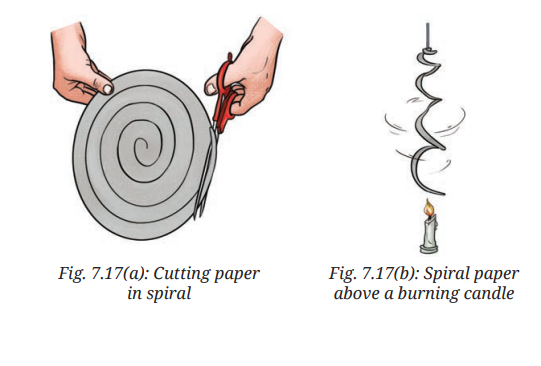
Answer:
Activity: Spinning Spiral
Observations: The paper spiral starts rotating when held above a burning candle.
Explanation:
- The candle flame heats the air around it.
- Hot air rises due to convection.
- The rising hot air strikes the paper spiral, causing it to spin.
- This shows that hot air moves upward.
- The rotation continues as long as the candle is burning and producing hot air.
Science and Society
Q1. Ice Stupa — During the spring season in Ladakh, streams often dry up, leading to scarcity of water as the heat from the Sun's radiation is not enough to melt the snow on the mountains. During winters, water from mountain streams is channeled down through underground pipes. This water is then sprayed into the cold air. As it falls, it freezes due to extremely low temperatures. The ice builds up layer by layer, creating a tall, cone-shaped structure called an ice stupa. The ice stupa melts slowly during spring, providing water for farming and other needs throughout the summer. 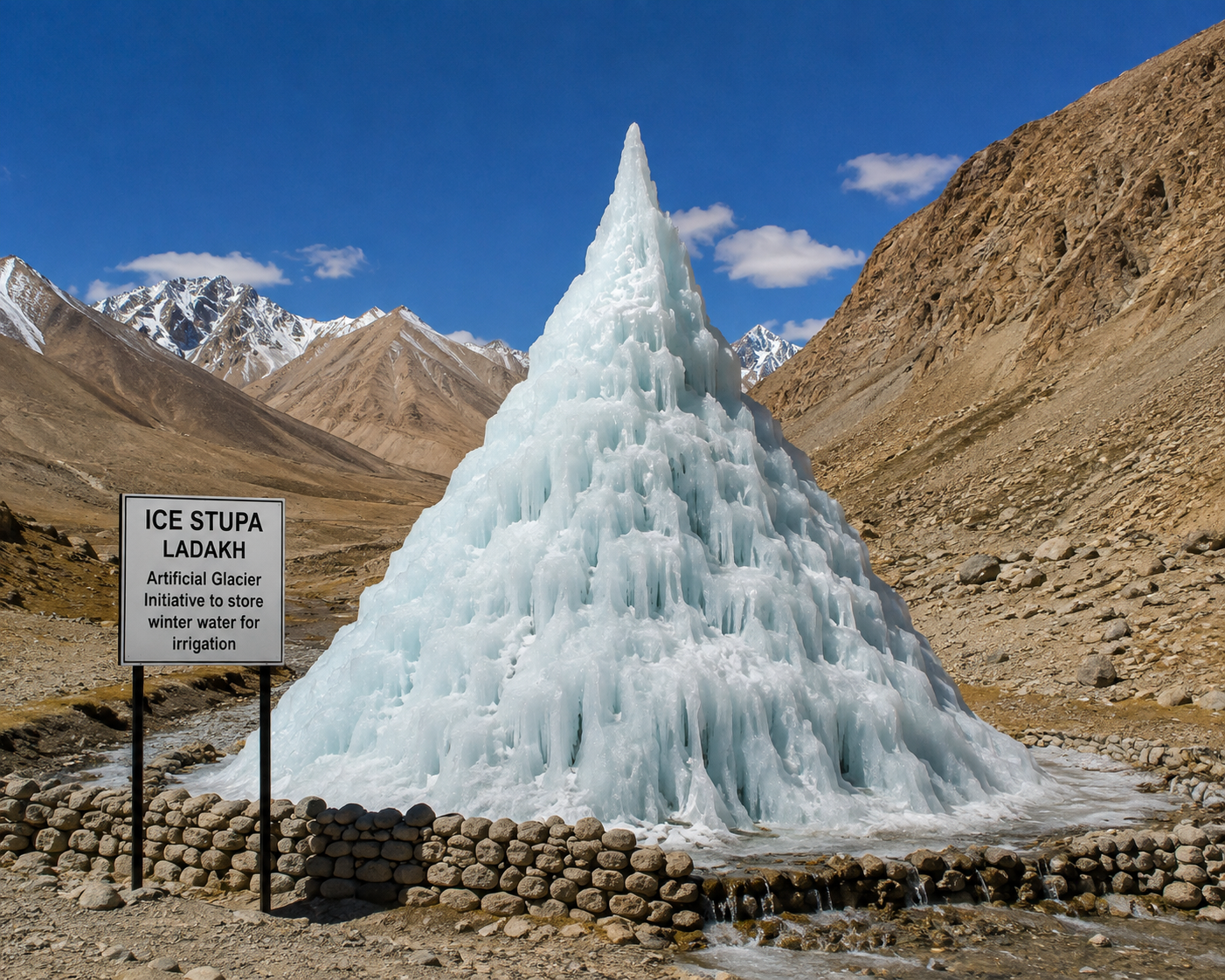
Answer:
Answer: The Ice Stupa is an innovative water conservation technique developed in Ladakh.
How the Ice Stupa works:
- Winter: Water from mountain streams is channeled through underground pipes and sprayed into the cold air.
- Freezing: Water freezes due to extremely low temperatures, building up layer by layer.
- Spring: The ice stupa melts slowly, providing water for farming during spring and summer.
- Purpose: Addresses water scarcity in the dry spring season.
Why is this important?
- Ladakh receives little rainfall, and streams dry up in spring.
- Snow on mountains does not melt early enough for farming.
- Ice stupa stores winter water in the form of ice and releases it gradually when needed.
Relevance of heat transfer:
- The ice stupa melts slowly because ice is a poor conductor of heat.
- This gradual melting provides a steady water supply throughout the summer.