
Activities
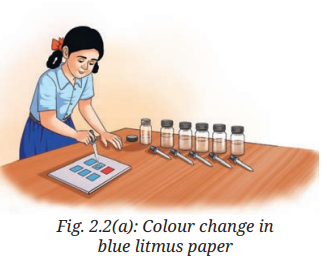
Q1. Activity 2.1: Let us explore Collect samples of lemon juice, soap solution, amla juice, tamarind water, vinegar, baking soda solution, lime water, tap water, washing powder solution, sugar solution, and salt solution. 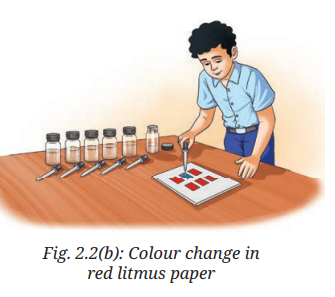 Do you observe any change in the colour of the blue litmus pieces? Record your observations in Table 2.1. Repeat the same activity with pieces of red litmus paper as shown in Fig. 2.2b and record your observations in Table 2.1. Take a strip of blue litmus paper and cut it into small pieces. Spread these pieces on a clean and dry white tile. Using a dropper, put one drop of each of the samples, one-by-one, on these litmus paper pieces, as shown in Fig. 2.2a.
  How to prepare lime water? Do not confuse lime water with the word lime, which is a fruit similar to lemon. Lime water (solution of calcium hydroxide in water) can be easily prepared by mixing lime (chuna, i.e. calcium oxide) in water and leaving it undisturbed for some time, say an hour. Filter the liquid into another container and use it as lime water.
| S.No. | Name of the sample | Colour of blue litmus paper after putting a drop of sample | Colour of red litmus paper after putting a drop of sample |
|---|---|---|---|
| 1. | Lemon juice | ||
| 2. | Soap solution | ||
| 3. | Amla juice | ||
| 4. | Tamarind water | ||
| 5. | Vinegar | ||
| 6. | Baking soda solution | ||
| 7. | Lime water | ||
| 8. | Tap water | ||
| 9. | Washing powder solution | ||
| 10. | Sugar solution | ||
| 11. | Salt solution | ||
| 12. | Any other |
| Group A | Group B | Group C |
|---|---|---|
Answer:
Completed Table 2.1:
| S.No. | Name of the sample | Colour of blue litmus paper after putting a drop of sample | Colour of red litmus paper after putting a drop of sample |
|---|---|---|---|
| 1. | Lemon juice | Turns red | No change |
| 2. | Soap solution | No change | Turns blue |
| 3. | Amla juice | Turns red | No change |
| 4. | Tamarind water | Turns red | No change |
| 5. | Vinegar | Turns red | No change |
| 6. | Baking soda solution | No change | Turns blue |
| 7. | Lime water | No change | Turns blue |
| 8. | Tap water | No change | No change |
| 9. | Washing powder solution | No change | Turns blue |
| 10. | Sugar solution | No change | No change |
| 11. | Salt solution | No change | No change |
| 12. | Any other |
Completed Table 2.2:
| Group A (Acidic) | Group B (Basic) | Group C (Neutral) |
|---|---|---|
| Lemon juice, Amla juice, Tamarind water, Vinegar | Soap solution, Baking soda solution, Lime water, Washing powder solution | Tap water, Sugar solution, Salt solution |
Explanation:
- Acids turn blue litmus paper red.
- Bases turn red litmus paper blue.
- Neutral substances do not change the colour of either litmus paper.
- Litmus is a natural substance obtained from lichens.
Q2. Activity 2.2: Let us relate and explore Are all the substances in Group A of Table 2.2 edible? Have you ever tasted these edible substances? Can you recall their taste? You will find that all these substances taste sour. Thus, we can say that substances that taste sour tend to contain acids and are acidic in nature. Caution - Do not taste anything until asked to do so. Do not taste any unknown substance. Some common edible substances and the names of the most common acids present in them are given in Fig. 2.4. 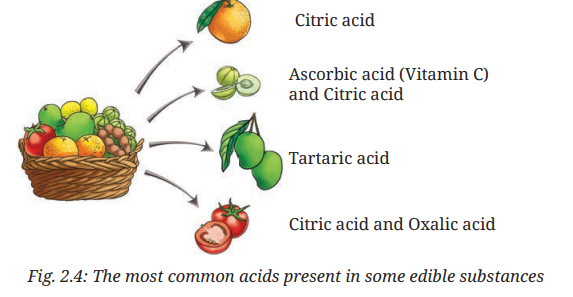 Find out and write the names of the most common acids present in the following substances - Lemon ______, Curd ______, Tamarind ______, Vinegar ______ Now, let us take one of the substances — baking soda solution — from Group B. Rub the baking soda solution between your fingers. What do you observe? It feels soapy or slippery. Basic substances are generally slippery to touch. Also, bases generally taste bitter, but everything that tastes bitter may not contain a base. For example, bitter gourd (karela) possesses a bitter taste but is not basic in nature.
Answer:
Acids present in edible substances:
- Lemon — Citric acid
- Curd — Lactic acid
- Tamarind — Tartaric acid
- Vinegar — Acetic acid
Observation with baking soda solution:
- Baking soda solution feels soapy or slippery when rubbed between fingers.
- This is a characteristic property of bases.
- Basic substances are generally slippery to touch and bitter in taste.
Note: Do not taste unknown substances. Bitter taste alone does not confirm a base (e.g., bitter gourd is bitter but not basic).
Q3. Activity 2.3: Let us prepare Collect some fallen petals of red roses available in your surroundings (Fig. 2.5). It is advised not to pluck flowers. You may pick petals or flowers fallen on the ground. Take a fistful of the collected petals of red roses and wash them with water. Crush the petals using a mortar and pestle. Place them in a glass tumbler. Pour some hot water into the glass tumbler to ensure that the crushed flower petals are completely immersed. 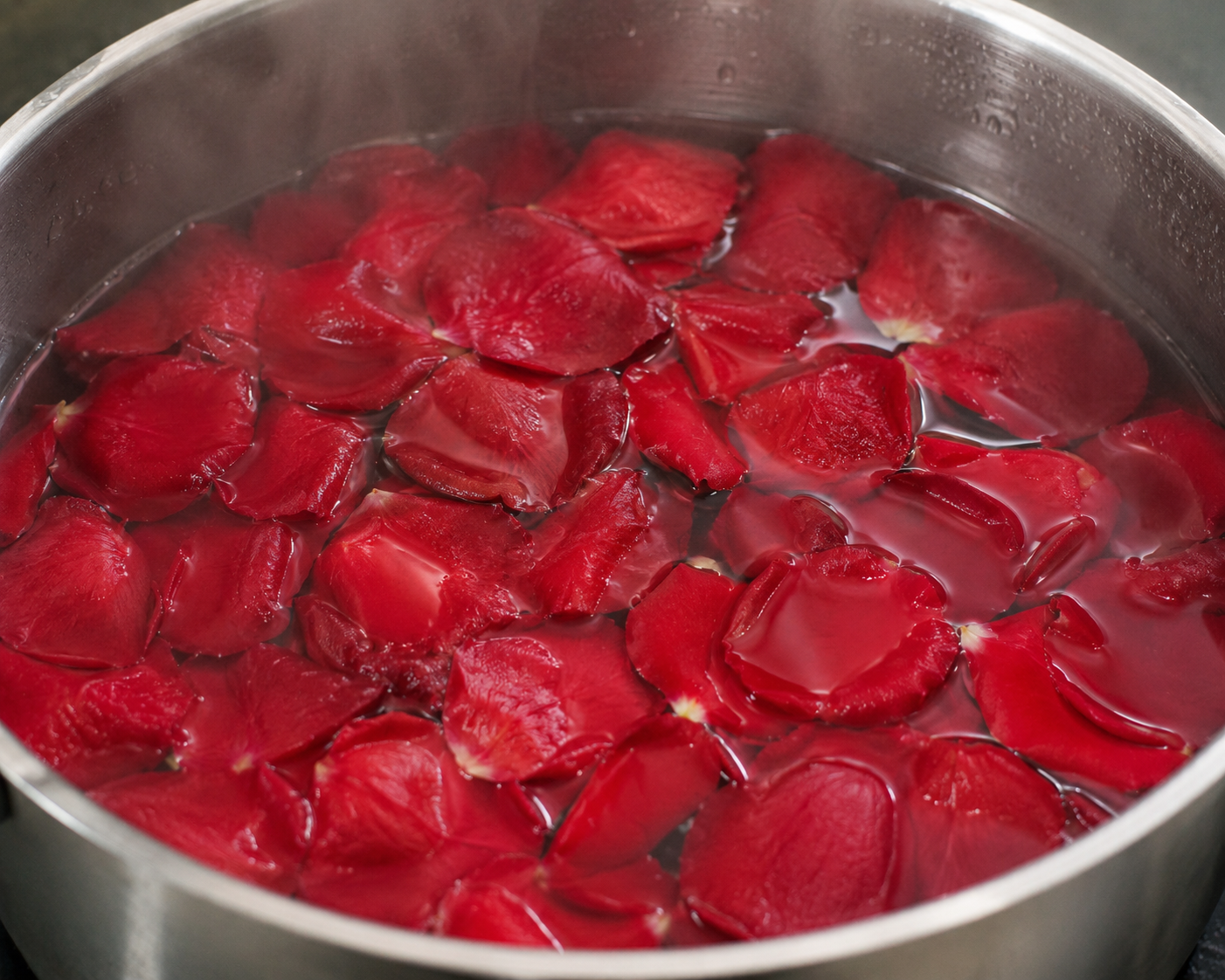 Caution—Perform this step under the supervision of an adult. Cover the glass tumbler with a lid. Wait for 5-10 minutes till the water becomes coloured (Fig. 2.6), and filter it. The filtrate (liquid after filtration) is the required flower extract (Fig. 2.7) to be used as an acid-base indicator.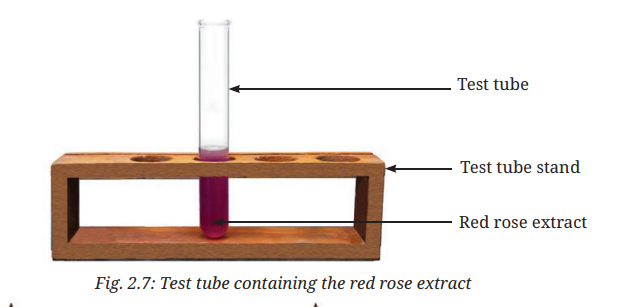
Answer:
Preparation of red rose extract indicator:
- Collect fallen red rose petals (do not pluck flowers).
- Wash the petals with water.
- Crush the petals using a mortar and pestle.
- Place crushed petals in a glass tumbler.
- Pour hot water to completely immerse the petals.
- Cover with a lid and wait for 5-10 minutes until water becomes coloured.
- Filter the liquid. The filtrate is the red rose extract indicator.
Purpose: This extract can be used as an acid-base indicator to test the nature of substances.
Q4. Activity 2.4: Let us find out Place 10-20 drops of the prepared red rose extract in each of two small transparent bottles or test tubes. Mark them A and B. Add 20-30 drops of lemon juice in test tube A and 20-30 drops of soap solution in test tube B with the help of droppers. Observe and record any colour changes (Fig. 2.8) to the extract in Table 2.3. Repeat the same with the other samples used in Activity 2.1 and record your observations in Table 2.3 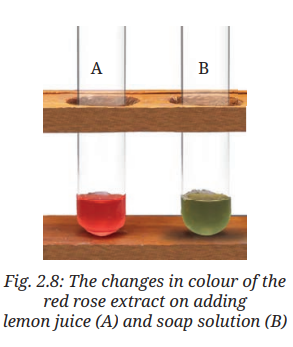
| S.No. | Name of the sample | The colour of the red rose extract after adding the sample | Nature of the substance |
|---|---|---|---|
| 1. | Lemon juice | ||
| 2. | Soap solution | ||
| 3. | Amla juice | ||
| 4. | ... |
Answer:
Completed Table 2.3:
| S.No. | Name of the sample | The colour of the red rose extract after adding the sample | Nature of the substance |
|---|---|---|---|
| 1. | Lemon juice | Red | Acidic |
| 2. | Soap solution | Green | Basic |
| 3. | Amla juice | Red | Acidic |
| 4. | Tamarind water | Red | Acidic |
| 5. | Vinegar | Red | Acidic |
| 6. | Baking soda solution | Green | Basic |
| 7. | Lime water | Green | Basic |
| 8. | Tap water | No change | Neutral |
| 9. | Washing powder solution | Green | Basic |
| 10. | Sugar solution | No change | Neutral |
| 11. | Salt solution | No change | Neutral |
Conclusion:
- Red rose extract turns red in acidic solutions.
- Red rose extract turns green in basic solutions.
- Red rose extract shows no change in neutral solutions.
- Red rose extract is an acid-base indicator.
Q5. Activity 2.5: Let us prepare Take a spoonful of turmeric (haldi) in a petri dish or container and add a little water to make a paste (Fig. 2.9a). You may also grind a piece of fresh turmeric. Carefully dip a piece of filter paper in the turmeric paste until it gets yellow colour. Take it out and allow it to dry. Cut this yellow paper into thin strips, which are used as 'turmeric paper' (Fig. 2.9b). Caution—Perform this step under the supervision of an adult. 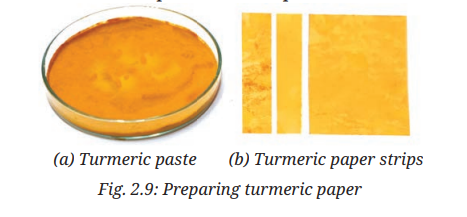 Using a dropper, put a drop of each of the samples used in Activity 2.1, one by one, on separate pieces of turmeric paper. Record your observations in Table 2.4.
| S.No. | Name of the sample | The colour of the turmeric paper after putting a drop of the sample |
|---|---|---|
| 1. | Lemon juice | |
| 2. | Soap solution | |
| 3. | Amla juice | |
| 4. | ... |
Answer:
Completed Table 2.4:
| S.No. | Name of the sample | The colour of the turmeric paper after putting a drop of the sample |
|---|---|---|
| 1. | Lemon juice | No change (yellow) |
| 2. | Soap solution | Turns red |
| 3. | Amla juice | No change (yellow) |
| 4. | Tamarind water | No change (yellow) |
| 5. | Vinegar | No change (yellow) |
| 6. | Baking soda solution | Turns red |
| 7. | Lime water | Turns red |
| 8. | Tap water | No change (yellow) |
| 9. | Washing powder solution | Turns red |
| 10. | Sugar solution | No change (yellow) |
| 11. | Salt solution | No change (yellow) |
Observations:
- Turmeric paper turns red when a basic substance is added.
- Turmeric paper shows no change (remains yellow) with acidic and neutral substances.
Conclusion:
- Turmeric is an indicator for basic substances only.
- It cannot differentiate between acidic and neutral substances.
Q6. Activity 2.6: Let us investigate Take some finely chopped onions in a container, along with some strips of clean cotton cloth or filter paper. Tightly close the container and leave it overnight. Take two of the cotton cloth or filter paper strips from the container and check their odour. Keep them on a clean surface and put a few drops of tamarind water on one strip and a few drops of baking soda solution on the other. Allow the drops to spread on the strips. Check the odour again. Do you notice any change in the odour of the onion strips before and after putting tamarind water and baking soda solution on them? Note your observations. Similarly, test the change in the odour with other acidic and basic substances and record your observations.
Answer:
Observations:
- Onion strips have a strong smell initially.
- After adding tamarind water (acidic), the smell remains or may become stronger.
- After adding baking soda solution (basic), the smell disappears or becomes very faint.
Explanation:
- Onion is an olfactory indicator.
- The odour of onion changes in acidic and basic media.
- In basic solutions, the pungent smell of onion disappears.
- In acidic solutions, the smell remains.
Other olfactory indicators: Cloves, vanilla essence, etc., also show changes in odour in acidic and basic solutions.
Q7. Activity 2.7: Let us experiment Take one drop of lemon juice in a test tube and add around twenty drops of water to it. Observe the colour. Add a drop of blue litmus solution to it. Do you observe any colour change (Fig. 2.10a)? Slowly add drops of lime water to this test tube with the help of a dropper and swirl it well. What do you observe? Is there any change in the colour of the solution? A stage comes when the colour of the solution changes from red to blue (Fig. 2.10b). Again, add one drop of lemon juice to the above solution. 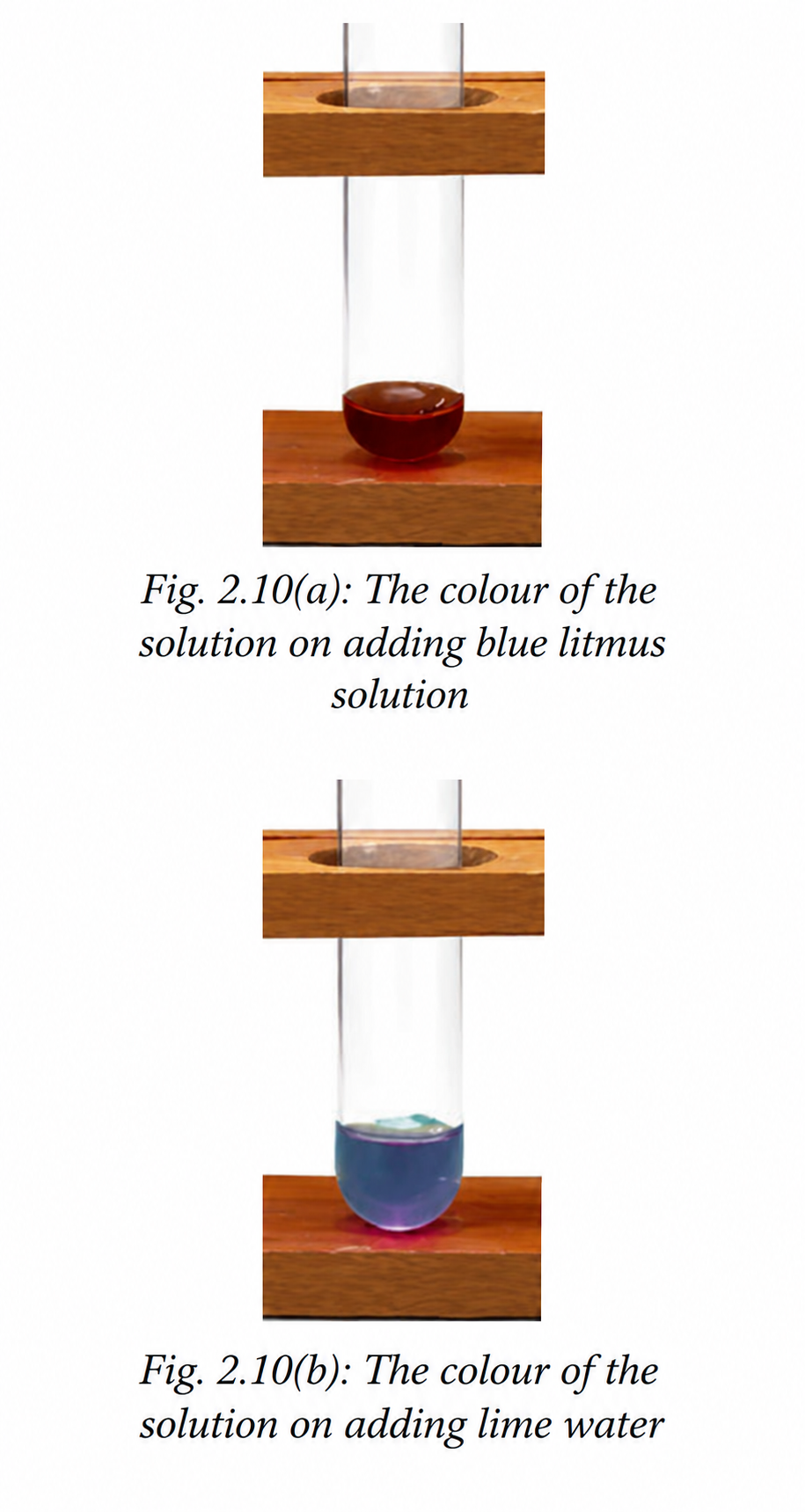 Can you predict why there is a change in colour? Initially, when a drop of blue litmus solution is added to the lemon juice solution, the colour of the solution turns red. When lime water is added to this test tube, the colour of the solution eventually changes from red to blue. This shows that the solution in the test tube is no longer acidic. Lime water has neutralised the effect of the acid. When the solution of an acid is mixed with the solution of a base in sufficient quantity, we find that the resulting solution is neither acidic nor basic. Such reactions are called neutralisation reactions. In a neutralisation reaction, salt and water are formed with the evolution (i.e., release) of heat. Acid + Base → Salt + Water + Heat There are many examples in everyday life where you can observe the use of neutralisation processes. Let us find out!
Answer:
Observations:
- Blue litmus added to lemon juice (acidic) turns red.
- When lime water (basic) is added slowly, the red colour gradually changes to blue.
- At the point of complete colour change (red to blue), the solution is neutralised.
- Adding more lemon juice turns the solution red again (acidic).
Explanation:
- This is a neutralisation reaction.
- Acid (lemon juice) reacts with base (lime water) to form salt and water.
- Heat is also released during this reaction.
- The neutralised solution is neither acidic nor basic.
Chemical equation: Acid + Base → Salt + Water + Heat
In-text Questions
Q1. Can you predict their nature? (From Section 2.1.1 — referring to Group C substances)
Answer:
Answer: The substances in Group C are neutral in nature.
Explanation:
- They did not change the colour of either blue or red litmus paper.
- They are neither acidic nor basic.
- Examples: Tap water, sugar solution, salt solution.
Q2. What do you observe? (From Activity 2.2 — rubbing baking soda solution)
Answer:
Answer: Baking soda solution feels soapy or slippery when rubbed between the fingers.
Explanation:
- This is a characteristic property of bases.
- Bases are generally slippery to touch.
Q3. If litmus is not available, are there some other natural substances that can serve as acid-base indicators? (From Section 2.1.1)
Answer:
Answer: Yes, several natural substances can serve as acid-base indicators.
Examples:
- Red rose extract
- Turmeric
- Red hibiscus (gudhal) extract
- Purple cabbage extract
- Beetroot extract
- Indian blackberry (jamun) extract
- Onion (olfactory indicator)
Q4. Can gardeners alter the colour of hydrangea flowers by adjusting the acidic or basic nature of the soil? (From Fascinating Facts box)
Answer:
Answer: Yes, gardeners can alter the colour of hydrangea flowers.
Explanation:
- Hydrangea flowers change colour depending on the nature of the soil.
- Acidic soil produces blue flowers.
- Basic soil produces pink or red flowers.
- By adjusting the pH of the soil, gardeners can control the flower colour.
Q5. Do all samples change the colour of the turmeric paper? (From Activity 2.5)
Answer:
Answer: No, not all samples change the colour of turmeric paper.
- Only basic substances change turmeric paper from yellow to red.
- Acidic and neutral substances show no change (remain yellow).
Q6. Can turmeric paper be used as an indicator for acidic substances? (From Activity 2.5)
Answer:
Answer: No, turmeric paper cannot be used as an indicator for acidic substances.
Explanation:
- Turmeric paper only turns red with bases.
- It shows no change (remains yellow) with acids.
- It also does not change with neutral substances.
- Therefore, it cannot differentiate between acids and neutral substances.
Q7. Which solution can be used to write the message? (From Ashwin's greeting card example)
Answer:
Answer: A basic solution can be used to write the message.
Explanation:
- Ashwin applied turmeric paste on white paper (yellow colour).
- When a basic solution (like soap solution or baking soda solution) is used to write, the letters turn red.
- This is because turmeric turns red in basic solutions.
- The message becomes visible as red letters on a yellow background.
Q8. Can you predict why there is a change in colour? (From Activity 2.7)
Answer:
Answer: The colour change occurs due to neutralisation.
Explanation:
- Lemon juice (acidic) turns blue litmus red.
- Adding lime water (basic) neutralises the acid.
- When the solution becomes neutral, the litmus returns to its original colour (blue).
- This is a neutralisation reaction.
Q9. What do you think might be the reason for this? (From Neutralisation in Daily Life — Situation 1 — ant bite)
Answer:
Answer: An ant bite injects formic acid (an acid) into the skin.
Explanation:
- Baking soda is basic in nature.
- When baking soda is applied to the ant bite, it neutralises the acid.
- This reduces the stinging pain and redness.
Q10. What remedy might be provided to him? (From Neutralisation in Daily Life — Situation 2 — acidic soil)
Answer:
Answer: If the soil is too acidic, it can be treated with lime (calcium hydroxide).
Explanation:
- Lime is basic in nature.
- It neutralises the acidity of the soil.
- This helps plants grow better.
- If the soil is basic, organic matter (manure, compost) can be added to neutralise it.
Q11. If the factory waste is acidic in nature, what could be done to save the fish in the lake? (From Neutralisation in Daily Life — Situation 3)
Answer:
Answer: The factory waste can be neutralised by adding basic substances before releasing it into the lake.
Explanation:
- Acidic factory waste harms aquatic life.
- Adding a base neutralises the acid, making the waste less harmful.
- This prevents the fish population from declining.
Q12. Now, can you explain why the words "Welcome to the Wonderful World of Science" appeared on Ashwin and Keerthi's paper sheets when the liquid was sprayed on them? (From Section 2.3)
Answer:
Answer: The words appeared because of a chemical reaction between the writing material and the sprayed liquid.
Possible explanation:
- The paper was treated with a basic solution (like soap solution) to write the message.
- The spray bottle contained a turmeric solution (an indicator).
- Turmeric turns red in basic solutions.
- When sprayed, the turmeric reacted with the basic writing, making the red letters appear.
Q13. Do you think that one possibility could be using a turmeric solution for the spraying liquid and a soap solution for writing on the paper? (From Section 2.3)
Answer:
Answer: Yes, that is a very likely possibility.
Explanation:
- Soap solution is basic.
- Turmeric solution is an indicator that turns red in basic solutions.
- When turmeric solution is sprayed on the soap-written message, the letters appear red on a yellow background.
Exercises
Q1. A solution turns the red litmus paper to blue. Excess addition of which of the following solution would reverse the change? (i) Lime water (ii) Baking soda (iii) Vinegar (iv) Common salt solution
Answer:
Answer: (iii) Vinegar
Explanation:
- Red litmus turning blue indicates the solution is basic.
- To reverse the change, we need to add an acid.
- Vinegar contains acetic acid (an acid).
- When vinegar is added, it will neutralise the base and turn the litmus red again.
- Lime water and baking soda are bases; they would not reverse the change.
- Common salt solution is neutral; it would not change the litmus colour.
Q2. You are provided with three unknown solutions labelled A, B, and C, but you do not know which of these are acidic, basic, or neutral. Upon adding a few drops of red litmus solution to solution A, it turns blue. When a few drops of turmeric solution are added to solution B, it turns red. Finally, after adding a few drops of red rose extract to solution C, it turns green. Based on the observations, which of the following is the correct sequence for the nature of solutions A, B, and C? (i) Acidic, acidic, and acidic (ii) Neutral, basic, and basic (iii) Basic, basic, and acidic (iv) Basic, basic, and basic
Answer:
Answer: (iv) Basic, basic, and basic
Explanation:
- Solution A: Red litmus turns blue only in basic solutions.
- Solution B: Turmeric turns red only in basic solutions.
- Solution C: Red rose extract turns green only in basic solutions.
- All three solutions show properties of bases.
- Therefore, the correct sequence is Basic, Basic, Basic.
Q3. Observe and analyse Figs. 2.13, 2.14, and 2.15, in which red rose extract paper strips are used. Label the nature of solutions present in each of the containers. 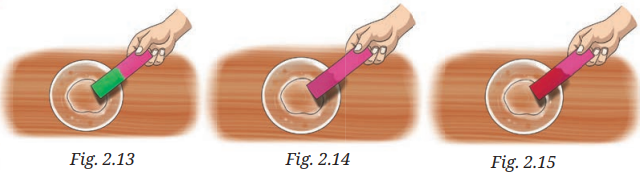
Answer:
Answer:
- Fig. 2.13: If the red rose extract paper strip turns red → the solution is acidic.
- Fig. 2.14: If the red rose extract paper strip turns green → the solution is basic.
- Fig. 2.15: If the red rose extract paper strip shows no change → the solution is neutral.
Explanation:
- Red rose extract is an acid-base indicator.
- It turns red in acids and green in bases.
- It shows no change in neutral solutions.
Q4. A liquid sample from the laboratory was tested using various indicators:
| Indicator | Red litmus | Blue litmus | Turmeric |
|---|---|---|---|
| Change | No change | Turned red | No change in colour |
Answer:
Answer: The liquid is acidic.
Justification:
- Red litmus: No change — Red litmus does not change in acids; it only turns blue in bases.
- Blue litmus: Turned red — Blue litmus turns red only in acidic solutions.
- Turmeric: No change — Turmeric does not change in acids; it only turns red in bases.
Conclusion: Since blue litmus turned red and the other indicators remained unchanged, the liquid is acidic.
Q5. Manya is blindfolded. She is given two unknown solutions to test and determine whether they are acidic or basic. Which indicator should Manya use to test the solutions and why?
Answer:
Answer: Manya should use an olfactory indicator, such as onion or clove oil.
Why:
- Since Manya is blindfolded, she cannot observe colour changes.
- An olfactory indicator works by changing its odour in acidic or basic media.
- She can use her sense of smell to detect the change.
- Onion: The pungent smell disappears in basic solutions but remains in acidic solutions.
- Clove oil: The smell changes in acidic and basic solutions.
Q6. Could you suggest various materials which can be used for writing the message on the white sheet of paper (given at the beginning of the chapter) and what could be in the spray bottle? Make a table of various possible combinations and the colour of the writing obtained.
Answer:
Answer: Various combinations can be used to write invisible messages and reveal them.
| S.No. | Writing Material (on white paper) | Spray Solution | Colour of Writing Obtained |
|---|---|---|---|
| 1. | Soap solution (basic) | Turmeric solution | Red letters on yellow background |
| 2. | Lemon juice (acidic) | Red rose extract | Red letters on green background |
| 3. | Baking soda solution (basic) | Turmeric solution | Red letters on yellow background |
| 4. | Vinegar (acidic) | Red rose extract | Red letters on green background |
| 5. | Lime water (basic) | Turmeric solution | Red letters on yellow background |
| 6. | Amla juice (acidic) | Red rose extract | Red letters on green background |
Explanation:
- Turmeric turns red in basic solutions.
- Red rose extract turns red in acidic solutions and green in basic solutions.
Q7. Grape juice was mixed with red rose extract; the mixture got a tint of red colour. What will happen if baking soda is added to this mixture? Justify your answer.
Answer:
Answer: The colour will change from red to green.
Justification:
- Grape juice is acidic in nature.
- Red rose extract turns red in acidic solutions.
- Baking soda is basic in nature.
- When baking soda is added, it neutralises the acid.
- As the solution becomes basic, the red rose extract turns green.
Colour change: Red (acidic) → Green (basic)
Q8. Keerthi wrote a secret message to her grandmother on her birthday using orange juice. Can you assist her grandmother in revealing the message? Which indicator would you use to make it visible?
Answer:
Answer: Her grandmother can reveal the message by using turmeric solution.
Explanation:
- Orange juice is acidic.
- Turmeric is an indicator that turns red in basic solutions but remains yellow in acidic solutions.
- If she sprays or applies turmeric solution on the paper:
- The areas where orange juice was applied will remain yellow (no change).
- The rest of the paper (if treated with a base or naturally basic) may turn red.
- Alternatively, if the paper is first treated with a base (like soap solution), the turmeric will turn red everywhere, and the acidic orange juice will keep the writing area yellow, creating contrast.
Alternative indicator: Red rose extract (turns red in acidic solutions).
Q9. How can natural indicators be prepared? Explain by giving an example.
Answer:
Answer: Natural indicators are prepared by extracting coloured pigments from plants using water or other solvents.
General method:
- Collect plant material (flowers, fruits, or vegetables).
- Wash the material thoroughly.
- Crush the material using a mortar and pestle.
- Place the crushed material in a container and add hot/warm water.
- Cover and wait for 5-10 minutes until the water becomes coloured.
- Filter the mixture to obtain the extract.
Example: Preparation of red rose extract indicator
- Collect fallen red rose petals.
- Wash the petals with water.
- Crush the petals using a mortar and pestle.
- Place crushed petals in a glass tumbler and pour hot water to immerse them.
- Cover and wait for 5-10 minutes until water becomes coloured.
- Filter the liquid. The filtrate is the red rose extract indicator.
- Turmeric paper turns red only in basic solutions.
- It remains yellow in both acidic and neutral solutions.
- Vinegar (acidic) → No change (yellow).
- Sugar solution (neutral) → No change (yellow).
- Baking soda solution (basic) → Turns red.
- Liquid X is basic because red rose extract turns green in basic solutions.
- When excess amla juice (acidic) is added to liquid X:
- Amla juice will neutralise the base.
- The solution will become acidic.
- The red rose extract will turn from green to red.
- Nature of soil (first blank): Acidic
- Nature of soil (second blank): Basic
- Indicator to test soil nature: Litmus paper (or turmeric paper, or any natural indicator)
- Treatment for acidic soil: Lime (calcium hydroxide) — a base
- Treatment for basic soil: Organic matter (manure, compost) — releases acids
- Eggshell and marble contain calcium carbonate — a basic substance (carbonate).
- Vinegar contains acetic acid.
- When an acid reacts with a carbonate, it produces salt, water, and carbon dioxide gas.
- This gas causes bubbling.
- Soap solution is basic (contains bases like sodium hydroxide).
- Bases do not react with carbonates to produce carbon dioxide gas.
- Therefore, no bubbles were observed with soap solution.
- Turmeric powder (indicator)
- Red rose extract (indicator)
- Lemon juice (acidic)
- Soap solution or baking soda solution (basic)
- Water
- White cloth or paper as a base
- Draw a rangoli design on the base material.
- Create different sections in the rangoli.
- Apply turmeric paste in one section, red rose extract in another, etc.
- Apply acidic substances (like lemon juice) in some areas to create colour changes with the indicators.
- Apply basic substances (like soap solution) in other areas to create different colour changes.
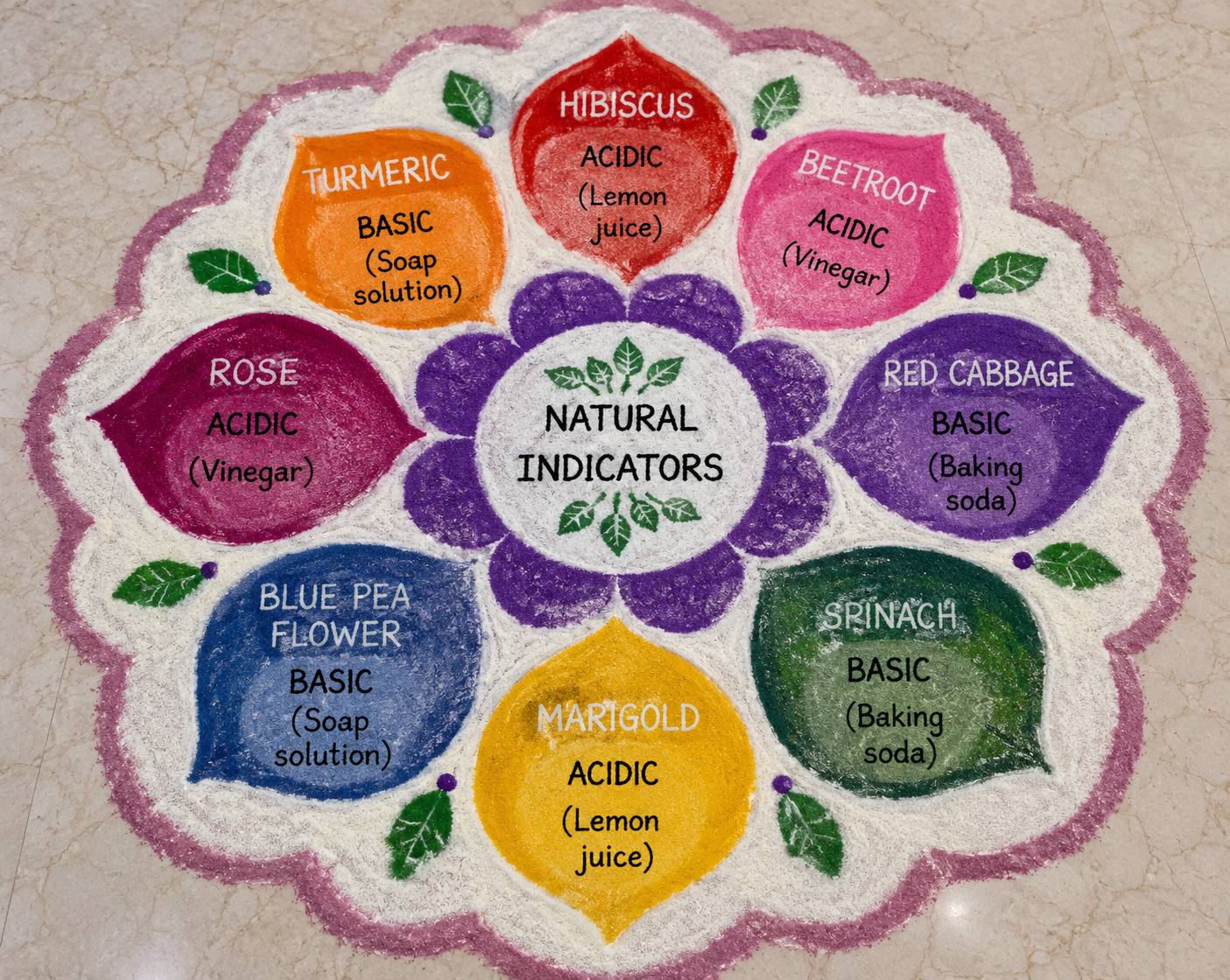
- Turmeric + Acid → Yellow (no change)
- Turmeric + Base → Red
- Red rose + Acid → Red
- Red rose + Base → Green
- Water samples from different sources (rainwater, tap water, river water, well water, bottled water)
- Blue and red litmus paper
- Turmeric paper
- Red rose extract
- Test tubes or small containers
- Collect water samples from different sources.
- Test each water sample with blue and red litmus paper.
- Also test with turmeric paper and red rose extract.
- Record your observations.
- Soil sample from your area
- Water
- Blue and red litmus paper
- Turmeric paper
- Red rose extract
- Glass beaker or container
- Filter paper or cloth
- Take a small amount of soil (about 1-2 spoons) in a beaker.
- Add water and stir well to dissolve any soluble substances.
- Allow the mixture to settle for some time.
- Filter the mixture to obtain the soil extract (liquid).
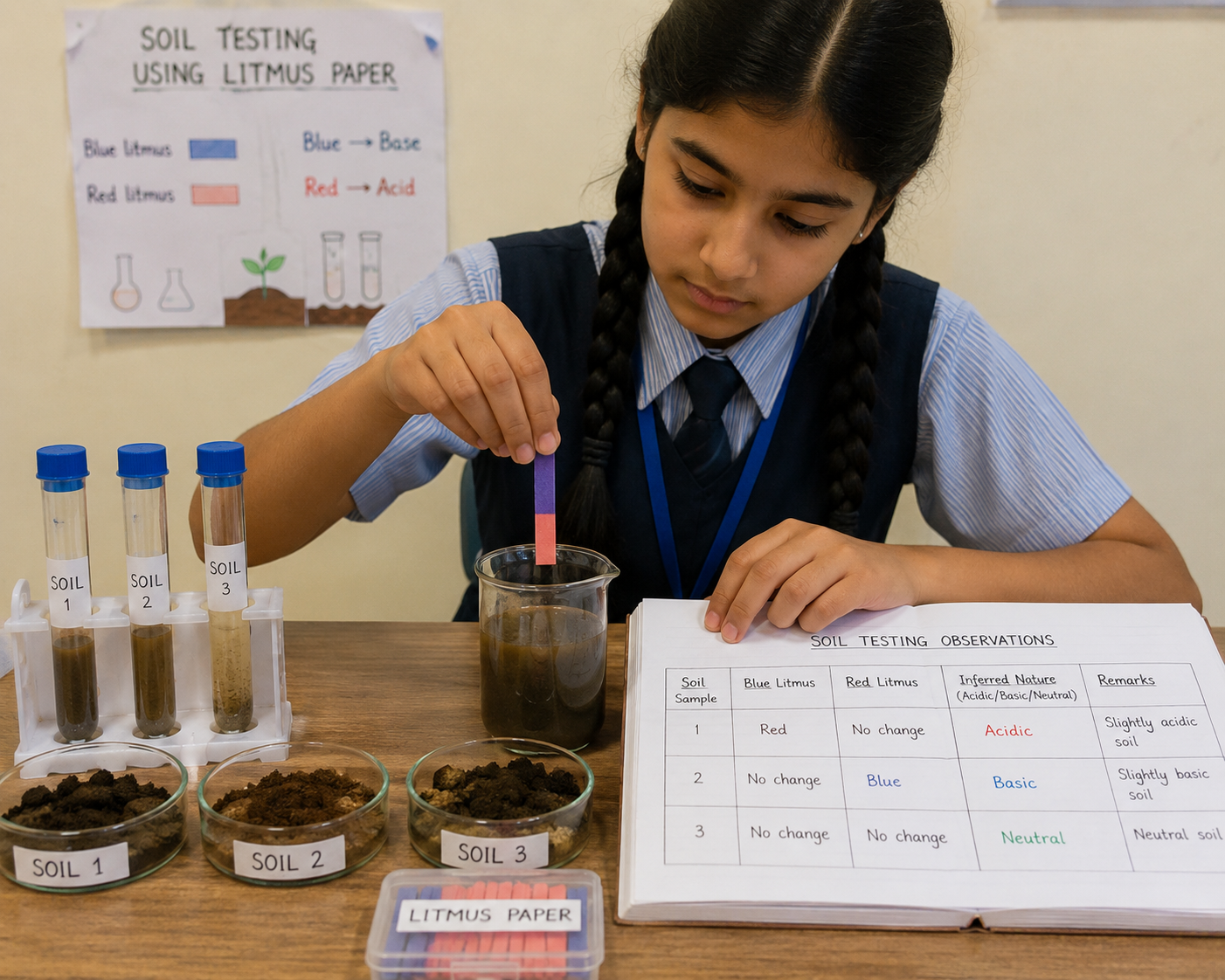
- Test the soil extract with different indicators:
- Blue litmus paper → turns red if acidic
- Red litmus paper → turns blue if basic
- Turmeric paper → turns red if basic
- Red rose extract → red if acidic, green if basic
- Record your observations and conclude whether the soil is acidic, basic, or neutral.
- They grow on rocks, trees, and walls.
- They are found in areas with abundant rainfall and clean air.
- Lichens are indicators of air pollution — they do not grow in polluted areas.
- If you find lichens in your neighbourhood, it indicates good air quality.
- If you do not find them, it may indicate air pollution.
- Baking soda: Rubbing moist baking soda (basic) on the bite neutralises the acid.
- Soap solution: Washing with soap water (basic) helps neutralise the acid.
- Lime juice: In some regions, lime juice is used (though it is acidic, it may provide relief).
- Ice: Applying ice reduces swelling and pain.
- Neem paste: Neem leaves have antibacterial properties and may provide relief.
- Calamine lotion: Available as an over-the-counter remedy for insect bites.
Other examples: Turmeric paste, red hibiscus extract, purple cabbage extract, beetroot extract.
Q10. Three liquids are given to you. One is vinegar, another is a baking soda solution, and the third is a sugar solution. Can you identify them only using turmeric paper? Explain.
Answer:
Answer: No, we cannot identify all three liquids using only turmeric paper.
Explanation:
Conclusion: We can identify the baking soda solution (turns red), but we cannot distinguish between vinegar and sugar solution using turmeric paper alone.
Solution: Use litmus paper or red rose extract to identify all three.
Q11. The extract of red rose turns the liquid X to green. What will the nature of liquid X be? What will happen when excess of amla juice is added to liquid X?
Answer:
Answer:
Colour change sequence: Green (basic) → Red (acidic).
Q12. Observe and analyse the information given in the following flowchart. Complete the missing information. Imagine a garden with plants showing signs of poor health. The soil can be in nature. The soil can be in nature. Which indicator can be used to test the nature of the soil? The acidic soil can be treated with The basic soil can be treated with 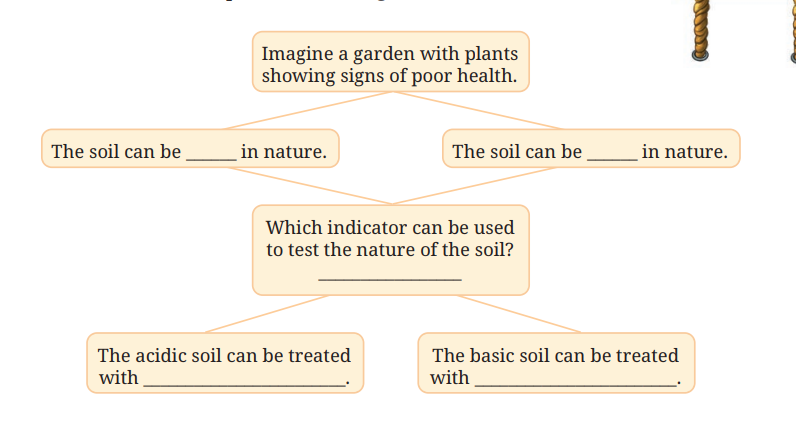
Answer:
Completed flowchart information:
Complete flowchart:
Imagine a garden with plants showing signs of poor health.
↓
The soil can be acidic in nature. OR The soil can be basic in nature.
↓
Which indicator can be used to test the nature of the soil? Litmus paper (or turmeric paper)
↓
The acidic soil can be treated with lime (a base).
OR
The basic soil can be treated with organic matter (manure/compost) which releases acids.
Q13. A man accidentally spilt vinegar on some pieces of an eggshell or marble and noticed bubbling. He then poured a soap solution on another piece of eggshell or marble, but no bubbles appeared. Why did bubbles occur with vinegar but not with soap solution?
Answer:
Answer: Bubbles occurred because vinegar (an acid) reacted with the eggshell/marble (which contains calcium carbonate), producing carbon dioxide gas.
Explanation:
Chemical equation: Acid + Carbonate → Salt + Water + Carbon dioxide
Exploratory Projects
Q1. Create rangoli using acidic or basic substances and natural indicators.
Answer:
Project Activity: Acid-Base Rangoli
Aim: To create a colourful rangoli using natural indicators and acidic/basic substances.
Materials required:
Method:
Colours produced:
Q2. You may discuss in your class the acidic, basic, or neutral nature of water obtained from various sources. You may like to test the water samples available from sources such as rain, taps, rivers, etc.
Answer:
Project Activity: Testing Water Samples
Aim: To test the acidic, basic, or neutral nature of water from different sources.
Materials required:
Method:
Expected observations:
| Water Source | Litmus Test | Nature |
|---|---|---|
| Rainwater | Slightly acidic | Slightly acidic (due to dissolved CO₂) |
| Tap water | No change | Neutral or slightly basic |
| River water | Varies | Depends on pollution and soil |
| Bottled water | No change | Neutral |
Q3. Collect a soil sample of your area and find out whether it is acidic, basic, or neutral in nature.
Answer:
Project Activity: Testing Soil Nature
Aim: To find out whether the soil in your area is acidic, basic, or neutral.
Materials required:
Method:
If soil is acidic: It can be treated with lime (base).
If soil is basic: It can be treated with organic matter (manure/compost).
Science and Society
Q1. Lichens are formed by the association of two living organisms, a fungus and an alga. They grow on rocks and trees in regions that have abundant rainfall and clean air. Do you find lichens on trees in your neighbourhood? (From Holistic Lens box)
Answer:
Answer: Lichens are organisms formed by a symbiotic association between a fungus and an alga.
Key points:
Activity: Observe trees in your neighbourhood and check if lichens are present. Discuss your findings with your classmates.
Q2. What remedies do people use to treat ant bites in your region? (From Section 2.3 — Neutralisation in Daily Life)
Answer:
Answer: Different regions use various remedies to treat ant bites.
Common remedies:
Scientific reason: Ant bites inject formic acid into the skin. Applying a base (like baking soda) neutralises the acid and relieves pain.