
Probe and Ponder
Q1. Why does every sip of your homemade ORS taste the same, no matter how much you drink? Why does it not taste salty in one sip and sweet in another?
Answer:
ORS (Oral Rehydration Solution) is a uniform mixture where the components (salt and sugar) are evenly distributed throughout the water. This means that every sip contains the same proportion of solute particles, resulting in a consistent taste.
Q2. Can you predict whether this mixture is uniform or not (Fig. 9.1)? What happens when chalk powder is mixed with water—does it form a uniform mixture? 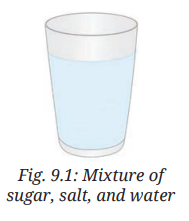
Answer:
When salt and sugar are mixed with water, it forms a uniform mixture (solution). When chalk powder is mixed with water, it does not form a uniform mixture because the chalk particles are visible and settle down over time.
Activity 9.1
Q1. Take a clean glass tumbler and fill it half with water. Add one spoon of salt into it and stir well till it dissolves completely (Fig. 9.5). Gradually add a spoonful of salt into the glass tumbler and stir. Observe how many spoons of salt you can add before it stops dissolving completely. Record your observations in Table 9.1. How many spoons of salt were you able to dissolve before some of it remained undissolved? What does this indicate about the capacity of water to dissolve salt? 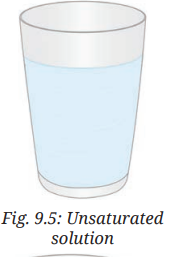
Answer:
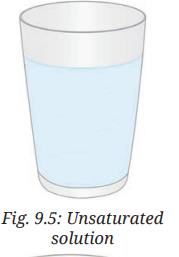
The number of spoons of salt that dissolve before some remains undissolved indicates the solubility of salt in water at that temperature. It shows that water can dissolve only a limited amount of salt. Once this limit is reached, the solution becomes saturated, and no more salt can dissolve.
Activity 9.2
Q1. Take about 50 mL of water in a glass beaker and measure its temperature using a laboratory thermometer, say 20°C. Add a spoonful of baking soda (sodium hydrogen carbonate) to the water and stir until it dissolves. Continue adding small amounts of baking soda while stirring, till some solid baking soda is left undissolved at the bottom of the beaker. Now, heat the contents to 50°C while stirring (Fig. 9.7). What happens to the undissolved baking soda? You will observe that it has dissolved. Continue adding more baking soda while stirring at this temperature until some solid baking soda remains undissolved. Again, heat the contents further to 70°C while continuing to stir. What do you observe? The undissolved baking soda dissolves. What do you infer from this experiment? Water at 70°C dissolves more baking soda than water at 50°C. The amount of baking soda dissolved in water at 20°C is even lesser. It has been found that for most of the substances, the solubility increases with an increase in temperature. We can also say that a saturated solution at a particular temperature behaves as an unsaturated solution if the temperature is increased. 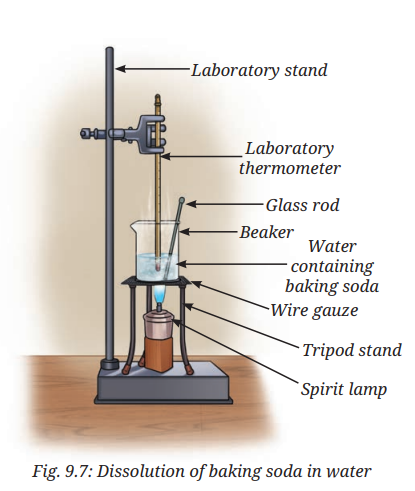
Answer:
When the temperature is increased, the undissolved baking soda dissolves. This shows that solubility increases with temperature for most solids. A saturated solution at a lower temperature becomes unsaturated at a higher temperature, allowing more solute to dissolve.
Activity 9.3
Q1. Switch ON the digital weighing balance. Observe the initial reading on the digital weighing balance display. It should show a zero reading. If not, then we must bring it to zero by pressing the tare or reset button (Fig. 9.12a). Place a dry and clean watch glass or butter paper on the pan. Note the reading on the digital weighing balance. Reset the digital weighing balance reading to zero by pressing the tare or reset button as shown in Fig. 9.12b. Now, carefully place the solid object, such as stone, on the watch glass (Fig. 9.12c). Note the reading displayed on the balance, which gives the mass of the stone, say 16.400 g. (You may use any other type of balance available in your school.) 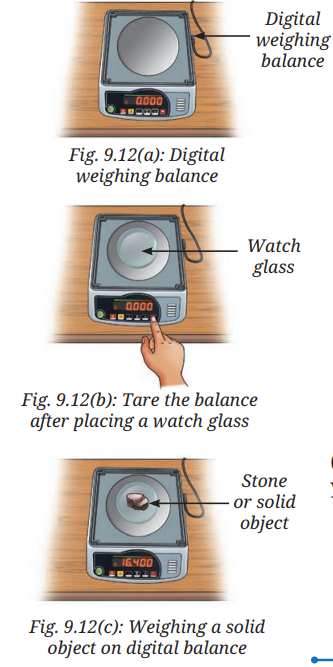
Answer:
The activity helps in measuring the mass of an object accurately using a digital balance. Taring ensures that the mass of the container is not included in the measurement.
Activity 9.4
Q1. Take a measuring cylinder and observe it carefully. Note down the following: What is the maximum volume it can measure? Now look at the measuring cylinder (Fig. 9.16) carefully. The cylinder is marked as 100 mL; therefore, it can measure volume up to 100 mL. What is the smallest volume it can measure? Look at the measuring cylinder again. How much is the volume difference indicated between the two bigger marks (for example, between 10 mL and 20 mL)? How many smaller divisions are there between the two bigger marks? How much volume does one small division indicate? The smallest volume that the measuring cylinder can read is... 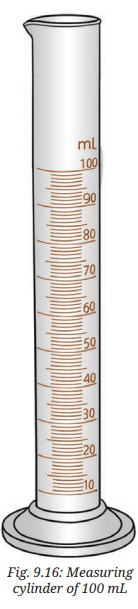
Answer:
Students should calculate the least count of the measuring cylinder. For a 100 mL cylinder with 10 divisions between major marks, the smallest measurement is 1 mL. This helps in selecting the right cylinder for accurate measurements.
Activity 9.5
Q1. Place a clean, dry measuring cylinder on a flat surface. Pour water slowly into the measuring cylinder up to the required mark, as shown in Fig. 9.17. If required, adjust the level of water in the measuring cylinder by adding or removing a small amount of water using a dropper. On careful observation, you will notice that the water inside the measuring cylinder forms a curved surface. This curved surface is called the meniscus (Fig. 9.18). Read the mark on the measuring cylinder that coincides with the bottom of the meniscus for water or other colourless liquids. Make sure that the eyes are at level with the bottom of the meniscus while noting the readings as shown in Fig. 9.18. Once it reaches the required level—that is, 50 mL—transfer this water to the required container. 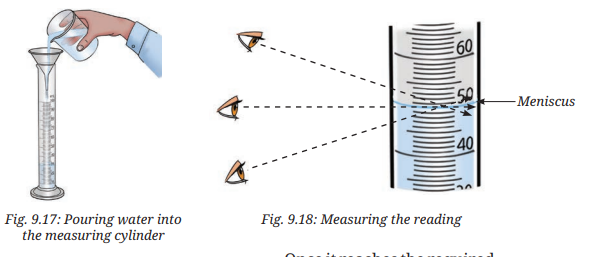
Answer:
This activity teaches how to correctly measure the volume of a liquid. The meniscus (curved surface) should be read at eye level to avoid parallax errors. For water, the reading is taken at the bottom of the meniscus.
Activity 9.6
Q1. Collect various objects with a cuboid shape, such as a notebook, a shoe box, or a dice. Measure the length (l), width (w), and height (h) of the objects using a scale. Suppose the length of the notebook is 25 cm, the width is 18 cm, and the height is 2 cm. Calculate the volume by using the following formula: Volume = l × w × h. Record in your notebook.
Answer:
The volume of a regular solid (cuboid) is calculated by multiplying its length, width, and height. For example, Volume = 25 cm × 18 cm × 2 cm = 900 cm³.
Activity 9.7
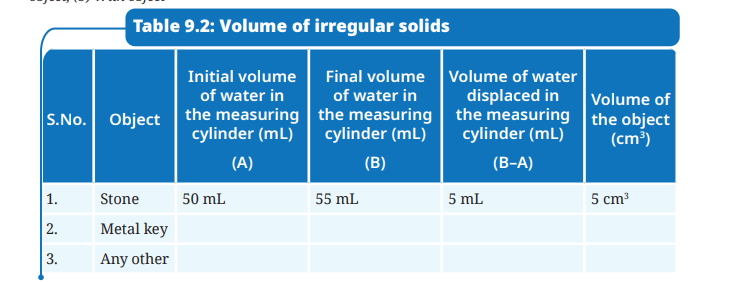
Q1. Collect various objects from your surroundings, such as a stone, metal keys, and so on. Fill a measuring cylinder with water up to any desired volume, say 50 mL (Fig. 9.19a) and record the initial volume taken in Table 9.2. Tie the object, say a stone, with a thread and slowly lower it into the measuring cylinder. What do you notice? Record the final volume after the level rises, say 55 mL, as shown in Fig. 9.19b. Subtract the initial volume from the final volume after the object is put into the measuring cylinder. This is the volume of the object. Record your observations in Table 9.2. 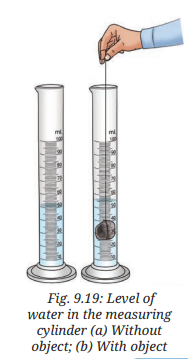
Answer:
The volume of an irregular solid is determined by the water displacement method. The volume of the object is equal to the rise in water level. For example, if the initial volume is 50 mL and final volume is 55 mL, the volume of the stone is 5 cm³.
Think Like a Scientist
Q1. Have you noticed that some packets of ghee or oil are labelled with a volume of 1 litre but a weight of only say 910 grams (Fig. 9.11)? What does this tell us about the density of the oil, and is it less or more than that of water? 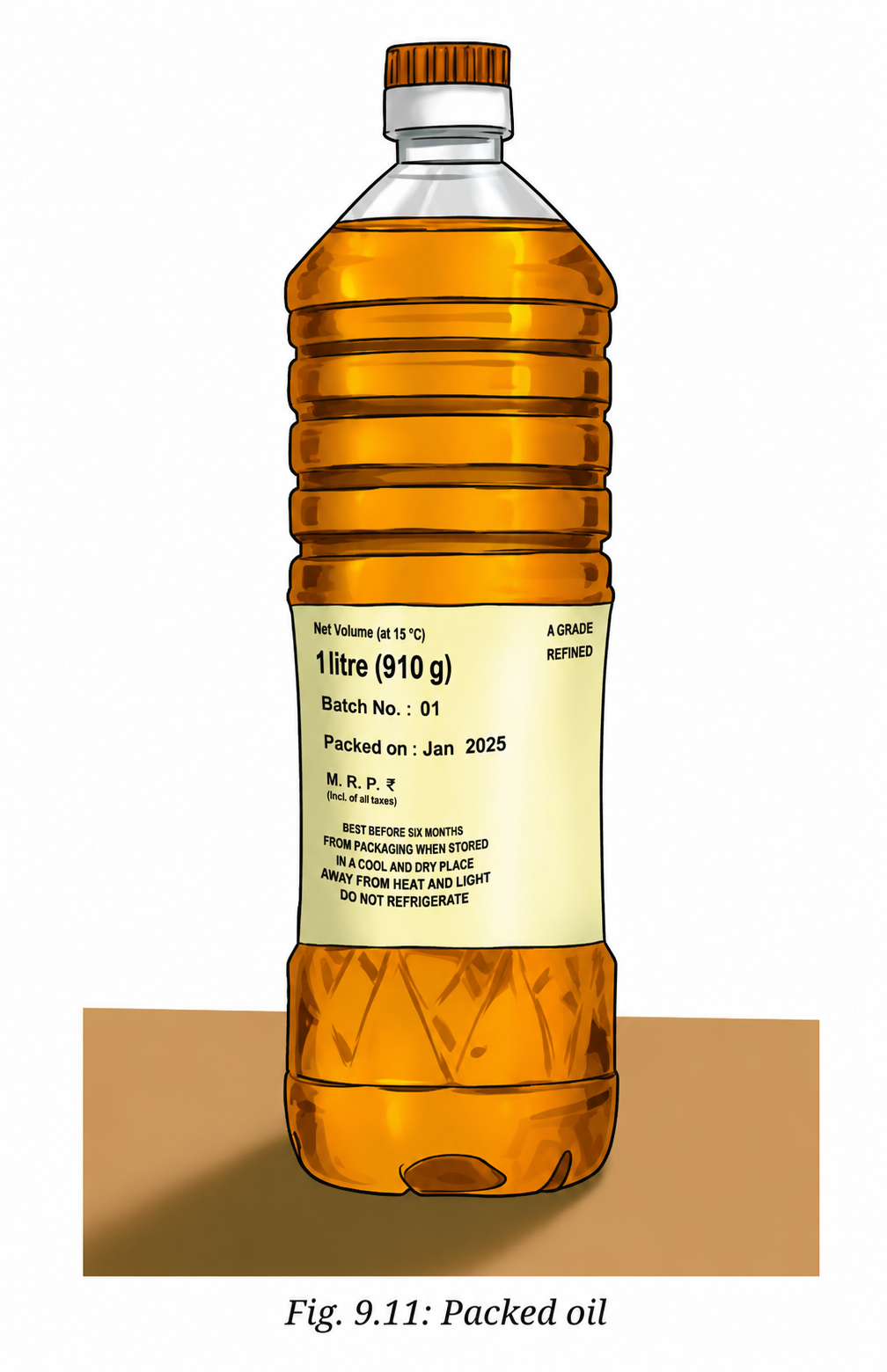
Answer:
Density = Mass/Volume. If 1 litre (1000 mL) of oil weighs 910 g, its density is 0.91 g/mL. Since the density of water is 1 g/mL, the oil is less dense than water. This is why oil floats on water.
Q2. Take a glass tumbler and fill it with tap water. Carefully place a raw whole egg into the water and observe what happens. You will notice that the egg sinks to the bottom (Fig. 9.24). What change can you make to this setup to make the egg float in water instead of sinking? In this chapter, you have learnt the concept of density and how it explains partially why some objects float while others sink. 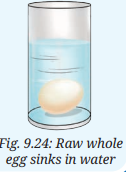
Answer:
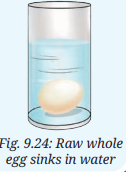
Add salt to the water. Dissolving salt increases the density of the water. When the density of the water becomes greater than the density of the egg, the egg will float. This is because the buoyant force acting on the egg increases.
Questions and Activities
Q1. State whether the statements given below are True [T] or False [F]. Correct the false statement(s). (i) Oxygen gas is more soluble in hot water rather than in cold water. (ii) A mixture of sand and water is a solution. (iii) The amount of space occupied by any object is called its mass. (iv) An unsaturated solution has more solute dissolved than a saturated solution. (v) The presence of different gases in the atmosphere is also a uniform mixture.
Answer:
(i) False - Oxygen is more soluble in cold water than in hot water.
(ii) False - Sand and water is a non-uniform mixture (suspension), not a solution.
(iii) False - The amount of space occupied by an object is called its volume. Mass is the amount of matter in it.
(iv) False - An unsaturated solution can dissolve more solute, while a saturated solution has dissolved the maximum amount.
(v) True - Air is a uniform mixture of gases.
Q2. Fill in the blanks. (i) The volume of a solid can be measured by the ______ method of displacement, where the solid is ______ in water and the ______ in water level is measured. (ii) The maximum amount of ______ dissolved in ______ at a particular temperature is called solubility at that temperature. (iii) Generally, the density ______ with increase in temperature. (iv) The solution in which glucose has completely dissolved in water, and no more glucose can dissolve at a given temperature, is called a ______ solution of glucose.
Answer:
(i) The volume of a solid can be measured by the water method of displacement, where the solid is immersed in water and the rise in water level is measured.
(ii) The maximum amount of solute dissolved in solvent at a particular temperature is called solubility at that temperature.
(iii) Generally, the density decreases with increase in temperature.
(iv) The solution in which glucose has completely dissolved in water, and no more glucose can dissolve at a given temperature, is called a saturated solution of glucose.
Q3. You pour oil into a glass containing some water. The oil floats on top. What does this tell you? (i) Oil is denser than water (ii) Water is denser than oil (iii) Oil and water have the same density (iv) Oil dissolves in water
Answer:
Answer: (ii) Water is denser than oil.
Oil floats on water because its density is less than that of water.
Q4. A stone sculpture weighs 225 g and has a volume of 90 cm³. Calculate its density and predict whether it will float or sink in water.
Answer:
Given: Mass = 225 g, Volume = 90 cm³.
Density = Mass / Volume = 225 / 90 = 2.5 g/cm³.
Since the density of water is 1 g/cm³, and the sculpture's density (2.5 g/cm³) is greater, it will sink in water.
Q5. Which one of the following is the most appropriate statement, and why are the other statements not appropriate? (i) A saturated solution can still dissolve more solute at a given temperature. (ii) An unsaturated solution has dissolved the maximum amount of solute possible at a given temperature. (iii) No more solute can be dissolved into the saturated solution at that temperature. (iv) A saturated solution forms only at high temperatures.
Answer:
Answer: (iii) No more solute can be dissolved into the saturated solution at that temperature.
(i) False - A saturated solution cannot dissolve more solute at that temperature.
(ii) False - An unsaturated solution has not reached the maximum solubility limit.
(iv) False - A saturated solution can form at any temperature, but the amount of solute dissolved varies.
Q6. You have a bottle with a volume of 2 litres. You pour 500 mL of water into it. How much more water can the bottle hold?
Answer:
2 litres = 2000 mL.
Water already poured = 500 mL.
More water that can be poured = 2000 - 500 = 1500 mL = 1.5 litres.
Q7. An object has a mass of 400 g and a volume of 40 cm³. What is its density?
Answer:
Density = Mass / Volume = 400 g / 40 cm³ = 10 g/cm³.
Q8. Analyse Fig. 9.25a and 9.25b. Why does the unpeeled orange float, while the peeled one sinks? Explain. 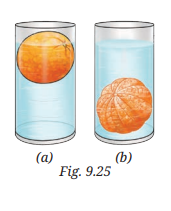
Answer:
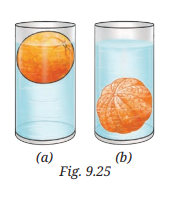
The unpeeled orange floats because the peel has tiny pores filled with air, which increases its volume and decreases its overall density. The peeled orange sinks because it has less air trapped in it, making it denser than water.
Q9. Object A has a mass of 200 g and a volume of 40 cm³. Object B has a mass of 240 g and a volume of 60 cm³. Which object is denser?
Answer:
Object A: Density = 200 / 40 = 5 g/cm³.
Object B: Density = 240 / 60 = 4 g/cm³.
Object A is denser (5 g/cm³ > 4 g/cm³).
Q10. Reema has a piece of modeling clay that weighs 120 g. She first moulds it into a compact cube that has a volume of 60 cm³. Later, she flattens it into a thin sheet. Predict what will happen to its density.
Answer:
Density is independent of shape. The mass and volume of the clay remain the same, so its density will not change. It will still be 2 g/cm³.
Q11. A block of iron has a mass of 600 g and a density of 7.9 g/cm³. What is its volume?
Answer:
Density = Mass / Volume, so Volume = Mass / Density.
Volume = 600 g / 7.9 g/cm³ = 75.95 cm³ ≈ 76 cm³.
Q12. You are provided with an experimental setup as shown in Fig. 9.26a and 9.26b. On keeping the test tube (Fig 9.26b) in a beaker containing hot water (~70°C), the water level in the glass tube rises. How does it affect the density? 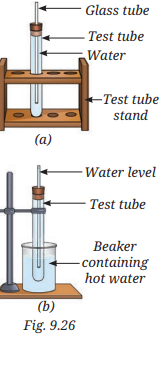
Answer:
When the test tube is heated, the water inside expands, increasing its volume. Since the mass remains the same, the density of water decreases.
Discover, Design, and Debate
Q1. Research project on Dead Sea: Why is there no aquatic life in the Dead Sea? Try to find out if there are any other similar water bodies. Investigate how well common salt dissolves in different solvents, such as water, vinegar, and oil. Compare the solubility of salt in each solvent and record your observations. Debate in class—Is water truly the most versatile solvent?
Answer:
Dead Sea: The Dead Sea has extremely high salt concentration, making it hyper-saline. The density of the water is so high that organisms cannot survive due to osmotic stress. Similar water bodies include the Great Salt Lake (USA) and Lake Assal (Djibouti).
Salt solubility: Salt dissolves well in water and vinegar (polar solvents) but does not dissolve in oil (non-polar solvent).
Debate: Water is called the "universal solvent" because it dissolves many substances, but it does not dissolve non-polar substances like oil. Other solvents (like acetone) are better for certain substances.