
Probe and Ponder
Q1. Have you ever wondered what you might see if the invisible world around you became visible? How do you think your observation of this hidden world might change the way you think about size, complexity, or even what counts as 'living'? Have you thought how these tiny living beings interact with each other?
Answer:
This is a reflective question designed to spark curiosity. If the invisible world became visible, we would see a vast and complex ecosystem of microorganisms—bacteria, fungi, protozoa, and algae—thriving all around us. It would change our perspective on size, showing that even the smallest entities are complex and perform vital functions. It would expand our understanding of what 'living' means, as we would witness unicellular organisms carrying out all life processes. Observing their interactions would reveal that these tiny beings compete, cooperate, and form intricate relationships with each other and with larger organisms, forming the foundation of all ecosystems.
Activity 2.1
Q1. Take a round-bottom flask made up of glass as shown in Fig. 2.1. Fill it with water. Close the mouth of the flask with a cork. Now, place the flask on an open book and look at the letters through it. Do you notice something interesting? The letters appear larger when seen through the flask! This happens because the flask filled with water acts like a magnifying glass. Now, use a real magnifying glass to look at small organisms, like an ant. Were you able to see the details of its body more clearly? 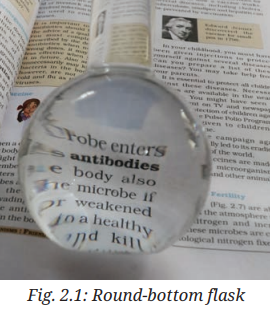
Answer:
Yes, the letters appear larger because the water-filled flask acts as a convex lens, which magnifies objects. Similarly, a magnifying glass, which is also a convex lens, makes small objects like an ant appear larger, allowing us to see details like its legs, antennae, and body segments more clearly.
Activity 2.2
Q1. Take an onion bulb from your kitchen or garden and wash it thoroughly with water. Cut the onion bulb vertically into pieces. Take one piece of onion and pull out the thin, transparent layer from its inner surface with the help of forceps. This layer is called the onion peel. Place the peel in a petri dish containing a few drops of safranin (red-coloured stain) for 30 seconds. This will give a pinkish colour to the cells and help us see them clearly. With the help of thin brush transfer the onion peel to another petri dish containing water to rinse the peel and remove extra stain. Now, carefully place the stained onion peel on the glass slide using a thin brush, ensuring it does not break or fold. Put a drop of glycerin over the onion peel on the slide. The glycerin will prevent drying of the cells and improve clarity for better visualisation of cells. Slowly place a coverslip over the peel using a needle, such that no air bubbles get trapped. Use blotting paper to gently wipe off any extra glycerin around the edges of the coverslip. Observe the slide under a microscope (A simple foldable paper microscope will suffice). Compare it with Fig. 2.3c. What similarities do you find in Fig. 2.3c and Fig. 2.3d? You will observe nearly rectangular structures under the microscope. These are the cells of the onion peel, which are closely arranged without any space between them. Try to observe the peels of the leaves of different plants around you. You will find that all plants are made up of cells. What do you think the body of an animal is made of? 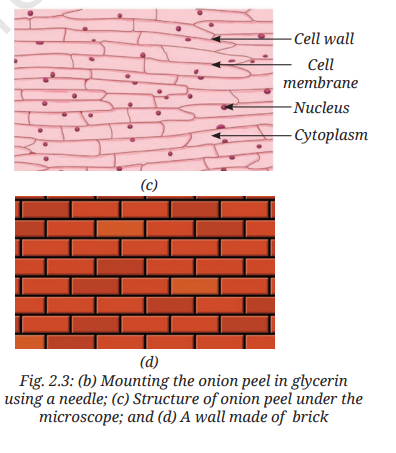
Answer:
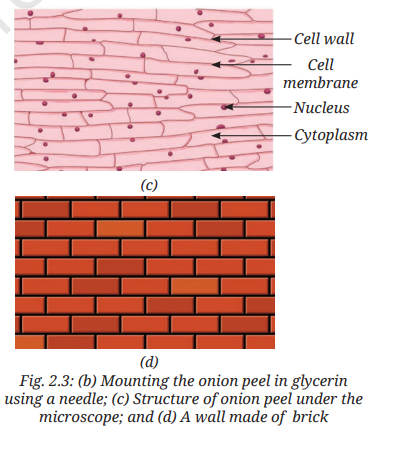
The onion peel cells appear as nearly rectangular structures arranged closely together, similar to bricks in a wall (Fig. 2.3d). This shows that plants are made up of cells. The body of an animal is also made up of cells, as observed in the next activity.
Activity 2.3
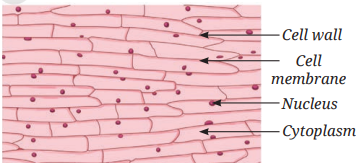
Q1. Rinse your mouth with clean water. Use the blunt end of a clean toothpick, and gently scrape the inside of your cheek. Place the scraped material in a drop of water on a clean glass slide and spread it evenly. Add a drop of methylene blue (a blue-coloured stain) over the material on slide. Adding stain improves the visibility of the material under the microscope by increasing contrast. After one minute, add a drop of glycerin over the material on the slide to prevent the cells from drying. Now, carefully place a clean coverslip on the material, and remove the excess glycerin from the edges of the coverslip using blotting paper. Observe the slide under a microscope and draw what you see in your notebook. What did you observe? You will observe a polygon-shaped structure as shown in Fig. 2.4. These are cheek cells, which form the inner lining of your mouth.3 What similarities and differences did you observe between the cells of onion peel in Activity 2.2 and human cheek cells in Activity 2.3? 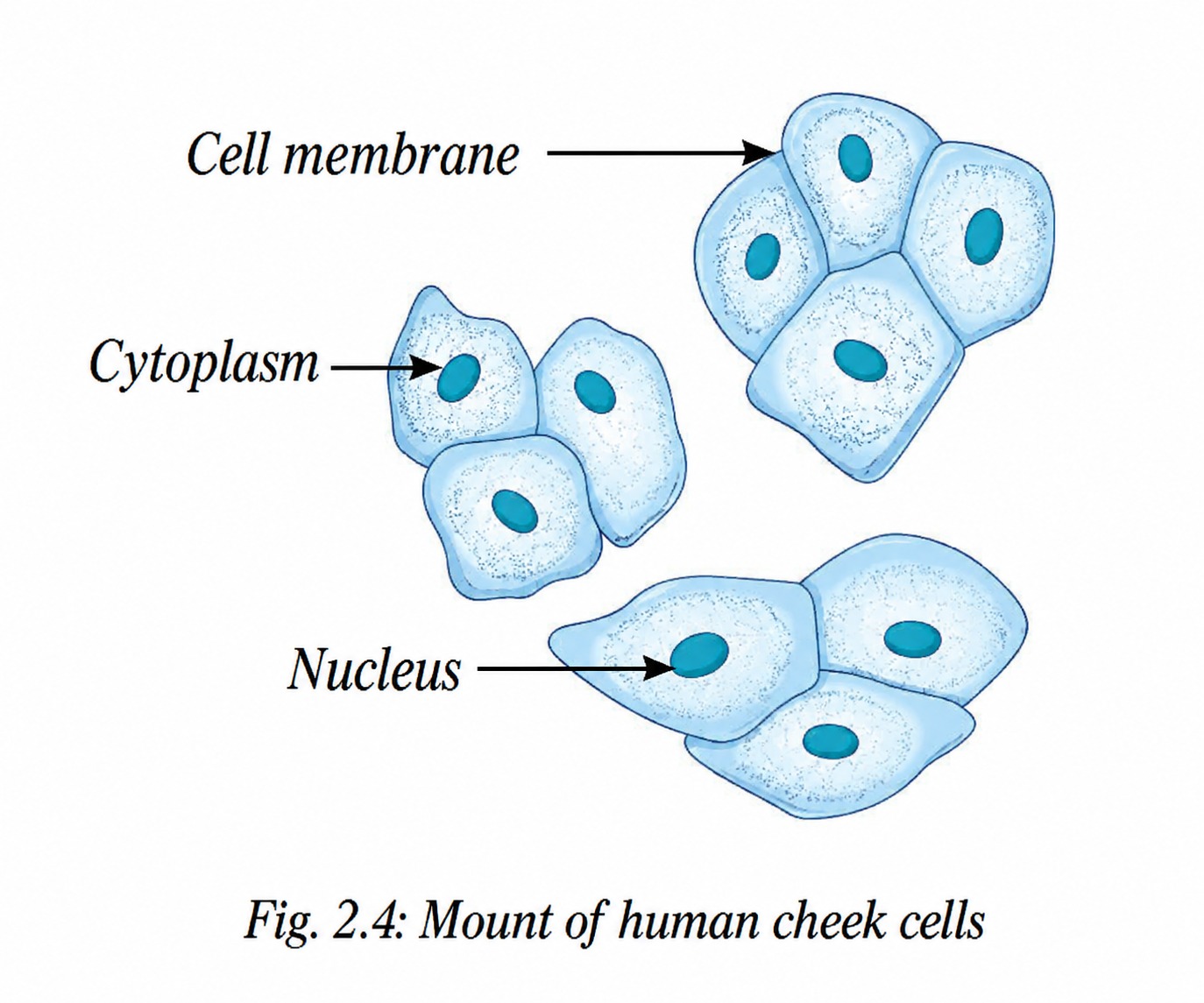
Answer:
Similarities: Both onion peel cells and human cheek cells have a cell membrane, cytoplasm, and a nucleus (the basic parts of a cell).
Differences: Onion peel cells have a rigid outer layer called a cell wall, which gives them a rectangular shape and makes them tightly packed. Human cheek cells lack a cell wall and are more irregularly shaped (polygon-shaped).
Activity 2.4
Q1. Take a container and collect pond or stagnant water in it with the help of your teacher or elder(s). Use a dropper and place a drop of pond or stagnant water on a microscope slide. Put a coverslip and observe it under the microscope. Observe the tiny organisms found in the pond or stagnant water.
Answer:
Under the microscope, you will observe various tiny organisms (microorganisms) like Amoeba, Paramecium, and some algae moving in the water. They are single-celled organisms that cannot be seen with the naked eye.
Activity 2.5
Q1. Take a beaker and collect some moist soil in it from the nearby field or garden. Do not touch the soil with your bare hands—use a spoon or gloves. Pour some water into the beaker and stir it with a glass rod. The liquid, which may look dirty, has very fine particles of soil, and is called soil suspension. Keep it aside for some time and let the mixture settle. Use a dropper and take a drop of water from the top layer. Place the drop on a microscope slide. Cover it gently with a coverslip and observe it under the microscope (Fig. 2.8). You may observe small moving organisms similar to those you saw in Activity 2.4. This indicates that even soil suspension contains a variety of tiny creatures that cannot be seen with the unaided eye. 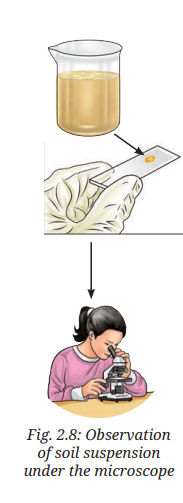
Answer:
Yes, soil suspension contains various microorganisms like bacteria, fungi, and protozoa. The observation shows that microbes are present not only in water but also in soil, indicating their ubiquitous nature.
Activity 2.7
Q1. Take an empty container and fill it halfway with garden soil. Add some fruit and vegetable peels to the container. Thereafter, put a layer of soil on it and leave it aside. After 2-3 weeks, observe the changes that have taken place. Do you observe any difference in the contents of the container? You may find that peels of fruits and vegetables have turned into a dark-coloured material. This is manure, which is rich in nutrients and helps increase the fertility of the soil. But how did the peels of fruits and vegetables turn into manure?
Answer:
The fruit and vegetable peels turn into manure because microorganisms (like bacteria and fungi) present in the soil decompose the plant waste. They break down the complex organic matter into simpler, nutrient-rich substances through a process called decomposition. This manure helps increase soil fertility.
Activity 2.8
Q1. Take two bowls A and B. In each, take 200 g of flour (atta or maida) and add a pinch of sugar. Now, in bowl A, add a small amount of yeast powder and mix it well with the flour. In bowl B, do not add any yeast, so that we can compare the results of the two bowls. Knead the flour of the two bowls with warm water to make soft dough (Fig. 2.11). Cover the dough with a damp cloth and keep it in a warm place. Observe both the bowls after 4-5 hours. Did you find any change in the volume, smell, or texture of the dough? If not, leave the dough for some more time. After some time, you may notice that the dough in bowl A, where yeast was added, has risen slightly, become fluffy, and has a different smell compared to the dough kneaded without yeast. Why does this happen? What is the role of yeast? Why did we add sugar and warm water to the flour? 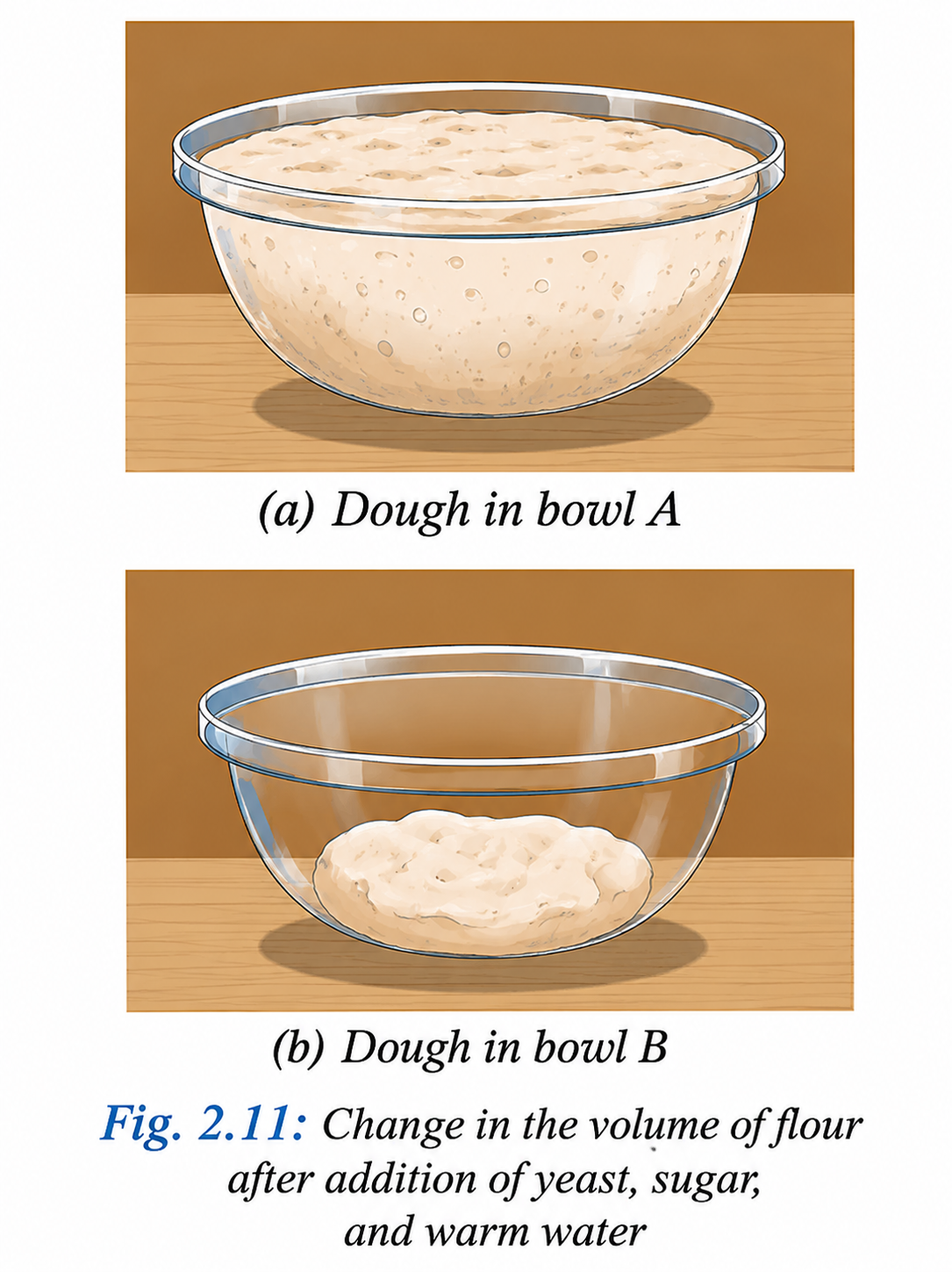
Answer:
Why does this happen? The dough in bowl A rises and becomes fluffy because yeast (a fungus) undergoes fermentation. Yeast respires and breaks down the sugar in the dough, releasing carbon dioxide gas. The gas gets trapped in the dough, making it rise and become soft and fluffy. The different smell is due to the small amount of alcohol produced during fermentation.
Role of yeast: Yeast is a microorganism that causes fermentation. It helps in making breads, cakes, and other baked goods soft and fluffy.
Why sugar and warm water? Sugar provides food for the yeast, and warm water provides the optimal temperature for yeast to grow and respire actively.
Activity 2.9
Q1. Take two small glass bowls—label them 'A' and 'B'. Pour lukewarm milk in bowl A, and cold milk in bowl B. Now, add a small spoonful of curd to each bowl and mix well using a spoon. Cover both bowls. Keep bowl A in a warm place and bowl B in a cool place (like a refrigerator) for a few hours or overnight. Observe the changes in the glass bowls. Write your predictions and observations in Table 2.4. You will observe that in bowl A, the milk has turned into curd after a few hours and has become little sour. Whereas in bowl B, the milk has not curdled, but it might be a little sour. Do you know why this happens? 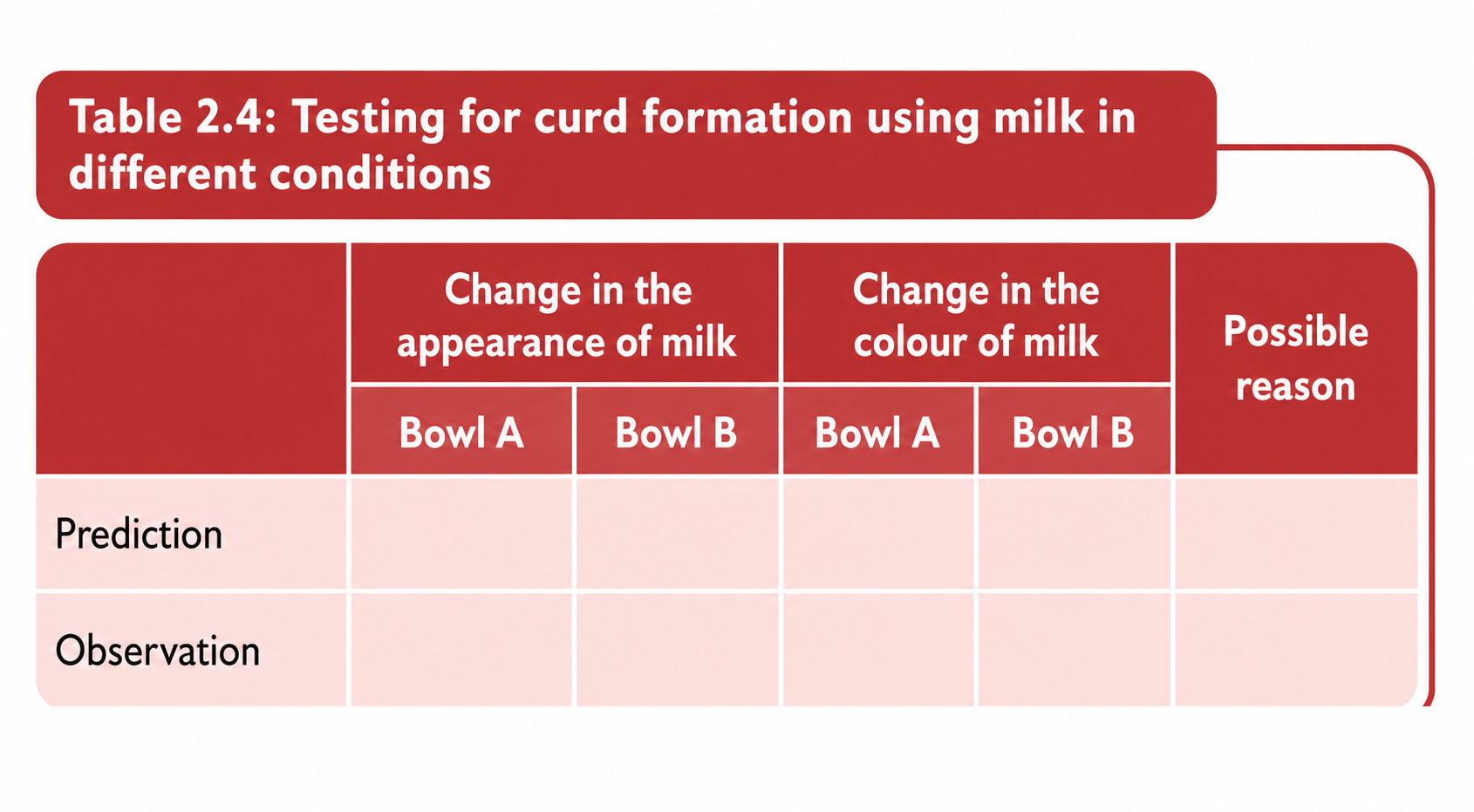
Answer:
Why does this happen? Curd contains the bacterium Lactobacillus. This bacterium feeds on the sugar (lactose) in the milk, multiplies, and ferments it, producing lactic acid. This acid makes the milk curdle and gives it a sour taste. The bacteria grow well in warm conditions, so curd forms in bowl A. In bowl B, the cold temperature (refrigerator) slows down the bacterial growth, so curd is not formed.
Keep the Curiosity Alive
Q1. Various parts of a cell are given below. Write them in the appropriate places in the following diagram. Nucleus Cytoplasm Chloroplast Cell wall Cell membrane Nucleoid
Answer:
Animal Cell: Cell membrane (outer boundary), Cytoplasm (jelly-like substance inside), Nucleus (round structure in the center).
Plant Cell: Cell wall (rigid outer covering), Cell membrane (inside the cell wall), Cytoplasm, Nucleus, Chloroplast (green, oval-shaped structures).
Bacterial Cell: Cell membrane, Cell wall, Nucleoid (region where DNA is located, no nuclear membrane).
Q2. Aanandi took two test tubes and marked them A and B. She put two spoonfuls of sugar solution in each of the test tubes. In test tube B, she added a spoonful of yeast. Then she attached two incompletely inflated balloons to the mouth of each test tube. She kept the set-up in a warm place, away from sunlight. (i) What do you predict will happen after 3-4 hours? She observed that the balloon attached to test tube B was inflated. What can be a possible explanation for this? (a) Water evaporated in test tube B and filled the balloon with the water vapour. (b) The warm atmosphere expanded the air inside the test tube B, which inflated the balloon. (c) Yeast produced a gas inside the test tube B which inflated the balloon. (d) Sugar reacted with warm air, which produced gas, eventually inflating the balloon. (ii) She took another test tube, 1/4 filled with lime water. She removed the balloon from test tube B in such a manner that the gas inside the balloon did not escape. She attached the balloon to the test tube with lime water and shook it well. What do you think she wants to find out?
Answer:
(i) The balloon attached to test tube B will inflate. The correct explanation is (c) Yeast produced a gas inside the test tube B which inflated the balloon. Yeast ferments the sugar solution, producing carbon dioxide gas, which inflates the balloon.
(ii) She wants to test whether the gas produced by yeast is carbon dioxide. Lime water turns milky when carbon dioxide is passed through it. This would confirm that the gas produced is CO₂.
Q3. A farmer was planting wheat crops in his field. He added nitrogen-rich fertiliser to the soil to get a good yield of crops. In the neighbouring field, another farmer was growing bean crops, but she preferred not to add nitrogen fertiliser to get healthy crops. Can you think of the reasons?
Answer:
The bean crops have root nodules that contain Rhizobium bacteria. These bacteria can trap nitrogen from the air and convert it into a form that plants can use (nitrogen fixation). Therefore, bean plants do not need additional nitrogen fertiliser. Wheat crops, however, do not have such nitrogen-fixing bacteria in their roots and need nitrogen fertiliser to grow well.
Q4. Snehal dug two pits, A and B, in her garden. In pit A, she put fruit and vegetable peels and mixed it with dried leaves. In pit B, she dumped the same kind of waste without mixing it with dried leaves. She covered both the pits with soil and observed after 3 weeks. What is she trying to test?
Answer:
Snehal is trying to test whether mixing dried leaves (which are rich in carbon) with fruit and vegetable peels helps in faster and better decomposition of the waste into manure. Dried leaves provide the right carbon-nitrogen ratio for microorganisms to decompose the waste effectively.
Q5. Identify the following microorganisms: (i) I live in every kind of environment, and inside your gut. (ii) I make bread and cakes soft and fluffy. (iii) I live in the roots of pulse crops and provide nutrients for their growth.
Answer:
(i) Bacteria (e.g., Lactobacillus in the gut).
(ii) Yeast (a fungus).
(iii) Rhizobium (a bacterium).
Q6. Design an experiment to test that microorganisms need optimal temperature, air, and moisture for their growth.
Answer:
Aim: To show that microorganisms need optimal temperature, air, and moisture for their growth.
Experiment: Take three bread slices. Keep one slice in a dry, warm place (A). Keep another slice in a moist, warm place (B). Keep the third slice in a moist, cold place (C). Observe the slices for 3-5 days.
Observation: Slice B (moist, warm) shows the most growth of mould (microorganisms). Slice A (dry) shows no or very little growth. Slice C (cold) shows less growth than B.
Conclusion: Microorganisms need optimal temperature, moisture, and air for growth. The absence of any of these conditions inhibits their growth.
Q7. Take 2 slices of bread. Place one slice in a plate near the sink. Place the other slice in the refrigerator. Compare after three days. Note your observations. Give reasons for your observations.
Answer:
Observation: The slice kept near the sink will show mould growth (black/green patches) because the conditions are warm and moist, which are favourable for the growth of microorganisms (fungi). The slice kept in the refrigerator will show little or no mould growth because the cold temperature slows down or prevents the growth of microorganisms.
Reason: Microorganisms need warmth and moisture to grow. The refrigerator provides a cold environment that inhibits their growth.
Q8. A student observes that when curd is left out for a day, it becomes more sour. What can be two possible explanations for this observation?
Answer:
Two possible explanations:
- Bacterial activity: Lactobacillus bacteria present in the curd continue to grow and ferment the milk sugar (lactose), producing more lactic acid, which makes the curd more sour.
- Temperature: At room temperature, the bacteria are more active and multiply faster, increasing the production of lactic acid compared to when the curd is kept in a refrigerator.
Q9. Observe the set-up given in Fig. 2.15 and answer the following questions. (i) What happens to the sugar solution in flask A? (ii) What do you observe in test tube B after four hours? Why do you think this happened? (iii) What would happen if yeast was not added in flask A? 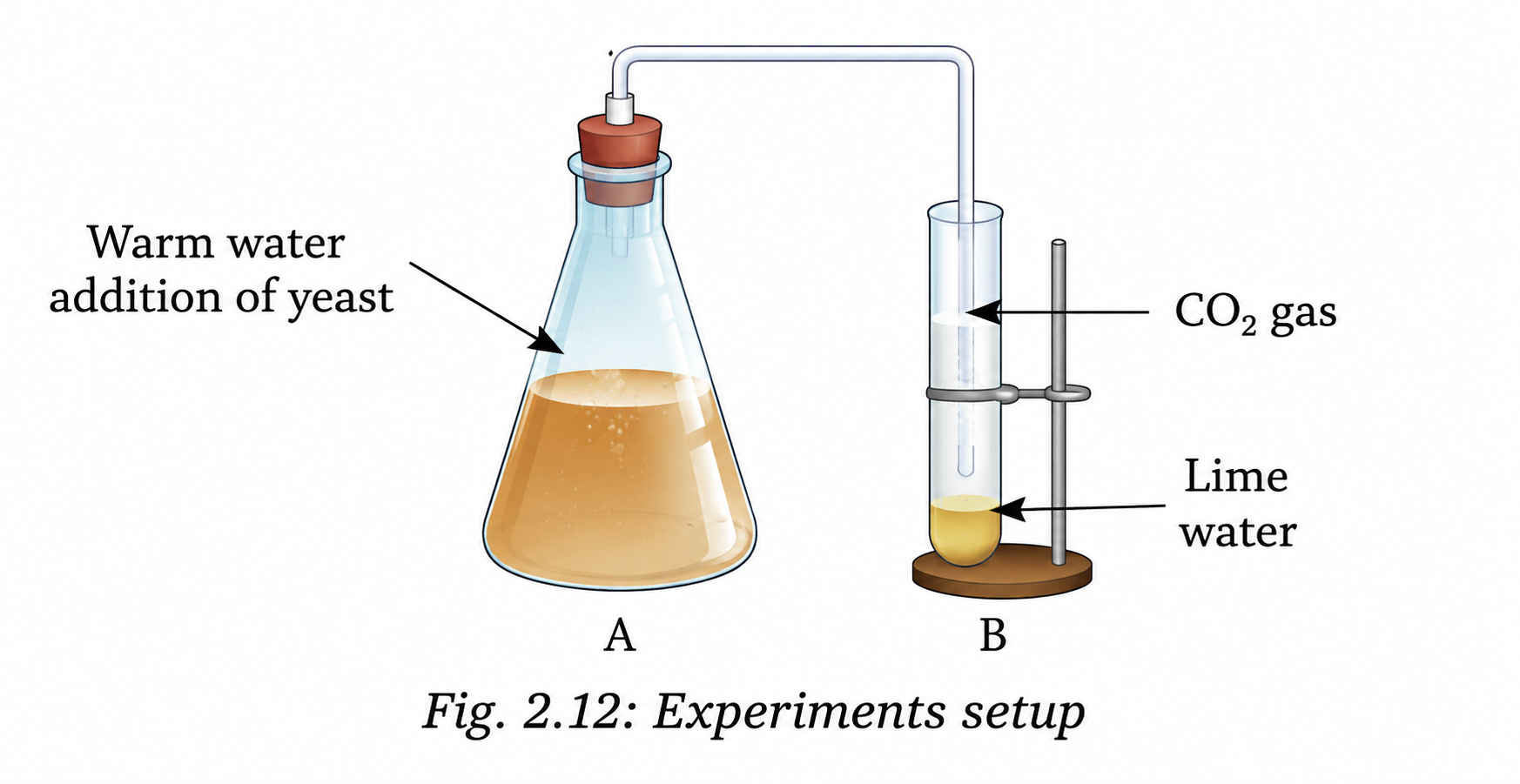
Answer:
(i) In flask A, yeast ferments the sugar solution, converting it into alcohol and carbon dioxide.
(ii) In test tube B, the lime water turns milky after four hours. This happens because the carbon dioxide gas produced by yeast in flask A passes through the tube and reacts with the lime water, forming a milky precipitate of calcium carbonate.
(iii) If yeast was not added, there would be no fermentation, so no carbon dioxide would be produced. The lime water would remain clear.
Discover, Design, and Debate
Q1. India has a long history of biogas production. One of our oldest biogas plant was set up in late 1850s. Find out about the Biogas Program initiated by the Ministry of New and Renewable Energy, Government of India. Fermented food items like fermented soya bean and fermented bamboo shoots are consumed as traditional food in some parts of India. With the help of your parents and teachers, list some traditional food items from your area that utilise the process of fermentation. Investigate the ingredients used in the preparation of these fermented food items; the method of preparing them; the microorganism responsible for the fermentation of the food, and the cultural and nutritional importance of the fermented food. Study the different parts of a macro fungus mushroom using a magnifying glass and microscope. Take the help of students from senior classes and explore the internal structure of different parts of mushrooms under the microscope in your school laboratory. Interact with an entrepreneur and learn the steps for cultivation of mushroom.
Answer:
This is a project-based activity. Students can research the Biogas Program, list fermented foods from their region (e.g., idli, dosa, dhokla, curd, pickles), and investigate the ingredients, preparation methods, microorganisms involved, and cultural/nutritional significance. They can also explore mushroom cultivation and structure.