
Probe and Ponder
Q1. Why are winds stronger on some days than on others?
Answer:
Winds are stronger on some days due to differences in air pressure. A larger difference in pressure between two regions results in stronger winds. Factors like temperature differences (e.g., uneven heating of the Earth's surface), seasonal changes, and weather systems like cyclones can create these pressure differences, leading to stronger winds.
Q2. Why are water tanks usually placed at a height?
Answer:
Water tanks are placed at a height to increase the pressure of water in the taps below. The pressure exerted by a liquid depends on the height of its column. A taller column of water exerts more pressure at the bottom, which ensures a strong flow of water from the taps.
Q3. Can air pressure really crush us?
Answer:
Air pressure (atmospheric pressure) is very large, but we are not crushed because the pressure inside our body is equal to the atmospheric pressure, balancing it out. If there were a sudden change in external pressure (like in a vacuum), the pressure difference could be harmful, but under normal conditions, our body is adapted to handle it.
Q4. What causes storms and cyclones?
Answer:
Storms are caused by the rapid upward movement of warm, moist air, creating low-pressure areas. Cyclones are large storms that form over warm ocean waters. The warm water heats the air above it, causing it to rise and create a low-pressure area. Air from surrounding high-pressure areas rushes in, and the Earth's rotation causes the system to spin, forming a cyclone.
Q5. If the Earth stopped rotating, would cyclones still form?
Answer:
Cyclones might still form, but they would be much weaker or different. The rotation of the Earth (Coriolis effect) is crucial for the spinning motion of cyclones. Without rotation, the air would flow directly from high to low pressure without spinning, so cyclones as we know them would likely not form.
Activity 6.1
Q1. Take two transparent glass or plastic pipes of the same length (about 25 cm), but of different diameters, as shown in Fig. 6.5. Take two good-quality rubber balloons. Attach them to one end of each pipe. Clamp the pipes on a stand as shown in Fig. 6.5. Now, fill both the pipes with water up to the same level about halfway. Observe what happens to the balloons. Do both balloons bulge? Do they bulge to the same extent? What can you infer from this activity? 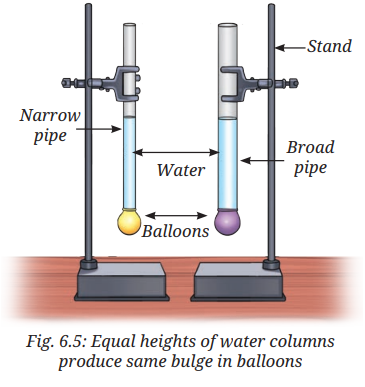
Answer:
Both balloons bulge to the same extent. This shows that the pressure exerted by a liquid depends on the height of the liquid column, not on the diameter or volume of the liquid. The pressure at the bottom of both pipes is equal because the height of the water column is the same.
Activity 6.2
Q1. Take a used plastic bottle and remove its cap. Make four small holes near the bottom around the sides using a needle or a nail. Make sure that the holes are at the same height from the bottom as shown in Fig. 6.7. (If you find it difficult to make a hole, you can slightly heat the needle and poke it to make holes.) Seal the holes with a tape and fill the bottle with water. Now, remove the tape from all holes at the same time. What do you observe? 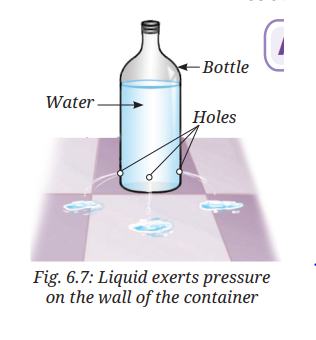
Answer:
Water flows out through the holes on the sides of the bottle. This shows that liquids exert pressure on the sides of the container as well, not just at the bottom. The water spurts out because it is under pressure from the weight of the water above it.
Activity 6.3
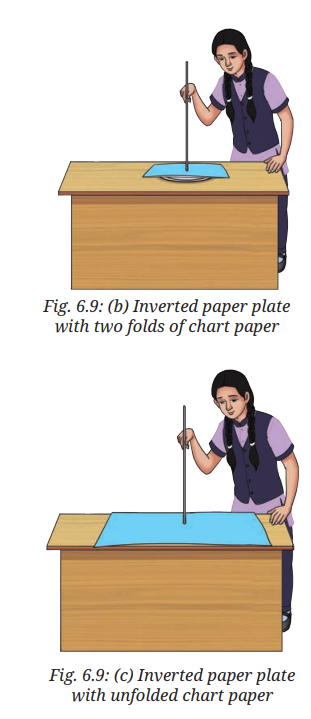
Q1. Take a paper plate, invert it and attach a stick to it as shown in Fig. 6.9a. Place it on a plain surface. Take two identical sheets of chart paper about 70 cm × 56 cm each. Fold one sheet twice and make a hole in the centre of the folded chart paper sheet—big enough for the stick to come out. Place the folded sheet on top of the inverted paper plate as shown in Fig. 6.9b. Now, try to lift the paper plate covered with a folded sheet using the stick. Observe how much effort is needed to lift it. Now, place the second unfolded chart paper sheet in place of the folded sheet. Make a hole at the centre of this chart paper for the stick to pass through. Cover the paper plate with the unfolded chart paper as shown in Fig. 6.9c. Lift the paper plate again and feel the effort needed in doing so. In which case is the lifting easier, with the folded or the unfolded chart paper covering the paper plate? 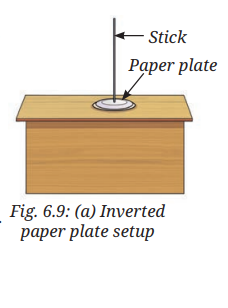
Answer:
More effort is needed to lift the paper plate when it is covered with the unfolded chart paper. This is because the air pressure acts on a larger area in the case of the unfolded sheet, increasing the total force that needs to be overcome. This shows that air exerts pressure on all objects, and the force increases with the area.
Activity 6.4
Q1. Take a good-quality rubber sucker. Press it firmly against a smooth flat surface (Fig. 6.11). Do you realise that it sticks to the surface? Now, try to pull it off. Do you find it difficult to pull it off? 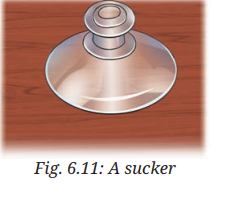
Answer:
The sucker sticks to the surface because most of the air between the sucker and the surface is pushed out, reducing the air pressure inside. The higher atmospheric pressure outside the sucker presses it against the surface, making it difficult to pull off. To remove it, you need to apply a force strong enough to overcome this pressure difference.
Activity 6.5
Q1. Take two similar balloons made of thin rubber, and a drinking straw. Insert one end of the straw into one balloon and secure it with a rubber band or thread. Now inflate the second balloon and hold its mouth with your fingers, so that air does not escape. Insert the free end of the straw into the neck of the inflated balloon and secure it with a rubber band or thread. Make sure that the air does not leak from the balloon as the straw is inserted in it. Now you have one end of the straw inside the inflated balloon and the other end inside the uninflated balloon as shown in Fig. 6.12. Predict what would happen to the balloons. Observe what happens to both the balloons. Did it happen as predicted? Do you observe any change in the size of the balloons? Write down your observations. What can be the reason for the change in the sizes of the balloons? 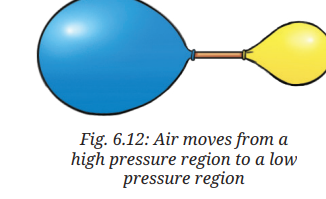
Answer:
The inflated balloon decreases in size, and the uninflated balloon increases in size. This happens because air moves from the high-pressure region (inflated balloon) to the low-pressure region (uninflated balloon) through the straw. The flow stops when the pressure in both balloons becomes equal.
Activity 6.6
Q1. Take two balloons of the same size. Inflate both balloons and tie strings to them. Hang the two balloons from a stick, leaving a gap of 6-10 cm (Fig. 6.13). Now, blow air into the narrow space between the balloons. What happens to the balloons? Note down your observations. Now blow harder and observe. 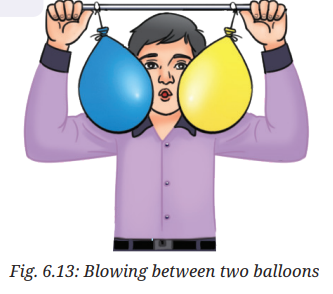
Answer:
The two balloons move towards each other. When you blow air between them, the speed of air increases, creating a low-pressure area between the balloons. The higher pressure on the outside pushes the balloons inward. Blowing harder increases the air speed, creating a lower pressure, and the balloons move closer together more quickly.
Questions and Activities
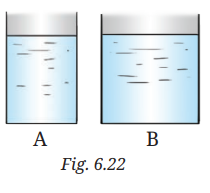
Q1. Choose the correct statement. (i) Look at Fig. 6.21 carefully. Vessel R is filled with water. When pouring of water is stopped, the level of water will be (a) the highest in vessel P (b) the highest in vessel Q (c) the highest in vessel R (d) equal in all three vessels (ii) A rubber sucker (M) is pressed on a flat smooth surface and an identical sucker (N) is pressed on a rough surface: (a) Both M and N will stick to their surfaces. (b) Both M and N will not stick to their surfaces. (c) M will stick but N will not stick. (d) M will not stick but N will stick. (iii) A water tank is placed on the roof of a building at a height 'H'. To get water with more pressure on the ground floor, one has to (a) increase the height 'H' at which the tank is placed. (b) decrease the height 'H' at which the tank is placed. (c) replace the tank with another tank of the same height that can hold more water. (d) replace the tank with another tank of the same height that can hold less water. (iv) Two vessels, A and B contain water up to the same level as shown in Fig. 6.22. PA and PB is the pressure at the bottom of the vessels. FA and FB is the force exerted by the water at the bottom of the vessels A and B. (a) PA = PB, FA = FB (b) PA = PB, FA < FB (c) PA < PB, FA = FB (d) PA > PB, FA > FB 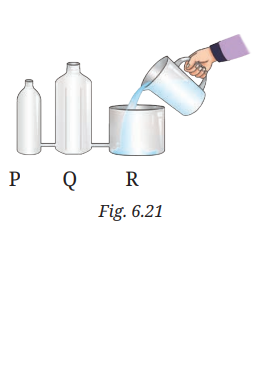
Answer:
(i) Answer: (d) equal in all three vessels - The water level will be equal in all three connected vessels due to the principle of communicating vessels.
(ii) Answer: (c) M will stick but N will not stick. - A sucker sticks to a smooth surface because the air pressure inside is reduced. On a rough surface, air can leak in, preventing the pressure difference.
(iii) Answer: (a) increase the height 'H' at which the tank is placed. - Pressure increases with the height of the water column.
(iv) Answer: (b) PA = PB, FA < FB - The pressure at the bottom is the same because the water level is the same, but the force is greater in vessel B because it has a larger base area (Force = Pressure × Area).
Q2. State whether the following statements are True [T] or False [F]. (i) Air flows from a region of higher pressure to a region of lower pressure. [ ] (ii) Liquids exert pressure only at the bottom of a container. [ ] (iii) Weather is stormy at the eye of a cyclone. [ ] (iv) During a thunderstorm, it is safer to be in a car. [ ]
Answer:
(i) True - Air flows from high-pressure to low-pressure regions.
(ii) False - Liquids exert pressure in all directions, not just at the bottom.
(iii) False - The eye of a cyclone has calm weather.
(iv) True - A car provides protection from lightning.
Q3. Fig. 6.23 a shows a boy lying horizontally, and Fig. 6.23 b shows the boy standing vertically on a loose sand bed. In which case does the boy sink more in sand? Give reasons. 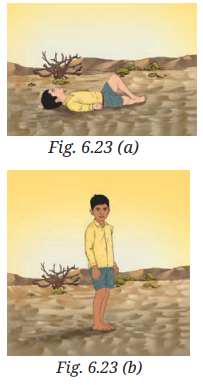
Answer:
The boy sinks more when standing vertically (Fig. 6.23b) because the weight of his body acts on a smaller area (his feet). This increases the pressure on the sand, causing him to sink deeper. When lying down, his weight is distributed over a larger area, reducing the pressure and preventing him from sinking as much.
Q4. An elephant stands on four feet. If the area covered by one foot is 0.25 m², calculate the pressure exerted by the elephant on the ground if its weight is 20000 N.
Answer:
Given: Weight (Force) = 20000 N; Area of one foot = 0.25 m²; Total area of four feet = 4 × 0.25 = 1.0 m².
Pressure = Force / Area = 20000 N / 1.0 m² = 20000 Pa.
Q5. There are two boats, A and B. Boat A has a base area of 7 m² and 5 persons are seated in it. Boat B has a base area of 3.5 m² and 3 persons are seating in it. If each person has a weight of 700 N find out which boat will experience more pressure on its base and by how much?
Answer:
Boat A: Total force = 5 × 700 = 3500 N; Area = 7 m²; Pressure = 3500 / 7 = 500 Pa.
Boat B: Total force = 3 × 700 = 2100 N; Area = 3.5 m²; Pressure = 2100 / 3.5 = 600 Pa.
Boat B experiences more pressure by 600 - 500 = 100 Pa.
Q6. Would lightning occur if air and clouds were good conductors of electricity? Give reasons for your answer.
Answer:
No, lightning would not occur if air and clouds were good conductors. Lightning happens when the build-up of charges becomes very large and the insulating property of air breaks down, allowing a sudden flow of charges. If air were a good conductor, charges would flow continuously without building up, preventing the sudden discharge that creates lightning.
Q7. What will happen to the two identical balloons A and B as shown in Fig.6.24 when water is filled into the bottle up to a certain height. Will both the balloons bulge? If yes, will they bulge equally? Explain your answer. 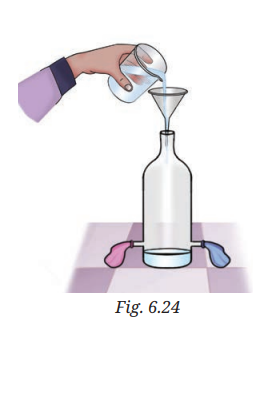
Answer:
Both balloons will bulge. They will bulge equally because the pressure exerted by a liquid depends on the height of the liquid column, not on the shape or size of the container. Since the water level is the same in both parts of the bottle, the pressure at the bottom is the same, causing equal bulges.
Q8. Explain how a storm becomes a cyclone.
Answer:
A storm becomes a cyclone when it forms over warm ocean waters. The warm water heats the air above it, causing it to rise and create a low-pressure area. As the moist air rises, water vapor condenses, releasing heat, which further warms the air and causes it to rise more. Air from surrounding high-pressure areas rushes in, and the Earth's rotation causes this system to spin. This creates a large, rotating system of clouds, winds, and rain—a cyclone.
Q9. Fig.6.25 shows trees along the sea coast in a summer afternoon. Identify which side is land—A or B. Explain your answer. 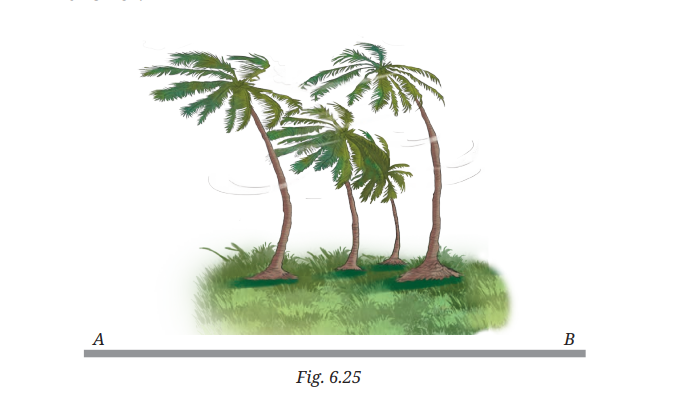
Answer:
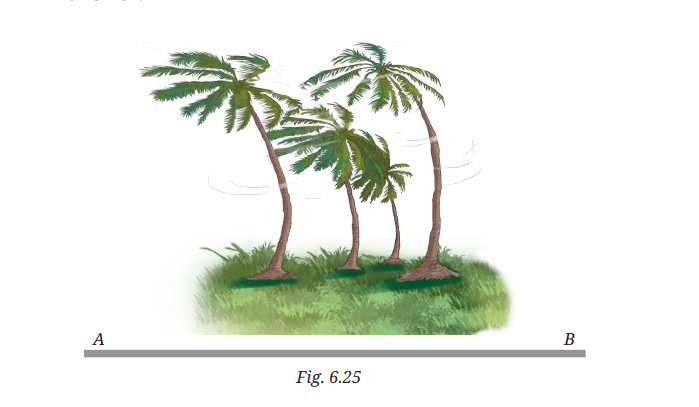
Side A is land. During a summer afternoon, the land heats up faster than the sea. The warm air over the land rises, creating a low-pressure area. Cooler air from the sea (high pressure) blows towards the land, creating a sea breeze. The trees will be bent towards the land (side A) by the wind blowing from the sea.
Q10. Describe an activity to show that air flows from a region of high pressure to a region of low pressure.
Answer:
Activity: Take two balloons, a straw, and rubber bands. Inflate one balloon and keep the other deflated. Insert one end of the straw into the inflated balloon and the other end into the deflated balloon, securing both with rubber bands. Observe what happens. The inflated balloon will shrink, and the deflated balloon will inflate. This happens because air moves from the high-pressure region (inflated balloon) to the low-pressure region (deflated balloon) until the pressure equalizes.
Q11. What is a thunderstorm? Explain the process of its formation.
Answer:
A thunderstorm is a storm accompanied by lightning and thunder. It forms when warm, moist air rises rapidly and creates a low-pressure area. As the air rises, it cools and condenses, forming clouds. Strong winds blowing upwards and downwards cause rubbing between water droplets and ice particles, leading to the build-up of static charges. When the charge build-up becomes large, it causes a sudden discharge of electricity (lightning) and a loud sound (thunder).
Q12. Explain the process that causes lightning.
Answer:
Lightning is caused by the build-up of static charges in clouds. Within a cloud, warm air rises, and water droplets and ice particles rub against each other. This friction causes the transfer of electrons, separating charges—positive charges accumulate at the top of the cloud and negative charges at the bottom. The ground becomes positively charged by induction. When the charge difference becomes large enough, the insulating property of air breaks down, and a sudden flow of charges occurs, producing a bright flash of light known as lightning.
Q13. Explain why holes are made in banners and hoardings.
Answer:
Holes are made in banners and hoardings to reduce the pressure difference created by wind. When wind blows against a large, solid surface, it can cause a significant pressure difference, which may tear the banner or knock down the hoarding. The holes allow air to pass through, reducing the force exerted by the wind and preventing damage.
Discover, Design, and Debate
Q1. Hold a strip of paper, 18 cm long and 2 cm wide, between your thumb and forefinger so that it hangs freely. Predict what you will observe if you blow over the paper. Perform the activity now. Note down your observations and interpret your results. List three major cyclones which have occurred in India in the last 20 years. List two major destruction caused by each of the cyclones. What measures were taken by the local government and communities to reduce the loss of life and destruction of property? Mention two suggestions you would like to propose to the local government. Collect data on the strength of thunderstorms for various regions of India. Compare your findings and identify which regions are more prone to thunderstorms. Can you give reasons for your findings?
Answer:
Activity (Paper Strip): When you blow over the strip of paper, it rises. This happens because the air moving over the paper creates a low-pressure area above it. The higher pressure below the paper pushes it upwards. This demonstrates that high-speed winds are accompanied by reduced pressure.
Cyclones (e.g., Amphan 2020, Fani 2019, Tauktae 2021): Students can list these cyclones and their destruction (e.g., uprooted trees, damaged houses, flooded areas). Measures taken included early warnings, evacuation, and relief camps. Suggestions: stronger coastal infrastructure, better early warning systems.
Thunderstorm Data: Students can research regions like Northeast India, Bengal, and Odisha, which are more prone to thunderstorms. Reasons include geographical location, proximity to the sea, and seasonal climatic conditions.