
Probe and Ponder
Q1. Why does it feel harder to pedal a bicycle when going uphill than on flat ground?
Answer:
It feels harder to pedal a bicycle uphill because the gravitational force pulls you and the bicycle downwards. When going uphill, you are working against gravity, which requires more muscular force. On flat ground, you only need to overcome friction and air resistance, so less effort is required.
Q2. Why is it easier to slip on a wet surface?
Answer:
It is easier to slip on a wet surface because water acts as a lubricant, reducing the friction between your shoes and the ground. Friction provides the grip needed to walk without slipping. When friction is reduced, there is less resistance to sliding, making it easier to lose balance and slip.
Q3. Why do we feel 'light' or like we are 'floating' just after our swing reaches its highest point and begins to come down?
Answer:
At the highest point of a swing, the motion changes direction from upward to downward. At the exact topmost point, the speed is momentarily zero, and the downward acceleration due to gravity begins. During this brief moment, the normal force (the force from the seat) decreases, making you feel lighter or momentarily 'floating' before gravity pulls you down again.
Activity 5.1
Q1. Take a large cardboard box. Try moving the box in as many different ways as you can think of. Did you move the box in any other way than shown in Fig. 5.1? In all the ways that you might have used to move the box, you had to apply a push or pull to the box. Generally, the push or pull applied on an object is called force in science. 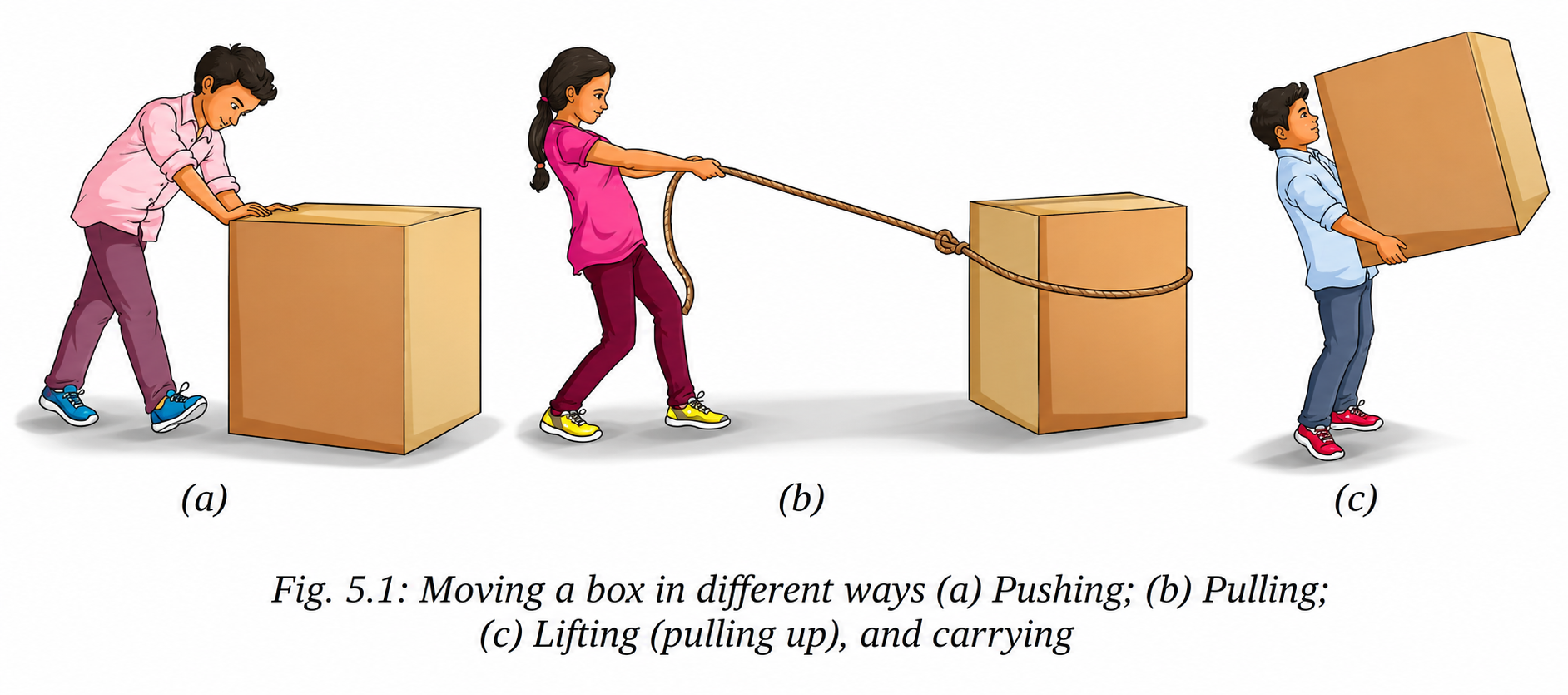
Answer:
This is an observation activity. Students can move the box by pushing it (from behind), pulling it (with a rope), lifting it (pulling upward), sliding it, tilting it, or rolling it. In all cases, a push or pull (force) is applied. The conclusion is that a force is a push or pull on an object.
Activity 5.2
Q1. Think of situations where a force (push or pull) is applied and list them in Table 5.1. Analyse each situation and write the effect of the force in Table 5.1. Some situations and their effects are already listed for you. What do you conclude from these examples? Does a force cause a moving object to stop? Can it change speed, or direction of motion, or change the shape of an object? 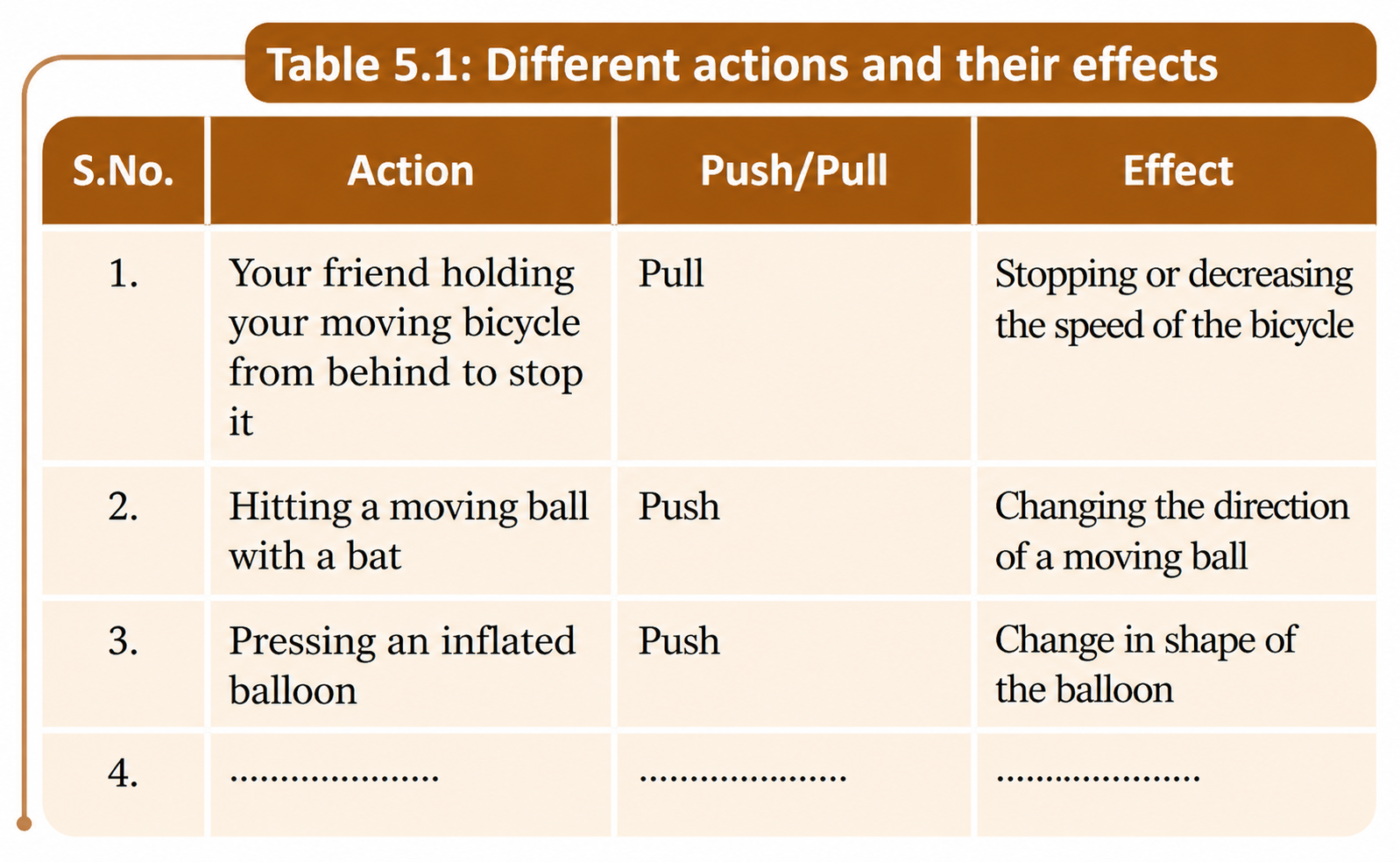
Answer:
Students should complete the table with examples like:
- Kicking a football: Push → changes direction of motion.
- Stretching a rubber band: Pull → changes shape.
- Applying brakes on a bicycle: Pull → decreases speed/stop.
- Opening a drawer: Pull → moves object from rest.
Conclusion: Force can: (a) make a stationary object move, (b) change the speed of a moving object, (c) change the direction of motion, and (d) change the shape of an object.
Activity 5.3
Q1. Take an object with a flat base (such as an empty lunch box/geometry box/a notebook) and place it on a table or floor. Gently push it and observe (Fig. 5.5). Does it stop after travelling some distance? Is there a force acting on it which brings it to rest? Now repeat by pushing the object in the opposite direction. Does it stop again after travelling some distance? 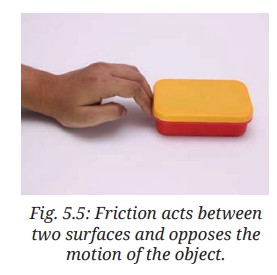
Answer:
The object stops after sliding some distance. This is due to the force of friction acting between the object and the surface in contact, in a direction opposite to the motion. When pushed in the opposite direction, it again stops due to friction acting opposite to the new direction of motion. This shows that friction is a force that opposes motion.
Activity 5.4
Q1. Try Activity 5.3 again, but this time place the same object on different surfaces, such as glass, cloth, wood, ceramic tile, and sand. Does the object stop after travelling the same distance as in Activity 5.3? Does the object stop at the same distance on all surfaces?
Answer:
The object stops after traveling different distances on different surfaces. On smooth surfaces (like glass), it travels farther before stopping because friction is less. On rough surfaces (like sand), it stops sooner because friction is greater. This shows that friction depends on the nature of the surfaces in contact.
Activity 5.5
Q1. Take two ring magnets and a wooden stick. While holding the stick in a vertical position over a wooden table, insert one ring magnet onto the stick (Fig. 5.7). Now insert the second ring magnet above it such that the like poles of the two magnets face each other. Does the second magnet stay floating above the first magnet? Try pushing the second magnet down gently. Do you feel a force on it? Now, reverse the poles of both the magnets. Does the second magnet still remain floating? 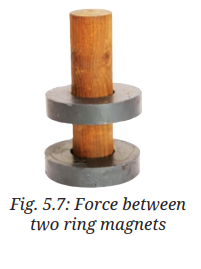
Answer:
When like poles face each other, the magnets repel, and the second magnet stays floating above the first. Pushing it down, you feel an upward repulsive force. When the poles are reversed (unlike poles facing), the magnets attract, and the second magnet falls down and sticks to the first. This shows that magnetic force can act without contact (non-contact force) and can be attractive or repulsive.
Activity 5.6
Q1. Take a plastic scale or a plastic straw, a piece of polythene, and small pieces of paper. Rub plastic scale/straw vigorously with polythene. Do not touch the rubbed part with your hand or any metal object. Now, bring it close to the small pieces of paper placed on a table, taking care not to touch the paper pieces (Fig. 5.8). Do you notice something surprising? 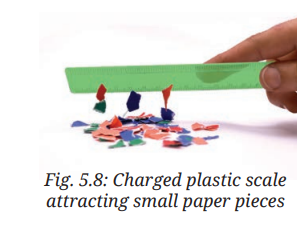
Answer:
The paper pieces get pulled towards the plastic scale/straw and stick to it. This happens because rubbing creates static charges on the scale. The charged scale exerts an electrostatic force on the uncharged paper pieces, attracting them. This is a non-contact force.
Activity 5.7
Q1. Take two balloons, a length of thread, and a woollen cloth. Inflate two balloons and hang them in such a way that they do not touch each other as shown in Fig. 5.9a. Rub both balloons with the woollen cloth and release them. Be careful not to touch the rubbed balloons with your fingers. What do you observe? They move away from each other as if they are repelling each other (Fig. 5.9b). Now bring the woollen cloth used for rubbing the balloons close to one of the rubbed balloons. What happens? They move towards each other as if they are attracting each other. What do we infer from these observations? 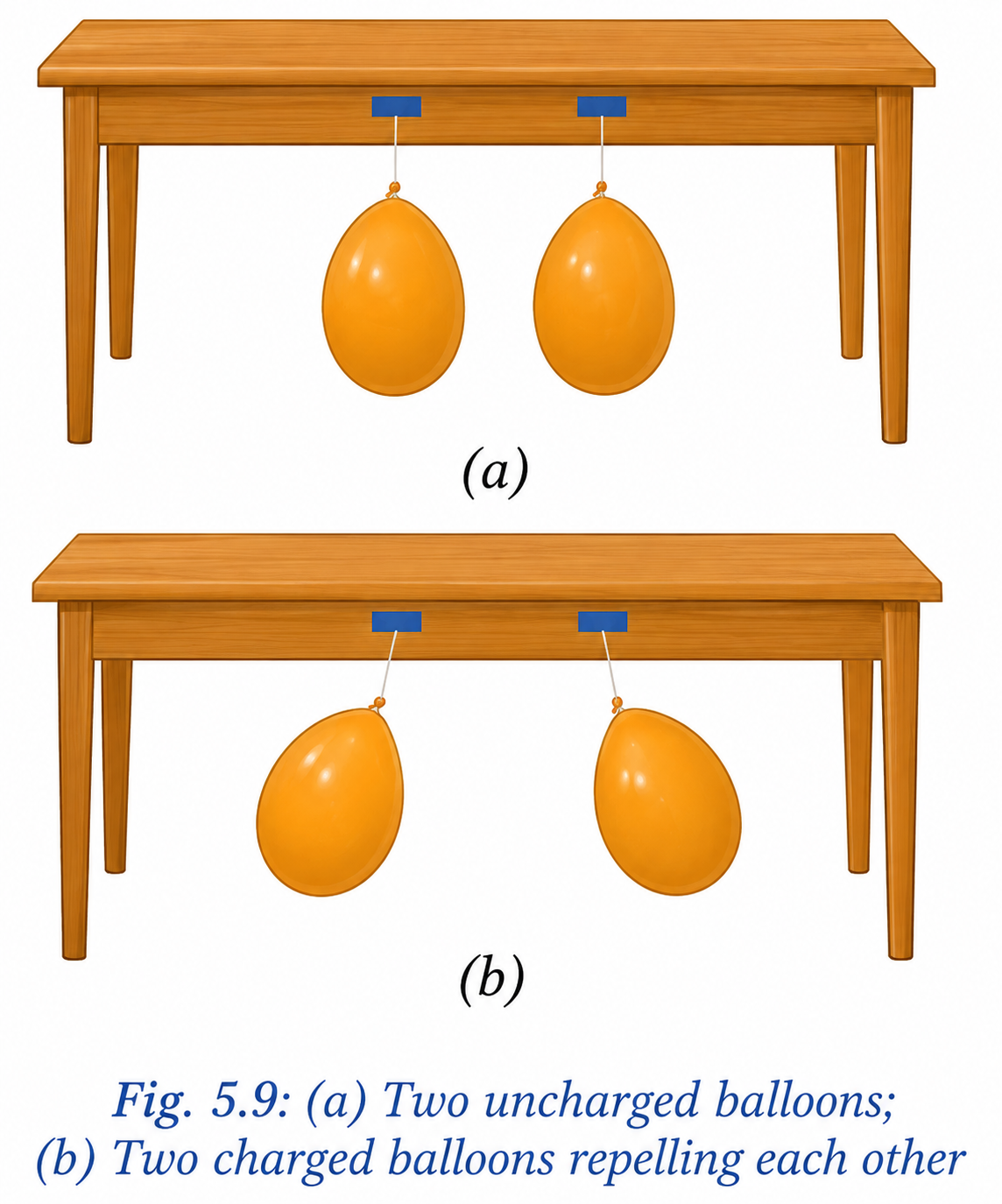
Answer:
The two balloons (similarly charged) repel each other, indicating like charges repel. The charged balloon and the woollen cloth (oppositely charged) attract each other, indicating unlike charges attract. This shows that electrostatic force is a non-contact force that can be attractive or repulsive.
Activity 5.8
Q1. Take a ball and throw it vertically upwards. Does it come down? Now throw it again, but this time harder. Does it still fall back down to the ground? Think about different situations around you where any object thrown up in any direction, finally falls or comes back to the ground or floor (Fig. 5.10). 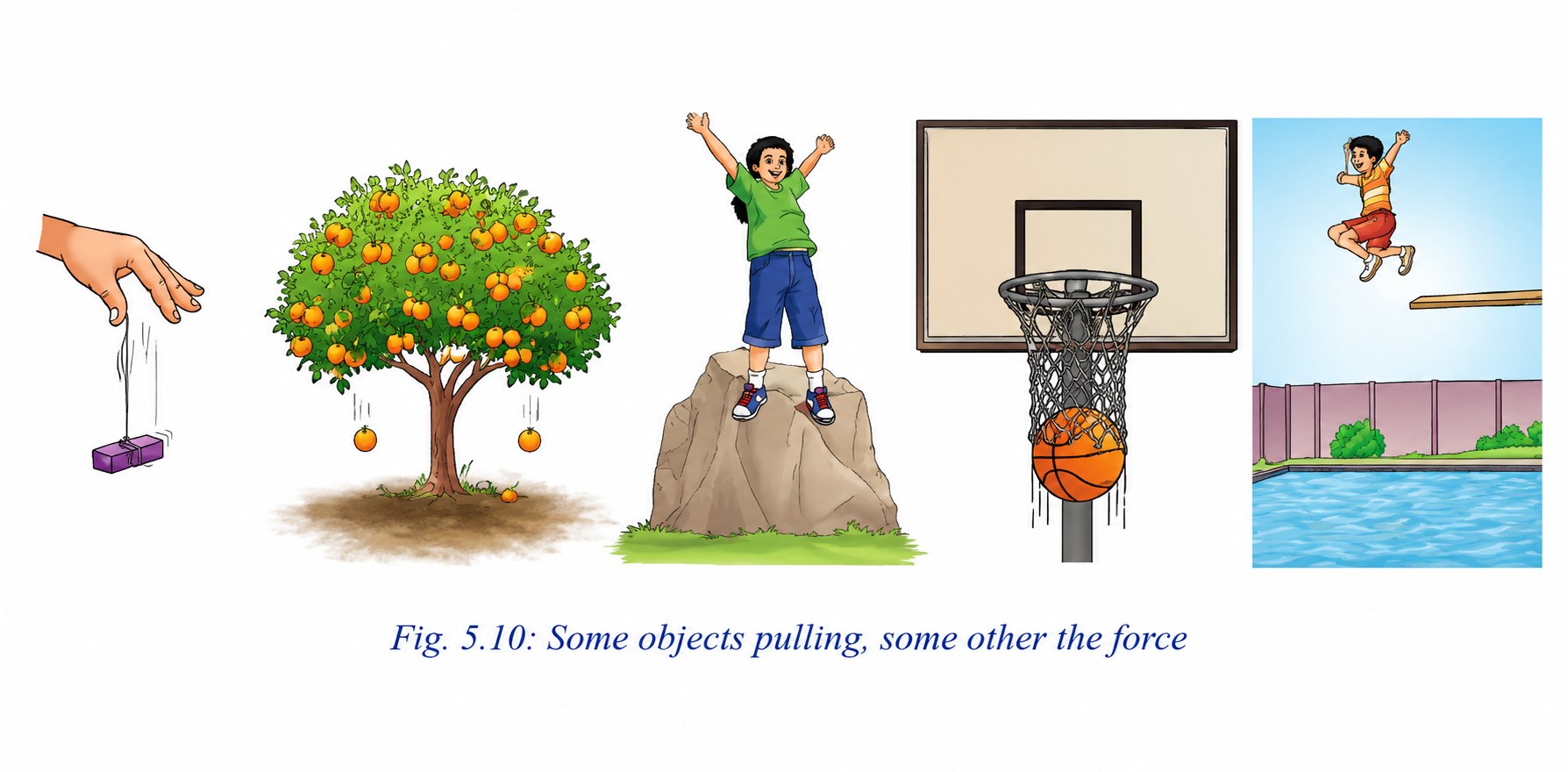
Answer:
Yes, the ball always falls back to the ground. This happens because the Earth exerts a gravitational force on all objects, pulling them towards its center. The gravitational force is always attractive and acts without contact (non-contact force).
Activity 5.9
Q1. Take a spring and a few objects of different masses, such as a pencil box, a tiffin box, and a small stone. Hang one end of the spring from a nail (Fig. 5.12a). From the other end, hang an object and observe the spring (Fig. 5.12b). Does the spring stretch? Now hang the other objects, one by one and notice the stretch in the spring each time. Is the stretch caused by each object the same? 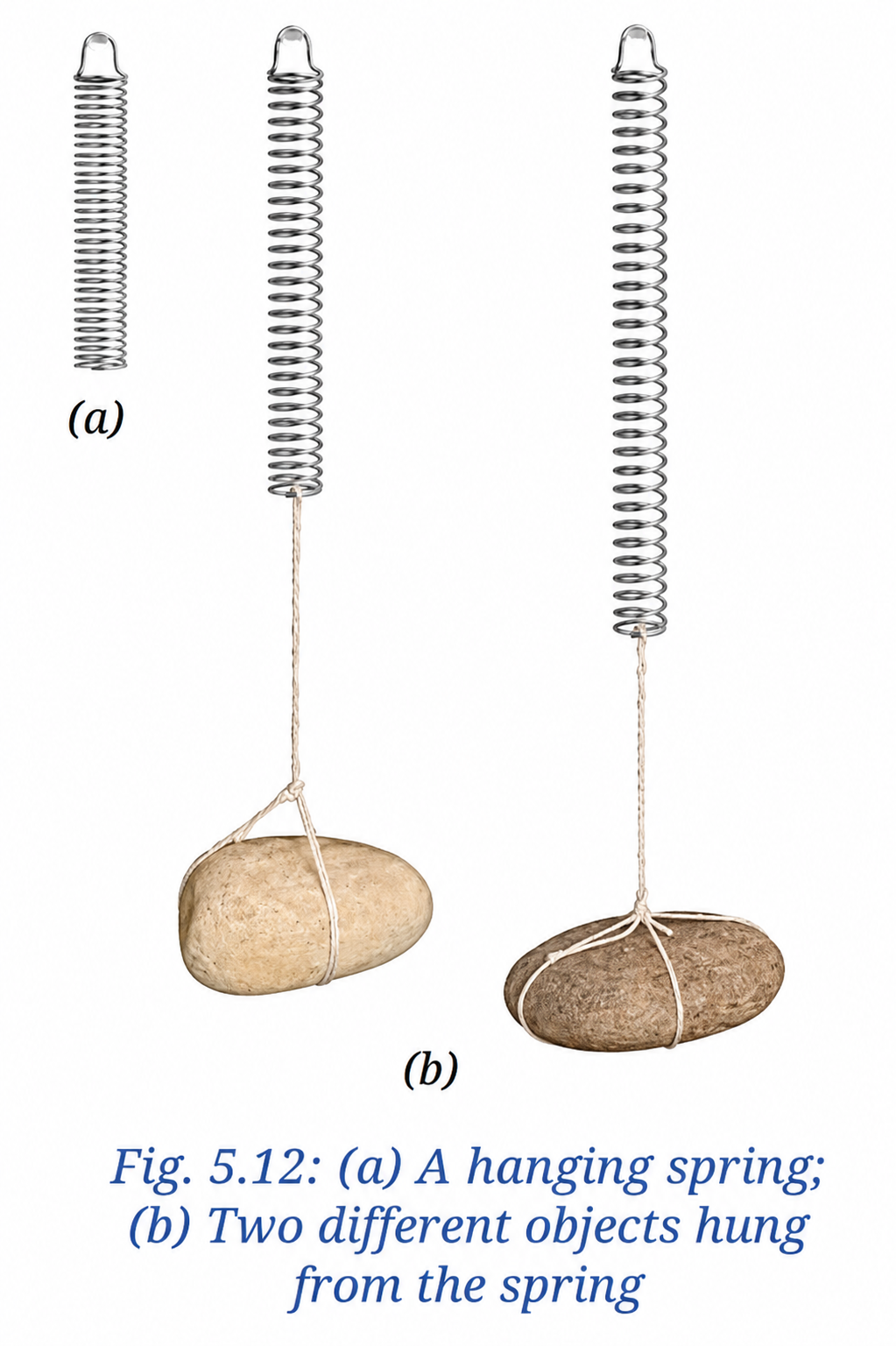
Answer:
The spring stretches when an object is hung from it. Different objects cause different amounts of stretch. Heavier objects cause more stretch. This indicates that the Earth pulls different objects with different forces (weights). The stretch shows the weight of the object.
Activity 5.10 & 5.11
Q1. Look at the spring balance shown in Fig. 5.13 carefully. What is the maximum weight it can measure? The maximum weight it can measure is 10 N. Thus, this scale has a range of 0 to 10 N. Look at the spring balance shown in Fig. 5.13 and note down the following: How much is the weight difference indicated between the two bigger marks? The weight difference indicated between 0 and 01 N or between 01 N and 02 N is 1 N. How many divisions (shown by smaller marks) are there between these two bigger marks? There are 5 divisions between these marks. How much weight does one small division indicate? One small division can read 1 N / 5 = 0.2 N. So, the smallest value that the spring balance can read is 0.2 N. 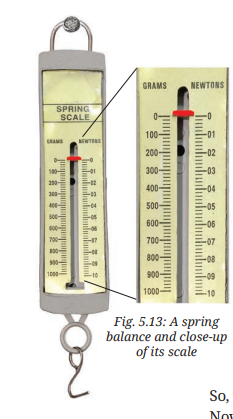
Answer:
The spring balance has a range of 0 to 10 N. The least count (smallest measurable value) is 0.2 N. Students should calculate the least count for the spring balance available in their lab by finding the difference between two major marks and dividing by the number of divisions between them.
Activity 5.12
Q1. Take a spring balance and a few objects. Keep in mind that the objects should not be heavier than the maximum value of weight the spring balance can measure, otherwise it may get damaged. Suspend the objects one by one from the hook (Fig. 5.14). Read the scale for weight carefully and record your observations in the Table 5.2. 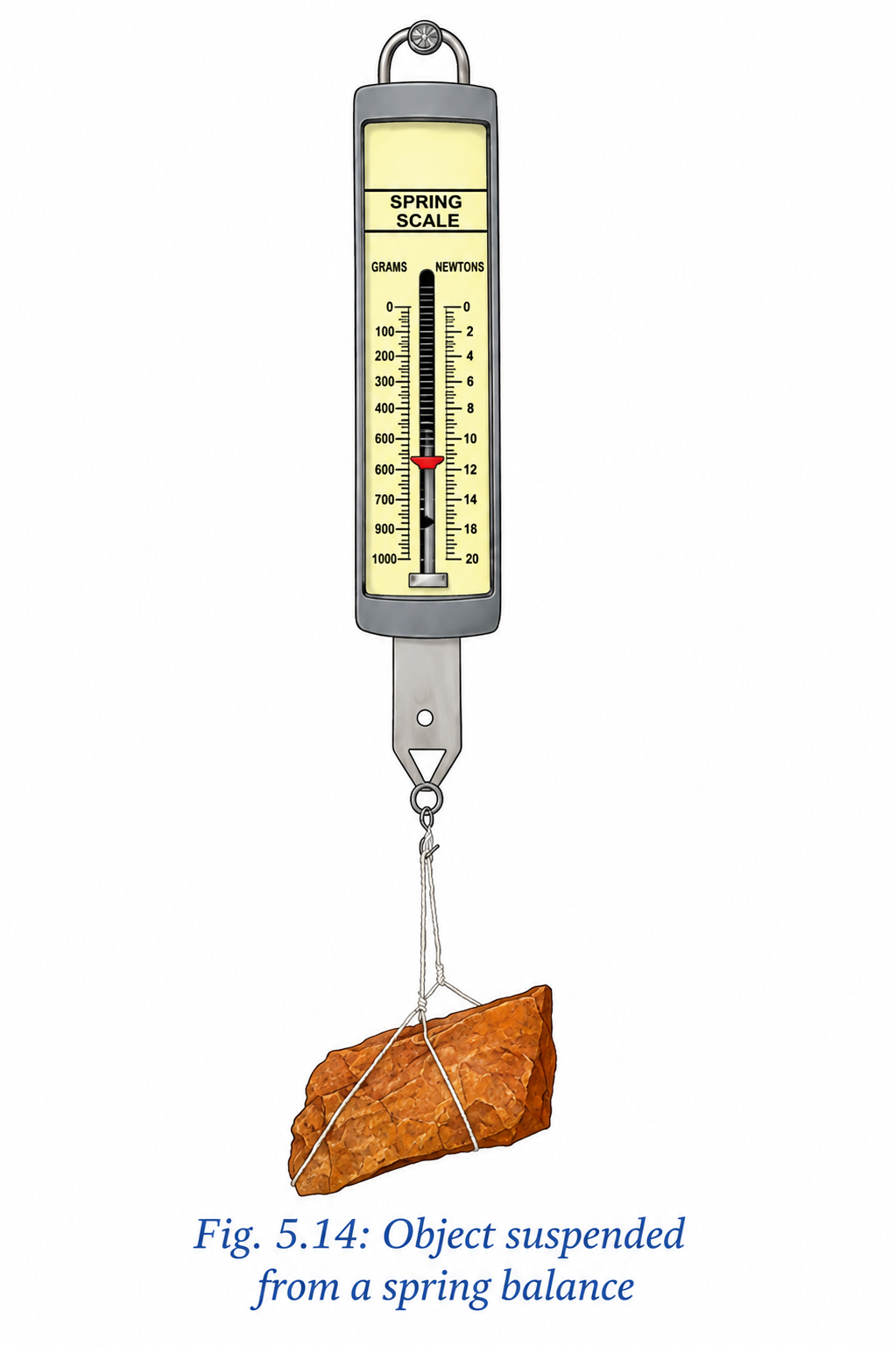
Answer:
Students should suspend different objects (pencil box, water bottle, stone, etc.) from the spring balance and record their weights in newtons. The heavier the object, the more it stretches the spring, indicating a larger weight.
Activity 5.13
Q1. Take an empty bottle (with its lid closed tightly) and a bucket full of water. Push the bottle in the water (Fig. 5.15). Do you feel an upward push? Release the bottle. Does it bounce up? You would have felt an upward push and the bottle bounces back to the surface of the water. This indicates that water applies a force on the bottle in the upward direction. In fact, all liquids apply a similar force. The force applied by a liquid on an object in the upward direction is known as upthrust or buoyant force. 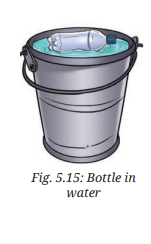
Answer:
When the bottle is pushed into water, an upward force (buoyant force) is felt. When released, the bottle bounces back to the surface. This shows that liquids exert an upward force on objects placed in them. This buoyant force opposes the downward gravitational force.
Questions and Activities
Q1. Match items in Column A with the items in Column B.
| Column A (Type of force) | Column B (Example) |
|---|---|
| (i) Muscular force | (a) A cricket ball stopping on its own just before touching the boundary line |
| (ii) Magnetic force | (b) A child lifting a school bag |
| (iii) Frictional force | (c) A fruit falling from a tree |
| (iv) Gravitational force | (d) Balloon rubbed on woollen cloth attracting hair strands |
| (v) Electrostatic force | (e) A compass needle pointing North |
Answer:
(i) Muscular force → (b) A child lifting a school bag
(ii) Magnetic force → (e) A compass needle pointing North
(iii) Frictional force → (a) A cricket ball stopping on its own just before touching the boundary line
(iv) Gravitational force → (c) A fruit falling from a tree
(v) Electrostatic force → (d) Balloon rubbed on woollen cloth attracting hair strands
Q2. State whether the following statements are True or False. (i) A force is always required to change the speed of motion of an object. (ii) Due to friction, the speed of the ball rolling on a flat ground increases. (iii) There is no force between two charged objects placed at a small distance apart.
Answer:
(i) True - Force is required to change speed (accelerate or decelerate).
(ii) False - Friction opposes motion and decreases the speed of a rolling ball.
(iii) False - There is an electrostatic force between two charged objects.
Q3. Two balloons rubbed with a woollen cloth are brought near each other. What would happen and why?
Answer:
The two balloons would repel each other. When rubbed with a woollen cloth, both balloons acquire the same type of charge. Like charges repel each other.
Q4. When you drop a coin in a glass of water, it sinks, but when you place a bigger wooden block in water, it floats. Explain.
Answer:
A coin sinks because its weight is greater than the buoyant force exerted by water on it. The wooden block floats because its weight is less than or equal to the buoyant force. The buoyant force depends on the volume of the object displaced. The wooden block displaces more water due to its larger volume, creating a greater upward force, while the coin displaces less water.
Q5. If a ball is thrown upwards, it slows down, stops momentarily, and then falls back to the ground. Name the forces acting on the ball and specify their directions. (i) During its upward motion (ii) During its downward motion (iii) At its topmost position
Answer:
(i) Upward motion: Gravitational force acts downward (towards the Earth). It slows down the ball.
(ii) Downward motion: Gravitational force acts downward, pulling the ball towards the Earth and increasing its speed.
(iii) Topmost position: Gravitational force acts downward (still pulling the ball towards the Earth).
Q6. A ball is released from the point P and moves along an inclined plane and then along a horizontal surface as shown in the Fig. 5.16. It comes to stop at the point A on the horizontal surface. Think of a way so that when the ball is released from the same point P, it stops (i) before the point A (ii) after crossing the point A. 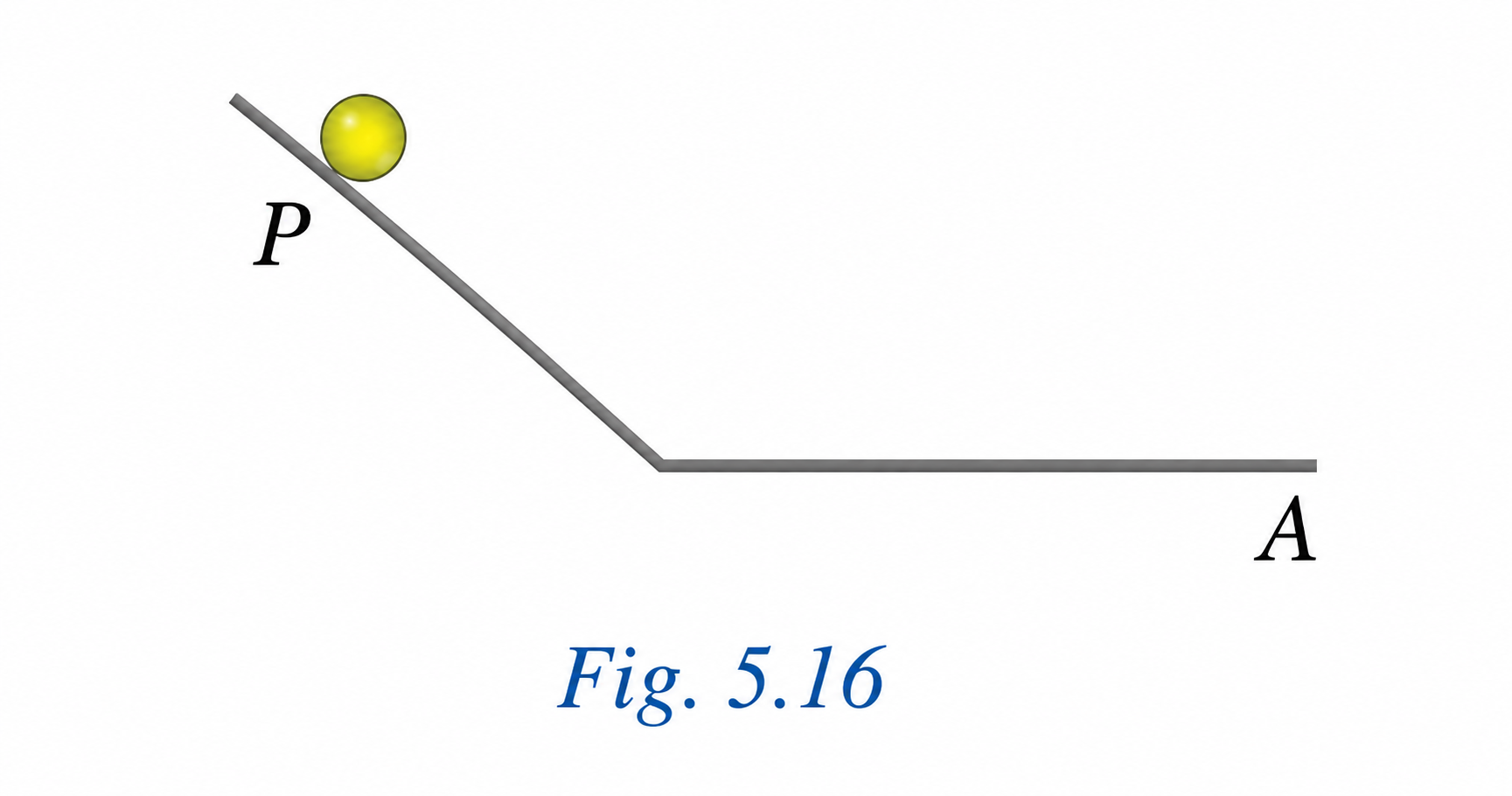
Answer:
(i) To stop before point A: Increase the friction on the horizontal surface (e.g., put sand or rough cloth on the surface) so the ball stops sooner.
(ii) To stop after crossing point A: Decrease the friction on the horizontal surface (e.g., put a smooth sheet like glass) so the ball travels further before stopping. Alternatively, increase the height of P (more potential energy) so the ball gains more speed and travels further.
Q7. Why do we sometimes slip on smooth surfaces like ice or polished floors? Explain.
Answer:
We slip on smooth surfaces like ice or polished floors because these surfaces have very low friction. The force of friction that normally provides grip between our shoes and the ground is greatly reduced. With less friction, our feet cannot get enough traction, making it easy to lose balance and slip.
Q8. Is any force being applied to an object in a non-uniform motion?
Answer:
Yes, when an object is in non-uniform motion (changing speed or direction), an unbalanced force is acting on it. A force is required to change the speed or direction of motion. According to Newton's first law, without an unbalanced force, an object would continue in uniform motion (constant speed in a straight line).
Q9. The weight of an object on the Moon becomes one-sixth of its weight on the Earth. What causes this change? Does the mass of the object also become one-sixth of its mass on the Earth?
Answer:
The weight changes because the gravitational force on the Moon is weaker (about one-sixth) than on Earth. The mass of the object does not change. Mass is the amount of matter in the object and remains the same everywhere. Weight depends on gravity, so it changes with the location.
Q10. Three objects 1, 2, and 3 of the same size and shape but made of different materials are placed in the water. They dip to different depths as shown in Fig. 5.17. If the weights of the three objects 1, 2, and 3 are w₁, w₂ and w₃ respectively, then (i) w₁ = w₂ = w₃ (ii) w₁ > w₂ > w₃ (iii) w₂ > w₃ > w₁ (iv) w₃ > w₁ > w₂
Answer:
The object that dips the deepest is the heaviest (largest weight). From the figure, if Object 1 dips the most, then w₁ > w₂ > w₃. Therefore, the correct option is (ii) w₁ > w₂ > w₃.
Discover, Design, and Debate
Q1. Collect objects made of different materials, such as plastic, wool, silk, rubber, polythene sheet, paper, and metals. Rub one material with another and check if it attracts small pieces of paper or not, that is, whether it gets charged or not. Record your observations in a systematic manner and write a research paper. Imagine a scenario where the gravity disappears. Develop a story. Create a cartoon strip to present your story. Organise a discussion in your class on the topic: Friction—a necessity or a problem? Make a note of the discussion and state where friction is a necessity and when it is a problem. Make your own spring balance with the help of your teacher and calibrate it using standard weights. Now measure the weights of different objects and calculate the ratio of the weight and mass of different objects. Do you observe a pattern? An electroscope is a device which can determine whether an object is electrically charged. You can make your own electroscope (Fig. 5.18) in your class with the help of your teacher, test the device. Explore in what other ways you may use this electroscope.
Answer:
Activity 1 (Charging materials): Students should rub different materials together (e.g., plastic with wool, silk with glass) and test if they attract paper. They should record which materials get charged.
Activity 2 (Gravity disappears): This is a creative story-writing/cartoon activity. Students can imagine a world where objects float, water doesn't flow downhill, and everything is weightless.
Activity 3 (Friction debate): Necessity: Walking, writing, holding objects, brakes in vehicles, lighting a match. Problem: Wear and tear of machinery, energy loss, reduced efficiency.
Activity 4 (Spring balance): Students can make a simple spring balance and measure weights. They can calculate the ratio of weight to mass (which equals acceleration due to gravity, g ≈ 9.8 m/s²).
Activity 5 (Electroscope): An electroscope can detect the presence and nature of charge on an object.