
Margin Questions
Q1. How might the loss of forest cover and changes in rainfall patterns lead to elephants to enter human farms and villages?
Answer:
Loss of forest cover and changes in rainfall patterns lead to scarcity of vegetation and drying up of waterholes in the elephants' natural habitat. When their natural food sources become scarce, elephants wander into nearby farms or plantations in search of food like bananas and sugarcane. Additionally, cutting down trees for constructing roads and buildings worsens this situation, causing the drying and shrinking of forests. This loss of habitat forces elephants to move into human habitats, leading to conflicts with human settlements.
Q2. Imagine you are a tree in a dense forest. What kind of relationships would you have with water, sunlight, other animals, and other components of the forest?
Answer:
As a tree in a dense forest, I would have several important relationships with different components of the forest:
- With Water: I would absorb water and minerals from the soil through my roots. Water is essential for photosynthesis and transporting nutrients throughout my body.
- With Sunlight: I would use sunlight to perform photosynthesis, converting carbon dioxide and water into food (glucose) and oxygen. My leaves would be positioned to capture maximum sunlight.
- With Other Animals: Birds would build nests on my branches. Insects would feed on my leaves. Some animals would eat my fruits and disperse my seeds. In return, I would provide food, shelter, and oxygen to these animals.
- With Other Components (Soil, Decomposers): I would depend on soil for anchorage and nutrients. Decomposers like fungi and bacteria would break down my fallen leaves and dead parts, returning nutrients to the soil that I can reuse.
Q3. Do you think the Earth can thrive without humans? Can humans survive without the Earth?
Answer:
The Earth can thrive without humans as it has existed for billions of years before human evolution. Ecosystems function naturally through interactions among biotic and abiotic components, maintaining balance and recycling nutrients. However, humans cannot survive without the Earth. We depend entirely on the Earth's resources—air, water, food, shelter, and raw materials—for our survival. Human well-being is deeply connected to the health of ecosystems and the environment. This interdependence highlights our responsibility to protect and sustainably use natural resources.
Q4. If two kinds of birds compete for the same fruit, how might their way of living change over time?
Answer:
If two kinds of birds compete for the same fruit, several changes might occur over time:
- One species might become better adapted at accessing the fruit (e.g., developing stronger beaks to crack open the fruit or better foraging skills).
- One species might shift to eating other types of food to reduce competition.
- The more efficient competitor might outcompete the other, leading to a decline in the population of the less efficient species.
- The birds might develop different feeding times (e.g., one feeding in the morning and the other in the evening) to avoid direct competition.
- One species might migrate to a different area where the fruit is more abundant.
These changes occur through natural selection, where individuals with advantageous traits survive and reproduce, gradually altering the way of living of the bird species.
Q5. Can human actions cause natural disasters? Share your questions?
Answer:
Yes, human actions can cause or worsen natural disasters. Deforestation, pollution, overexploitation of resources, and climate change are human activities that can trigger or intensify events like floods, droughts, cyclones, soil erosion, and habitat loss. Examples include:
- Deforestation: Leads to soil erosion, landslides, and floods.
- Pollution: Contributes to climate change, which can cause extreme weather events.
- Overextraction of groundwater: Can lead to droughts and land subsidence.
Based on this learning, here are some questions to explore:
- What specific human activities contribute most to climate change?
- How does pollution affect the balance of ecosystems?
- What can communities do to reduce the impact of natural disasters caused by human actions?
Activities
Q1. Activity 12.1: Let us explore Identify two habitats in your surroundings. These could be any two of the following: a pond, a forest, an agricultural farm, or even a large tree like banyan, mango, or pilkhan (white fig) tree. List the living beings and non-living things that you observe in these habitats. Record your observations in Table 12.1. 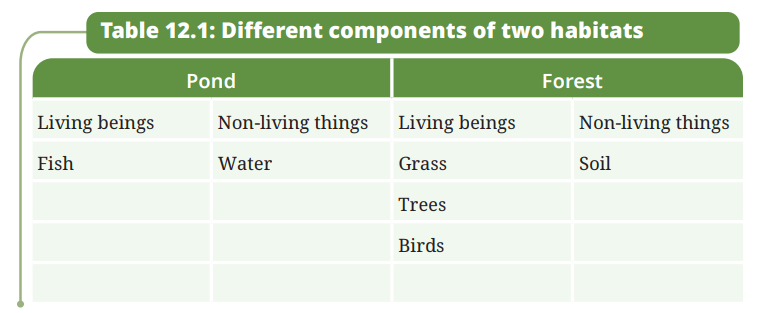
Answer:
This is an activity-based question. Students should explore habitats in their surroundings and record their observations. A sample response for a pond and forest habitat is provided:
For a Pond Habitat:
| Living Beings (Biotic) | Non-living Things (Abiotic) |
|---|---|
| Fish | Water |
| Frogs | Soil |
| Dragonflies | Sunlight |
| Mosquitos | Rocks/Pebbles |
| Snails | Air |
| Ducks | Temperature |
| Algae | |
| Duckweeds | |
| Lotus |
For a Forest Habitat:
| Living Beings (Biotic) | Non-living Things (Abiotic) |
|---|---|
| Grass | Water |
| Trees | Soil |
| Birds | Sunlight |
| Deer | Air |
| Hare | Temperature |
| Fox | Rocks |
Q2. Activity 12.2: Let us record Divide students into four to five groups. Each group may identify any two organisms, plant(s) or animal(s). Mark an area of 1m×1m in your school garden. Identify four organisms in this area, and count their numbers. Record the number of the organisms in Table 12.2. Compile the data from all groups. 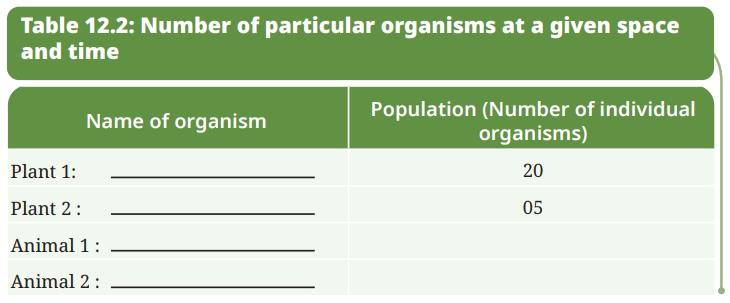
Answer:
This is an activity-based question. Students should perform the activity in their school garden and record their observations. Sample data for Table 12.2 is provided:
| Name of organism | Population (Number of individual organisms) |
|---|---|
| Plant 1 (Grass) | 20 |
| Plant 2 (Clover) | 5 |
| Animal 1 (Ants) | 15 |
| Animal 2 (Earthworms) | 3 |
Based on the activity, students should understand that a population is a group of the same type of organisms in a habitat at a given time. Different populations together form a community.
Q3. Activity 12.3: Let us read Researchers conducted a study to see how fish in ponds affect seed production in the plants nearby. They observed two ponds — A with fish and large number of flowering plants around it; B without fish and fewer flowering plants around it (Fig. 12.3). Think of a reason for these observations. 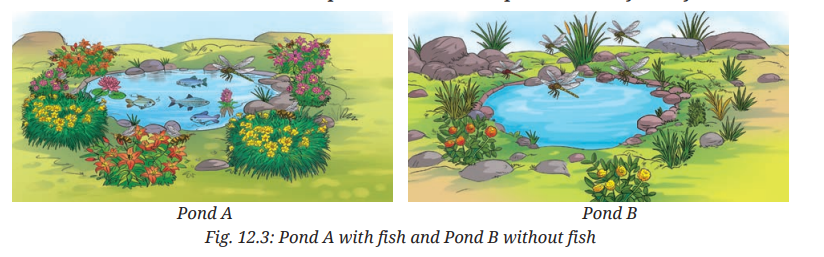
Answer:
Pond A (with fish) had more flowering plants because fish eat dragonfly larvae. With fewer dragonflies, there were more bees, flies, and butterflies. These insects help pollinate flowers, which helps plants produce more seeds. In Pond B (without fish), there were more dragonflies because no fish ate their larvae. More dragonflies meant fewer bees and butterflies, so fewer flowers were pollinated, resulting in fewer flowering plants.
Q4. Activity 12.4: Let us relate and identify Based on the given criteria, identify and describe the interactions between biotic and abiotic components shown in Fig. 12.5. Record your observations in Table 12.3 at the appropriate places. 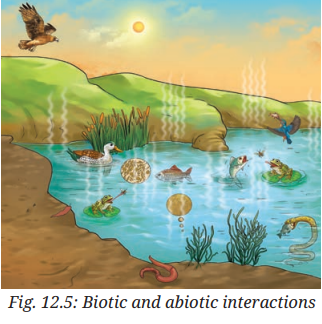
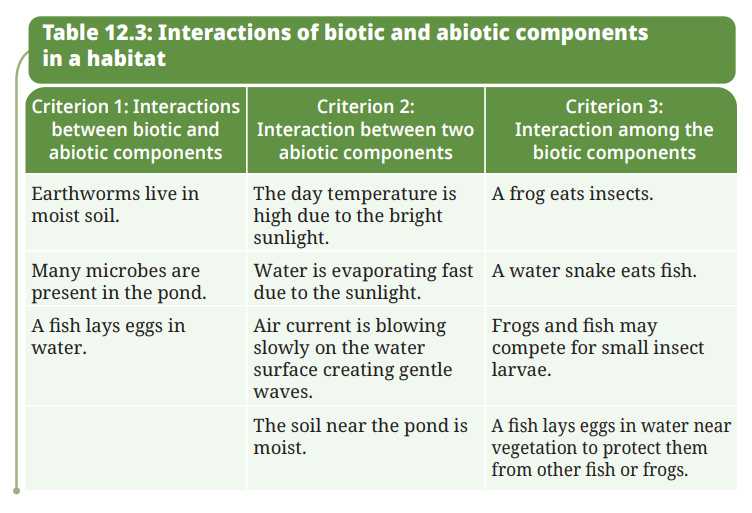
Answer:
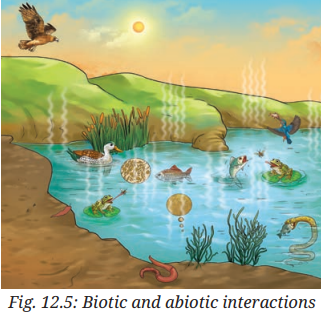
Based on the criteria provided, here are the interactions categorized:
| Criterion 1: Interactions between biotic and abiotic components | Criterion 2: Interaction between two abiotic components | Criterion 3: Interaction among the biotic components |
|---|---|---|
| Earthworms live in moist soil. | The day temperature is high due to the bright sunlight. | A frog eats insects. |
| Many microbes are present in the pond. | Water is evaporating fast due to the sunlight. | A water snake eats fish. |
| A fish lays eggs in water. | Air current is blowing slowly on the water surface creating gentle waves. | Frogs and fish may compete for small insect larvae. |
| The soil near the pond is moist. | A fish lays eggs in water near vegetation to protect them from other fish or frogs. |
These interactions demonstrate how biotic components depend on abiotic components (Criterion 1), how abiotic components affect physical characteristics (Criterion 2), and how biotic components interact for resources (Criterion 3).
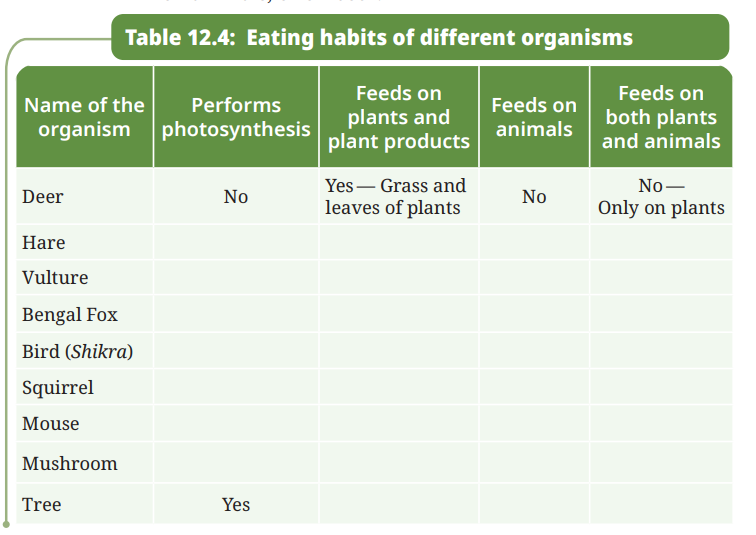
Q5. Activity 12.5: Let us classify Observe Fig. 12.7, which illustrates a forest ecosystem. Study the picture carefully and spot the organisms listed in Table 12.4. Using the internet or your school library, find out what do these organisms eat. Record your observations in Table 12.4 by identifying whether each organism feeds only on plants and plant products, only on animals, or on both. 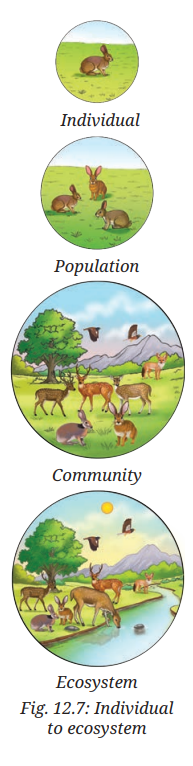
Answer:
Based on the eating habits of different organisms:
| Name of the organism | Performs photosynthesis | Feeds on plants and plant products | Feeds on animals | Feeds on both plants and animals |
|---|---|---|---|---|
| Deer | No | Yes — Grass and leaves of plants | No | No (Only on plants) |
| Hare | No | Yes — Grass and plant parts | No | No (Herbivore) |
| Vulture | No | No | Yes — Dead animals | No (Carnivore) |
| Bengal Fox | No | No | Yes — Small animals, rodents | No (Carnivore) |
| Bird (Shikra) | No | No | Yes — Small birds, lizards | No (Carnivore) |
| Squirrel | No | Yes — Nuts, seeds, fruits | No | No (Herbivore) |
| Mouse | No | Yes — Grains, plant parts | No | No (Herbivore) |
| Mushroom | No | No | No | No (Decomposer — feeds on dead organic matter) |
| Tree | Yes | No | No | No (Producer/Autotroph) |
From this activity, students should identify that trees are producers (autotrophs), animals like deer, hare, squirrel, and mouse are herbivores, vulture, Bengal fox, and Shikra are carnivores, and mushrooms are decomposers (saprotrophs).
Q6. Activity 12.6: Let us link (relate) Take an example of a grassland ecosystem. Consider the following organisms that we can spot in a grassland ecosystem: grass, frog, hare, grasshopper, snake, and eagle. In Fig. 12.8, a relationship of who eats whom is shown among some of the organisms. Draw the feeding relationships for the remaining organisms by adding arrows, similar to those in Fig. 12.8. 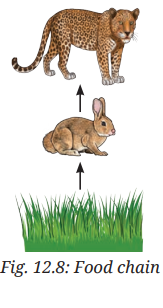
Answer:
In a grassland ecosystem, the feeding relationships among the organisms can be represented as a food chain:
Grass → Grasshopper → Frog → Snake → Eagle
Another possible food chain is:
Grass → Hare → Eagle
The arrows indicate the direction of energy flow ("is eaten by"). For example, grass is eaten by grasshopper, grasshopper is eaten by frog, frog is eaten by snake, and snake is eaten by eagle.
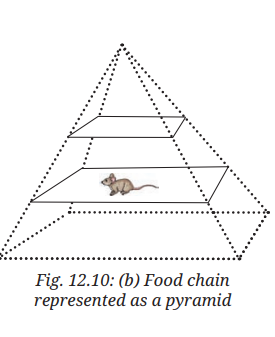
Q7. Activity 12.7: Let us draw Fig. 12.10a represents a crop field with millets, mouse, and eagle. Count the number of each type of organism in Fig. 12.10a. Make a table and set a number in the table against each of the organisms. Arrange the numbers in the ascending order, consider the highest number at the base and the lowest at the top. Place the mouse, millet, and eagle appropriately in Fig. 12.10b. What figure do you get? It looks like a pyramid. Complete the pyramid in Fig. 12.10b. 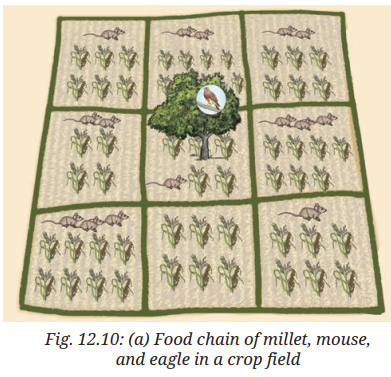
Answer:
Based on the food chain in a crop field: Millet (Producer) → Mouse (Herbivore) → Eagle (Carnivore)
Typically, the number of organisms decreases at each trophic level:
- Millet (Base): Highest number (e.g., 100 plants)
- Mouse (Middle): Fewer than millet (e.g., 20 mice)
- Eagle (Top): Lowest number (e.g., 2 eagles)
When arranged in ascending order with the highest number at the base and the lowest at the top, the figure forms a pyramid. This represents the trophic pyramid, showing that producers are most numerous and top carnivores are least numerous in a stable ecosystem.
Each organism in a food chain has a specific position called a trophic level: Producers (millet) at the first trophic level, herbivores (mouse) at the second, and carnivores (eagle) at the third.
Q8. Activity 12.8: Let us trace and link Look at Fig.12.11. Put more arrows for the missing relationship of 'who eats whom'. How many other organisms might be connected to one organism through a feeding relationship in an ecosystem? 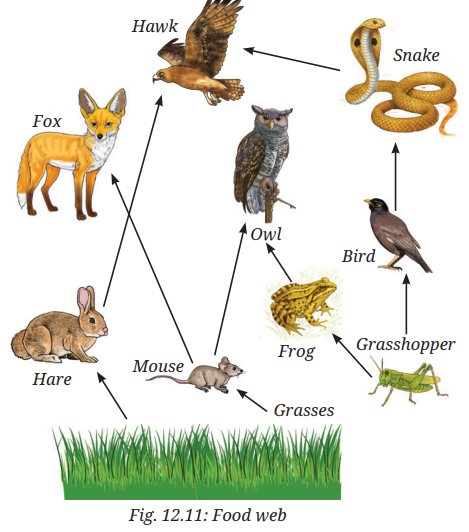
Answer:
A single organism in an ecosystem can be connected to many other organisms through feeding relationships. For example, grass is eaten by deer, hare, mouse, and grasshopper. Deer may be eaten by lion, leopard, or vulture. A food web shows how food chains are interlinked, with each organism potentially having multiple predators and prey. The more arrows drawn, the more complex the food web, demonstrating that energy flows through the ecosystem in multiple interconnected pathways.
Q9. Activity 12.9: Let us read In the 1980s, India was a significant exporter of frog legs, especially of the Indian bullfrog (Hoplobatrachus tigerinus). This large-scale harvesting led to a decline in frog populations. Since frogs eat insects, their reduced numbers resulted in a rise in agricultural pests. This forced farmers to use more synthetic pesticides, which harmed the environment, soil and water quality, and affected the overall environmental and human health. The Government of India banned the export of frog legs to prevent further ecological damage. What happens when we intervene in nature? 
Answer:
When we intervene in nature, we disrupt the delicate balance of ecosystems. In the case of the Indian bullfrog, overharvesting for export led to a decline in frog populations. Since frogs eat insects, their reduced numbers allowed agricultural pests to multiply. This forced farmers to use more synthetic pesticides, which caused environmental pollution, soil and water contamination, and health problems for humans. This chain of events demonstrates that interventions in nature can have cascading and unintended consequences, affecting multiple components of the ecosystem. The ban on frog leg exports was a step toward preventing further ecological damage and restoring balance.
Q10. Activity 12.10: Let us survey Visit a nearby farm with your parents or teacher/interact with farmers in your community to find out about the farming practices they adopt. Prepare a list of questions for farmers to find out the pesticides and other farm inputs they use, and whether they reuse or recycle materials to improve their crops. Here are some sample questions: How have your farming practices changed over time? And why? What effects do you notice when using synthetic fertilisers and pesticides? Have you seen any changes in soil health after using these synthetic fertilisers and pesticides? Interact with farmers based on these questions. Based on your findings, prepare a report.
Answer:
This is an activity-based question. Students should conduct a survey with farmers and prepare a report based on their findings. A sample report structure is provided:
Sample Survey Report:
- Objective: To understand farming practices, use of pesticides and fertilisers, and their effects on soil health.
- Methodology: Interacted with 3 farmers in the local area using prepared questions.
- Key Findings:
- Farmers have shifted from traditional organic methods to synthetic fertilisers and pesticides over the past 20 years.
- Synthetic fertilisers initially increased crop yield but are now leading to soil hardening and reduced fertility.
- Pesticides are used regularly, but farmers observed that pests are becoming resistant.
- Some farmers are returning to traditional methods like using cow dung and compost.
- Inference: While synthetic inputs boosted production, their long-term use is harming soil health and the environment. Sustainable farming practices are needed for future food security.
Suggestions:
- Encourage organic farming and use of natural fertilisers.
- Promote crop rotation and intercropping.
- Reduce pesticide use by encouraging natural pest predators.
Exercises
Q1. Refer to the given diagram (Fig. 12.19) and select the wrong statement. (i) A community is larger than a population. (ii) A community is smaller than an ecosystem. (iii) An ecosystem is part of a community. 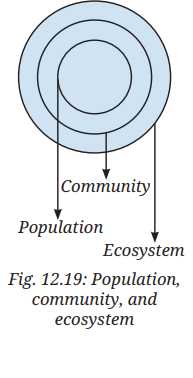
Answer:
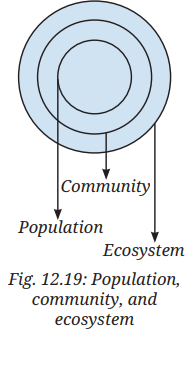
The wrong statement is: (iii) An ecosystem is part of a community.
Explanation: A community is a group of different populations living in the same habitat. An ecosystem includes both the biotic community and the abiotic components (air, water, soil, sunlight, temperature) interacting with each other. Therefore, a community is part of an ecosystem, not the other way around.
Q2. A population is part of a community. If all decomposers suddenly disappear from a forest ecosystem, what changes do you think would occur? Explain why decomposers are essential.
Answer:
If all decomposers suddenly disappear from a forest ecosystem, the following changes would occur:
- Dead plants and animals would accumulate and not decompose.
- Nutrients would not be recycled back into the soil.
- Soil fertility would decrease, affecting plant growth.
- Producers would not get enough nutrients, leading to a decline in their population.
- Herbivores and carnivores would eventually decline due to lack of food.
Decomposers are essential because:
- They break down complex substances in dead plants and animals into simpler ones.
- They return important nutrients to the soil, which plants use for growth.
- They recycle nutrients, ensuring that nothing is wasted in nature.
- They maintain the balance of ecosystems by preventing the accumulation of dead matter.
Q3. Selvam from Cuddalore district, Tamil Nadu, shared that his village was less affected by the 2004 Tsunami compared to nearby villages due to the presence of mangrove forests. This surprised Sarita, Shabnam, and Shijo. They wondered if mangroves were protecting the village. Can you help them understand this?
Answer:
Yes, mangroves were protecting the village. Mangrove forests act as natural barriers against storms, tsunamis, and cyclones. Here's how they protect coastal areas:
- Absorb wave energy: Mangrove roots and trunks slow down strong winds and waves, reducing their impact on land.
- Prevent soil erosion: Mangrove roots hold the soil together, preventing coastal erosion.
- Reduce flooding: Mangroves absorb water during floods and tsunamis, reducing water flow inland.
- Carbon absorption: Mangrove trees absorb carbon dioxide and release oxygen, improving air quality.
Because of these protective functions, villages with mangrove forests (like Selvam's village) were less affected by the 2004 Tsunami compared to villages without mangroves. This is why the Sundarbans mangroves are considered important for protecting coastal communities.
Q4. Look at this food chain: Grass → Grasshopper → Frog → Snake If frogs disappear from this ecosystem, what will happen to the population of grasshoppers and snakes? Why?
Answer:
If frogs disappear from this ecosystem:
- Grasshopper population will increase because frogs are their primary predators. Without frogs to eat them, grasshoppers will multiply.
- Snake population will decrease because snakes eat frogs as their food source. Without frogs, snakes will have less food, leading to a decline in their population.
This disruption in the food chain shows how the removal of one organism can lead to imbalances in the ecosystem.
Q5. In a school garden, students noticed fewer butterflies the previous season. What could be the possible reasons? What steps can students take to have more butterflies on campus?
Answer:
Possible reasons for fewer butterflies:
- Use of pesticides that kill butterflies and their larvae.
- Loss of host plants (where butterflies lay eggs).
- Loss of nectar sources (flowering plants).
- Climate changes (unseasonal rains or temperature changes).
- Increase in predators (birds, spiders).
Steps students can take to attract more butterflies:
- Plant native flowering plants that provide nectar (e.g., marigold, sunflower, lantana).
- Plant host plants for caterpillars (e.g., milkweed, citrus plants).
- Avoid using pesticides in the school garden.
- Provide shallow water sources for butterflies to drink.
- Create a butterfly garden with diverse plants to support different butterfly species.
Q6. Why is it not possible to have an ecosystem with only producers and no consumers or decomposers?
Answer:
It is not possible to have an ecosystem with only producers because:
- Nutrient cycling: Decomposers are needed to break down dead organic matter and recycle nutrients back to the soil. Without decomposers, nutrients would remain locked in dead matter and not be available for producers.
- Energy flow: Energy flows through the ecosystem from producers to consumers and eventually to decomposers. Without consumers and decomposers, the food chain is incomplete, and energy cannot flow through the ecosystem.
- Waste management: Dead producers would accumulate and occupy space, leading to overcrowding and lack of resources for new plants.
- Balance: Consumers and decomposers help maintain the balance of populations and resources in the ecosystem. Without them, producers would overgrow and exhaust available resources.
Q7. Observe two different places near your home or school (e.g., a park and a roadside). List the living and non-living components you see. How are the two ecosystems different?
Answer:
This is an observation-based question. A sample response is provided:
Observation 1: Park
| Living Components (Biotic) | Non-living Components (Abiotic) |
|---|---|
| Grass, trees, flowering plants, birds, squirrels, butterflies, earthworms | Soil, water (pond/puddle), sunlight, air, temperature |
Observation 2: Roadside
| Living Components (Biotic) | Non-living Components (Abiotic) |
|---|---|
| Stray grass, small shrubs, weeds, insects (flies, ants), birds (crows), stray animals | Concrete/road, dust, sunlight, air, temperature, vehicle exhaust, litter |
Differences between the two ecosystems:
- Biodiversity: The park has greater biodiversity with more plant and animal species. The roadside has fewer species.
- Abiotic factors: The park has soil and water, while the roadside has concrete, dust, and pollution.
- Human impact: The roadside is heavily impacted by human activities (vehicles, litter), while the park is managed for human recreation.
- Naturalness: The park is more natural, while the roadside is a human-altered environment.
Q8. 'Human-made ecosystems like agricultural fields are necessary, but they must be made sustainable.' Comment on the statement
Answer:
Human-made ecosystems like agricultural fields are necessary because they provide food, fibre, and other resources to support the growing human population. Agriculture is a major livelihood in India and essential for food security.
However, they must be made sustainable because:
- Overuse of synthetic chemicals: Synthetic fertilisers and pesticides can degrade soil health, reduce beneficial microorganisms, and contaminate water sources.
- Monoculture: Growing the same crop repeatedly reduces biodiversity and makes crops more vulnerable to pests and diseases.
- Groundwater depletion: Excessive irrigation leads to overextraction of groundwater.
- Soil erosion: Without proper management, soil becomes degraded and prone to erosion.
Ways to make agriculture sustainable:
- Adopt organic farming and use natural fertilisers (compost, cow dung).
- Practice crop rotation and intercropping to maintain soil fertility.
- Use integrated pest management to reduce pesticide use.
- Conserve water through efficient irrigation methods (drip irrigation, rainwater harvesting).
- Encourage agroforestry and maintain natural habitats around farms.
Sustainable farming practices ensure that agricultural fields can continue to produce food without harming the environment for future generations.
Q9. If the Indian hare population (Fig. 12.20) drops because of a disease, how would it affect the number of other organisms? 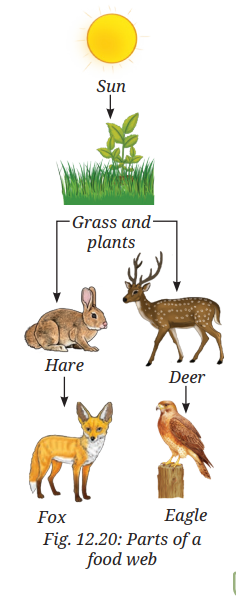
Answer:
If the Indian hare population drops due to disease, the following effects would occur:
- Grass population will increase: Since hares eat grass, fewer hares mean less grazing, allowing grass to grow more abundantly.
- Fox population will decrease: Foxes prey on hares. With fewer hares, foxes will have less food, leading to a decline in their population.
- Eagle population may also decrease: Eagles may eat hares and other animals. If hares are a significant food source for eagles, their population may also decline.
This shows how a change in one population can have cascading effects on other organisms in the food web, demonstrating the interconnectedness of ecosystems.
Discover, Design, and Debate
Q1. Plan a clean-up day at school or a nearby park. Wearing gloves and using bags, collect the litter you find. Discuss the kinds of waste you found. Which was the most common? How can we reduce such waste?
Answer:
This is an activity-based question. Students should plan and conduct a clean-up activity and then answer the questions based on their findings.
Sample response:
During the clean-up day at the school park, we found the following types of waste:
- Plastic waste: Polythene bags, plastic bottles, wrappers (most common).
- Paper waste: Notebook pages, newspapers, paper cups.
- Glass waste: Broken bottles.
- Organic waste: Fruit peels, food waste.
Most common waste: Plastic waste (polythene bags and wrappers).
How to reduce such waste:
- Use reusable bags instead of polythene bags.
- Avoid single-use plastics and carry refillable water bottles.
- Segregate waste into biodegradable and non-biodegradable bins.
- Promote recycling and upcycling of waste materials.