
Probe and Ponder
Q1. Why is it possible to pile up stones or sand, but not a liquid like water?
Answer:
Stones and sand are solids. In solids, the particles are closely packed with strong interparticle forces of attraction, giving them a fixed shape and volume. Liquids like water have particles that are not as tightly packed and can move past each other, so they take the shape of the container and cannot be piled up.
Q2. Why does water take the shape of folded hands but lose that shape when released?
Answer:
Water is a liquid, so its particles can move and flow. When you hold water in folded hands, it takes the shape of your hands. When you release it, the water flows out because its particles are not held together by strong forces and can move freely, spreading out and flowing away.
Q3. We cannot see air, so how does it add weight to an inflated balloon?
Answer:
Air is made up of gas particles that have mass. When a balloon is inflated, air is pumped into it, adding more gas particles. These particles have weight, so the balloon becomes heavier. Although we cannot see the air, its mass contributes to the weight of the balloon.
Q4. Is the air we breathe today the same that existed thousands of years ago?
Answer:
The air we breathe today is not exactly the same, but it is made of the same types of particles (nitrogen, oxygen, carbon dioxide, etc.). The particles have been recycled through natural processes like photosynthesis, respiration, and the water cycle over thousands of years. However, the composition of the atmosphere has changed due to human activities like burning fossil fuels.
Activity 7.1
Q1. Take a stick of chalk (Fig. 7.1a) and break it into two pieces (Fig. 7.1b). Continue breaking the chalk till it becomes difficult to break it further by hand. Grind the small pieces of chalk thus obtained (Fig. 7.1c) using mortar and pestle. Observe the fine powder of chalk with a magnifying glass (Fig. 7.1d). What do you observe? Each tiny grain you observe is still a speck of chalk. Recall Curiosity, Grade 7 chapter 'Changes Around Us: Physical and Chemical'—is grinding chalk a physical change or a chemical change? You learnt that the chalk does not change into a new substance on grinding. It is a physical change in which only the size of each speck of chalk has reduced further. 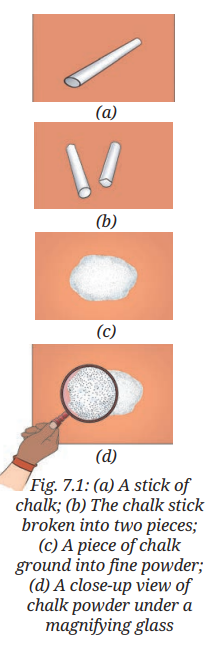
Answer:
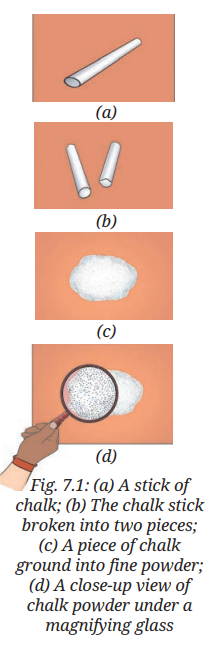
When chalk is broken and ground, it turns into a fine powder. Each grain is still chalk and has the same properties. This shows that chalk is made up of smaller particles. Grinding is a physical change because no new substance is formed—only the size of the chalk particles is reduced.
Activity 7.2
Q1. Fill a glass tumbler with drinking water. Put two teaspoons of sugar into it. Do not stir the water. Taste a small spoonful of water from the top layer. Does the water taste sweet? Now, stir the water until the sugar dissolves completely (Fig. 7.2). Again taste a spoonful of water from the top layer. What difference in taste do you notice? Does it taste sweet? Since the top layer of water tastes sweet after dissolving sugar, it must be present in the solution. Do you observe any sugar particles in the solution? 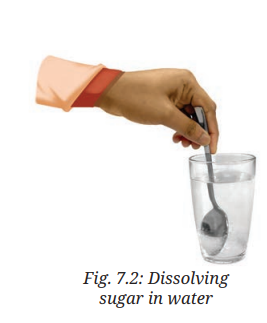
Answer:
Before stirring, the water may not taste sweet at the top layer. After stirring, the water tastes sweet, even though no sugar particles are visible. This shows that sugar particles are extremely small and spread evenly throughout the water, occupying the spaces between water particles. This supports the idea that matter is made up of tiny particles.
Activity 7.3
Q1. Collect a few solid objects, such as a piece of iron or an iron nail, a piece of rock salt, a stone, a piece of wood, a key, and a piece of aluminium (Fig. 7.3). Observe their shapes and sizes. Try hammering them. In which of the above six objects do you think particles are strongly held together? 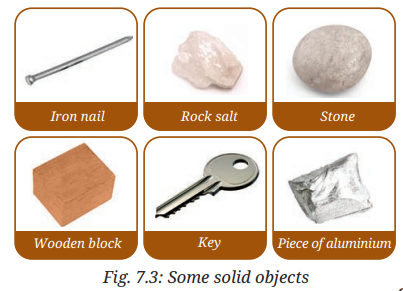
Answer:
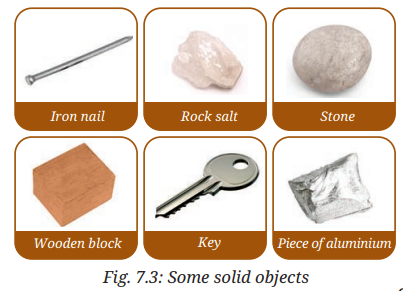
In all these solids, the particles are strongly held together. They have a definite shape and volume because the interparticle forces of attraction are very strong, keeping the particles in fixed positions. This is why solids cannot be compressed easily and maintain their shape.
Activity 7.4
Q1. Take three clean and dry containers of different shapes. Label them A, B, and C (Fig. 7.5). Mark the 200 mL level in each container using a marker or by pasting a thin strip of paper. Fill Container A with water up to the marked level. Carefully transfer the water from Container A to Container B without spilling, and observe the shape and level of the water. Now, transfer the same water from Container B to Container C, carefully, and observe the shape and its level again. You will notice that the water takes the shape of the container into which it is poured. So, we can say that the liquids do not have a fixed shape and take the shape of the container they are kept in. This happens because the particles of liquids are free to move. In all three containers, the water level remains at 200 mL and no change in volume is observed. Hence, we can say that liquids have a definite volume. However, if a container is not clean, some water may stick to its walls, causing the water level in the next container to be slightly less than 200 mL after pouring. 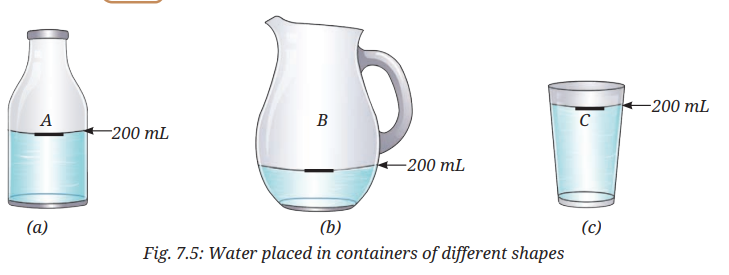
Answer:
Water takes the shape of the container it is poured into because its particles can move freely and slide past each other. However, the volume remains constant at 200 mL because liquids have a definite volume. This shows that liquids have no fixed shape but a fixed volume.
Activity 7.5
Q1. Take two transparent gas jars or glass tumblers and mark them A and B. Create some smoke by burning an incense stick. Hold the Gas Jar A upside down over the smoke (Fig. 7.7a). The gas jar should trap the smoke inside. Turn it over and cover it with a glass plate (Fig. 7.7b). Hold another Gas Jar B upside down and gently place it over the glass plate covering the Gas Jar A. Remove the glass plate slowly and ensure that both gas jars are close enough and there is no gap for smoke to escape (Fig. 7.7c). Observe how the smoke spreads inside the Gas Jar B. The smoke fills the entire space in the Gas Jar B, indicating that gases do not have a fixed volume and tend to occupy the entire available space (Fig. 7.7d). Like liquids, they also acquire the shape of the vessel they are in. 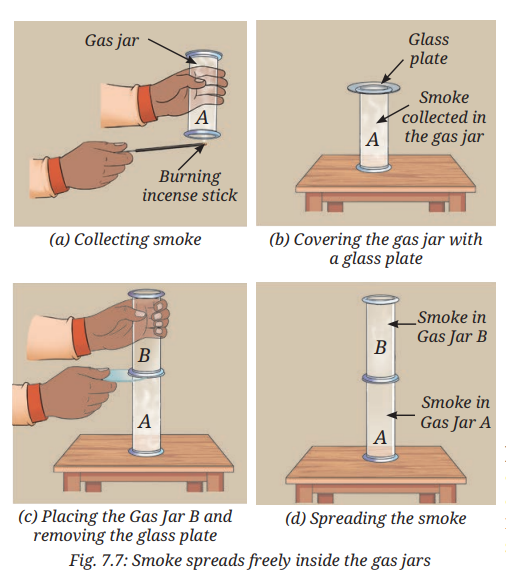
Answer:
Smoke spreads to fill the entire gas jar, showing that gas particles are in constant random motion and move freely in all directions. Gases have no fixed shape or volume—they fill the entire container they are in. This happens because the interparticle forces in gases are negligible, and the particles are far apart.
Activity 7.6
Q1. Take a syringe without a needle. Pull the plunger of the syringe outwards in a fully extended position (Fig. 7.9a). Place your thumb over the open end of the syringe to prevent the air present inside the syringe from escaping (Fig. 7.9b). Push the plunger slowly and steadily inward (Fig. 7.9c). What do you observe? As you do this, you will notice that the volume of air inside the syringe decreases. What can we say about the behaviour of gas in the syringe? When you compress the air by pushing the plunger, the particles are forced to come closer. This shows that the gas particles have a lot of space between them in their natural state, and this space can be reduced by applying external pressure. If you stop pushing the plunger, the gas particles spread, and the plunger moves back to its original position. Repeat this activity using water and observe. You would observe that water is practically incompressible. 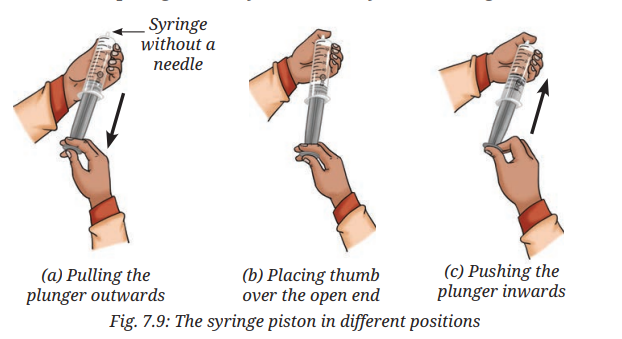
Answer:
Air in the syringe is compressible because there are large spaces between gas particles. When the plunger is pushed, the particles are forced closer together, reducing the volume. Water is practically incompressible because the particles in liquids are already close together with little space between them.
Activity 7.7
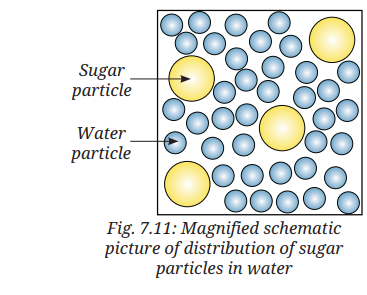
Q1. Take a glass vessel, fill it about half with water, and mark the level of water A (Fig. 7.10a). Add two teaspoons of sugar into it. Mark the new water level on the glass vessel B (Fig. 7.10b). Stir the water with a glass rod to dissolve the sugar (Fig. 7.10c). Predict whether the water level will increase or decrease with respect to the mark B. Mark this water level again as C (Fig. 7.10d). What difference do you observe in the water levels? You will observe that initially, when sugar is added, the level of water increases, but after dissolution, it may decrease to some extent. Since the volume of the solution is less than the sum of the volumes of water and sugar, it indicates that there is some space between the water particles. The particles of the dissolved substance occupy these spaces (Fig. 7.11). 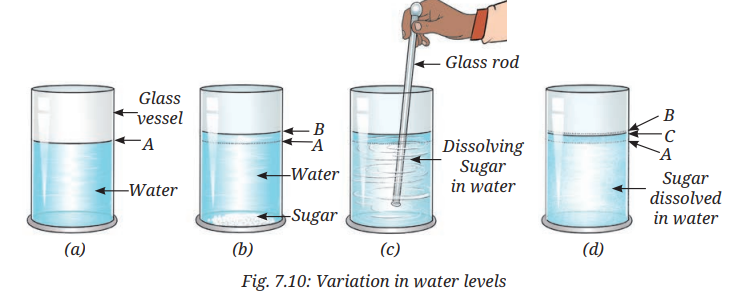
Answer:
When sugar is added, the water level rises. After dissolution, the level may decrease slightly because sugar particles occupy the spaces between water particles. This shows that there are interparticle spaces between particles in liquids, and dissolved particles can occupy these spaces.
Activity 7.8
Q1. Take a glass tumbler containing water and put a few grains of potassium permanganate into it. What do you observe? Initially, you will see some streaks of pink colour spreading out from the grain (Fig. 7.13a). With the passage of time, the entire bulk of water will acquire a uniform pink colour (Fig. 7.13b). Do you know why this happens? 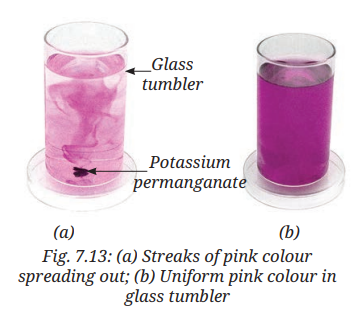
Answer:
Potassium permanganate particles spread throughout the water because water particles are in constant motion. They collide with the potassium permanganate particles, breaking them up and distributing them evenly. This shows that particles in liquids are constantly moving (diffusion).
Activity 7.9
Q1. Light an incense stick in one corner of the room (Fig. 7.14). Wait for a few minutes and observe. Do you notice the fragrance from a distance? When an incense stick is burnt in one corner of the room, initially, the fragrance is felt only around the incense stick. Shortly, you can smell the fragrance throughout the room. This happens because the particles of the fragrance spread, filling the entire room. This shows that the particles of air are moving constantly. The air particles hit the particles of the fragrance and help them spread throughout the room. 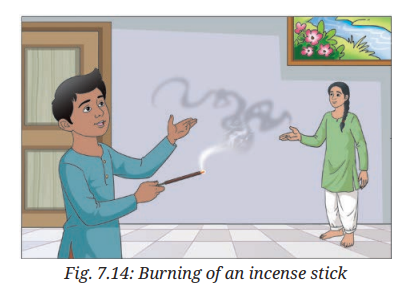
Answer:
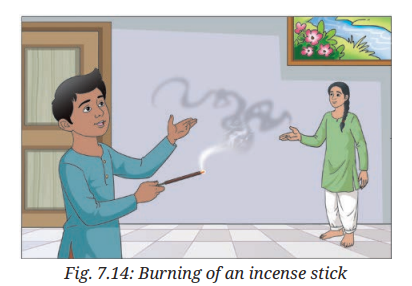
The fragrance spreads throughout the room because the particles of incense are in constant motion and move to all parts of the room due to diffusion. This shows that gas particles are in constant random motion and can move freely in all directions.
Think Like a Scientist
Q1. Take three clean glass tumblers. Pour hot water in one of them, water at room temperature in the second and ice-cold water in the third. Drop a small grain of potassium permanganate into each of them. Watch carefully and compare. What do you observe?
Answer:
Potassium permanganate spreads fastest in hot water, slower in room temperature water, and slowest in ice-cold water. This shows that the movement of particles increases with temperature because particles gain kinetic energy and move faster when heated.
Questions and Activities
Q1. Choose the correct option. The primary difference between solids and liquids is that the constituent particles are: (i) closely packed in solids, while they are stationary in liquids. (ii) far apart in solids and have fixed position in liquids. (iii) always moving in solids and have fixed position in liquids. (iv) closely packed in solids and move past each other in liquids.
Answer:
Answer: (iv) closely packed in solids and move past each other in liquids.
In solids, particles are closely packed and can only vibrate. In liquids, particles are less tightly packed and can move past each other, allowing the liquid to flow.
Q2. Which of the following statements are true? Correct the false statements. (i) Melting ice into water is an example of the transformation of a solid into a liquid. (ii) Melting process involves a decrease in interparticle attractions during the transformation. (iii) Solids have a fixed shape and a fixed volume. (iv) The interparticle interactions in solids are very strong, and the interparticle spaces are very small. (v) When we heat camphor in one corner of a room, the fragrance reaches all corners of the room. (vi) On heating, we are adding energy to the camphor, and the energy is released as a smell.
Answer:
(i) True
(ii) True - Melting weakens interparticle attractions.
(iii) True
(iv) True
(v) True - Camphor particles diffuse through the air.
(vi) False - Heat energy is converted to kinetic energy of particles, causing them to move faster and spread; the smell is due to the particles reaching our nose, not heat being released as smell.
Q3. Choose the correct answer with justification. If we could remove all the constituent particles from a chair, what would happen? (i) Nothing will change. (ii) The chair will weigh less due to lost particles. (iii) Nothing of the chair will remain.
Answer:
Answer: (iii) Nothing of the chair will remain.
The chair is made up of constituent particles (atoms/molecules). If all particles are removed, there is no matter left—the chair would cease to exist.
Q4. Why do gases mix easily, while solids do not?
Answer:
Gases mix easily because their particles are far apart and are in constant random motion, allowing them to diffuse and spread quickly. Solids do not mix easily because their particles are closely packed and held together by strong forces, limiting their movement.
Q5. When spilled on the table, milk in a glass tumbler, flows and spreads out, but the glass tumbler stays in the same shape. Justify this statement.
Answer:
Milk is a liquid, so its particles can move and flow, taking the shape of the surface it is spilled on. The glass tumbler is a solid, so its particles are closely packed and fixed in position, giving it a definite shape that does not change.
Q6. Represent diagrammatically the changes in the arrangement of particles as ice melts and transforms into water vapour.
Answer:
Students should draw diagrams showing:
- Ice (solid): Particles are closely packed in a regular arrangement with small interparticle spaces.
- Water (liquid): Particles are less tightly packed, with larger spaces and some disorder.
- Water vapour (gas): Particles are far apart, with very large spaces and random movement.
Q7. Draw a picture representing particles present in the following: (i) Aluminium foil (ii) Glycerin (iii) Methane gas
Answer:
(i) Aluminium foil (solid): Particles are closely packed in a regular pattern.
(ii) Glycerin (liquid): Particles are less tightly packed and can move past each other.
(iii) Methane gas: Particles are far apart and move randomly in all directions.
Q8. Observe Fig. 7.16a which shows the image of a candle that was just extinguished after burning for some time. Identify the different states of wax in the figure and match them with Fig. 7.16b showing the arrangement of particles. 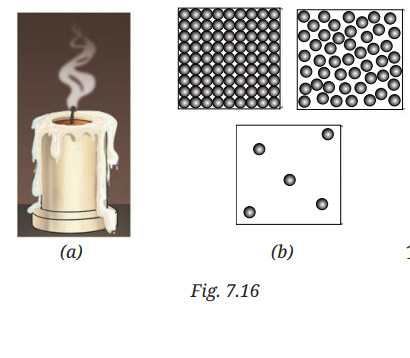
Answer:
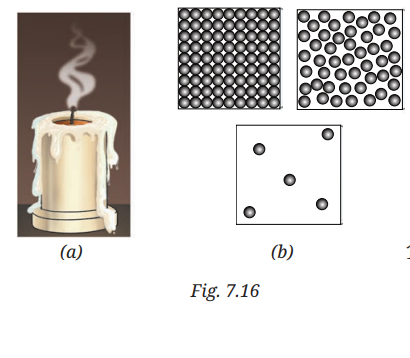
The candle wax can be in three states:
- Solid wax (candle body): Particles closely packed (Fig. 7.16b, arrangement 1).
- Liquid wax (molten wax pool around the wick): Particles less packed, can flow (Fig. 7.16b, arrangement 2).
- Gaseous wax (vapours/smoke): Particles far apart, random motion (Fig. 7.16b, arrangement 3).
Q9. Why does the water in the ocean taste salty, even though the salt is not visible? Explain.
Answer:
Salt is soluble in water and dissociates into its constituent particles (ions). These particles are extremely small and evenly spread throughout the water, occupying the spaces between water particles. Although the salt is not visible, it is present and can be tasted.
Q10. Grains of rice and rice flour take the shape of the container when placed in different jars. Are they solids or liquids? Explain.
Answer:
Grains of rice and rice flour are solids. They take the shape of the container because they are made up of many small solid particles that can move past each other when poured, but each individual particle is a solid with a fixed shape. They do not have the properties of liquids (like definite volume but no fixed shape). They can be poured, but they are still solids.
Discover, Design, and Debate
Q1. Fix a balloon over the neck of a bottle and put the bottle in hot water. Explore what will happen? Design and create simple models to represent particles of solids, liquids, and gases showing interparticle spacing using clay balls, beads, etc. Pretend to be particles of solids, liquids, and gases, at different temperatures—create and perform a role-play/dance showing particles in motion. Debate in the class—'Gases can spread and fill all the available space'. Is this property of gases beneficial or harmful?
Answer:
Balloon experiment: The balloon will inflate because the air inside the bottle expands when heated, pushing the balloon outward. This shows that gas particles expand on heating.
Models: Students can use clay balls to show the arrangement of particles: closely packed for solids, slightly spaced for liquids, and far apart for gases.
Role-play: Students can act as particles: as solids, they vibrate in one place; as liquids, they move slowly past each other; as gases, they move rapidly and randomly.
Debate: The property of gases spreading can be beneficial (e.g., oxygen spread for breathing, fragrance) or harmful (e.g., spread of pollutants, toxic gases). Students can debate both sides.