
Probe and Ponder
Q1. Which of the entities in the picture above consist of matter, and which of them do not?
Answer:
All objects in the picture that have mass and occupy space consist of matter. This includes the staircase, books, water bottle, food, clothes, shoes, trees, ball, and stick. Light, heat, and thoughts are not made of matter.
Q2. How can elements be combined to form a compound?
Answer:
Elements combine in fixed ratios through a chemical reaction to form a compound. For example, hydrogen and oxygen combine in a 2:1 ratio to form water. The properties of a compound are different from the elements that form it.
Q3. How could the discovery of a compound that absorbs carbon dioxide from the air contribute to solving environmental challenges?
Answer:
A compound that absorbs carbon dioxide could help mitigate climate change by reducing the amount of CO₂ in the atmosphere. It could be used in industrial settings, power plants, or even in direct air capture technologies to lower greenhouse gas emissions.
Activity 8.1
Q1. Take a glass tumbler and fill it half with water. Add a small amount of calcium oxide (quick lime) slowly to it. What do you observe? Calcium oxide reacts vigorously with water to form calcium hydroxide and releases heat. Stir continuously to make a solution of calcium hydroxide. This solution is called lime water. Filter it and observe its colour. Leave this colourless solution in a petri dish for a few hours (Fig. 8.5a). Keep stirring the solution at regular intervals. What do you observe (Fig. 8.5b)? Does it turn milky? Can you explain why the solution has turned milky? You know that lime water turns milky when carbon dioxide reacts with calcium hydroxide to form calcium carbonate (insoluble tiny white particles) and water (Fig. 8.5). Since lime water turns milky when exposed to air, this activity demonstrates the presence of carbon dioxide in the air. 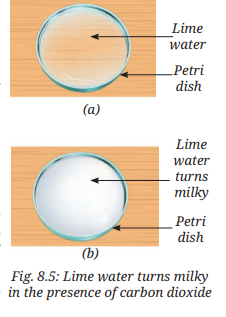
Answer:
Lime water turns milky when exposed to air because carbon dioxide from the air reacts with calcium hydroxide to form insoluble calcium carbonate. The chemical reaction is: Calcium hydroxide + Carbon dioxide → Calcium carbonate + Water. This confirms the presence of carbon dioxide in the air.
Activity 8.2
Q1. Take a black sheet of paper. Ensure that it is free from any visible dust particles. Place the black sheet of paper undisturbed near an open window (Fig. 8.6a), or in the garden, for a few hours. What do you observe? You may notice tiny particles settled on its surface. You may use a magnifying glass to examine the particles more closely (Fig. 8.6b). This shows that dust particles are suspended in the air. They are not an integral part of the air and are considered pollutants. The nature and the number of dust particles in the air may vary from time to time and from place to place. 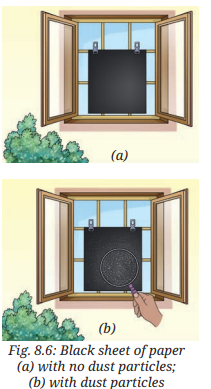
Answer:
Dust particles settle on the black sheet over time. This shows that the air contains suspended particulate matter, which is not a part of the air's natural composition. These particles can vary in type and quantity depending on the environment and are considered pollutants.
Activity 8.3
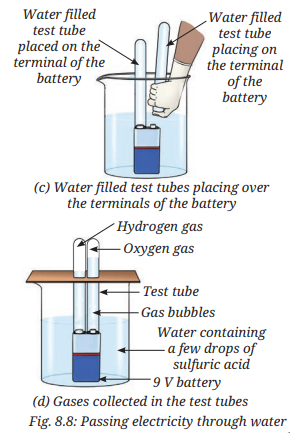
Q1. Collect two small test tubes, a beaker or a glass tumbler, and a 9 V battery. Fill 2/3rd of the beaker with water and add a few drops of dilute sulfuric acid to it. Fill both the small test tubes completely with water taken from the beaker (Fig. 8.8a). Place a 9 V battery inside the beaker (Fig. 8.8b). Without spilling the water, carefully place the water-filled test tubes on each of the terminals of the battery (Fig. 8.8c). Wait for a few minutes. Do you observe the formation of any gas bubbles at both the terminals inside the test tubes? Let it continue for 10-15 minutes. Observe the volume of gas collected in each test tube (Fig. 8.8d). Is the volume of the gas collected the same in both the test tubes? Remove these test tubes one-by-one carefully. Test these gases one-by-one by bringing a burning candle close to the mouth of the test tubes. What happens in each case? Which gas is present in each test tube? Can these collected gases be water vapour? These gases are not water vapour otherwise they would have condensed back to form water. Let us try to identify these gases. To test the gases present in the two test tubes, bring a burning candle near the mouth of each test tube. A pop sound can be heard from one, indicating the presence of hydrogen gas (Fig. 8.9a). In the other test tube, the flame of the burning candle will glow brighter, confirming the presence of oxygen gas (Fig. 8.9b). 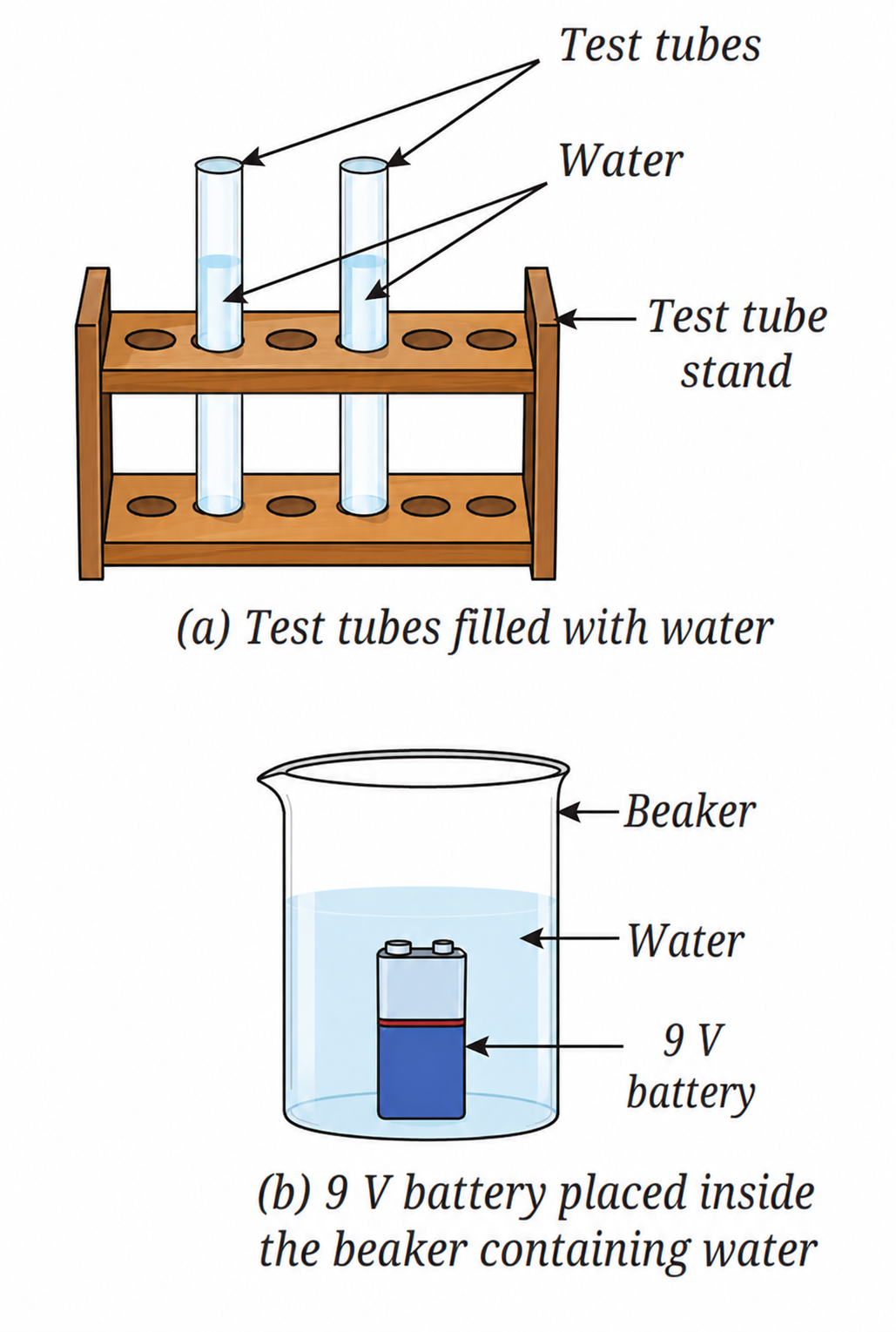
Answer:
The test tube attached to the negative terminal collects hydrogen gas (twice the volume), and the one attached to the positive terminal collects oxygen gas. Hydrogen gives a pop sound with a burning candle, while oxygen makes the candle glow brighter. This shows that water is a compound made of hydrogen and oxygen in a 2:1 ratio.
Activity 8.4
Q1. Put a teaspoon of sugar in a boiling tube. Heat it gently as shown in Fig. 8.12a. What do you observe? As you heat the sugar, it turns brown (Fig. 8.12b). Later, it begins to char, i.e., it turns blackish (Fig. 8.12c). You will find small droplets of water inside the boiling tube near its open end. Where did this water come from? Was it in the dry sugar, or did it come by the condensation of water vapour in the air? Since we are heating the tube, the water must have come from the dry sugar and not from the air. Can you predict what is left behind? Charcoal (carbon) is left behind in the boiling tube. You can scoop it out in a watch glass (Fig. 8.12c) and explore if it burns like coal. Sugar decomposes on heating and gives carbon and water. As you know, water consists of hydrogen and oxygen. Hence, sugar cannot be an element. It may be stated that sugar is a chemical compound consisting of the elements carbon, hydrogen, and oxygen. 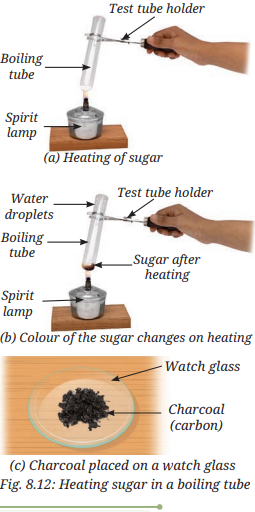
Answer:
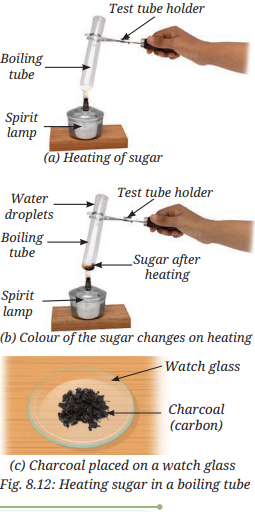
On heating sugar, it decomposes into carbon (charcoal) and water. The water droplets seen are from the sugar itself. This shows that sugar is a compound made of carbon, hydrogen, and oxygen, and not an element.
Activity 8.5
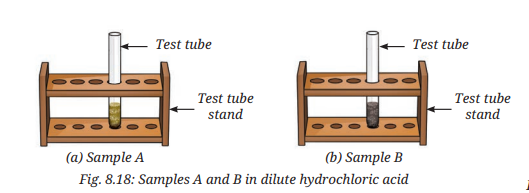
Q1. Take 5.6 grams of iron filings (Fig. 8.13a) and 3.2 grams of sulfur powder (Fig. 8.13b) on a watch glass. Observe them carefully. Mix them thoroughly in a watch glass. Label this mixture as Sample A (Fig. 8.14). Observe it carefully. Is this a uniform or a non-uniform mixture? Can you still observe both iron and sulfur as separate substances? Take half of Sample A in a china dish and gently heat it (Fig. 8.15a) with continuous stirring until a black mass is formed. Let the content of the china dish cool. Place this black mass in a mortar and grind it with the help of a pestle. Now, put it on another watch glass and label it as Sample B (Fig. 8.15b). Now, you have two samples—Sample A and Sample B (Fig. 8.16a and 8.16b). Compare both the Samples A and B step by step and record your observations in Table 8.2. Step 1-Appearance: Compare the appearance of Sample A and Sample B like colour and texture. Step 2-Magnet test: Take a magnet and move it over the Samples A (Fig. 8.17a) and B (Fig. 8.17b), one by one. What do you observe? Step 3-Gas test: Take a small amount of Sample A in a test tube and add a few drops of dilute hydrochloric acid (Fig. 8.18a). Some discussion points: Do the Samples, A and B look the same? Which sample exhibits magnetic properties? Can we separate the components of Samples A and B? On adding dilute hydrochloric acid, do gases evolve in both Samples A and B? In both the cases, do the gases smell the same or different? Also, categorise the substances used in this activity into mixtures, compounds, and elements. Sample A: We can say that Sample A is a mixture of the two elements- iron and sulfur. Its components retain their properties, and their black and yellow coloured particles can be seen. On bringing magnet near Sample A, the iron filings get attracted towards the magnet. Hence, iron and sulfur can be separated. You might have observed that in Sample A, iron in the mixture reacts with dilute hydrochloric acid to form iron chloride and hydrogen gas. The gas is colourless, has no smell, and burns with a 'pop' sound. The reaction can be represented as: Iron + Dilute Hydrochloric acid → Iron chloride + Hydrogen gas Sulfur on the other hand, is left as a yellow solid at the bottom of the test tube. This shows that sulfur does not react with hydrochloric acid. Sample B: The black mass obtained in Sample B is iron sulfide. We observe that the texture and the colour are the same throughout. It is formed by heating the two elements, iron and sulfur. It is not attracted by a magnet. The new substance has completely different properties, and iron and sulfur can no longer be separated. Hence, we can say that a compound has been formed. Can you explain now why the magnet has no effect on Sample B? Also, Sample B, iron sulfide, reacts with dilute hydrochloric acid, to form iron chloride and hydrogen sulfide gas. The gas is colourless and has a rotten egg-like odour. The reaction can be represented as: Iron sulfide + Dilute Hydrochloric acid → Iron chloride + Hydrogen sulfide 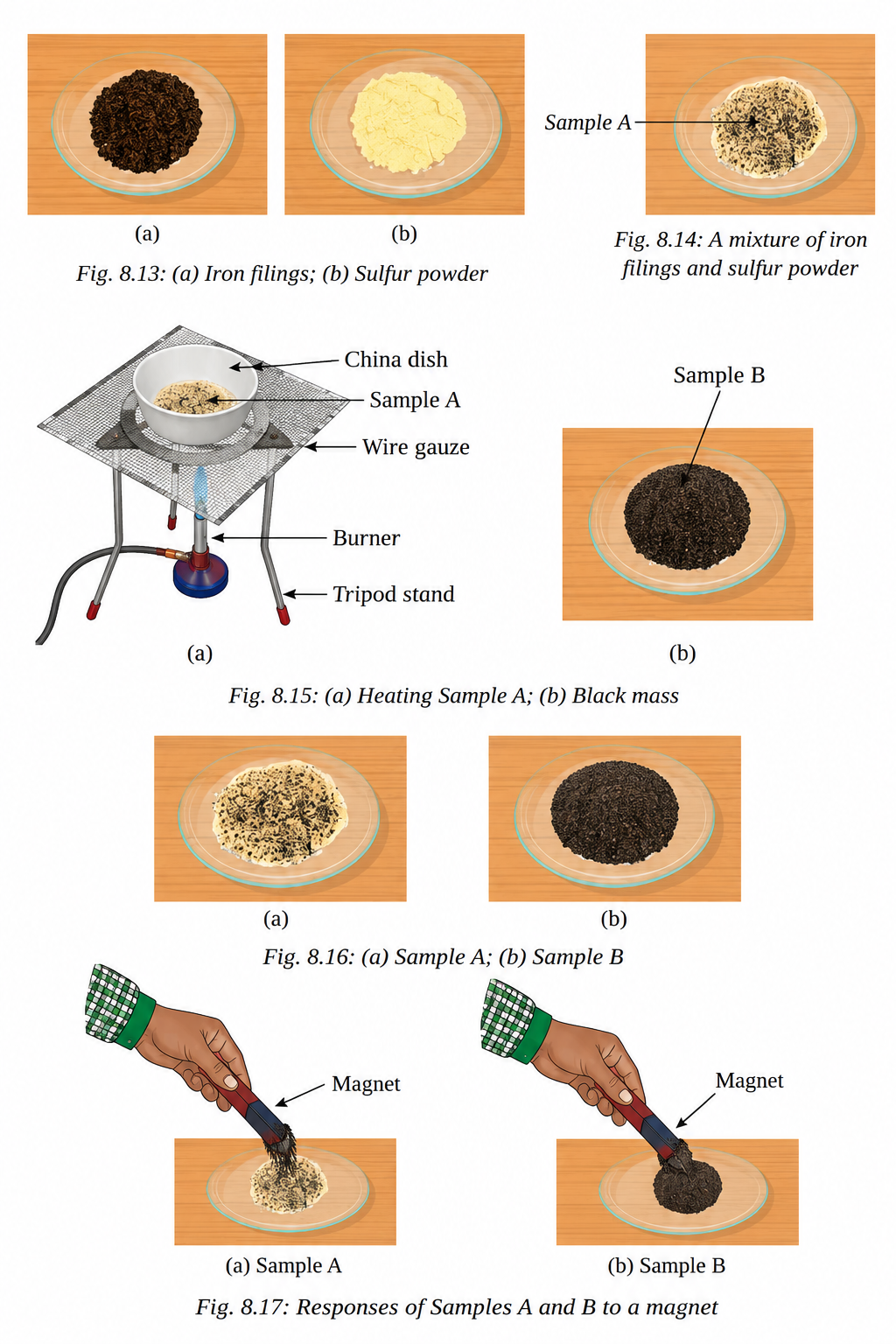
Answer:
Sample A (Mixture of iron and sulfur): Non-uniform mixture. Iron and sulfur can be seen separately. Iron is attracted to a magnet. On adding HCl, iron reacts to produce hydrogen gas (pop sound), while sulfur remains unchanged.
Sample B (Iron sulfide - Compound): Uniform black mass. Not attracted to a magnet. On adding HCl, it produces hydrogen sulfide gas (rotten egg smell). Iron and sulfur cannot be separated by physical methods. This is a compound formed by a chemical reaction.
Categories: Iron and sulfur are elements. Sample A (iron and sulfur mixture) is a mixture. Sample B (iron sulfide) is a compound.
Questions and Activities
Q1. Consider the following reaction where two substances, A and B, combine to form a product C: A + B → C Assume that A and B cannot be broken down into simpler substances by chemical reactions. Based on this information, which of the following statements is correct? (i) A, B, and C are all compounds and only C has a fixed composition. (ii) C is a compound, and A and B have a fixed composition. (iii) A and B are compounds, and C has a fixed composition. (iv) A and B are elements, C is a compound, and has a fixed composition.
Answer:
Answer: (iv) A and B are elements, C is a compound, and has a fixed composition.
Since A and B cannot be broken down further, they are elements. When they combine chemically in a fixed ratio, they form a compound C, which has properties different from A and B.
Q2. Assertion: Air is a mixture. Reason: A mixture is formed when two or more substances are mixed, without undergoing any chemical change. (i) Both Assertion and Reason are true and Reason is the correct explanation for Assertion. (ii) Both Assertion and Reason are true, but Reason is not the correct explanation for Assertion. (iii) Assertion is true, but Reason is false. (iv) Assertion is false, but Reason is true.
Answer:
Answer: (i) Both Assertion and Reason are true and Reason is the correct explanation for Assertion.
Air is a mixture because it contains gases like nitrogen, oxygen, carbon dioxide, etc., which are not chemically combined and can be separated by physical methods.
Q3. Water, a compound, has different properties compared to those of the elements oxygen and hydrogen from which it is formed. Justify this statement.
Answer:
Water is a compound because hydrogen and oxygen are chemically combined in a fixed ratio (2:1). Its properties are completely different from those of hydrogen and oxygen. For example, hydrogen is a flammable gas, oxygen supports combustion, but water is a liquid that extinguishes fire.
Q4. In which of the following cases are all the examples correctly matched? Give reasons in support of your answers. (i) Elements — water, nitrogen, iron, air. (ii) Uniform mixtures—minerals, seawater, bronze, air. (iii) Pure substances—carbon dioxide, iron, oxygen, sugar. (iv) Non-uniform mixtures—air, sand, brass, muddy water.
Answer:
Answer: (iii) Pure substances—carbon dioxide, iron, oxygen, sugar.
All these are pure substances: carbon dioxide (compound), iron and oxygen (elements), sugar (compound).
Reasons for others:
(i) Water and air are not elements; they are compounds/mixtures.
(ii) Minerals are generally non-uniform mixtures; bronze is a uniform mixture (alloy).
(iv) Air is a uniform mixture; brass is a uniform mixture (alloy).
Q5. Iron reacts with moist air to form iron oxide, and magnesium burns in oxygen to form magnesium oxide. Classify all the substances involved in the above reactions as elements, compounds or mixtures, with justification.
Answer:
Iron: Element (cannot be broken down).
Moist air: Mixture (contains oxygen, water vapour, nitrogen, etc.).
Iron oxide: Compound (iron and oxygen chemically combined).
Magnesium: Element.
Oxygen: Element.
Magnesium oxide: Compound (magnesium and oxygen chemically combined).
Q6. Classify the following as elements, compounds, or mixtures in Table 8.3. Carbon dioxide, sand, seawater, magnesium oxide, muddy water, aluminium, gold, oxygen, rust, iron sulfide, glucose, air, water, fruit juice, nitrogen, sodium chloride, sulfur, hydrogen, baking soda. 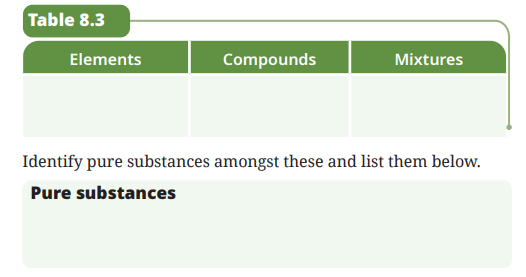
Answer:
Elements: Aluminium, Gold, Oxygen, Nitrogen, Sulfur, Hydrogen
Compounds: Carbon dioxide, Magnesium oxide, Iron sulfide, Glucose, Water, Sodium chloride, Baking soda
Mixtures: Sand, Seawater, Muddy water, Rust (mixture of iron oxides), Air, Fruit juice
Pure substances among these: Carbon dioxide, Magnesium oxide, Aluminium, Gold, Oxygen, Iron sulfide, Glucose, Water, Nitrogen, Sodium chloride, Sulfur, Hydrogen, Baking soda.
Q7. What new substance is formed when a mixture of iron filings and sulfur powder is heated, and how is it different from the original mixture? Also, write the word equation for the reaction.
Answer:
When a mixture of iron filings and sulfur powder is heated, a new substance called iron sulfide is formed. It is a compound, not a mixture.
Differences from the original mixture:
- Iron sulfide is a uniform black solid, while the mixture is a non-uniform mixture of yellow sulfur and grey iron.
- Iron sulfide is not attracted to a magnet, while iron in the mixture is.
- The properties of iron sulfide are different from those of its components.
Word equation: Iron + Sulfur → Iron sulfide
Q8. Is it possible for a substance to be classified as both an element and a compound? Explain why or why not.
Answer:
No, a substance cannot be both an element and a compound. An element is made up of only one type of atom and cannot be broken down further. A compound is made up of two or more elements chemically combined in a fixed ratio. They are mutually exclusive categories.
Q9. How would our daily lives be changed if water were not a compound but a mixture of hydrogen and oxygen?
Answer:
If water were a mixture of hydrogen and oxygen, its properties would be different. Hydrogen is flammable and oxygen supports combustion. Water as we know it would not exist; instead, we would have a mixture that could be easily separated into its components and would likely be highly flammable. Life as we know it would be impossible.
Q10. Analyse Fig. 8.24. Identify Gas A. Also, write the word equation of the chemical reaction. 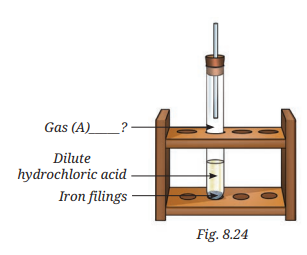
Answer:
Based on the figure, Gas A is likely hydrogen (which gives a pop sound with a burning candle). The other gas is oxygen.
The word equation for the decomposition of water is: Water → Hydrogen + Oxygen
Q11. Write the names of any two compounds made only from non-metals, and also mention two uses of each of them.
Answer:
1. Carbon dioxide (CO₂):
- Used in carbonated drinks.
- Used in fire extinguishers.
2. Water (H₂O):
- Essential for drinking and life.
- Used as a solvent.
Q12. How can gold be classified as both a mineral and a metal?
Answer:
Gold is a metal because it is an element with metallic properties (luster, malleability, conductivity). It is also a mineral because it occurs naturally in the Earth's crust in its pure form as a native mineral.
Discover, Design, and Debate
Q1. Design and create comic strips from real-life examples to differentiate between elements, compounds, and mixtures with diagrams and illustrate their properties and uses. Search for discoveries of some elements (such as phosphorus, sodium), compounds (such as penicillin) and mixtures (such as brass, bronze, stainless steel). Present your findings in the class. Let us search: Read labels on items like detergents or snacks, and try to list the mixtures and compounds they contain. Work in groups: Each group will pretend to be in the role of either an element, a compound, or a mixture. Debate which category among them is the most important.
Answer:
Comic Strips: Students can create comic strips showing examples like:
- Element: A pure block of gold.
- Compound: Water formed by H₂ and O₂.
- Mixture: A fruit salad or air.
Discoveries: Students can research and present about:
- Phosphorus (discovered by Hennig Brand).
- Sodium (discovered by Humphry Davy).
- Penicillin (discovered by Alexander Fleming).
- Brass, bronze, stainless steel (alloys/mixtures).
Reading Labels: Students can list ingredients in snacks (mixtures) and identify compounds like sodium chloride, sugar, etc.
Debate: Students can debate the importance of elements (building blocks), compounds (new properties), and mixtures (practical uses).