
Margin Questions
Q1. What do you think Earth would look like if there were no life on it at all?
Answer:
If there were no life on Earth at all, the planet would look barren and desolate. There would be no green vegetation covering the land, no forests, grasslands, or blooming flowers. The oceans would be devoid of fish, plankton, and other marine life. The skies would be empty of birds and insects. The surface would consist only of rocks, soil, mountains, and water bodies without any living organisms to interact with them. There would be no oxygen in the atmosphere produced by photosynthesis, and the carbon cycle would be disrupted. The planet would be similar to what we observe on Mars or Venus — a lifeless rocky planet.
Q2. Life on Earth has survived for billions of years. What allows it to keep going despite major changes and disasters?
Answer:
Life on Earth has survived for billions of years due to several factors:
- Earth's position in the habitable zone: The right distance from the Sun maintains temperatures that allow water to exist in liquid form.
- Atmosphere: Contains oxygen for respiration, carbon dioxide for photosynthesis, and traps heat to maintain suitable temperatures.
- Water cycle: Ensures continuous supply of freshwater through evaporation, condensation, and precipitation.
- Biodiversity and interactions: Living organisms interact with each other and their environment to maintain ecological balance.
- Reproduction: Ensures continuity of species through passing genetic material to offspring.
- Nutrient cycling: Decomposers break down dead matter and recycle nutrients back into the soil.
- Adaptation and evolution: Organisms can adapt to changing conditions over generations through variations in genetic material.
Q3. Why don't dogs lay eggs? Or hens give birth to live chicks?
Answer:
Dogs are mammals, and mammals give birth to live young ones (viviparous) because their embryos develop inside the mother's body where they receive nutrition and oxygen directly from the mother. Hens are birds, and birds are oviparous — they lay eggs. The fertilized egg develops outside the mother's body, and the embryo gets its nutrition from the yolk inside the egg. These differences are due to the distinct reproductive strategies that have evolved in different groups of animals. Mammals provide more protection and nutrition to developing embryos, while birds invest energy in producing eggs that can survive outside the body.
Q4. If a spaceship carried soil and water to Mars, could plants start growing there?
Answer:
Plants cannot grow on Mars even if soil and water are provided because:
- Lack of atmosphere: Mars has a very thin atmosphere (100 times thinner than Earth's) with very little oxygen and carbon dioxide.
- Temperature: Mars is much colder than Earth with average temperatures around -60°C, which is too cold for most plants to survive.
- Low pressure: The atmospheric pressure is too low for liquid water to remain stable — it would freeze or evaporate.
- No ozone layer: Mars lacks an ozone layer, so harmful ultraviolet radiation from the Sun reaches the surface and would damage plant cells.
- Soil composition: Martian soil lacks essential nutrients and organic matter that plants need for growth.
Even with soil and water, plants would need a controlled environment (like a greenhouse) with proper temperature, pressure, and atmospheric conditions to survive.
Q5. Is the temperature or distance from the Sun, the only factor that makes the Earth habitable?
Answer:
No, temperature and distance from the Sun are not the only factors that make Earth habitable. Other important factors include:
- Size and gravity: Earth's size creates just enough gravity to hold its atmosphere, but not so much that it would crush living beings.
- Atmosphere: Provides oxygen for respiration, carbon dioxide for photosynthesis, and traps heat through the greenhouse effect.
- Ozone layer: Protects life from harmful ultraviolet radiation.
- Magnetic field: Shields Earth from harmful solar wind and cosmic rays.
- Water cycle: Maintains liquid water on the surface.
- Circular orbit: Keeps temperature stable throughout the year.
- Interacting systems: The atmosphere, hydrosphere, geosphere, and biosphere work together to sustain life.
Q6. What would happen if the size of the Earth were too small or too big?
Answer:
If Earth were too small (with the same density):
- Gravity would be weaker and unable to hold the atmosphere — gases would escape into space.
- Without an atmosphere, there would be no air to breathe, no greenhouse effect, and no protection from UV radiation.
- Water would evaporate or freeze, making it impossible for life to survive.
If Earth were too large:
- Gravity would be much stronger, making it difficult for living beings to move or even stand.
- The strong gravity would crush bones and make movement impossible.
- The atmosphere would be much thicker and denser, creating extreme pressure conditions.
Earth's size is just right to support the atmosphere and allow life to thrive — this is why it's called a habitable planet.
Q7. Does the magnetic field of the Earth have any role in sustaining life on Earth?
Answer:
Yes, the Earth's magnetic field plays a crucial role in sustaining life. It acts as a protective shield that:
- Deflects harmful high-energy particles from the Sun (solar wind) and cosmic rays from outer space.
- Prevents these particles from damaging the atmosphere and reducing the ozone layer.
- Without the magnetic field, the solar wind would strip away the atmosphere over time, similar to what happened on Mars.
- It protects living organisms from DNA damage and other harmful effects caused by high-energy radiation.
- The magnetic field also helps animals like birds and sea turtles navigate during migration.
Without the magnetic field, life on Earth would be at much greater risk from space radiation, and our atmosphere might not survive.
Q8. Can you observe and list some plants around you that grow this way?
Answer:
Some common plants that grow through vegetative propagation (asexual reproduction) are:
- Potato: Grows from the 'eyes' (buds) on the tuber.
- Ginger: Grows from rhizomes (underground stems).
- Money plant: Grows from stem cuttings placed in water or soil.
- Bamboo: Grows from rhizomes and can also propagate through stem cuttings.
- Sugarcane: Grows from stem cuttings with nodes.
- Sweet potato: Grows from roots (root tubers).
- Rose: Can be grown from stem cuttings.
- Mint: Grows from runners (stems that grow along the ground).
- Bryophyllum: Produces tiny plantlets along the margins of its leaves.
- Onion: Grows from bulbs (underground stems).
Q9. How do bamboo and sugarcane grow into new plants? I have never seen their seeds.
Answer:
Bamboo and sugarcane grow into new plants through vegetative propagation, which is a type of asexual reproduction. Instead of producing seeds, they grow from underground stems or stem cuttings:
- Bamboo: Grows from rhizomes (underground stems) that produce new shoots at intervals. Bamboo can also be propagated by planting stem cuttings with nodes.
- Sugarcane: Is propagated by planting stem cuttings (setts) that have buds (nodes). When planted in moist soil, the buds sprout and develop into new sugarcane plants.
Farmers prefer vegetative propagation for sugarcane and bamboo because it is faster, produces uniform plants, and preserves desirable characteristics. Though these plants do produce seeds occasionally, they flower very rarely (bamboo flowers once every several decades, and sugarcane seeds are not commonly used for cultivation).
Activities
Q1. Activity 13.1: Let us find out List some features of the Earth that we often take for granted, but are interesting and important to us. Write them in Table 13.1. We have filled in a few for you.
| S.No. | Interesting features of the Earth |
|---|---|
| 1. | The air we breathe doesn't fly off and disappear into space. (We learnt in Chapter 7 that the particles of a gas move freely, and gases do not have a fixed volume) |
| 2. | We can stand on the ground held by gravity (as we learnt in Chapter 5), but our heart can pump blood up to our head. |
| 3. | |
| 4. |
Answer:
Here are some interesting features of the Earth that can be added to Table 13.1:
| S.No. | Interesting features of the Earth |
|---|---|
| 1. | The air we breathe doesn't fly off and disappear into space. (We learnt in Chapter 7 that the particles of a gas move freely, and gases do not have a fixed volume) |
| 2. | We can stand on the ground held by gravity (as we learnt in Chapter 5), but our heart can pump blood up to our head. |
| 3. | Water is found in all three states — solid (ice), liquid (water), and gas (water vapour) — on Earth, making the water cycle possible. |
| 4. | The Earth has just the right amount of atmosphere that provides oxygen for breathing, carbon dioxide for plants, and protection from harmful radiation. |
| 5. | Day and night occur regularly, giving us a predictable cycle of light and darkness, which is essential for life. |
| 6. | Earth has a magnetic field that protects us from harmful solar particles and helps animals like birds navigate during migration. |
Q2. Activity 13.2: Let us find out Collect information about the temperature and size of the planets in the solar system, and check if they have an atmosphere. You may collect this information from books in your school library, trusted websites, or discuss with your teachers. Fill out the missing information in Table 13.2.
| S.No. | Planet | Average temperature (°C) | Radius, compared to the Earth | Has an atmosphere? |
|---|---|---|---|---|
| 1. | Mercury | 170 | 0.38 | No |
| 2. | Venus | 450 | 0.95 | Yes |
| 3. | Earth | 15 | 1 | Yes |
| 4. | ||||
| 5. | ||||
| 6. | ||||
| 7. | ||||
| 8. |
Answer:
Here is the completed Table 13.2 with information about the planets in our solar system:
| S.No. | Planet | Average temperature (°C) | Radius, compared to the Earth | Has an atmosphere? |
|---|---|---|---|---|
| 1. | Mercury | 170 | 0.38 | No |
| 2. | Venus | 450 | 0.95 | Yes (thick, mostly CO₂) |
| 3. | Earth | 15 | 1 | Yes (nitrogen, oxygen, CO₂) |
| 4. | Mars | -60 | 0.53 | Yes (very thin, mostly CO₂) |
| 5. | Jupiter | -110 | 11.2 | Yes (thick, hydrogen, helium) |
| 6. | Saturn | -140 | 9.5 | Yes (thick, hydrogen, helium) |
| 7. | Uranus | -200 | 4.0 | Yes (hydrogen, helium, methane) |
| 8. | Neptune | -200 | 3.9 | Yes (hydrogen, helium, methane) |
Note: Venus is the hottest planet despite being second from the Sun because its thick atmosphere of carbon dioxide traps heat through an extreme greenhouse effect. Mercury has a very thin atmosphere (exosphere), so it is often considered to have no significant atmosphere.
Q3. Activity 13.3: Let us find out Take some parts of plants like stem cutting of a money plant, the 'eyes' of a sprouted potato, or a piece of ginger (Fig. 13.11b). Plant each of them separately in moist soil (not too deep). For money plant, you can just put a cutting in a glass container which makes it easy to observe. Make sure they get all the conditions they need to grow—like water, air, and sunlight. Watch them every day and note how many days it takes for roots stem and leaves to appear. Also observe when the first new leaf appears. 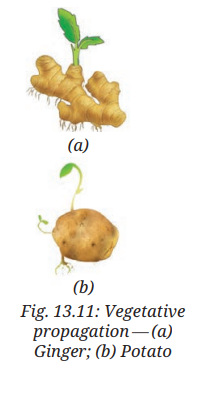
Answer:
This is an activity-based question. Students should perform the experiment and record their observations. A sample observation is provided:
Observations:
- Money plant (stem cutting in water): Roots appeared after 5-7 days. New leaves appeared after 12-15 days.
- Potato (eyes planted in soil): Sprouts emerged from the eyes after 10-12 days. New leaves appeared after 18-20 days.
- Ginger (rhizome in soil): New shoots emerged from the nodes after 8-10 days. Leaves appeared after 15-18 days.
Conclusion: Vegetative propagation is a type of asexual reproduction where new plants grow from parts of existing plants like stems, roots, or leaves. These parts contain buds that can develop into new plants when provided with suitable conditions (water, air, sunlight, and nutrients).
Exercises
Q1. What is one major reason Mars cannot currently support life like Earth? (i) It has too many volcanoes. (ii) It is too close to the Sun. (iii) It lacks a thick atmosphere and liquid water. (iv) Its magnetic field is too strong.
Answer:
The correct answer is (iii) It lacks a thick atmosphere and liquid water.
Mars cannot currently support life like Earth because it has a very thin atmosphere (100 times thinner than Earth's) and lacks liquid water on its surface. The thin atmosphere means there is very little oxygen and carbon dioxide for life processes, and the low pressure prevents liquid water from remaining stable. Additionally, Mars is much colder than Earth, and its magnetic field is very weak (not too strong), offering little protection from solar radiation.
Q2. Which of these is an example of geodiversity? (i) Variety of bird chirping in a forest. (ii) Different landforms like mountains, valleys, and deserts. (iii) Changing weather during monsoons. (iv) Number of different types of fish in a pond.
Answer:
The correct answer is (ii) Different landforms like mountains, valleys, and deserts.
Geodiversity refers to the variety of non-living parts of the Earth, including different landforms (mountains, valleys, deserts), rocks, soils, and the natural processes that shape them. The other options (bird chirping, weather, types of fish) relate to biodiversity (living components) or weather patterns, not geodiversity.
Q3. If the Earth were smaller with the same density, what might happen to its atmosphere? (i) It would become thicker and hotter. (ii) It would escape into space due to weaker gravity. (iii) It would become frozen. (iv) It would cause stronger winds.
Answer:
The correct answer is (ii) It would escape into space due to weaker gravity.
If Earth were smaller with the same density, its gravity would be weaker. Gravity is what holds the atmosphere in place. With weaker gravity, atmospheric gases would gradually escape into space, similar to what happened on Mars (which is smaller than Earth and has a very thin atmosphere). Without a sufficient atmosphere, life would not be able to survive on Earth.
Q4. In sexual reproduction, why are offspring different from their parents? (i) They grow in different climates. (ii) They eat different food. (iii) They acquire new instructions after birth. (iv) They get mixed instructions (genes) from both parents.
Answer:
The correct answer is (iv) They get mixed instructions (genes) from both parents.
In sexual reproduction, offspring receive genetic material from both parents through specialized reproductive cells called gametes (sperm and egg). Each gamete carries half the parent's genetic material, and when they combine, the offspring gets a unique mix of instructions from both parents. This mixture results in offspring that share traits with both parents but are not exactly identical to either one.
Q5. You notice tiny green plants growing in cracks on your school wall after the monsoon. Where do you think the seeds came from? What conditions helped these plants grow there?
Answer:
Where the seeds came from:
- The seeds may have been carried by wind from nearby areas.
- Birds that ate fruits from nearby trees may have dropped the seeds.
- Water from rain may have washed seeds into the cracks.
- Insects or animals may have transported the seeds.
Conditions that helped these plants grow:
- Water: Rainwater from the monsoon provided moisture.
- Soil/dust: Dust and fine soil particles accumulated in the cracks, providing a medium for root growth.
- Sunlight: The wall likely received enough sunlight for photosynthesis.
- Temperature: Monsoon temperatures were warm enough for seed germination.
- Nutrients: Organic matter in the dust provided nutrients for the plants.
This shows how life can find opportunities to grow in unexpected places when the right conditions come together.
Q6. A city has recently cut down a large patch of forest to build new roads and buildings. Discuss the possible effects this could have on the local climate and biodiversity? How might this affect water availability or quality in the area?
Answer:
Effects on local climate:
- Increased temperature: Trees provide shade and cool the air through transpiration. Without them, temperatures in the area will rise.
- Reduced rainfall: Trees release water vapour, which contributes to cloud formation and rain. Deforestation can reduce local rainfall.
- Altered wind patterns: Forests slow down winds; their removal can change wind directions and intensities.
Effects on biodiversity:
- Loss of habitat: Animals and plants that lived in the forest lose their homes, leading to population decline or extinction.
- Disruption of food chains: The removal of plants affects herbivores, which in turn affects carnivores.
- Loss of biodiversity: Many species may disappear from the area, reducing species richness.
Effects on water availability and quality:
- Reduced groundwater recharge: Trees help absorb water into the ground. Without them, water runs off quickly, reducing groundwater levels.
- Soil erosion: Roots hold soil together. Without roots, soil is washed away by rain, leading to sedimentation of water bodies.
- Water quality: Soil erosion can pollute rivers and streams with sediments, and reduced natural filtration can make water quality poorer.
Q7. A friend says, "The Earth has always had climate changes in the past, so today's global warming is nothing new." How would you respond using what you've learnt in this and other chapters of your science book?
Answer:
I would respond by explaining that while climate change has occurred naturally in the past, the current global warming is different because it is happening much faster and is primarily caused by human activities.
Key differences:
- Rate of change: Past climate changes happened over thousands or millions of years, giving life enough time to adapt. Current warming is happening over decades — much too fast for many species to adapt.
- Human cause: The rapid increase in greenhouse gases (especially carbon dioxide and methane) is due to human activities like burning fossil fuels, deforestation, and industrial processes. This releases carbon that had been locked underground for millions of years.
- Extra greenhouse effect: Normally, Earth's natural systems absorb carbon dioxide through forests and oceans. But we are releasing more than these systems can absorb, leading to a net increase in atmospheric CO₂.
- Massive impacts: This rapid warming is causing ice caps to melt, sea levels to rise, extreme weather events, and loss of biodiversity — impacts that are already visible and severe.
So while climate change has happened before, the current warming is uniquely rapid and human-caused, making it a serious threat to life on Earth.
Q8. Imagine Earth's magnetic field suddenly disappeared. What kinds of problems could arise for life on Earth? Explain.
Answer:
If Earth's magnetic field suddenly disappeared, it would cause serious problems for life on Earth:
- Loss of protection from solar wind: The Sun constantly emits a stream of charged particles called solar wind. Without the magnetic field, these particles would hit Earth directly, stripping away our atmosphere over time (similar to what happened on Mars).
- Damage to the ozone layer: Solar particles can destroy ozone molecules, reducing the ozone layer's ability to block harmful ultraviolet (UV) radiation from the Sun.
- Increased UV radiation: More UV radiation reaching Earth's surface would increase rates of skin cancer, cataracts, and damage to plants and marine life.
- Climate changes: Atmospheric loss would affect temperature regulation and weather patterns.
- Disruption to migration: Many animals, including birds and sea turtles, use Earth's magnetic field for navigation during migration. Without it, these species would struggle to find their way.
- Electrical grid damage: Solar particles could cause massive geomagnetic storms that would damage satellites, power grids, and communication systems.
In summary, the loss of the magnetic field would make Earth much less habitable and could eventually lead to the loss of our atmosphere and life as we know it.
Q9. You are tasked with designing a new settlement for humans on Mars. Name three things you would need to recreate from Earth to support human life there. Which of these do you think is the hardest to replicate, and why?
Answer:
Three things needed to recreate from Earth on Mars:
- Breathable atmosphere: Mars has a very thin atmosphere with very little oxygen. We would need to create oxygen and manage carbon dioxide levels through a controlled life-support system.
- Liquid water: Mars is too cold for liquid water to exist on the surface. We would need to extract water from ice deposits, melt it, and keep it in liquid form using heating systems.
- Protection from radiation: Mars lacks a magnetic field and a thick atmosphere, so harmful UV rays and cosmic rays reach the surface. We would need to build shelters with shielding (e.g., using regolith or underground habitats) to protect humans from radiation.
Hardest to replicate: Earth's magnetic field and full atmosphere
While we can create oxygen and build pressurized domes, recreating Earth's natural protective systems is the hardest. A thick, stable atmosphere and a magnetic field are planetary-scale features that cannot be artificially replicated. We can build shielded habitats, but they would be limited in size and would not offer the same natural balance that Earth provides (e.g., nutrient cycling, weather regulation, ecosystem services). Thus, designing a self-sustaining settlement on Mars is extremely challenging.
Q10. In a village, the temperature has been increasing and rainfall has become unpredictable over the past few years. What could be causing this change? Suggest two ways the village could adapt to these new conditions.
Answer:
Possible causes of the change:
- Climate change: Global warming caused by increased greenhouse gas emissions is leading to rising temperatures and changing rainfall patterns.
- Deforestation: Cutting down trees in and around the village can reduce rainfall and increase local temperatures because trees cool the air and contribute to cloud formation.
- Changes in land use: Farming practices, urbanization, and other human activities can alter local weather patterns.
Ways the village could adapt:
- Rainwater harvesting: The village can collect and store rainwater during wet seasons to use during dry periods. This helps manage unpredictable rainfall and ensures a reliable water supply.
- Switch to drought-resistant crops: Farmers can grow crops that are better adapted to higher temperatures and variable rainfall, such as millet, sorghum, or other climate-resilient varieties. This reduces the risk of crop failure and ensures food security.
Q11. If there were no atmosphere on the Earth, would it affect life, temperature, and water on the planet? Explain.
Answer:
If there were no atmosphere on Earth, it would drastically affect life, temperature, and water:
Effect on Life:
- Life as we know it would not exist because there would be no oxygen to breathe and no carbon dioxide for plants.
- Without the ozone layer, harmful UV radiation from the Sun would reach the surface, destroying DNA and preventing life from surviving.
Effect on Temperature:
- There would be no greenhouse effect, so heat from the Sun would escape rapidly into space.
- Daytime temperatures would be extremely high (similar to Mercury, about 170°C), while nighttime temperatures would drop to freezing cold (about -100°C). The temperature difference between day and night would be extreme.
Effect on Water:
- Without an atmosphere, water would either evaporate quickly or freeze, depending on the temperature.
- The water cycle (evaporation, condensation, precipitation) would not function, so there would be no rain.
- Any liquid water on the surface would eventually evaporate into space because there would be no air pressure to hold it.
In summary, without an atmosphere, Earth would become a barren, lifeless planet similar to Mercury or the Moon.
Q12. Discuss five examples of vegetative propagation.
Answer:
Vegetative propagation is a type of asexual reproduction in which new plants grow from parts of existing plants like stems, roots, or leaves. Five examples are:
- Potato: Potatoes grow from tubers (underground stems). The 'eyes' or buds on the potato sprout and develop into new plants when planted in soil.
- Ginger: Ginger grows from rhizomes (underground stems). The buds on the rhizome develop into new shoots that grow into ginger plants.
- Money plant: Money plant can be grown from stem cuttings. When a cutting is placed in water or moist soil, it develops roots and grows into a new plant.
- Sugarcane: Sugarcane is propagated by planting stem cuttings (setts) that have nodes or buds. Each cutting develops roots and shoots to form a new sugarcane plant.
- Bryophyllum: This plant produces tiny plantlets along the margins of its leaves. When these plantlets fall to the ground, they develop roots and grow into new plants.
Other examples: Onion (bulbs), bamboo (rhizomes), sweet potato (root tubers), rose (stem cuttings), and mint (runners).
Discover, Design, and Debate
Q1. Design an 'Earth Survival Kit'. Imagine you're building a tiny model of Earth for another planet. What must it have to support life, and why?
Answer:
Earth Survival Kit (Model of Earth for another planet):
To support life, the kit must include the following essential components:
| Component | Why it's needed |
|---|---|
| 1. Atmosphere | Provides oxygen for breathing, carbon dioxide for photosynthesis, and traps heat through greenhouse effect. Also protects from harmful solar radiation. |
| 2. Water | Essential for all life processes. Liquid water dissolves nutrients and allows biochemical reactions to occur in cells. |
| 3. Soil and nutrients | Provides a medium for plant growth, anchors roots, and supplies essential minerals and nutrients. |
| 4. Sunlight | Drives photosynthesis in plants, providing food for the entire ecosystem. Also regulates temperature and climate. |
| 5. Producers (Plants) | Make their own food through photosynthesis and produce oxygen for consumers. |
| 6. Consumers (Animals) | Consume producers and other consumers, maintaining energy flow through the food chain. |
| 7. Decomposers | Break down dead matter and recycle nutrients back into the soil, ensuring continuity of life. |
| 8. Temperature regulation system | Maintains suitable temperatures to keep water in liquid form and support life processes. |
| 9. Protection from radiation | Ozone layer or magnetic field to block harmful UV and cosmic rays. |
Q2. India is planning for a challenging lunar mission, Chandrayaan-4, which will bring back samples of soil from the Moon. If the Moon had water, could plants grow in that soil? Think of some experiment that could help you explore whether plant growth is possible on the Moon.
Answer:
Could plants grow in lunar soil if water were present?
Plants might be able to grow in lunar soil if water were available, but several challenges exist:
- Lack of nutrients: Lunar soil lacks essential nutrients like nitrogen, phosphorus, and potassium that plants need.
- No organic matter: Lunar soil has no humus or organic matter, which plants need for healthy growth.
- Lack of microorganisms: Earth's soil contains beneficial microbes that help plants absorb nutrients, which lunar soil lacks.
- Low gravity: The Moon's gravity is about 1/6th of Earth's, which could affect root growth and water uptake.
- Radiation: The Moon has no atmosphere or magnetic field, so plants would be exposed to harmful solar radiation.
Experiment to explore plant growth on the Moon:
We could design an experiment using lunar soil samples brought back by Chandrayaan-4:
- Setup: Grow plants in lunar soil samples in a controlled environment on Earth, simulating lunar conditions (reduced gravity, UV radiation, and carbon dioxide-rich atmosphere).
- Variables: Test different plant species (e.g., Arabidopsis, wheat, or mustard) and add different nutrients (fertilizers, compost).
- Control: Compare growth with Earth soil under the same conditions.
- Observe: Measure germination rates, root/shoot growth, chlorophyll content, and overall health.
- Conclusion: Determine which nutrients or treatments are needed for plant growth in lunar soil.
Q3. Flowers are often brightly coloured and have a pleasant smell. How do you think these features help the plant reproduce?
Answer:
Bright colours and pleasant smells in flowers help plants reproduce by attracting pollinators such as insects (bees, butterflies), birds, and bats. Here's how each feature helps:
- Bright colours: Flowers with bright colours (red, yellow, blue, purple) are easily visible to pollinators. Different colours attract different types of pollinators — bees are attracted to blue and yellow, butterflies to red and orange, and birds to bright colours.
- Pleasant smell: Flowers release fragrances to attract pollinators from a distance. Some smells attract specific pollinators (e.g., sweet scents attract bees, while rotting smells attract flies).
- Nectar: Flowers also produce sweet nectar as a reward for pollinators. When insects or birds visit flowers to collect nectar, pollen grains stick to their bodies and are transferred to other flowers, enabling pollination and fertilisation.
This relationship between flowers and pollinators is an example of mutualism, where both benefit — the plant gets pollinated, and the pollinator gets food (nectar).
Q4. Why do animals like fish and frogs lay hundreds or even thousands of eggs at a time, while other animals lay only a few? What might be the advantages and disadvantages of laying so many eggs?
Answer:
Animals like fish and frogs lay hundreds or thousands of eggs at a time because they use external fertilisation (eggs are fertilised outside the body, usually in water). The eggs and young ones are exposed to many dangers, so producing many eggs increases the chance that at least a few will survive to adulthood.
Advantages of laying many eggs:
- Increases chances of survival: More eggs mean more offspring, so even if many are eaten or die, some may survive.
- No parental care: These animals do not protect or feed their young, so producing many eggs compensates for high mortality.
Disadvantages of laying many eggs:
- Low survival rate: Most eggs and young are eaten by predators or die due to environmental conditions.
- Waste of energy: Producing so many eggs requires significant energy and resources from the female.
- No parental care: Without protection, the young ones are vulnerable to predators.
Why other animals lay only a few eggs:
Animals like birds and mammals provide parental care and protection to their offspring. They invest energy in raising few young ones with a higher chance of survival. This is a trade-off between quantity and quality of offspring.
Q5. Birds like sparrows build nests and care for their eggs and chicks, while reptiles like snakes usually lay their eggs and leave them without protection. How might this difference in parental care affect the chances of survival for the young ones in each case?
Answer:
Birds (Sparrows):
- Parental care includes: Building nests, incubating eggs, feeding and protecting chicks, and teaching them to fly.
- Survival chances: Offspring have a much higher chance of survival because they are protected from predators, have a stable food supply, and learn essential skills from parents.
- Advantage: Fewer young are needed because each has a higher chance of surviving to adulthood.
Reptiles (Snakes):
- Parental care: Snakes typically lay eggs and leave them without any protection or feeding. The young hatch and must survive on their own.
- Survival chances: Young snakes face many dangers — predators, harsh weather, lack of food — and have a very low chance of survival.
- Disadvantage: To compensate for low survival, snakes must lay many eggs (hundreds or thousands) to ensure at least some survive.
Overall comparison:
- Birds invest heavily in few offspring, leading to higher survival rates.
- Reptiles invest little in many offspring, leading to lower survival rates but ensuring some survive through sheer numbers.
- This difference reflects different reproductive strategies that have evolved to maximize the survival of each species.