
In-text Discussion Questions
QD1. Are the tape and rod similar to the scale in the geometry box? What did mother mean by char angula?
Answer:
Yes, the tailor's tape and shopkeeper's rod are similar in function to a geometry box scale — all are used to measure length, just of different sizes/flexibility. Char angula means 'four fingers' width' — a traditional Indian unit of length based on finger width (angula).
QD2. Why is the number of handspans different for all students measuring the same table?
Answer:
Because handspans differ in size from person to person — each person's hand is a different size, so the same length gives a different 'number' depending on whose handspan is used as the unit.
QD3. Would it be convenient to use the unit metre to measure larger lengths (like a railway track) or smaller lengths (like the thickness of a page)?
Answer:
No. For very large lengths, metre would give unwieldy large numbers, so kilometre is used. For very small lengths, metre would give tiny decimal fractions, so millimetre (or smaller units) is used. Choosing an appropriate unit makes measurements practical and easy to read.
QD4. Suppose we all measure the table again using a metre scale — will results still be different?
Answer:
No. Since a metre scale is a standard unit (same for everyone, unlike handspans), all students would get the same measurement (allowing for very small errors in reading).
QD5. What do kilometre stones indicate? How could Padma conclude she was getting closer?
Answer:
Kilometre stones indicate the distance from a fixed reference point (Delhi). Since the number on successive stones was decreasing (70 km ? 60 km), Padma could conclude she was getting closer to Delhi.
QD6. Does the position of Padma change with respect to the reference point with time? When does position change?
Answer:
Yes, her position changes with time because she is moving (in a bus). An object's position with respect to a reference point changes with time whenever the object is in motion.
QD7. Think it over: If you're on a ship moving at constant speed on a calm sea with no windows, can you tell if it's moving?
Answer:
No, without any external reference point (a window, view of the shore, etc.), it would be very difficult to tell whether the ship is moving or stationary, since there's no way to observe a change in position relative to anything.
QD8. Why are some length-measuring devices made of flexible materials?
Answer:
So they can be bent/wrapped around curved or irregular surfaces (like a body, a tree trunk, or curved lines) that a rigid scale cannot measure directly.
In-text Activities
Q5.1. Activity 5.1: Let us measure (Table 5.2 – lengths of comb, pen, pencil, eraser).
Answer:
Sample measurements:
| Object | Length |
|---|---|
| Comb | 15 cm |
| Pen | 14 cm |
| Pencil | 17 cm |
| Eraser | 4 cm |
Comparing with friends: measurements should be nearly identical (small differences may occur due to reading errors or eye position), since a metre scale is a standard unit — unlike handspans.
Q5.2. Activity 5.2: Let us explore (Table 5.3 – objects in motion/at rest).
Answer:
Sample table:
| Objects in motion | Justification | Objects at rest | Justification |
|---|---|---|---|
| Moving car | Position changes with time w.r.t. road | Table | Position doesn't change w.r.t. room |
| Flying bird | Position changes w.r.t. ground | Building | Position fixed w.r.t. ground |
| Running child | Position changes w.r.t. playground | Cupboard | Position doesn't change w.r.t. floor |
Conclusion: An object is in motion if its position changes with respect to a reference point over time; it is at rest if its position does not change.
Q5.3. Activity 5.3: Let us explore (dropping an eraser).
Answer:
The eraser falls straight down in a straight line — this is linear motion. Similarly, an orange falling from a tree, a march-past parade, and a pushed box moving along the ground are also examples of linear motion.
Q5.4. Activity 5.4: Let us investigate (whirling an eraser on a thread).
Answer:
The eraser moves along a circular path — similar to a merry-go-round. This is called circular motion.
Q5.5. Activity 5.5: Let us investigate (eraser on thread, released to one side).
Answer:
The eraser moves to and fro, similar to a swing. This is called oscillatory motion.
Q5.6. Activity 5.6: Let us investigate (metal strip pressed and released).
Answer:
The free end of the strip moves up and down repeatedly — this is another example of oscillatory motion.
Q5.7. Activity 5.7: Let us identify (Table 5.4 – children's park motions).
Answer:
| Object | Linear motion | Circular motion | Oscillatory motion |
|---|---|---|---|
| Slide | Sliding down (linear) | ||
| Merry-go-round | Moving in circles | ||
| See-saw | Moving up and down | ||
| Swing | Moving to and fro | ||
| Skipping rope | Circular swing of rope |
Let Us Enhance Our Learning (End-of-chapter Q&A)
Q1. Match lengths with suitable units: (Distance between Delhi and Lucknow, Thickness of a coin, Length of an eraser, Length of school ground)
Answer:
| Column I | Column II |
|---|---|
| Distance between Delhi and Lucknow | kilometre |
| Thickness of a coin | millimetre |
| Length of an eraser | centimetre |
| Length of school ground | metre |
Q2. True/False: (i) The motion of a car moving on a straight road is an example of linear motion. (ii) Any object which is changing its position with respect to a reference point with time is said to be in motion. (iii) 1 km = 100 cm
Answer:
- (i) True
- (ii) True
- (iii) False (1 km = 100,000 cm)
Q3. Which is NOT a standard unit of measuring length? (mm, cm, km, handspan)
Answer:
(iv) handspan — it varies from person to person and is not a fixed/universal unit like mm, cm, or km.
Q4. Finding smallest measurable value on different scales (15-cm plastic ruler, tailor's tape, carpenter's steel tape).
Answer:
A 15-cm plastic ruler can measure up to 1 mm (0.1 cm); a tailor's tape may also measure up to 1 mm; a carpenter's steel tape may measure up to 1 mm as well. Record findings in a table listing scale type and smallest measurable unit.
Q5. Distance of 1.5 km in metres.
Answer:
1.5 km = 1.5 × 1000 m = 1500 m
Q6. Measuring the curved base of a tumbler/bottle.
Answer:
Wrap a thread around the curved base, mark the point where it meets, then straighten the thread and measure its length using a scale — this gives the circumference of the base.
Q7. Height of a friend in three units (if height = 140 cm).
Answer:
- In metres: 1.40 m
- In centimetres: 140 cm
- In millimetres: 1400 mm
Q8. Estimating number of coins to cover a notebook side.
Answer:
Estimate by eye first, then measure the diameter of one coin (e.g., 2.5 cm) and the length of the notebook side (e.g., 25 cm) using a 15-cm scale. Number of coins = length of side ÷ diameter of coin = 25 ÷ 2.5 = 10 coins. Compare with your initial estimate.
Q9. Two examples each of linear, circular, and oscillatory motion.
Answer:
- Linear motion: A car moving on a straight road; a stone falling from a height.
- Circular motion: The motion of a merry-go-round; the tip of a clock's second hand.
- Oscillatory motion: A swinging pendulum; a child on a swing.
Q10. Table 5.6 — Objects measured in mm, cm, m.
Answer:
| Size | Objects |
|---|---|
| mm | Thickness of a coin, thickness of a page, width of a pencil lead |
| cm | Length of an eraser, width of a notebook, length of a pen |
| m | Length of a classroom, height of a door, length of a cricket pitch |
Q11. Rollercoaster track (Fig. 5.19) — types of motion: A?B, B?C?D?E (loop), E?F.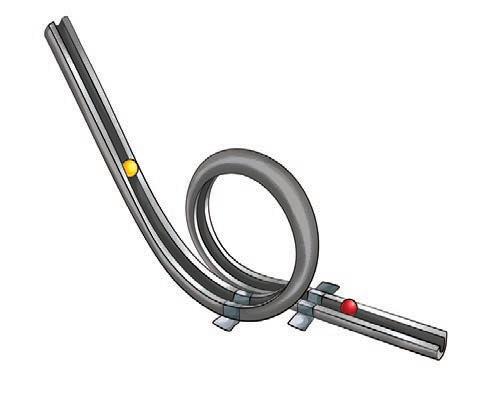
Answer:
- A?B: Linear motion (straight sloped section)
- B?C?D?E (the loop): Circular motion (ball moves along the circular loop)
- E?F: Linear motion (straight section to exit)
Q12. Materials Tasneem should NOT use for a metre scale.
Answer:
She should not use paper, cloth, or stretchable rubber, because these materials can stretch, bend, tear, or change shape/size easily, making measurements inaccurate and unreliable. Plywood or steel are suitable since they are rigid and maintain a constant length.
Q13. Card game on unit conversion — sample idea.
Answer:
Create cards with lengths in one unit (e.g., '500 cm') and matching cards in another unit (e.g., '5 m'); players match pairs like a memory game, or answer conversion questions to collect points/cards.