
Pause and Ponder
Q1. According to you, whose statement is correct and why? (Refer to the conversation: 'The cow is standing in the Sun. But it does not mean that it is getting energy from the Sun.' and 'No, I think this cow is getting energy from the Sun. Look at this cow. It is grazing the grass and getting energy from it.')
Answer:
The second statement is correct. The cow gets energy from the Sun indirectly. The grass uses sunlight to make its own food through photosynthesis. The cow eats the grass, and thus gets energy that originally came from the Sun. So, the Sun is the main source of energy for the cow.
Q2. What will happen if the Sun is not visible for a few days? (Complete the given points) 1. We may have to depend on artificial lighting during day time also. 2. 3.
Answer:
2. Plants will not be able to make food, and they may die. 3. It will become very cold, and many living beings may not survive without the Sun's heat.
Q3. What are the consequences of cutting a large forest area? Make a presentation or do a role play, or write a story or a poem that shows what could happen if we continue to cut down trees in our forests.
Answer:
If we continue to cut down trees in forests, many animals will lose their homes and food. The soil will not be held by roots, so it will be washed away by rain (soil erosion). The air will become more polluted because there will be fewer trees to clean it. The climate may become hotter and drier. Floods may become more common. Many plant and animal species may become extinct.
Check your progress
Revise, Reflect, Refine
Exercises
Q1. Write at least two sentences that tell what the chapter ‘Nature’s Treasures’ is about.
Answer:
This chapter is about the natural resources that are essential for life on Earth, such as air, water, sunlight, forests, and soil. It explains why these treasures are important and how we should use them wisely and conserve them.
Q2. List any two things you can do to save water.
Answer:
1. Turn off the tap while brushing your teeth. 2. Fix any leaking taps in your house immediately.
Q3. Sun is the main source of energy for all living beings. Justify this statement.
Answer:
Plants use sunlight to make their own food. Animals eat plants (or other animals that eat plants) to get energy. Even things like wind and water movement are driven by the Sun's heat. Without the Sun, there would be no food, no warmth, and no life on Earth.
Q4. Write two importances of soil.
Answer:
1. Soil provides nutrients to plants so they can grow. 2. Soil holds the roots of plants firmly and provides a home for many small animals like earthworms and insects.
Q5. Why are forests called ‘green lungs’?
Answer:
Forests are called ‘green lungs’ because trees absorb carbon dioxide and release oxygen during photosynthesis. This oxygen is essential for all living beings to breathe.
Q6. Draw a neat and labelled diagram to show the composition of air.
Answer:
Draw a circle to represent the total air. Divide it into sections: 78% Nitrogen, 21% Oxygen, and 1% Other gases (Argon, Carbon dioxide, etc.). Label each section clearly with the name and percentage.
Q7. Table 11.1: Wastage of water in your daily activities. Complete Column II and Column III. (Hand washing, Washing clothes, Washing utensils, Taking shower, Cooking, Gardening, Brushing teeth)
Answer:
Sample answers: (1) Hand washing: Wastage - Leaving tap running while soaping hands. Reduce - Turn off tap while soaping. (2) Washing clothes: Wastage - Using too much water. Reduce - Use washing machine only when full. (3) Washing utensils: Wastage - Washing under running tap. Reduce - Fill a basin with water and wash in it. (4) Taking shower: Wastage - Taking very long showers. Reduce - Take shorter showers. (5) Cooking: Wastage - Throwing away water used to wash vegetables. Reduce - Use that water to water plants. (6) Gardening: Wastage - Watering plants in the afternoon when water evaporates quickly. Reduce - Water plants early morning or evening. (7) Brushing teeth: Wastage - Leaving tap running. Reduce - Use a glass of water to rinse mouth.
Q8. Why do we need to conserve water? Suggest any two methods of water conservation.
Answer:
We need to conserve water because freshwater sources are limited and many regions face water shortage. Two methods: 1. Rainwater harvesting - collecting and storing rainwater for later use. 2. Fixing leakages and turning off taps when not in use.
Q9. What is the importance of wind?
Answer:
Wind has many uses: it rotates windmills which can grind grain, pump water, or generate electricity. It also helps in drying clothes, dispersing seeds of plants, and brings cool air.
Q10. Read the following statements and select the correct option. Statement 1: The Sun helps plants to prepare food. Statement 2: All living beings get energy directly from the Sun. (a) Both statements are correct. (b) Both statements are incorrect. (c) Statement 1 is correct; Statement 2 is incorrect. (d) Statement 1 is incorrect; Statement 2 is correct.
Answer:
(c) Statement 1 is correct; Statement 2 is incorrect. Explanation: The Sun helps plants to prepare food through photosynthesis. However, not all living beings get energy directly from the Sun. Some animals eat plants and get energy indirectly.
Think and Answer
Let us think
Let us enhance our learning
Q1. Fig. 11.9 shows items related to natural resources. Match them with their jumbled up names. Make another table and write the names of these resources. Classify these resources as renewable or non-renewable.
Answer:
ocrk – Rock – Non-renewable
refost – Forest – Renewable
ndiw – Wind – Renewable
atwre – Water – Renewable
Q2. State whether the following statements are True [T] or False [F]. If False, correct them. (i) Nature has all the resources to meet human needs. (ii) Machines are a resource found in nature. (iii) Natural gas is a non-renewable resource. (iv) Air is a renewable resource.
Answer:
(i)True
(ii)False- Correct statement:
Machines are human-made resources.
(iii)True
(iv)True
Q3. Fill in the blanks using the most appropriate option— (i) A fuel that is commonly used in two wheelers like scooters or bikes is......... (a) Kerosene (b) Petrol (c) Diesel (d) LPG (ii) An example of a renewable resource is .................. (a) Coal (b) Water (c) Natural gas (d) Petrol
Answer:
(i)Petrol
(ii)Water
Q4. Classify the following as renewable or non-renewable resources—coal, natural gas, forests and minerals.
Answer:
Coal – Non-renewable
Natural gas – Non-renewable
Forests – Renewable
Minerals – Non-renewable
Q5. Why do we say that petroleum is a non-renewable resource?
Answer:
Petroleum takes millions of years to form and cannot be replenished within a reasonable period after use. Therefore, it is a non-renewable resource.
Q6. It is difficult to regrow forests. Justify this statement.
Answer:
Trees require many years to grow into forests. Deforestation occurs much faster than forest regeneration, making it difficult to regrow forests.
Q7. Make a list of five daily activities in which you use natural resources. Suggest ways by which you can reduce their use.
Answer:
Drinking water – Avoid wasting water.
Bathing – Use only the required amount of water.
Cooking food – Use fuel efficiently.
Travelling – Walk, cycle or use public transport whenever possible.
Using electricity – Switch off lights and fans when not in use.
Q8. List four activities that are possible due to the presence of air.
Answer:
Breathing
Flying of birds and aeroplanes
Burning of fuels
Winnowing of grains
Q9. How can you contribute towards enhancing the green cover of your locality? Make a list of actions to be taken.
Answer:
Plant more trees.
Protect existing trees.
Participate in tree plantation drives.
Water and care for young plants.
Create awareness about conserving forests.
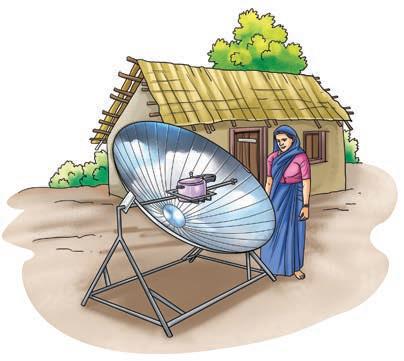
Q10. Answer the following questions— (i) What type of energy is being used for cooking? (ii) Name one benefit and one drawback of using this type of energy for cooking.
- In the given illustration, we see that food is being cooked.
Answer:
(i) Heat energy produced by burning LPG is being used for cooking.
Benefit:
(ii) It cooks food quickly and efficiently.
Drawback:
It is obtained from fossil fuels, which are non-renewable and cause air pollution when used.
Q11. Cutting down trees on a large scale impacts the quality of the soil. Why do you think it is so?
Answer:
Trees hold the soil firmly with their roots. When trees are cut down, the soil becomes loose and is easily washed away by wind and water, leading to soil erosion and loss of fertility.
Q12. Explain two ways in which human activities pollute the air. Propose one action which can help in reducing air pollution.
Answer:
Two ways:
Burning fossil fuels in vehicles and industries releases harmful gases.
Burning garbage and crop residue releases smoke and pollutants.
One action:
Use public transport, walk or cycle whenever possible to reduce vehicle emissions.
Q13. A family uses solar panels to generate electricity, a gas stove to cook food and a windmill for pumping water from a well. What would happen if there were no sunlight for a week?
Answer:
The solar panels would not generate electricity. The family would still be able to cook using the gas stove and pump water with the windmill if there was sufficient wind.
Q14. Fill up the blanks using the following terms— (fossil fuels, forest, air, petroleum, coal, water and non-renewable resource)
Answer:
Natural resources include air, water and forest.
Petroleum and coal are fossil fuels.
Petroleum is a non-renewable resource.
Q15. There is an increasing demand of trees to meet the requirements of industries and for housing. Therefore, trees are being felled. Is it justified? Discuss and prepare a brief report.
Answer:
No, it is not justified to cut down trees on a large scale. Trees provide oxygen, prevent soil erosion, support wildlife, regulate climate and maintain ecological balance. Trees should be cut only when necessary, and new trees should be planted to replace them. Sustainable use of forests is essential for protecting the environment.
Q16. Propose a plan to use less water in your school. What steps would you take to make this plan happen and how would it help the environment?
Answer:
Plan:
Promote water conservation in school.
Steps:
Repair leaking taps.
Turn off taps after use.
Install rainwater harvesting systems.
Reuse water for gardening.
Conduct awareness campaigns among students.
Benefit:
This will reduce water wastage, conserve freshwater resources and protect the environment.