
Revise, Reflect, Refine
Q1. How would you now categorise a seed, as living or non-living?
Answer:
A seed is categorised as living because it can germinate under suitable conditions (air, water, warmth) to grow into a new plant, showing characteristics like growth, respiration, and response to stimuli. A seed is dormant but not dead.
Q2. Do plants show growth in Activity 10.2?
Answer:
Yes, in Activity 10.2, the germinated seeds in pots with adequate water and air (Pots C and D) develop into seedlings, showing growth.
Q3. Are there any other characteristics of living beings that these plants show?
Answer:
Yes, plants show movement (shoot grows upward, root grows downward), respiration (through stomata), excretion (e.g., water droplets on leaves), response to stimuli (e.g., shoot grows towards light), and reproduction (seed formation).
Exercises
Q1. Why is reproduction necessary for living beings?
Answer:
Reproduction is necessary for the continuity of life. It ensures that new individuals of the same species are produced to replace older ones, so that the species does not become extinct.
Q2. Compare your predictions with your observations in Activity 10.2. Write possible reasons in favour of your observations in Table 10.2.
Answer:
This is based on the student's own experiment. Generally: Pot A (no water, sunlight): No germination because water is essential. Pot B (excess water, sunlight): No germination because excess water fills air spaces, depriving seeds of air. Pot C (moist soil, dark): Germination occurs if air and water are present; light is not essential. Pot D (moist soil, sunlight): Germination occurs because air, water, and suitable temperature are available.
Q3. Based on your observations, state the conditions which favour seed germination.
Answer:
Seed germination requires adequate water and air (oxygen). Most seeds do not require sunlight for germination, but after germination, sunlight is necessary for the growth of the seedling.
Q4. Which of the following are essential for seed germination – air, water and sunlight?
Answer:
Air and water are essential for seed germination. Sunlight is generally not essential for germination, but it is needed for further growth of the seedling.
Q5. What other conditions do you think would affect seed germination?
Answer:
Other conditions that affect seed germination include suitable temperature (warmth), soil nutrients, and sometimes the depth of sowing (which affects light/dark conditions for certain seeds).
Q6. In which category would you place a seed—living or non-living? Why?
Answer:
A seed is living because it contains an embryo that can grow into a new plant under suitable conditions. It shows characteristics like growth, respiration, and response to environment, though it may be dormant.
Q7. Do you think sunlight is necessary for germination of seeds?
Answer:
No, sunlight is not necessary for germination of most seeds (e.g., bean seeds). Germination requires water and air. However, once the seedling emerges, sunlight is needed for its growth.
Let us enhance our learning
Q1. List the similarities and differences in life cycles of plants and animals.
Answer:
Similarities:
Both begin life from a young stage.
Both grow into adults.
Both reproduce.
Both eventually die.
Differences:
Plants usually begin from seeds, while animals begin from eggs or by birth.
Plants produce flowers and seeds, whereas animals produce young ones or eggs.
Some animals undergo metamorphosis, while plants do not.
Q2. The table on the next page shows some data. Study the data and try to find out examples appropriate for the conditions given in the second and third columns. If you think that an example for any of the conditions given below is not possible, explain why.
Answer:
S. no. 1
Does it grow? No
Does it respire? No
Answer:
Example: Stone
Remarks: It is non-living.
S. no. 2
Does it grow? No
Does it respire? Yes
Answer:
No example is possible because all living beings that respire also grow at some stage of their life.
S. no. 3
Does it grow? Yes
Does it respire? No
Answer:
No example is possible because growth in living beings requires respiration.
S. no. 4
Does it grow? Yes
Does it respire? Yes
Example: Human being or Plant
Remarks: Living organism.
Q3. You have learnt that different conditions are required for seed germination. How can we use this knowledge for proper storage of grains and pulses?
Answer:
Grains and pulses should be stored in clean, dry and airtight containers to prevent moisture and air from causing germination or spoilage.
Q4. You have learnt that a tail is present in a tadpole but it disappears as it grows into a frog. What is the advantage of having a tail in the tadpole stage?
Answer:
The tail helps the tadpole swim efficiently in water and escape from predators.
Q5. Charan says that a wooden log is non-living as it cannot move. Charu counters it by saying that it is living because it is made of wood obtained from trees. Give your arguments in favour or against the two statements given by Charan and Charu.
Answer:
Charan is correct. A wooden log is non-living because it no longer performs life processes such as growth, respiration or reproduction. Although it came from a living tree, the log itself is non-living.
Q6. What are the similarities and distinguishing features in the life cycles of a mosquito and a frog?
Answer:
Similarities:
Both begin life as eggs.
Both undergo several stages before becoming adults.
Both reproduce to continue their species.
Differences:
Mosquito stages are egg, larva, pupa and adult.
Frog stages are egg, tadpole, froglet and adult.
Mosquitoes undergo complete metamorphosis including a pupal stage, whereas frogs do not have a pupal stage.
Q7. A plant is provided with all the conditions suitable for its growth (Fig. 10.9). Draw what you expect to see in the shoot and the root of the plant after one week. Write down the reasons.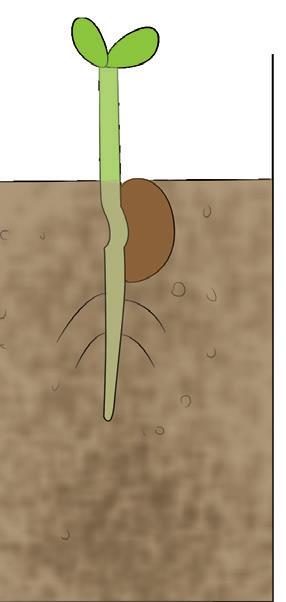
Answer:
The shoot bends upward while the root grows downward.
Reason:
Shoots grow upward and towards light, whereas roots grow downward due to gravity.
Q8. Tara and Vijay set up the experiment shown in the picture (Fig. 10.10). What do you think they want to find out? How will they know if they are correct?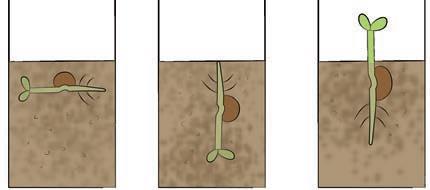
Answer:
They want to find out whether light affects the direction of shoot growth.
They will know they are correct if the shoot bends towards the light source while the root continues to grow downward.
Q9. Design an experiment to check if temperature has an effect on seed germination.
Answer:
Take three sets of identical seeds and keep them under the same conditions of water and air but at different temperatures such as cold, room temperature and warm. Observe germination for several days and compare the results. The seeds kept at a suitable temperature will germinate best.