
Let us enhance our learning
Q1. In Fig. 12.17, how many hours of sunlight do the North Pole and the South Pole receive during one rotation of the Earth?
Answer:
North Pole: 24 hours of sunlight
South Pole: 0 hours of sunlight (24 hours of darkness)
Q2. Fill in the blanks (i) Stars rise in the _________ and set in the ___________. (ii) Day and night are caused by the Earth’s __________________ (iii) When the Moon fully covers the Sun from our view, it is called a _____________ solar eclipse.
Answer:
1.East, West
2.rotation
3.total
Q3. State whether True or False (i) Lunar eclipse occurs when the Sun comes between the Earth and the Moon. (ii) Sunrise happens earlier in Gujarat than in Jharkhand. (iii) In Chennai, the longest day occurs on the summer solstice. (iv) We should watch the solar eclipse directly with our naked eye. (v) Seasons occur due to the tilt of Earth’s axis of rotation and its spherical shape. (vi) The Earth’s revolution around the Sun causes day and night.
Answer:
(i) False
(ii) False
(iii) True
(iv) False
(v) True
(vi) False
Q4. Padmashree saw the Orion constellation nearly overhead at 8 pm yesterday. When will she see Orion overhead today?
Answer:
She will see Orion nearly overhead about 4 minutes earlier, at approximately 7:56 pm.
Q5. Nandhini saw a group of stars rising at midnight on 21 June. When will she see the same group of stars rising at midnight next year?
Answer:
She will see the same group of stars rising at midnight again around 21 June next year.
Q6. Abhay noticed that when it was daytime in India, his uncle who was in the USA was generally sleeping as it was night-time there. What is the reason behind this difference?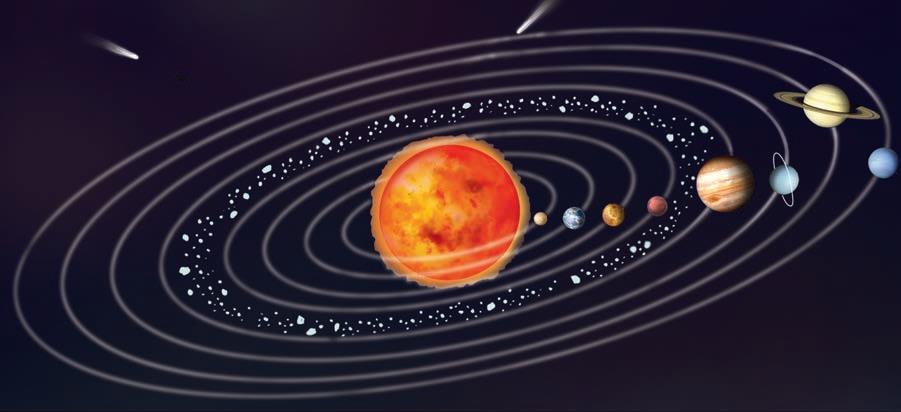
Answer:
The Earth rotates on its axis. At any given time, one part of the Earth faces the Sun and experiences daytime, while the opposite side faces away from the Sun and experiences night. India and the USA are on different longitudes, so they experience day and night at different times.
Q7. Four friends used the following ways to see the solar eclipse. Who among them was being careless? (i) Ravikiran used a solar eclipse goggle. (ii) Jyothi used a mirror to project the Sun’s image. (iii) Adithya saw the Sun directly with his eyes. (iv) Aruna attended a programme arranged by a planetarium. ?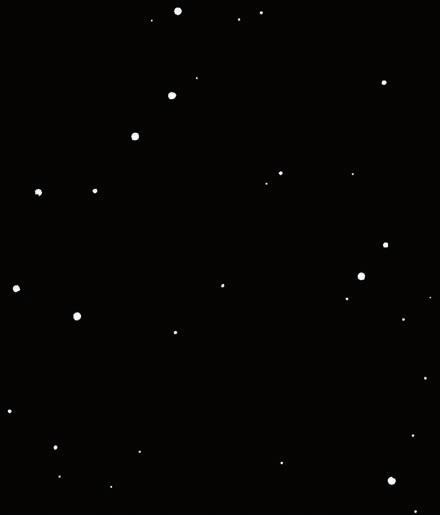
Answer:
Adithya was being careless because looking directly at the Sun during a solar eclipse can seriously damage the eyes.
Q8. Fill in the circles in Fig. 12.18 appropriately with one of the following: Sun, Moon, Earth. ?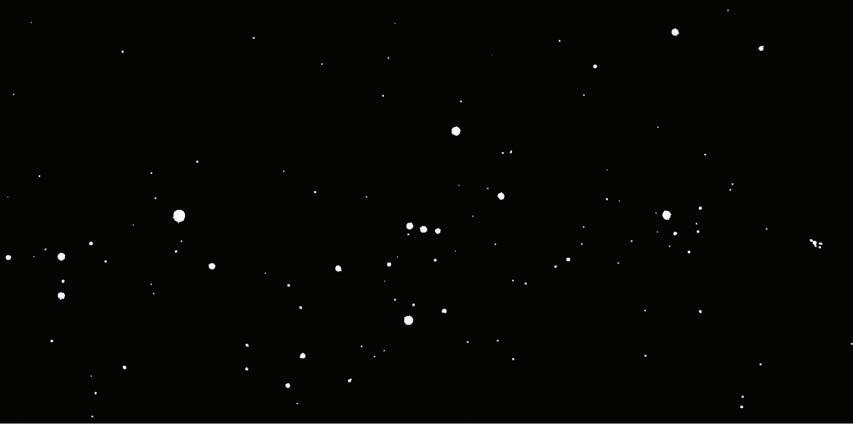
Answer:
Solar eclipse:
Sun ? Moon ? Earth
Lunar eclipse:
Sun ? Earth ? Moon
Q9. The Moon is much smaller than the Sun, yet it can block the Sun completely from our view during a total solar eclipse. Why is it possible?
Answer:
The Moon is much closer to the Earth than the Sun. Therefore, both appear almost the same size in the sky. This allows the Moon to completely cover the Sun during a total solar eclipse.
Q10. The Indian cricket team matches in Australia are often held in December. Should they pack winter or summer clothes for their trip?
Answer:
They should pack summer clothes because December is summer in Australia, which lies in the Southern Hemisphere.
Q11. Why do you think lunar eclipses can be seen from a large part of the Earth when they happen, but total solar eclipse can be seen by only a small part of the Earth?
Answer:
During a lunar eclipse, the Earth's shadow falls on the Moon, which is visible from the entire night side of the Earth. During a total solar eclipse, the Moon's shadow falls on only a small region of the Earth's surface, so only people within that narrow path can see the total eclipse.
Q12. If the Earth’s axis were not tilted with respect to the axis of revolution, explain what would be the effect on seasons?
Answer:
If the Earth's axis were not tilted, there would be no significant seasonal changes. Day and night would remain nearly equal throughout the year, and the intensity of sunlight would remain almost the same at a given place all year round.
Let us check our understanding
Check your learning
Pause and Ponder
Revise, Reflect, Refine
Exercises
Think and Answer
End-of-Chapter Questions
Questions after Summary/Keywords
Activity Questions
QActivity 12.1. Look at Fig. 12.2 showing bright stars in one part of the night sky. Carefully imagine a pattern formed by a group of stars. Draw lines to connect the stars and make the pattern. Think of an animal or an object similar to the pattern and write its name. Repeat to make more patterns. Then think of an interesting story about your patterns. Compare your patterns with friends. Are the patterns same or different? Narrate your story and listen to others.
Answer:
This is a creative drawing and storytelling activity. There is no single correct answer. Students should observe the stars in Fig. 12.2, connect them with imaginary lines to form any pattern they like (e.g., a bear, a cup, a spoon), name it, and create a story. The goal is to understand that different people see different patterns, similar to how ancient cultures created constellations.
QActivity 12.2. Look for the Big Dipper during summer time in the early part of the night, say, around 9 p.m. View the sky towards the northern part of the sky and identify the Big Dipper. Once you identify the Big Dipper, try to locate the Pole Star. Look at the two stars present at the end of the Big Dipper's cup and imagine a straight line passing through these towards the north. At about five times the distance between these two stars, the imaginary line will lead to another star which is not very bright. This star is the Pole Star.
Answer:
This is an observational activity. Students should go to a dark, open area with an adult on a clear summer night around 9 p.m. Face north and locate the Big Dipper (a ladle-shaped pattern of seven stars). Identify the two stars at the end of the 'cup' (the part farthest from the handle). Imagine a straight line passing through these two stars extending northward. About five times the distance between these two stars along that line, you will find a moderately bright star – the Pole Star (Polaris). This star remains fixed in the north direction.
QActivity 12.3. In India, Orion is best viewed during the months of December to April after sunset. Look for it during that period. Three bright stars in a short straight line are located around the middle of Orion (imagined to be the belt of a hunter). Identify these three stars first, as this is the easiest way to find Orion. Once you identify Orion, it is easy to locate the very bright star Sirius which is located close to Orion. Imagine a straight line passing through the three middle stars of Orion and look along this line towards the east. This will lead to Sirius.
Answer:
This is an observational activity. Between December and April after sunset, look towards the southern part of the sky. First, find three bright stars in a short, straight, slanted line – these are Orion's belt. Once you see the belt, the rest of the constellation (the hunter's shoulders and legs) becomes visible. To find Sirius (the brightest star in the night sky), take an imaginary line through the three belt stars and extend it eastward (towards the left if facing south). The next very bright star you see along that line is Sirius.
QActivity 12.4. With the help of an app, Venus can be located either at dawn or at dusk. When you are viewing at dawn, look for it near the Eastern direction before sunrise. When you are viewing at dusk, look for it near the Western direction after sunset.
Answer:
This is an observational activity. Use a sky map app to confirm when Venus is visible from your location. At dawn (before sunrise), look towards the eastern horizon – Venus will appear as a very bright, non-twinkling 'star'. At dusk (after sunset), look towards the western horizon – Venus will appear similarly bright. It is often called the 'Morning Star' or 'Evening Star'. Unlike stars, planets do not twinkle, so Venus will shine with a steady light.